Forging Industry in India: Process, Machinery and Plant Cost
Contents 8 sections
- How big is India's forging industry, and who buys what it makes?
- Which companies make up the Indian forging industry?
- Open die, closed die or ring rolling: which route does your buyer need?
- How is a forging made, from steel bar to finished part?
- Which machines does a forging plant need, and what do they cost?
- Which approvals does a forging unit need before it can sell?
- What should you do before ordering a hammer or press?
- Frequently asked questions about the forging industry
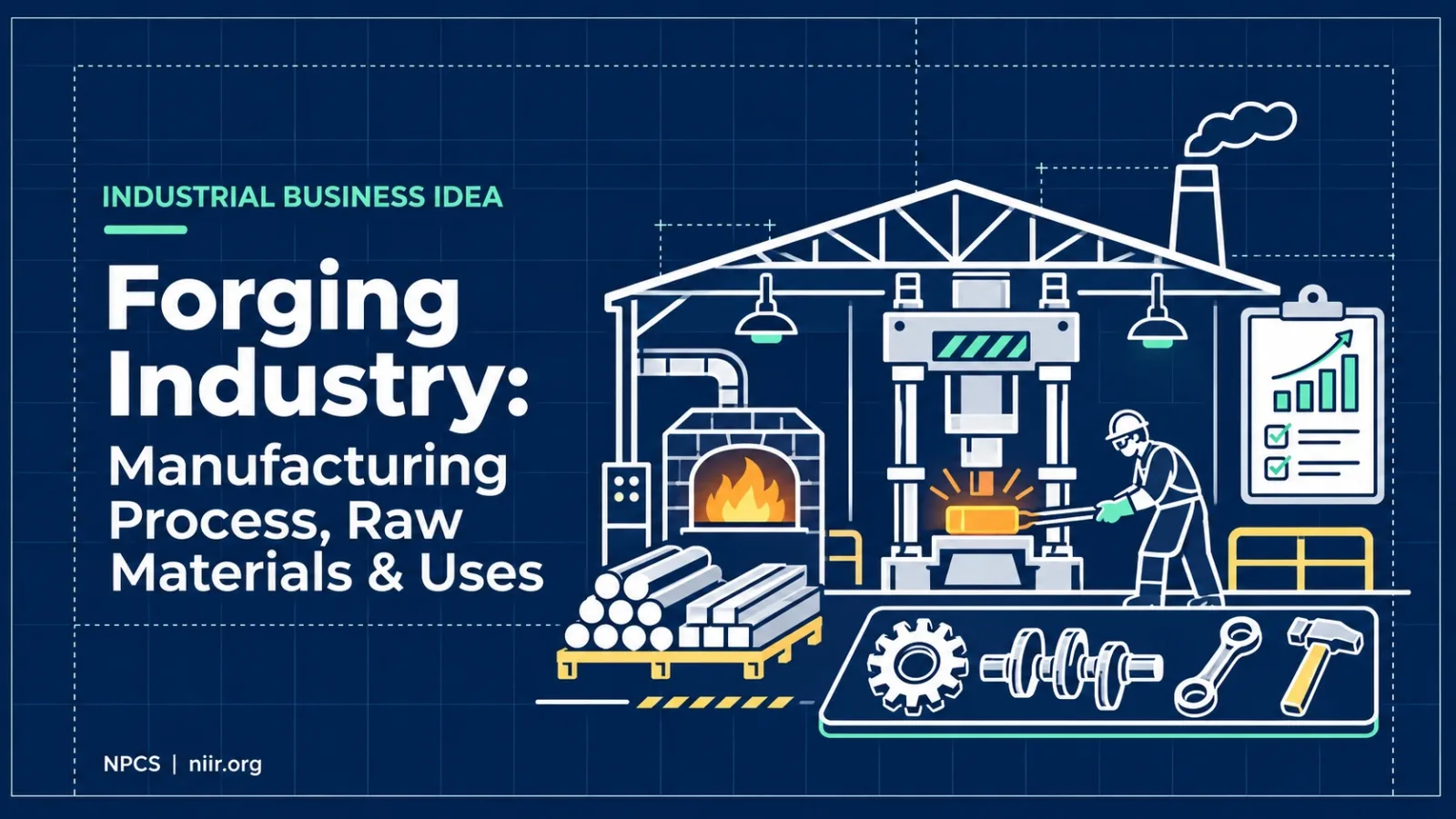
The forging industry turns heated steel bars into strong, load-bearing parts such as crankshafts, connecting rods, gears, shafts and railway components, and it does so without melting the metal. India is the world's second-largest forging producer after China. At an October 2025 congress in Frankfurt, the president of the Association of Indian Forging Industry (AIFI) put annual output at about 29 lakh tonnes, from roughly 48 lakh tonnes of installed capacity. The automotive sector takes 58% of production; railways, power, farm equipment and general engineering take the rest. Most of the 400 to 600 units are small workshops.
If you are weighing a forging plant, two numbers frame the decision. In NPCS's illustrative sample reports, a unit making 5.5 tonnes a day costs about ₹6.2 crore on the open-die route and about ₹9.6 crore on the closed-die route. And because the industry already runs well below its capacity, the hard part is rarely buying a bigger press. It is getting a buyer to approve your first part.
How big is India's forging industry, and who buys what it makes?
India produces about 29 lakh tonnes a year on 48 lakh tonnes of capacity, so roughly 60% is in use (29 ÷ 48). Sources: the AIFI president's 2025 figures (The Machinist) and AIFI's own profile.
|
Measure |
Figure |
|
Share of output exported |
nearly 30% |
|
Automotive and non-automotive share |
58% and 42% |
|
Units by size |
83% small or very small, 9% medium, 8% large or very large |
Spare capacity changes how a newcomer should think: buyers already have suppliers, so you win on an approved part, not on machine count. Demand runs mostly through auto component manufacturing chains, and units cluster around Pune (Maharashtra), Ludhiana (Punjab), Chennai (Tamil Nadu), Rajkot, Bengaluru and Jamshedpur. Exports are the soft spot. The India-US trade deal was still under negotiation in mid-November 2026, per Bloomberg Government, and Ramkrishna Forgings' export sales fell about 20% in FY2025-26. Build the first business case on domestic buyers; steel and metal manufacturing ideas covers other ventures.
Which companies make up the Indian forging industry?
No official league table exists. These names recur at AIFI events and in market listings:
|
Company |
What its disclosures show |
|
Bharat Forge |
Pune registered office; forged components with in-house die making, machining and testing for auto, power, oil and gas, rail, aerospace and other sectors. |
|
Ramkrishna Forgings |
Kolkata head office; plants in Jharkhand, Haryana and Pune; commercial-vehicle heavy, now making railway bogie frames; targets over 30% non-auto revenue by FY30; FY2025-26 revenue ₹3,755 crore. |
|
Happy Forgings, Balu Forge |
Highest-valued forging-named companies on Screener's Castings & Forgings list on 21 November 2026: ₹17,005 crore and ₹6,260 crore market cap. |
Open die, closed die or ring rolling: which route does your buyer need?
Closed-die work holds about 63% of Indian installed capacity and open-die 17%; cold closed-die takes 7%, ring rolling 6% and other methods 7% (BEE, 2021). The route fixes your machines, your buyers and your capital.
|
Route |
What it makes |
Who buys |
NPCS sample unit |
|
Closed die |
Connecting rods, gears, axle and steering parts |
Vehicle and component makers |
Total cost ₹957 lakh |
|
Open die |
Shafts, flanges, rings, blocks |
Machine, valve and pump makers; railway, mining and plant-maintenance buyers |
Total cost ₹624 lakh |
|
Ring rolling |
One-piece rings from a pierced workpiece |
Heavy engineering, mining and off-highway equipment |
Not sampled |
Take open die if your first customers are machine builders and plant maintenance departments, who order small and uneven batches. Take closed die only after a vehicle or component maker has agreed to qualify you, because dies and a press pay back only on repeat volume.
How is a forging made, from steel bar to finished part?
A typical closed-die line:
1. Cut. Bars are sawn or sheared into billets of fixed weight.
2. Heat. Induction heaters or oil and gas furnaces take billets well above 1,000 °C (the NPCS closed-die sample assumes 1,150 to 1,200 °C). Most Indian tonnage is now induction-heated, per BEE.
3. Forge. A hammer or press shapes the billet: between flat dies for open die, in a die cavity for closed die.
4. Trim and pierce. Flash is cut off and holes punched while the part is hot.
5. Heat treat. Parts are normalised, or hardened and tempered; smaller units sometimes send this out.
6. Clean. Shot blasting removes scale so defects show.
7. Inspect and machine. Hardness, cracks and dimensions are checked and parts machined to the buyer's drawing.
The NPCS open-die sample uses EN8 and C45 bars for general shafts, and EN19 and EN24 where a part is hardened and tempered.
Which machines does a forging plant need, and what do they cost?
NPCS's illustrative samples, both for 5.5 tonnes a day over 330 working days, price the routes like this (₹ lakh unless stated):
|
Item |
Open die |
Closed die |
|
Hammer set (open die) or press with dies (closed die) |
95.15 |
145.63 |
|
Billet heating: oil or gas furnaces, or induction heater |
41.63 |
77.37 |
|
Heat treatment furnaces |
38.66 |
54.61 |
|
Die shop with CNC milling and EDM |
- |
59.16 |
|
Trimming and piercing press |
- |
36.41 |
|
Manipulator, jib and overhead cranes |
56.49 |
- |
|
Cutting, shot blasting, testing lab, rough turning |
65.41 |
81.93 |
|
Total plant and machinery |
297.34 |
455.11 |
|
Total project cost |
623.74 |
957.18 |
|
Selling price assumed (₹ per tonne) |
1,13,000 |
1,45,000 |
|
Break-even (% of capacity) |
37.6 |
32 |
|
Return on investment, Year 3 (%) |
24.3 |
27 |
Steel is the biggest running cost: in the open-die sample, raw materials are 58.8% of sales in Year 3, with carbon steel 62% of the bill and alloy steel 32%. Assumed buyer credit of 45 days and steel stock of 30 days put Year 1 working capital at ₹200.38 lakh. Both samples use industry-typical ratios, not real projects, and are not for bank submission, so get current quotes before relying on any number. A manufacturing feasibility study tests the assumptions against your site and buyers.
Which approvals does a forging unit need before it can sell?
Register as a Udyam (MSME) unit, take a GST number, then seek consent to establish and consent to operate from the State Pollution Control Board. Fuel choice can change your category: the orange list that Odisha's board publishes under Central Pollution Control Board criteria includes forging with oil or gas fired furnaces and heat treatment with oil fired furnaces, so ask your board how it treats an induction-heated unit. Factory licence and fire NOC rules vary by state.
The approvals that decide sales are the buyer's. TÜV NORD calls IATF 16949, the automotive quality standard built on ISO 9001, practically a must for automotive suppliers, and you should expect buyers to test sample parts before they place volume orders. For general engineering work, the NPCS samples cite IS 2004 for carbon steel forgings.
What should you do before ordering a hammer or press?
Start with the buyer, not the plant. Get a drawing and an indicative annual volume from at least one buyer and let that decide the route. Then spend a few days in a cluster unit in Pune, Ludhiana or Rajkot, noting how often dies are changed and how many parts are rejected. Last, have three suppliers quote the heating system, the hammer or press and the die shop, and rerun the table above with their numbers.
NPCS prepares project reports for forging units in the format banks ask for: plant and machinery with suppliers, raw materials, plant layout, manpower, project cost, working capital, cost of production, break-even and multi-year cash flow. It has consulted since 1994 under an ISO 9001:2015 certified research process. A lending decision needs a report built for your project; see what a detailed project report contains.
Frequently asked questions about the forging industry
What products are made by forging?
Forged parts are mostly components inside larger machines: engine and transmission parts, axles, steering links, rail and tractor components, oil drilling equipment, ship parts and aircraft structures, per the Forging Industry Association. In India the automotive sector takes 58% of output; railways, agriculture and general engineering share the rest.
Which materials are used in forging?
Carbon, alloy and stainless steels dominate, followed by tool steels, aluminium, titanium, brass, copper and nickel or cobalt superalloys, per the Forging Industry Association. Indian units mostly buy steel bars, which is why steel is the biggest running cost in the NPCS open-die sample.
Who are the top forging companies in India and the world?
No official ranking exists. In India, Bharat Forge, Ramkrishna Forgings, Happy Forgings and Balu Forge are the names to start with (see the table above). By country, India ranks second after China, according to AIFI. No verified global company ranking is published.
Why do sources quote different capacity figures for Indian forging?
AIFI's website profile, last updated in May 2025, still shows about 38.5 lakh tonnes of capacity. Its president's October 2025 congress figures are 48 lakh tonnes of capacity and 29 lakh tonnes of production. BEE's 2021 study gave 47 lakh and 23.5 lakh tonnes for FY2019-20. Use the newer figures.

Planning a new manufacturing unit?
NIIR prepares detailed project reports and feasibility studies for new projects. Share your requirement and the team will get in touch.