Vertical Farming in India: Cost, Crops and How to Start
Contents 8 sections
- Polyhouse racks or an indoor LED room: which vertical farm to build
- Vertical farming setup cost in India per sq ft
- Running cost and the real power bill of a vertical farm
- Which crops pay back in a vertical farm, and who buys them
- Is vertical farming profitable in India? The price per kg decides
- Subsidy for vertical farming and the indoor farming market
- How to start a vertical farm in India, in the right order
- Frequently asked questions about vertical farming in India
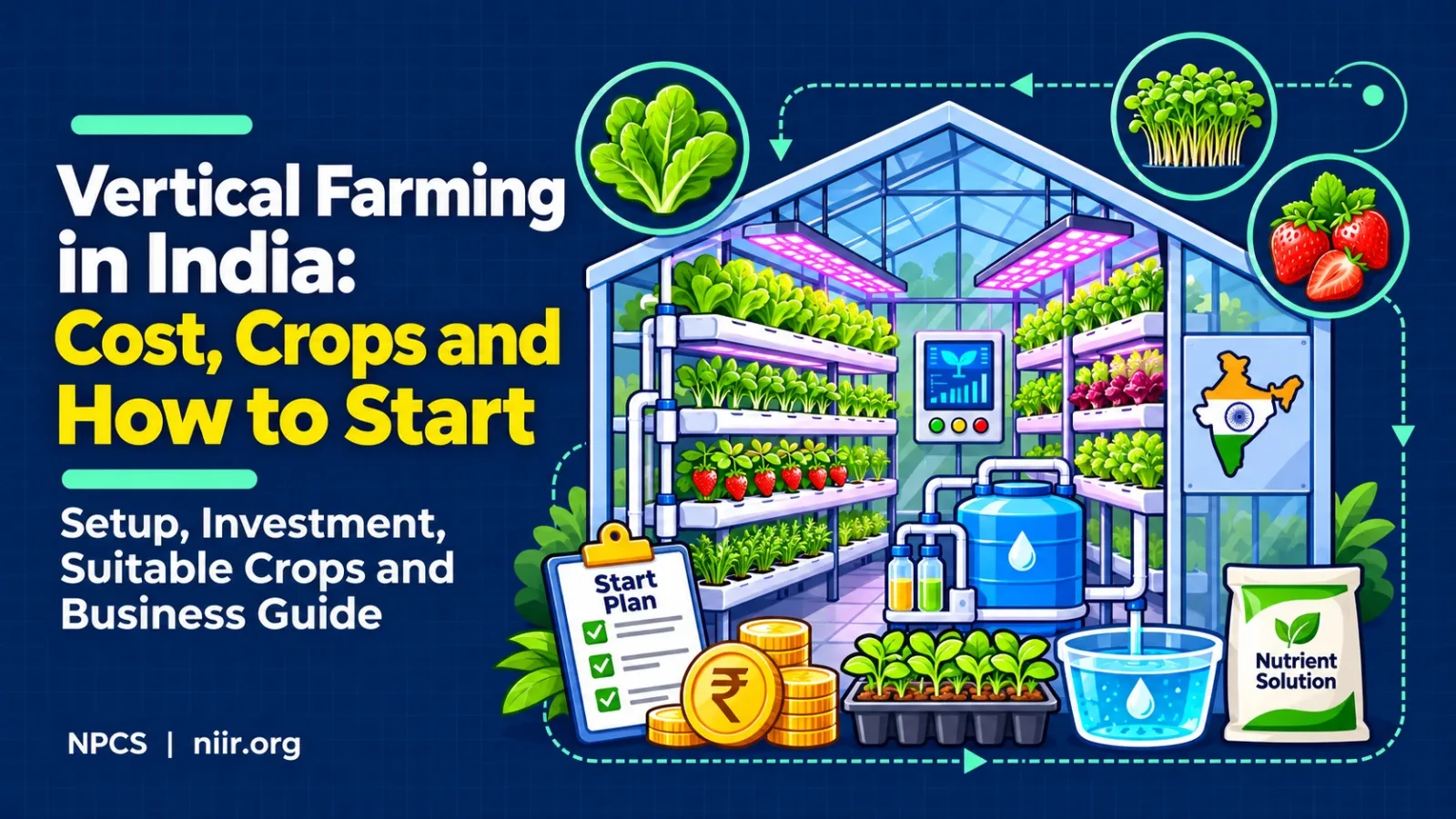
Vertical farming in India pays as a premium-greens business, not as a cheap-vegetable business. A polyhouse farm with stacked hydroponic channels costs about ₹200 to ₹370 per sq ft to build. That puts a 5,000 sq ft unit near ₹18 lakh and a one-acre unit near ₹87 lakh, going by a study of 23 working hydroponic farms around Bengaluru. A fully indoor farm under LED lights costs more to build and much more to run.
The crops that earn their keep are short and quick: lettuce, basil, spinach, celery, microgreens and, indoors, strawberries. They sell to hotels, restaurants, food chains and well-off city households. Two numbers decide whether you make money: the price per kg your buyer agrees to in writing, and how much electricity goes into light and cooling.
Polyhouse racks or an indoor LED room: which vertical farm to build
Choose the building first, because it fixes both your setup cost and your power bill.
|
What you are deciding |
Polyhouse with stacked channels |
Indoor room or warehouse under LEDs |
|
Light for the plants |
Sunlight, filtered by the polyhouse film |
LED grow lights, many hours a day |
|
Electricity in running cost |
About 4-5% of variable cost in the Bengaluru farms |
Lighting and climate control near one-third of operating cost |
|
Where it fits |
Peri-urban land, 5,000 sq ft to 1 acre or more |
City sites close to buyers, high-price crops like strawberries |
|
Main risk |
Heat in summer, pests getting in |
Power bill, and losing a crop in a power cut |
The one-third figure for indoor farms comes from the National Academy of Agricultural Sciences (NAAS) policy paper on vertical farming, which also describes the sector as still in its infancy. Go indoors only if a buyer pays for a crop a polyhouse cannot grow well where you are.
Vertical farming setup cost in India per sq ft
Smaller farms cost more per sq ft to build and to run. The figures are 2022-23 averages from the Bengaluru study (University of Agricultural Sciences Bangalore, 2024): a benchmark, not a quote.
|
Farm size (sq ft) |
Setup cost (₹ lakh) |
Setup cost per sq ft (₹) |
Running cost a year (₹ lakh) |
Running cost per sq ft a year (₹) |
|
5,000 |
18.4 |
368 |
6.8 |
135 |
|
10,700 |
32.2 |
301 |
11.0 |
102 |
|
21,780 (half acre) |
50.3 |
232 |
20.4 |
94 |
|
43,560 (one acre) |
87.1 |
200 |
35.9 |
82 |
|
82,170 (about two acres) |
180.0 |
216 |
73.2 |
88 |
The polyhouse frame explains the gap: it takes 57% of setup cost at 5,000 sq ft against 41% at one acre. The growing system (channels, tanks and pumps) takes another 32-38%.
Ask each supplier to price the polyhouse, growing system and cooling separately, so quotes compare like with like.
Running cost and the real power bill of a vertical farm
In a sunlit polyhouse farm, electricity is a small bill; under LEDs it becomes one of the largest. The Bengaluru farms spent only 4-5% of their variable cost on electricity. Their big lines were labour (20-27%), nutrient solution (13-18%) and plant protection chemicals (13-25%).
Indoors, the picture flips. A model study by Luuk Graamans and colleagues at Wageningen University (Agricultural Systems, 2018) found a closed plant factory needed 247 kWh of bought electricity per kg of dry lettuce, against 70 kWh for a Dutch greenhouse. The greenhouse gets sunlight free; the plant factory buys it, then pays again to remove the lights' heat.
• A pump or chiller failure can damage a whole hydroponic crop quickly, so budget for backup power for pumps and cooling from day one.
• Get your site's electricity tariff category in writing before you sign a lease, and work out cost per kg at that rate.
Which crops pay back in a vertical farm, and who buys them
Pick the crop your buyer already orders, then check it suits racks: short, fast and high-priced. NAAS lists leafy greens, herbs, strawberries, microgreens and mushrooms among suitable crops.
|
Crop group |
Examples |
Price evidence |
Usual buyers |
Watch out for |
|
Salad leaves |
Lettuce, kale |
₹110-160 a kg recorded in the Bengaluru study |
Hotels, restaurants, quick-service food chains |
Bengaluru alone has 70+ hydroponic units, so fix prices before planting |
|
Herbs |
Basil, celery, parsley |
Basil ₹110 a kg, celery ₹90-120 a kg in the same study |
Restaurants, premium grocers |
Small orders; you need many buyers |
|
Microgreens |
Radish, mustard, pea shoots |
Sold by the gram; no study price |
Fine-dining kitchens, health-food buyers |
7-21 day cycle (NAAS); a missed order is waste |
|
Strawberries and berries |
Strawberry, blueberry |
No published Indian farm price |
Premium retail under a brand |
Grown fully indoors, the costliest format |
Indoor strawberries are a funded-venture model: Fragaria Fruits raised $2 million in 2025 to scale from 2-3 kg to 120-150 kg a day near Bengaluru, Inc42 reported.
NAAS places the market mainly in the metros, among high-end hotels and high-income households. Far from such buyers, delivery matters more than crop choice.
Is vertical farming profitable in India? The price per kg decides
The selling price decides profit more than any equipment choice. Its one-acre farms grew about 19,000 kg a year at a total cost of ₹35.85 lakh, which works out to roughly ₹190 per kg. At the study's average selling price of ₹400 a kg, those farms earned ₹40 lakh net a year and an internal rate of return of 30%.
The same paper also records crop prices of only ₹90 to ₹160 a kg. At ₹130 a kg, the one-acre farm's sales fall to about ₹24.7 lakh, roughly ₹11 lakh short of its yearly cost. The study does not reconcile the two, so plan only on prices your buyers sign.
Break-even prices worked out from the study's own cost and yield figures:
|
Farm size (sq ft) |
Yield a year (kg) |
Break-even price (₹ per kg) |
|
5,000 |
4,100 |
165 |
|
10,700 |
6,900 |
159 |
|
21,780 |
11,000 |
186 |
|
43,560 |
19,000 |
189 |
|
82,170 |
30,080 |
243 |
Earning ₹1 lakh a month (₹12 lakh a year) from one acre's 19,000 kg needs an average price of about ₹250 a kg, with every kg sold. Only signed premium buyers pay that.
Big money has not fixed indoor economics abroad. Plenty, a US indoor farm that raised nearly $1 billion, filed for bankruptcy in March 2025, TechCrunch reported, after Bowery Farming and AeroFarms had already failed.
Subsidy for vertical farming and the indoor farming market
There is no subsidy line called vertical farming, but the polyhouse and the hydroponic system can both qualify. Under the Mission for Integrated Development of Horticulture (MIDH) operational guidelines of April 2025, the main norms are:
• Hydroponics and aeroponics add-on: cost norm ₹350 per sq m, 50% assistance, up to 1,000 sq m per beneficiary. On a full 1,000 sq m that is at most ₹1.75 lakh.
• Naturally ventilated tubular polyhouse: cost norm ₹1,200 per sq m up to 500 sq m, falling to ₹1,050 and ₹1,000 for larger areas, 50% assistance up to 2,500 sq m.
North-eastern, Himalayan and other listed areas get higher rates. The norms cap the subsidy, not your actual spend. States run the scheme, so confirm current rates locally.
IMARC Group puts the India vertical farming market, 72% of it indoor, at $100.46 million in 2025, rising to $699.35 million by 2034. Lighting is its largest component at 29%, so read the forecast as equipment demand, not proof that farms make money.
How to start a vertical farm in India, in the right order
A farm built before its buyers are found has no real price to plan on.
1. Line up buyers first. Approach hotel kitchens, restaurants and premium grocers near your site. Get at least two to agree a weekly volume and a price per kg, in writing.
2. Work out your break-even price per kg. Start from the table above, with your own quotes, rent and tariff. If the signed price is not clearly above break-even, stop here.
3. Choose the format. Start with a polyhouse and stacked channels unless your buyers need a crop that only an indoor room can grow.
4. Test your water and site. Hard or salty borewell water can change your nutrient cost, and summer heat decides how much cooling you need.
5. Collect line-by-line quotes from two or more suppliers, with polyhouse material that meets BIS standards so the subsidy stays open. Before ordering, ask the district horticulture office which MIDH components your state funds this year.
6. Run a pilot of a few thousand sq ft through a full year, recording yield, wastage and the share of harvest sold. Scale only on those numbers.
Frequently asked questions about vertical farming in India
What is the biggest problem with vertical farming?
Selling the crop at a price that covers the cost. The Bengaluru study shows a one-acre farm swinging from about ₹40 lakh profit to an ₹11 lakh loss on the selling price alone. Indoors, the power bill adds a second risk.
Is produce from a vertical farm pesticide-free?
Not automatically. The Bengaluru hydroponic farms spent 13% to 25% of their variable cost on plant protection chemicals, far more than on electricity. Pests and fungal disease still get in with people, air and seed trays. If you plan to sell on a pesticide-free claim, get the produce residue-tested and claim only what the test supports.
Can you grow tomatoes, wheat or rice in a vertical farm?
Not profitably on racks. NAAS says the method does not suit major food crops such as wheat and rice. Tomatoes, cucumbers and peppers do grow without soil, but they are tall, vining plants that suit a single-layer polyhouse better than stacked racks. Keep the racks for short, fast crops.
Does a vertical farm need a lot of water?
Far less than field farming. NAAS cites water savings of up to 90%, because the nutrient water is recirculated. Quality matters more: the water carries every nutrient, so test its salt content before choosing the site.

Planning a new manufacturing unit?
NIIR prepares detailed project reports and feasibility studies for new projects. Share your requirement and the team will get in touch.