Biomass Pellets Uses in India: Who Buys Them and What Each Buyer Demands
Contents 10 sections
- Three buyers with a rule behind them
- Power plants buy because a policy tells them to
- Industrial boilers in NCR: coal is out, approved pellets are in
- Brick kilns: a phased paddy-straw mandate and a feeding problem
- Why there is no single price per kg
- Pellets, briquettes or raw biomass: what each buyer accepts
- Four checks before choosing a buyer
- Scale check: the NPCS sample report for a 35 TPD plant
- Pick the buyer first, then size the plant
- FAQs
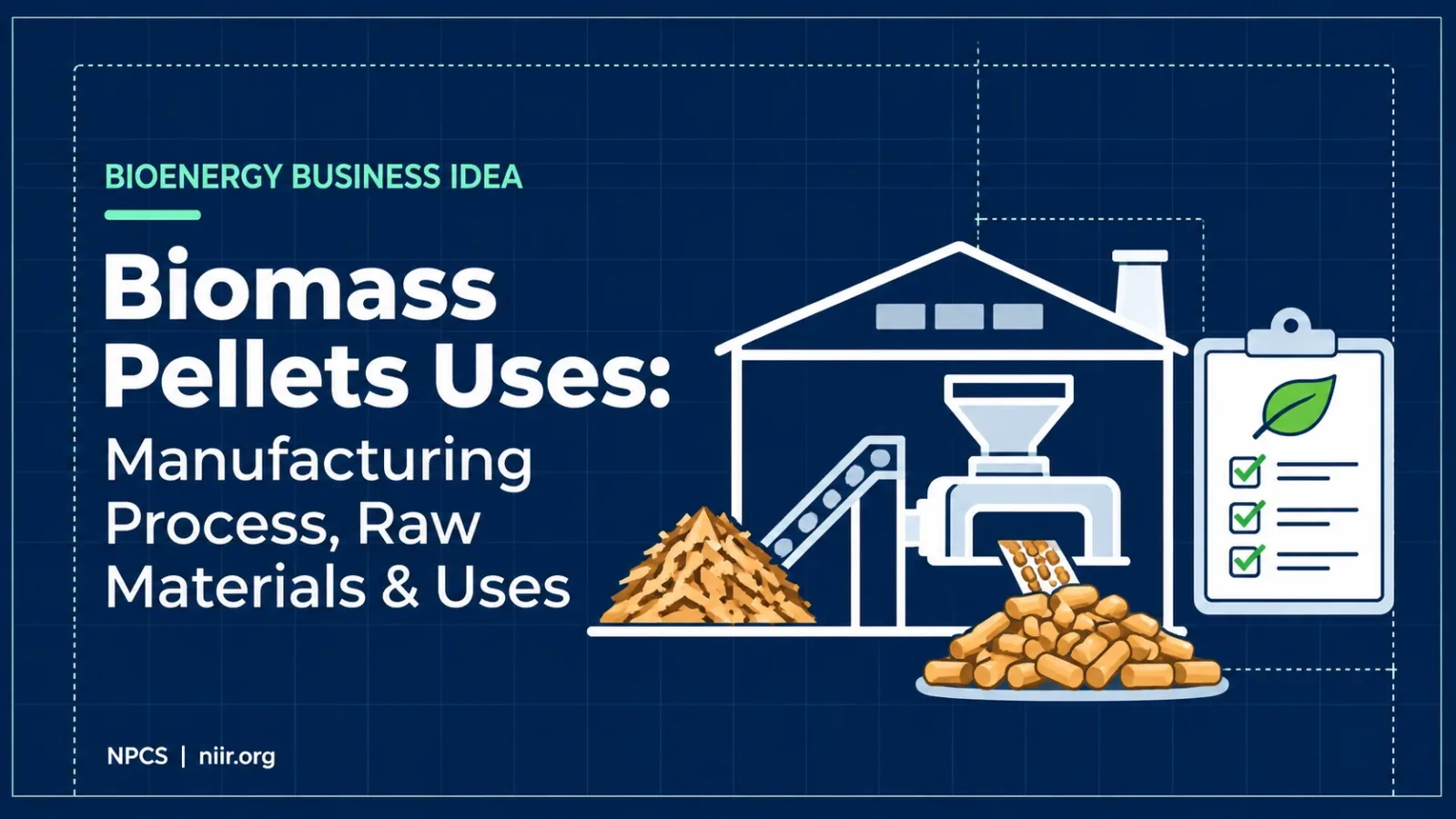
Biomass pellets uses in India come down to three jobs: replacing part of the coal in thermal power plants, firing industrial boilers, and fuelling brick kilns. Each buyer purchases every month because a rule or a fuel-cost calculation pushes it to, and that steady purchase decides whether a pellet plant finds customers. The three ask for different things. A power station watches calorific value and ash, a boiler operator watches moisture and continuity of supply, and a kiln owner watches price against the coal it replaces. A producer who knows the target buyer can settle raw material, machine and selling price before spending anything. The sections below cover each use, how pellet price is judged and what to check before choosing a market.
Three buyers with a rule behind them
Each of these buyers has a mandate or a ban pushing it towards pellets, and each judges a pellet differently.
|
Buyer |
What pushes it to buy |
What it asks of a supplier |
|
Coal-based power plants |
Ministry of Power co-firing policy |
SAMARTH-specification pellets, delivered on schedule in large lots |
|
Industrial boilers in NCR |
Coal ban, approved fuels only |
Low moisture, uniform size, uninterrupted supply |
|
Brick kilns in Punjab and non-NCR Haryana |
CAQM Direction 92 |
A price below coal for the same heat, from paddy straw |
Hotels and dhabas in NCR outside Delhi may also burn pellets in tandoors and grills with emission controls, but that is a permission and not a quota.
Power plants buy because a policy tells them to
Power plants buy pellets under an obligation, so their demand is the easiest to forecast. Under Ministry of Power policy, plants in the NCR must blend at least 5 per cent biomass pellets by weight from 2025-26, plus 2 per cent more that can be biomass or municipal-waste charcoal. They had used a cumulative 4.38 million tonnes of pellets by 15 June 2026, according to a Renewable Watch conference report.
Buying is bumpy for the plants too. The report cites seasonal residue supply, monsoon moisture in non-torrefied pellets, uneven quality, slow tendering, and pellets costing more than coal. A power station is a large but demanding customer, and it favours the producer who delivers dry, consistent pellets through the rains.
Industrial boilers in NCR: coal is out, approved pellets are in
Industrial units in the NCR may burn only fuels on the CAQM approved list. Coal has been completely banned across the region since 1 January 2023, except low-sulphur coal in thermal power plants. Under Direction No. 65, biomass, agricultural refuse, pellets and briquettes are permitted for industrial boilers, power plants and cement plants in NCR areas beyond the Delhi territory, according to a PIB note on the CAQM reminder.
For a boiler operator the question is therefore reliability, not compliance: steady moisture, a size the feeder handles, and deliveries planned a month ahead. CAQM has amended its list since 2022, so read the current direction before signing a contract.
Brick kilns: a phased paddy-straw mandate and a feeding problem
CAQM's Direction 92, issued in June 2025, asks Punjab and Haryana to make kilns outside the NCR co-fire paddy-straw pellets or briquettes. A Tribune report of 26 November 2025 quotes an HSPCB officer on the steps: 20 per cent from 1 November 2025, 30 per cent in 2026, 40 per cent in 2027 and 50 per cent on 1 November 2028.
The kilns are not all convinced. A Yamunanagar kiln association told the paper that its kilns are hand-fed through narrow channels, that pellets and briquettes disintegrate quickly and burn unevenly, and that members prefer chopped paddy straw mixed with coal. A producer targeting this buyer needs a hard, durable pellet and a delivered price that makes switching worthwhile.
Why there is no single price per kg
A rate per kg says little, because pellets of different quality carry different heat. Buyers compare the price of 1,000 kcal, and four things move it.
|
What changes |
Effect on what a buyer will pay |
|
Calorific value (GCV) |
More heat for the same rupees |
|
Moisture |
Wet pellets lose heat and crumble, so buyers discount them |
|
Raw material |
Paddy straw, mustard stalk, wood waste and rice husk differ in ash and heat |
|
Torrefaction |
Costs more to make, resists moisture |
Here is the method with illustrative numbers. The NPCS sample project report assumes ₹8.37 per kg. For a pellet with a GCV of 3,400 kcal per kg (a figure chosen for this example), that is ₹8.37 ÷ 3.4 = ₹2.46 per 1,000 kcal. At 2,800 kcal per kg it is ₹8.37 ÷ 2.8 = ₹2.99, about 21 per cent more for the same heat. For power plants, check the benchmark prices the Ministry of Power publishes on SAMARTH before quoting.
Pellets, briquettes or raw biomass: what each buyer accepts
The power-plant policy is written around pellets, the NCR list names pellets and briquettes for boilers, and Direction 92 accepts either in kilns. Pellets are denser and more uniform, which suits automatic feeding. Briquettes are larger blocks, and chopped raw biomass is cheapest but varies in moisture and size. Decide the form before buying a machine, since a pellet mill and a briquetting press are separate investments with different buyers.
Four checks before choosing a buyer
The use decides the plant, so run these checks before ordering machinery.
1. The buyer's specification. Power plants work from the SAMARTH recommended technical specifications for agro-residue pellets, so get the current version first.
2. The Indian Standard. IS 18724:2024 covers pellets from agro and herbaceous residues, and IS 18725:2024 covers briquettes. The pellet standard excludes torrefied pellets.
3. Raw material within reach. Residue supply is seasonal, so plan storage and a second feedstock before promising monthly volumes.
4. A written offtake. Ask for a supply contract or tender record, since slow procurement troubles even power plants.
Production steps are in the biomass pellet manufacturing guide, and the biomass briquette manufacturing guide covers the block form.
Scale check: the NPCS sample report for a 35 TPD plant
NPCS has prepared project reports for clients in 85 countries over more than 30 years. Its illustrative sample report for a biomass pellet plant assumes 35 TPD, which over 330 working days is 35 × 330 = 11,550 MT a year, or about 960 MT a month. Total project cost in the sample is ₹367.71 lakh, with break-even at about 35 per cent capacity utilisation. The sample is not meant for investment or lending decisions, so treat it as a scale reference and compare its monthly output with the lot sizes your target buyer orders.
Pick the buyer first, then size the plant
Write down one buyer's specification and likely monthly lot, then size the plant to that. More renewable energy manufacturing ideas are listed on this site, and NPCS prepares detailed project reports for pellet and briquette plants.
FAQs
What are biomass pellets mainly used for in India?
They serve mainly as a coal substitute. Thermal power plants co-fire them, NCR boilers and furnaces burn them because coal is banned, and brick kilns in Punjab and non-NCR Haryana must mix paddy-straw pellets into their fuel. Some hotels and dhabas use them in tandoors and grills where permitted.
Are biomass pellets allowed as fuel in Delhi NCR?
Yes, with limits. CAQM's approved list permits pellets and briquettes for industrial boilers in NCR areas beyond the Delhi territory, while coal has been banned since 1 January 2023 apart from low-sulphur coal in power plants. Check Direction No. 65 and its amendments for your application.
How many bags are in a tonne of biomass pellets?
It depends on bag size: 20 bags of 50 kg (1,000 ÷ 50) or 25 bags of 40 kg (1,000 ÷ 40). The buyer usually fixes the bag size, so confirm it in the purchase order before you quote any per-bag rate.
What does a bag of biomass pellets cost?
There is no standard bag price, because it is the price per kg multiplied by the bag weight. At the ₹8.37 per kg assumed in the NPCS sample report, a 50 kg bag works out to ₹418.50 (8.37 × 50). Actual quotes shift with calorific value, moisture, raw material and delivery distance.

Planning a new manufacturing unit?
NIIR prepares detailed project reports and feasibility studies for new projects. Share your requirement and the team will get in touch.