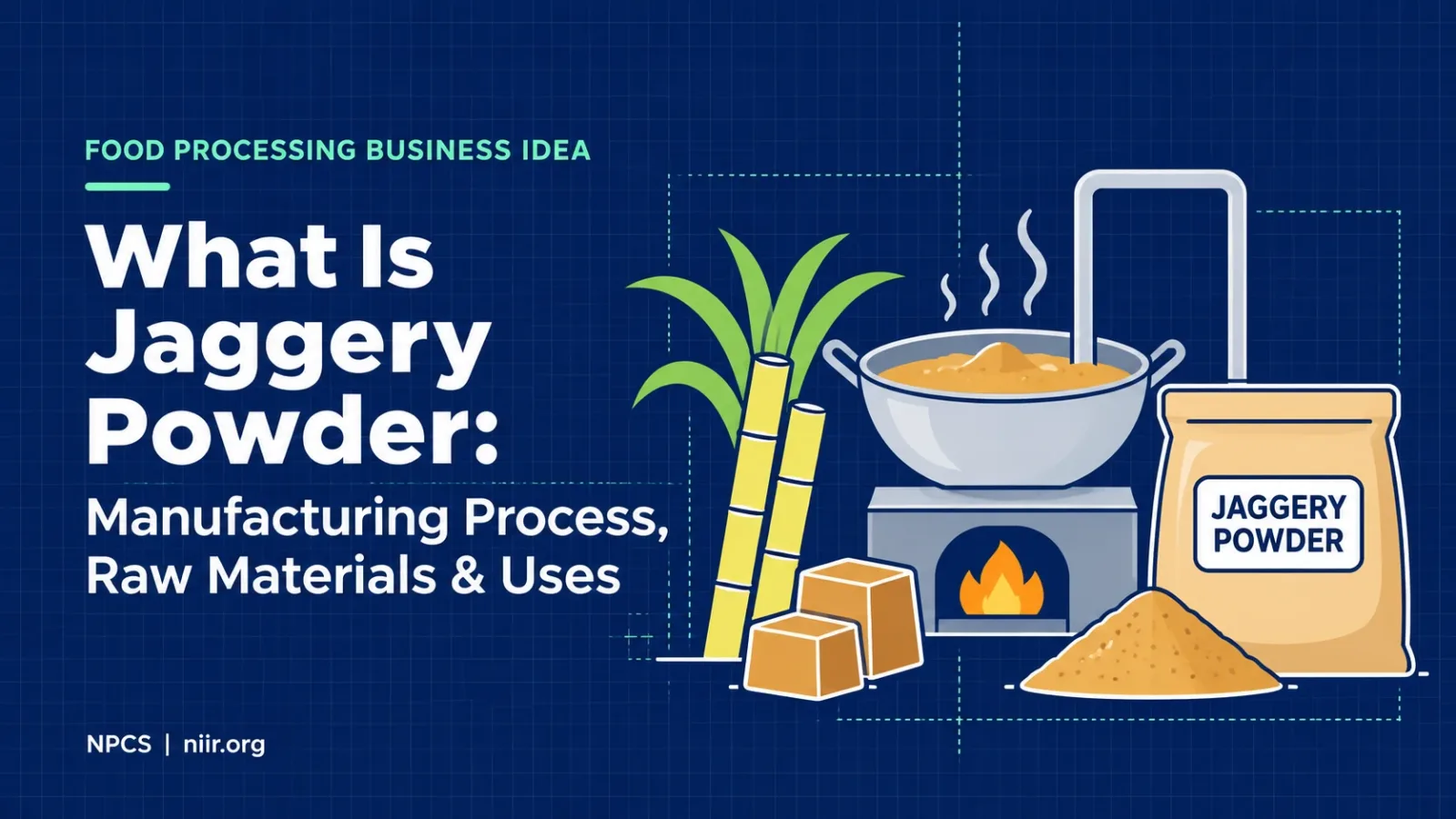
What Is Jaggery Powder: Manufacturing Process, Raw Materials & Uses
Contents 9 sections
- What is jaggery powder made of, and how does it differ from block jaggery?
- Is jaggery powder healthier than sugar?
- How is jaggery powder made from sugarcane juice?
- Which machines does a jaggery powder unit need?
- What does a kilo of jaggery powder cost to make?
- What quality rules apply to jaggery powder?
- Who buys jaggery powder, and how big is the market?
- What should you do before setting up a jaggery powder unit?
- Questions people ask about jaggery powder
Jaggery powder is sugarcane juice boiled to a thick mass, cooled until it crystallises, and broken into loose, dry granules instead of being set in a block. No centrifuge strips out the molasses, as it does in a sugar mill, so the powder stays golden-brown and tastes of toffee.
It is the same gur that Indian kitchens already use, made easier to measure, pack and store because the moisture is dried down to 1 to 2%. India makes more than 70% of the world's jaggery, and powder is the version that suits branded packs and exports. For a maker, three things decide the result: the finishing temperature, how dry the powder gets, and what cane costs per kilo.
What is jaggery powder made of, and how does it differ from block jaggery?
Cane juice is the only raw material. Palm sap gives palmyra or date jaggery, a separate product now reaching powder form too: in October 2026 APEDA, the agricultural export agency, facilitated a first consignment of 1.755 tonnes of organic palmyra jaggery powder to Bulgaria.
The table follows a 2021 review of non-centrifugal sugar by G.P. Rao and colleagues.
|
Form |
Finishing temperature |
Moisture |
Energy per 100 g |
|
Solid block |
118-120 °C |
3-10% |
383 kcal |
|
Liquid |
105-106 °C |
30-35% |
300 kcal |
|
Powder (granular) |
120-122 °C |
1-2% |
383 kcal |
A model project report that the Indian Institute of Food Processing Technology (IIFPT) wrote for the food processing ministry says about 80% of India's jaggery is solid. It adds that granular jaggery at 1 to 2% moisture keeps for up to two years, longer than moulded blocks. That storage life is the commercial case for powder.
Is jaggery powder healthier than sugar?
Marginally, on trace minerals, but it is still sugar. Published iron figures vary widely because minerals depend on the cane variety, the soil and the boiling vessels, so treat any packet's number as indicative.
|
Question |
What the evidence says |
Source |
|
Energy |
About 383 kcal per 100 g, same as block jaggery |
Rao et al., 2021 |
|
Sugar content |
Cane jaggery must carry at least 70% sucrose |
|
|
Minerals |
Total minerals 0.6-1%; calcium 40-100 mg per 100 g |
Rao et al., 2021 |
|
Daily limit |
Free sugars under 10% of energy, ideally under 5% (about 25 g a day); jaggery counts |
WHO, 2015 |
How is jaggery powder made from sugarcane juice?
The steps combine research from the ICAR-Sugarcane Breeding Institute with the IIFPT model unit.
1. Choose the cane. Mature cane of 11 to 12 months with juice above 19 Brix (a sugar-content measure) works best. Mixing varieties of different Brix spoils crystal formation, so press one variety per batch.
2. Crush and filter. A three-roller mill extracts 60 to 70% of the cane's weight as juice.
3. Clarify. Heat the juice to 70-80 °C, add a plant clarificant and skim the rising scum. Okra and hibiscus extracts gave the best colour in the institute's trials.
4. Boil to the striking point, where powder is made or lost. The 2021 review puts it at 120 to 122 °C, while the ICAR method runs anywhere from 116 to 130 °C depending on juice Brix.
5. Cool and crystallise. The manual route tips the mass onto a platform and breaks it with wooden scrapers. Mechanised units use a concentrator pan with a churner and a granulator.
6. Dry and sieve. A tray dryer takes the granules to 1 to 2% moisture, and screening evens the grain.
7. Pack. A form-fill-seal machine pouches the powder.
Which machines does a jaggery powder unit need?
The IIFPT model lists ten machines costing ₹21.50 lakh together.
|
Machine |
Job |
Size in the model unit |
|
Crusher |
Extracts juice |
1.5 tonnes an hour |
|
Collecting tanks (4) and filter |
Hold and clean raw juice |
1,000 litres each; 500 litres an hour |
|
Steam-jacketed tanks (2) |
Heat juice for clarification |
1,000 litres each |
|
Double-effect evaporator |
Concentrates juice |
Not specified |
|
Concentrator pans with churner (2) |
Finish to the striking point |
Not specified |
|
Granulator |
Breaks cooled mass into grains |
Not specified |
|
Tray dryer |
Dries granules |
100 kg |
|
Form-fill-seal machine |
Packs pouches |
100 kg an hour |
|
Boiler |
Raises steam |
10 bar rating |
What does a kilo of jaggery powder cost to make?
The model unit needs about 12 kilos of cane for every kilo of powder. It assumes cane at ₹3 a kilo and powder at ₹80, so ₹36 of each ₹80 kilo goes to cane before fuel, labour and packing. Each ₹1 rise in cane adds ₹12.
|
Cane price per kg |
Cane cost per kg of powder |
Share of an ₹80 price |
|
₹3 |
₹36 |
45% |
|
₹4 |
₹48 |
60% |
|
₹5 |
₹60 |
75% |
A Tirunelveli farmer cited in the PIB backgrounder sells organic powder at about ₹75 a kilo and reports a production cost near ₹30. That is farmer-reported and unverified.
The model's project cost is ₹32.80 lakh, with working capital of ₹11.89 lakh in year two. Its printed capacity and revenue do not match its own utilisation and price assumptions, so size the plant from the daily cane figure and work out revenue yourself. Its finance plan assumes a ₹10 lakh PMFME subsidy and a ₹14 lakh term loan. Without the subsidy, your own share rises from ₹8.8 lakh to about ₹18.8 lakh.
PMFME's term was due to end in September 2026. Read the PMFME scheme guide and check the PMFME portal before counting on it.
What quality rules apply to jaggery powder?
As of November 2026, FSSAI's standard for cane jaggery caps moisture at 7%, requires at least 70% sucrose and bars added colour. In practice that rules out chemical whitening, which the 2021 review names as one reason shoppers distrust jaggery.
You also need an FSSAI registration or licence for the size you operate at. The model report does not cost it, so budget separately. AGMARK grading, which PIB lists for jaggery, is optional if buyers ask for it.
Who buys jaggery powder, and how big is the market?
Food makers use powdered and liquid jaggery in place of refined sugar in bakery, chocolate, confectionery and beverages, according to the 2021 review.
Exports of jaggery and confectionery together reached USD 406.8 million in 2024-25, up 106.5% in value from 2015-16, per PIB. The figure cannot separate jaggery from confectionery. At home, per-person use of jaggery and khandsari together fell from 15.2 kg a year in 1960-61 to 4.1 kg in 2018-19, which points the opportunity at packaged and export sales rather than the loose market. For the wider product, see the jaggery manufacturing process guide.
What should you do before setting up a jaggery powder unit?
• Lock the cane first. Get a written price and a season's supply of one variety before ordering machines.
• Decide the route. For packed powder, budget the dryer and sealing machine from the start; the two come to ₹4 lakh of the ₹21.50 lakh machinery cost.
• Test the process. The ICAR-Sugarcane Breeding Institute in Coimbatore licenses its powder method, so ask whether it suits your cane.
• Apply for FSSAI registration, then take a feasibility study to your bank.
Read the sugar mill business guide for the sugar side. More ideas sit under food processing business ideas.
Questions people ask about jaggery powder
Are brown sugar and jaggery powder the same?
No. Refined brown sugar is white sugar with molasses added back, as Healthline explains. Jaggery powder is concentrated cane juice whose molasses was never removed. Unrefined sugars such as muscovado are the closer relatives, so read the ingredient list before assuming a brown crystal is unrefined.
What can I use instead of jaggery powder?
Muscovado, an unrefined cane sugar, is the closest match in flavour. Palm or date jaggery swap in like for like. Dark brown sugar works in baking but is refined sugar with molasses. Sweetness differs between these, so add gradually and taste as you go.
Can we eat jaggery powder daily?
In small amounts, yes. WHO's limit on free sugars covers jaggery along with table sugar, honey and sweets, so count it with everything else sweet in the day. Under 10% of energy is the limit; under 5%, about 25 g, is better. Anyone managing diabetes should ask a doctor how much is safe.
What is the healthiest alternative to sugar?
No sweetener is a health food, and the sensible aim is less sweetener overall. Jaggery has a small mineral edge but similar energy at about 383 kcal per 100 g. WHO's limit applies to jaggery, honey and syrups alike, while sugars in whole fruit and milk sit outside it.
How should jaggery powder be stored?
Keep it in an airtight container in a cool, dry place and use a dry spoon. Powder at 1 to 2% moisture pulls water from humid air, which is why it clumps. The IIFPT report notes that jaggery loses quality in storage, especially in the monsoon.

Planning a new manufacturing unit?
NIIR prepares detailed project reports and feasibility studies for new projects. Share your requirement and the team will get in touch.