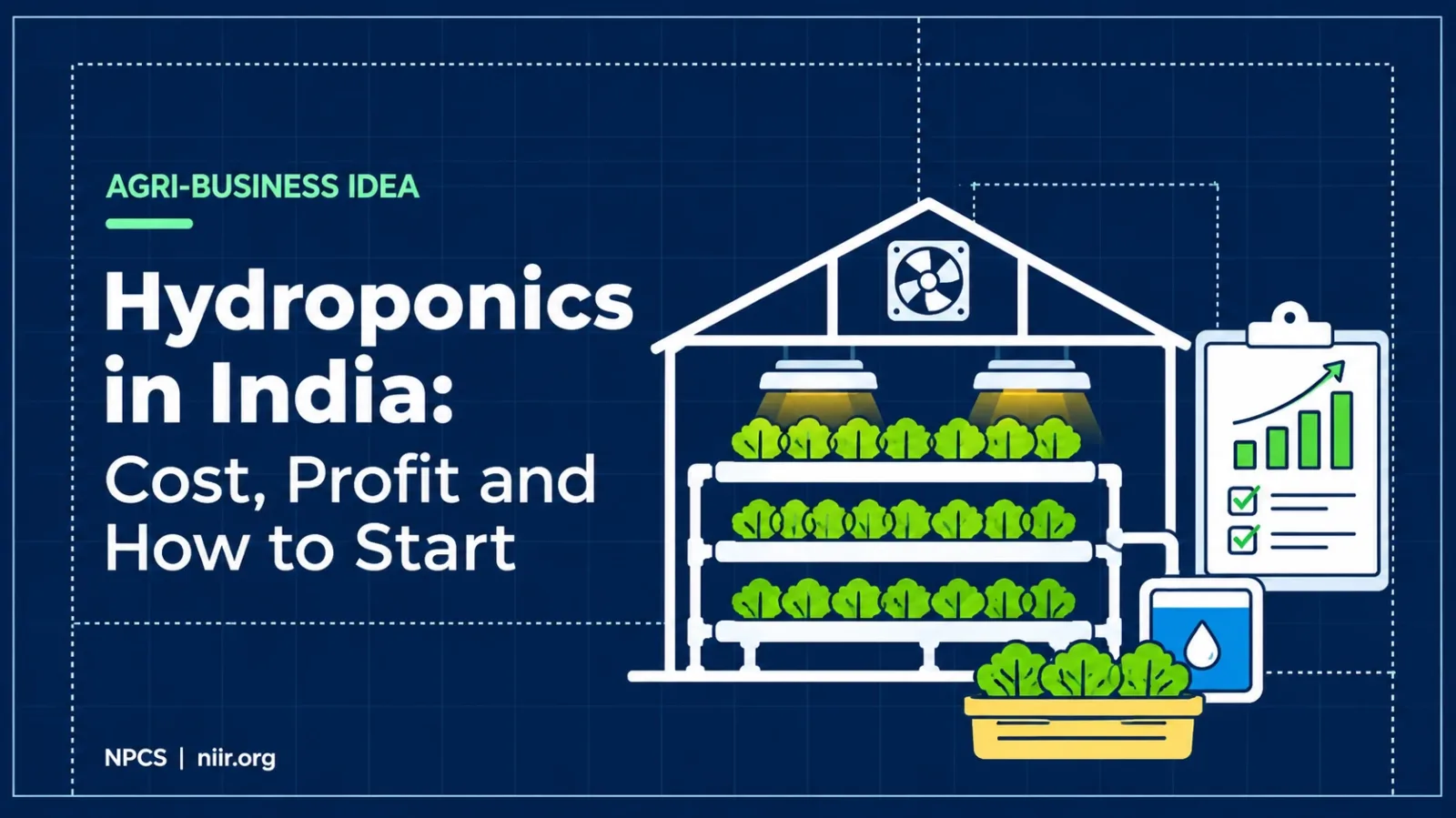
Hydroponics in India: Cost, Profit and How to Start
Contents 9 sections
- How much does a hydroponic farm cost in India?
- Is hydroponics in India profitable?
- Which hydroponic system should a beginner start with?
- How do you set up a hydroponic farm, step by step?
- Who buys hydroponic produce, and how big is the market?
- Is there a subsidy for hydroponics in India?
- What goes wrong on hydroponic farms in India?
- What should you do before spending the first lakh?
- Frequently asked questions
Hydroponics in India comes down to three numbers: what the set-up costs, how many kilos you harvest, and the price per kg a buyer will pay. A small urban unit designed by scientists at the Indian Council of Agricultural Research (ICAR) costs ₹2,400 to ₹12,700. A 5,000 sq ft commercial farm costs about ₹18 lakh to ₹20 lakh in two studies, and an acre about ₹87 lakh. Government help is small: the central horticulture mission pays at most ₹1.75 lakh towards hydroponic equipment in most states. Profit is where sources disagree most. One budget shows ₹3.6 lakh a month from 5,000 sq ft; a survey of working farms shows a fraction of that output. Run one small trial, with a buyer who has agreed a price, before building bigger.
How much does a hydroponic farm cost in India?
Cost per sq ft drops from ₹368 at 5,000 sq ft to ₹200 at one acre. The most detailed scale-wise figures come from a 2024 survey of 23 Bengaluru hydroponic farms in the Mysore Journal of Agricultural Sciences.
|
Farm size |
Farms surveyed |
Set-up cost |
Cost per sq ft |
|
5,000 sq ft |
2 |
₹18.42 lakh |
₹368 |
|
10,700 sq ft |
3 |
₹32.22 lakh |
₹301 |
|
21,700 sq ft |
5 |
₹50.33 lakh |
₹232 |
|
1 acre (43,560 sq ft) |
11 |
₹87.13 lakh |
₹200 |
|
About 2 acres |
2 |
₹1.80 crore |
₹217 |
These are 2022-23 costs, so check them against current quotes. A 2023 article in ICAR's Indian Horticulture, by scientists at SKUAST-Kashmir, prices a 5,000 sq ft unit using the nutrient film technique (NFT) at ₹18.9 lakh to ₹20 lakh, close to the Bengaluru figure. In the NPCS project report on hydroponic greenhouse farming, a unit producing 500 tonnes of tomatoes, 45 tonnes of peas and 70 tonnes of cucumber a year lists plant and machinery at ₹22 lakh within a project cost of ₹188 lakh.
Where the money goes in a 5,000 sq ft NFT unit
Pipework and stands take about half the SKUAST-Kashmir budget and the polyhouse about a third. The tanks, pumps, net cups, cooler and meters that make it hydroponic come to under a fifth.
|
Component group |
What it does |
Cost |
Share |
|
Channels, connectors, stands |
Carry the growing lines |
₹9,32,000 |
49% |
|
Polyhouse shelter |
Keeps rain and pests off |
₹6,00,000 |
32% |
|
Tanks and pumps |
Store and circulate nutrient solution |
₹1,32,000 |
7% |
|
Cooler, RO purifier, pH and TDS meters |
Keep the solution cool, clean, measurable |
₹1,13,200 |
6% |
|
Net cups (20,000 plus) |
Hold each plant |
₹1,00,000 |
5% |
|
Installation labour |
Fitting |
₹10,000 |
1% |
|
Total |
₹18,87,200 |
100% |
Is hydroponics in India profitable?
Published budgets disagree, so check what each counts. One 5,000 sq ft lettuce farm, three sources:
|
Source |
What it counts |
Cost per sellable kg |
|
SKUAST-Kashmir budget |
Running cost of ₹80,000 a month over 2,200 kg sold |
₹36 |
|
Bengaluru survey, two 5,000 sq ft farms |
Full yearly cost of ₹6.77 lakh, with depreciation and interest, over 4,100 kg |
₹165 |
|
Rise Hydroponics co-founder, Entrepreneur India |
Stated per kg cost, with price needed above ₹100; scale not given |
₹30-40 |
The gap is mostly yield. The SKUAST-Kashmir budget assumes 3,200 kg a month, of which 2,200 kg is sellable at ₹200 per kg, a profit of ₹3.6 lakh a month. The two Bengaluru farms of that size harvested 4,100 kg in a whole year, about 340 kg a month. Plan on the cautious yield until your own trial crop beats it.
Then do the one sum that matters: sellable kilos a month times a price a buyer has confirmed, less monthly running cost. A thin result means the farm is too big or the crop too cheap.
Which hydroponic system should a beginner start with?
The SKUAST-Kashmir article lists six types: wick, deep water culture, ebb and flow, drip, NFT and aeroponics. For a first farm, leafy greens in NFT or deep flow are the sensible start. Add drip bags only once tomato or capsicum buyers are lined up. Vertical designs save floor area (see vertical farming in India). ICAR's Central Institute for Subtropical Horticulture (ICAR-CISH) published these low-cost designs in 2026, priced per unit:
|
Design |
Plants per unit |
Cost per unit |
Suits |
|
Deep flow |
48 |
₹2,400 |
Leafy greens, tomato, capsicum |
|
Triangular vertical NFT |
80 |
₹3,500 |
Leafy vegetables, herbs, strawberries |
|
Vertical double row NFT |
192 |
₹12,700 |
Lettuce, kale, coriander, mint, basil |
|
Drip bags |
100 bags |
₹6,500 with drip system |
Tomato, capsicum, cucumber |
|
Pyramid, solid media |
72 to 140 |
₹3,000 |
Leafy greens, herbs; copes with power cuts |
How do you set up a hydroponic farm, step by step?
1. Test your water before buying anything. The budget above carries an RO purifier and meters because the starting water decides your nutrient mix.
2. Pick one system for one crop family.
3. Build the shelter. Rain, pests and summer heat all need a plan, which is why the budget includes a ₹60,000 cooler. Our greenhouse farming guide covers structures.
4. Install channels, tanks and pumps, then run plain water for a few days to find leaks.
5. Plant a trial batch and log pH, TDS, kilos harvested, wasted and sold every cycle.
6. Sign up buyers before you scale: restaurants, retailers or a subscription base.
Who buys hydroponic produce, and how big is the market?
Buyers are mostly urban. In 2023 the Ministry of Agriculture and Farmers Welfare said hydroponic use was mostly limited to urban farming, rooftop gardens and commercial farms. Ignore market-size headlines: Invest India's own blog gives $1.4 billion for the Indian market in 2022 and $75 million for 2023.
Is there a subsidy for hydroponics in India?
Yes, but a small one. The Mission for Integrated Development of Horticulture (MIDH) lists hydroponics and aeroponics as an add-on under protected cultivation. As of November 2026, the MIDH Operational Guidelines 2025 set a cost norm of ₹350 per sq m with 50% assistance, for up to 1,000 sq m per beneficiary. The norm is 15% higher in the North East, Himalayan states and some other regions.
The ceiling is ₹350 × 1,000 × 50% = ₹1.75 lakh. A 5,000 sq ft farm covers about 465 sq m, so its add-on tops out near ₹81,000, about 4% of the ₹18.42 lakh set-up cost. At one acre the ceiling is 2% of ₹87.13 lakh. Fan-and-pad, naturally ventilated and shade-net structures carry a separate 50% for up to 2,500 sq m. States implement the mission, so ask your state horticulture department which norms and route apply.
What goes wrong on hydroponic farms in India?
• Quitting early. ICAR-CISH scientists note that most designs are imported and used mainly by affluent people, who often stop soon after because of limited know-how, high initial cost and expensive nutrients.
• Power cuts and heat. NFT and deep-flow systems run on pumps, and the SKUAST-Kashmir budget allows ₹15,000 a month for electricity. Solid-media systems cope better with erratic supply.
• Calling it organic. The National Programme for Organic Production (NPOP) standards of 2024 say hydroponic and aeroponic systems cannot be certified under them, so do not label the produce certified organic.
What should you do before spending the first lakh?
Build one low-cost unit from the table above and run it for several cycles, noting kilos and prices. Collect written price quotes from three buyers. Then run the break-even sum on your own numbers and compare the result with other agro business ideas.
If the plan is a commercial greenhouse that needs a bank loan, the lender will ask for a project report. NPCS has been consulting since 1994 and has prepared more than 5,000 project reports across 40-plus sectors. Its hydroponic greenhouse report covers the market, machinery, utilities, manpower, land and layout, and the financials: break-even, repayment cover and returns. Our guide to the detailed project report format shows what lenders look for.
Frequently asked questions
Can I start hydroponic farming at home?
Yes. ICAR-CISH describes low-cost units for urban growers at ₹2,400 to ₹12,700, built from items such as PVC pipes, buckets or trays. Start with leafy greens or herbs and log pH and plant health daily. On a terrace, our rooftop farming guide covers the site side.
Is hydroponics cheaper than soil farming?
Not at set-up: a 5,000 sq ft unit costs ₹18 lakh or more before the first harvest. Per kilo, running cost can be low, ₹36 in the SKUAST-Kashmir budget, but only if yields hold; the Bengaluru survey's full cost is ₹165. We found no published like-for-like comparison with soil-grown lettuce.
How much water does hydroponics save?
ICAR-CISH reports 60 to 70% less water and 40% less nutrient for its triangular vertical NFT unit, because the solution recirculates. The paper does not say what it compares against, so treat it as a design figure, not a promise.
Which crops can you grow hydroponically?
Leafy greens and herbs are the easy start: the Bengaluru farms grew lettuce, spinach, celery, basil and amaranthus. Tomato, cucumber and capsicum suit drip bags, per ICAR-CISH.

Planning a new manufacturing unit?
NIIR prepares detailed project reports and feasibility studies for new projects. Share your requirement and the team will get in touch.