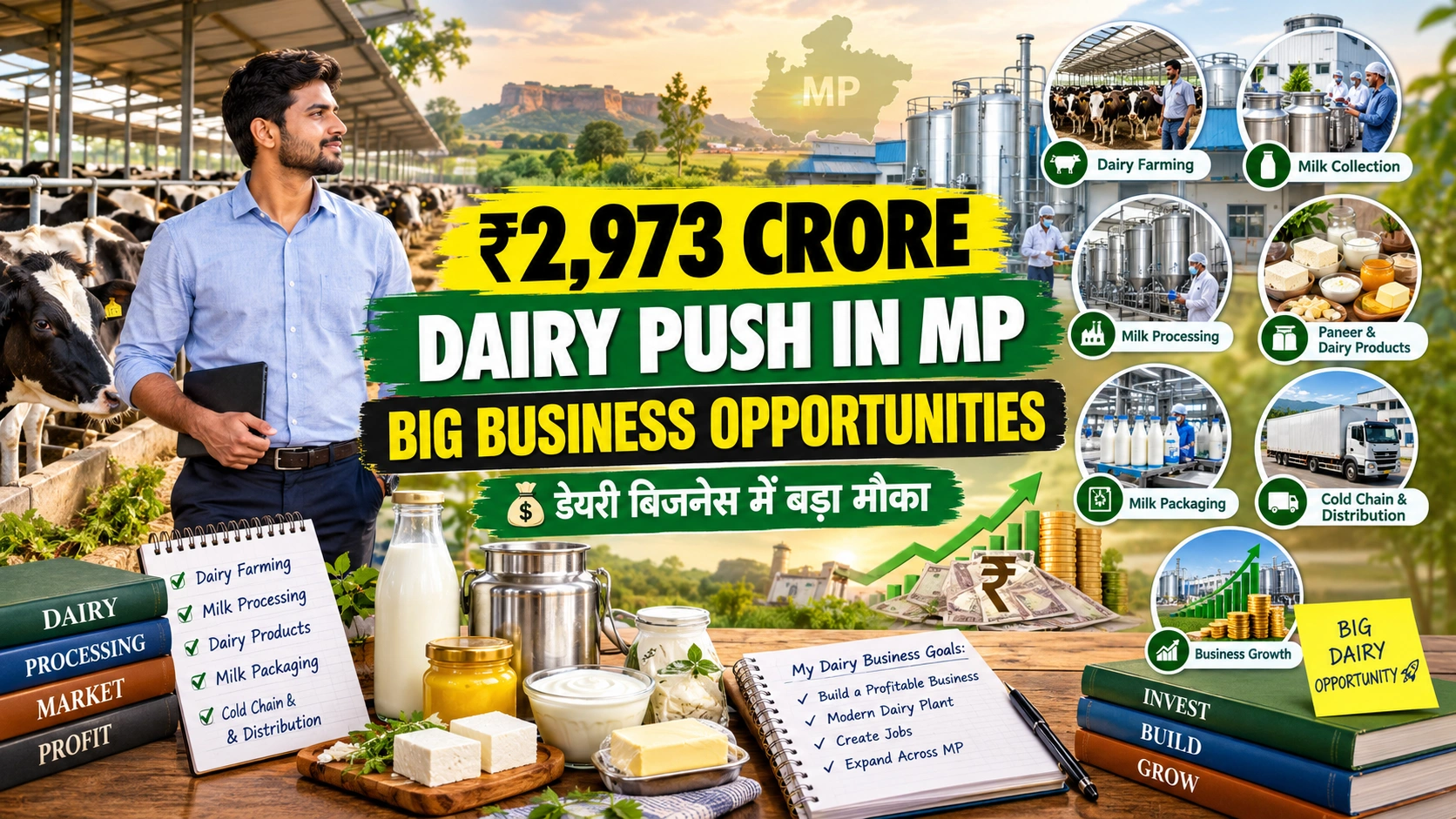

The Madhya Pradesh government has greenlighted a dairy development scheme with a budget of ₹2,973 crore that is transforming the business environment of the dairy entrepreneurs in India. The campaign is not just to help farmers at the level of milk cooperatives. It establishes the framework for a major upgrading of the entire milk value chain in the State — from the procurement infrastructure at the village level, to processing plants and branded product distribution. This is a development to be considered carefully by manufacturers, investors and MSME founders seeking a viable and demand driven industrial opportunity.
The scope of ambition is remarkable. The goal is to procure more than four times as much milk daily (12 lakh kg per day as compared to 52 lakh kg). The processing capacity will go up by over three times, from 17.8 lakh litres to 63.3 lakh litres per day. The state’s flagship dairy brand, Sanchi, is set to see sales rise by 35 times from 7 lakh litres a day to 35 lakh litres a day. All these targets point to the huge demand for the dairy machinery, packaging material, logistics, cold chain facilities and processed dairy products on both sides of the spectrum, which are investable and MSME friendly manufacturing opportunities.
What This Development Means for Indian Businesses
The approved scheme is based on the development and professionalization of milk cooperative network in Madhya Pradesh. Presently 7,331 villages have milk cooperative societies. In the next five years, the project aims to integrate 26,000 villages into the formal organised cooperative network, serving a larger rural population base and significantly more milk volume in the formal milk supply chain.
The business implications are multi-layered. First, every new village dairy society will require physical infrastructure, including milk collection points, bulk milk coolers, automated milk testing machines, insulated transport tankers, and power backup systems. Second, the increase in processing capacity from 17.8 to 63.3 lakh litres per day will drive the construction or expansion of dairy processing plants. This growth will also increase demand for pasteurisation units, homogenisers, UHT lines, butter and ghee processing equipment, cheese-making lines, and packaging systems. Thirdly, the brand Sanchi’s expansion on the retail front calls for a much bigger network for packaging and distributing.
For entrepreneurs, this signals that the government is providing coherent and measurable support across at least four or five manufacturing segments, while also strengthening a supply chain that currently lacks the capacity to meet planned demand.
Get Detailed Project Report (DPR): Milk & Dairy Products Manufacturing
Why This Industry Could See Stronger Growth
India is the largest milk producer in the world with more than 22 per cent share of the total world milk production. However, organised processed dairy products production has not been able to reach the full potential of milk production. Most milk in the rural areas in India is still traded informally through small contractors and local traders and has limited value addition. The one structural lever which can change that equation at scale is government-backed cooperative expansion.
The state of Madhya Pradesh has some other geographical benefits. The state has high numbers of cattle and livestock farming density in its eastern and central districts, and a well established that is not adequately supported cooperative dairy tradition in Sanchi. Under a formal institutional collaboration, that took place under the MoU signed in April 2025 with NDDB, the scheme gets the same institutional support as given to Gujarat’s dairy sector decades ago.
The increasing consumption of value-added products like flavoured milk, UHT milk, paneer, shrikhand, probiotic drinks, dahi and dairy based products with these in cities is not leading to the construction of processing plants for a product. They are being constructed to add value in areas where they will be able to generate much higher margins than raw milk. This fundamentally alters the economics of dairy investment.
India’s exports of dairy products have been steadily increasing as well, with skimmed milk powder, casein, ghee and paneer being exported to Southeast Asia, West Asia and Africa. The development of processing infrastructure in central India with its strong rail and road access to major ports provides new opportunities for export related manufacturing activities, which was not possible at this scale earlier.
Government Policies and Incentives
Entrepreneurs considering dairy-linked manufacturing businesses will find a supportive policy environment at both the central and state level. The National Dairy Development Board (NDDB) provides technical assistance, project planning support, and financing for dairy cooperative infrastructure across India. Through its subsidiary, NDDB Dairy Services, it also supports private players working in the cooperative supply chain.
At the central level, the Department of Animal Husbandry and Dairying (DAHD) administers several relevant schemes. The Animal Husbandry Infrastructure Development Fund (AHIDF) provides interest subvention of up to 3% on eligible loans for setting up dairy processing and value-addition infrastructure. The National Programme for Dairy Development (NPDD) supports cooperative milk procurement and processing infrastructure with central grant funding.
The Ministry of Food Processing Industries (MoFPI) supports dairy processing entrepreneurs through the Production Linked Incentive (PLI) Scheme for Food Processing, which includes dairy as an eligible segment. Capital investment subsidies under the Food Processing Fund are available through NABARD.
In Madhya Pradesh, the Madhya Pradesh State Agro Industries Development Corporation (MPAIDC) and Invest Madhya Pradesh / MP Industrial Development Corporation offer location-linked incentives including capital subsidy, stamp duty exemption, and electricity duty concessions for food and dairy processing investments under MP’s industrial promotion policy.
MSME entrepreneurs can access collateral-free credit through the MSME Ministry’s Credit Guarantee Scheme (CGTMSE), and startups in agri-food processing can apply through the Startup India Portal for tax exemptions, regulatory support, and funding connections. Dairy equipment manufacturers and exporters can access export promotion support from the Agricultural and Processed Food Products Export Development Authority (APEDA), which actively supports Indian dairy product exports.
Manufacturing Business Opportunities Emerging From This Development
1. Bulk Milk Cooling and Cold Chain Equipment Manufacturing
All newly established VMS needs a bulk milk cooler (BMC) at the village level. The increase in the number of villages covered from 7,331 to 26,000 translates to a requirement of approximately 18,000–19,000 additional BMCs and equipment for the plan period. The size of BMCs varies from 300L to 5,000L, and the size and level of automation determine the unit price, which usually range from ₹2 lakh to ₹12 lakh. Other related products are stainless steel fabrication, agitator assemblies, refrigeration compressors, and insulated milk tanker bodies. It clearly defines an MSME manufacturing opportunity that requires an investment of ₹50–150 lakh for a small unit and serves a definite institutional buyer base within the cooperative dairy network.
Target customers: state dairy federations, milk unions, co-operative societies and private dairy processors. There is export potential to Bangladesh, Sri Lanka, Nepal and to the markets in East Africa where similar cooperative dairy expansion is taking place.
Read the Complete Book Here: Modern Technology Of Milk Processing & Dairy Products
2. Dairy Packaging and Flexible Pouch Manufacturing
If Sanchi needs to scale up its branded milk sales from 7 lakh litres per day to 35 lakh litres per day, the dairy processing plant will also need a corresponding increase in packaging supplies. The main packaging format typically uses multilayer co-extruded polyethylene milk pouches in 200 ml, 500 ml, and 1-litre sizes. Assuming an average pouch fill of 500 ml, the plant would require approximately 7 crore pouches every day to support its operations at the 35 lakh litres per day production level. This makes it necessary to buy packaging at a rate of ₹2–3.5 crore a day at just Sanchi alone, at a manufacturing cost of ₹0.30–0.50 per pouch at scale.
In addition to milk pouches, the market for aseptic Tetra Pak-format packaging, polypropylene cups, aluminium foil lidding and printed corrugated outer packaging cartons is growing. Packaging machinery equipment or flexible packaging film converting equipment placed at the Sanchi chain can basically aim for the volumes that are not easily attainable in most B2B markets. Investment size: Mid-size flexible packaging unit requires between ₹1.5 and 5 crores.
Explore This Book: Handbook on Modern Packaging Industries
3. Dairy Processing Equipment and Machinery Fabrication
Capacity increases are needed to boost the processing capacity from 17.8 lakh litres/day to 63.3 lakh litres/day, which will involve multiple new dairy processing plants in the state, along with equipment upgrades on existing plants. The major equipment types are pasteurisers, homogenisers, plate heat exchangers, milk separators, UHT treatment systems, butter churns, spray dryers for milk powder, evaporators for condensed milk, paneer press and cutting machines, ghee melting and clarification systems and CIP cleaning systems.
Stainless steel process equipment fabricators in the food-grade segment are already in demand nationally. A fabricator with dairy-specific design capabilities, BIS certification, and the ability to supply turnkey line segments can enter this market with an investment of ₹2–8 crore depending on scope. Major dairy machinery clusters exist around Pune, Ludhiana, and Rajkot—but Madhya Pradesh-based units would benefit from geographic proximity to the buyer.
View Full Project Details: Milk & Dairy Processing Business Ideas
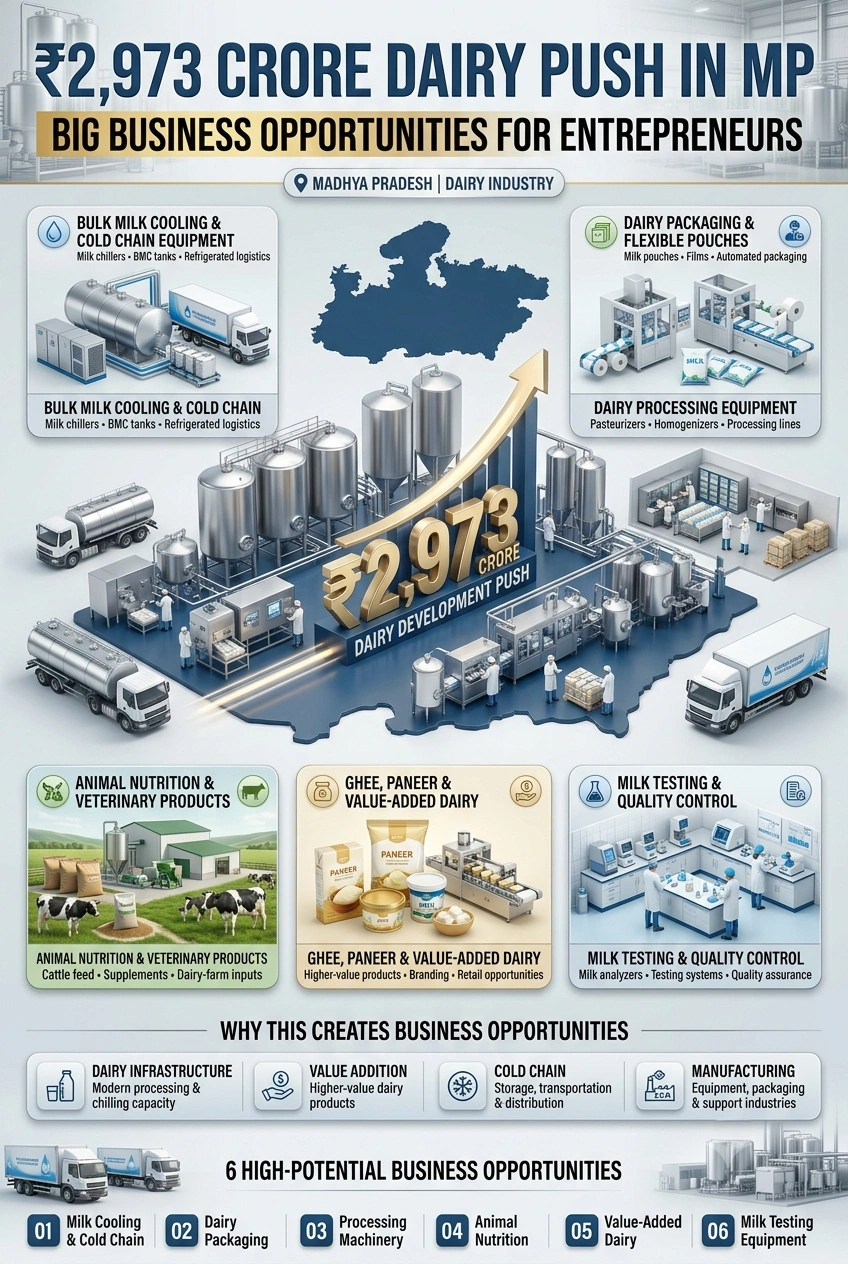
4. Animal Nutrition and Veterinary Products Manufacturing
Specifically, the scheme aims to boost the number of cows inseminated via AI from 15% to 50%. The higher the proportion of AI used, the more rapid the improvement in the breed – the higher the yield from crossbred cows, and the better the genetic stock will be – but the larger, more productive the animals, the more they will need to be fed better. This increases the demand for compound cattle feed, bypass protein supplements, mineral mixture blocks and total mixed ration (TMR) formulations.
It is MSME friendly capital moderate business with an investment of ₹1.5-4 crore per day with capacity of cattle feed of 5-10 tonne. Raw materials such as de oiled rice bran, cotton seed cake, maize, soya, calcium supplements are mainly available in Madhya Pradesh. The dairy cooperative network can also be a natural marketing platform for allied feeds, medicines and teat dips for allied inputs as the network procures milk from about more than 10,000 farmers.
5. Ghee, Paneer, and Value-Added Dairy Product Manufacturing
The processing capacity growth has resulted in more offtakes from ancillary value-added product manufacturers of cream, whey and excess milk volume by cooperative dairies to make shelf-stable products. Ghee production from cooperative cream, paneer production from standardised milk, and sweet manufacturing from chhena have already gained strong recognition among MSMEs. Setting up a ghee plant with a capacity of 500 kg per day requires an investment of around ₹40–80 lakh, while a paneer unit with a similar capacity may require approximately ₹60–100 lakh.
The opportunity here is to join the Sanchi co-operative network as a contractor, or a value-added processing partner, instead of getting into the branded consumer market. This B2B model has reduced marketing cost, known volume of offtake, and simple quality standards as per FSSAI norms.
Related Article: Milk & Dairy Products Industry Consultants in India: A Complete Guide for Entrepreneurs and Investors
6. Milk Testing and Quality Control Equipment Manufacturing
Rapid milk quality testing equipment is needed at every milk procurement point whether it’s a cooperative society, a chilling centre or a processing plant. The dairy networks are using a huge number of lactometers, fat testers (Gerber method), electronic milko-tronics, somatic cell count meters and advanced multi-parameter milk analysers. Indian manufacturers have been able to build low-cost milk testing devices, and are even able to match imported brands for the middle market. Procurement is growing and expanding with thousands of new collection points, and here, domestic MSME manufacturers can find a true large and growing institutional customer base.
Import-Export and International Market Opportunity
Although India’s dairy product exports are growing, they remain comparatively small relative to the country’s production levels, mainly because domestic consumers use most of the output. With the expansion of processing facilities, however, the ratio can change. West Asia, Southeast Asia and some parts of Africa have a consistent demand for anhydrous milk fat (AMF), ghee, skimmed milk powder and casein. Dairy export corridors are already in place in India for UAE, Bangladesh, Nepal and Malaysia. The additional processing capacity in the country as a whole in Central India will increase the country’s overall exportable surplus, and new cold chain infrastructure will minimize losses in post-processing which presently constrain exportable volumes.
Other Indian categories emerging for dairy export products include dairy processing machinery and milk cooperative equipment. Indian-made BMCs, milk testing equipment, stainless steel dairy equipment, and packaging machines have strong market potential in Africa, South Asia, and Central Asia. The NDDB promotes cooperative dairy models in these regions through technical assistance. Manufacturers can build strong relationships with NDDB-linked projects and use these connections to expand into international markets.
Import Substitution: India continues to import specialized dairy processing equipment such as high-capacity Aseptic filling machines, spray drying towers, and UHT treatment systems, from Europe. The potential of domestic manufacturing in these categories is enhancing with increasing the scale of processing in India. A large quantity of other components like important dairy processing high precision stainless steel valves, pneumatic actuators, membrane filtration systems are also imported. In a market with a large procurement opportunity each year, MSME-scale manufacturers can find an opportunity for import substitution for these sub-components.
Indian MSMEs and Startups in Related Industries
Milk Testing Equipment Cluster, Ludhiana
There is a well-established chain of MSME manufacturers of milk testing instruments, dairy laboratory equipment’s, lactometers etc. mainly for the cooperative dairy sector in Ludhiana. These units have supplied equipment to various dairy federations in different states, including Uttar Pradesh, Rajasthan, and Gujarat, and now actively participate in government tender procurement. Educating the entrepreneurs looking into this area on the “Ludhiana model” of closely linked component sourcing and low overhead manufacturing can help them understand viable economics at investment levels as low as ₹1 crore.
Sterling Agro Industries (Nova Dairy), Haryana
Sterling Agro established a big processed dairy business, targeting institutional and industrial customers, while avoiding the premium branded consumer market. The company’s trajectory of growth reflects the possibilities of achieving a fast-growing, non-branded processed dairy manufacturing business with a B2B model of milk supply. There may be some useful parallels to consider for entrepreneurs looking to contract dairy processing for a cooperative network.
Parag Milk Foods, Maharashtra
Parag Milk Foods started off as a relatively small dairy processor in Maharashtra and the complimentary dairy processing line led to expansion, especially in spices, flavoured milk and whey protein, but not in the commodity milk pouch market. This example shows how technology can support a cooperative-origin milk economy by developing a product that can carve out niche markets within the broader milk-processing opportunities offered by the Madhya Pradesh scheme.
What Entrepreneurs Should Evaluate Before Investing
Market demand Verification: Ensure that the target customer is commercial dairy processors or the cooperative dairy network will be the main buyer. Cooperative procurement is institutional and tender based, whereas commercial dairy processors need quality certification and have a vendor lock-in with established suppliers. The first step is to identify the exact product with your buyer segment.
Proximity to Milk Surplus Areas: Processing companies also depend on the location of raw materials. The Malwa Plateau, Chambal, Bundelkhand, and Mahakaushal regions have different cattle densities and numbers of procurement outlets. Equipment manufacturers require the supply chain mapping of 304 or 316 grade stainless steel, refrigeration compressors and electronic control parts.
For processed dairy companies, technology and Machinery is a must for food safety compliance with FSSAI. Equipment should comply with BIS Standards, if applicable. The leading sources of mid-scale dairy plant machinery are the domestic dairy processing machinery vendors in Pune, Kolhapur and Ludhiana.
Location and Utilities: Dairy processing requires consistent cold-water supply, electricity (preferably with backup), and waste water treatment infrastructure. Industrial areas near Indore, Bhopal, Jabalpur, or Gwalior with good amenities should be prioritised. Rural food park locations under MoFPI’s Pradhan Mantri Kisan Sampada Yojana offer ready infrastructure at subsidised rates.
Regulatory Requirements: Dairy manufacturing units require FSSAI manufacturing licence, state PCB consent, GST registration, BIS product certification for specific categories, and for export—APEDA registration and EIC (Export Inspection Council) compliance. Timelines for FSSAI approval typically range from 3 to 6 months for state-level licences to 6 to 12 months for central licences.
Discover scalable startups tailored to your goals:
Working Capital and Break-Even: Dairy processing is working-capital intensive—raw milk is a perishable daily cash purchase while finished goods have a slightly longer collection cycle. A 500-litre/day ghee plant typically achieves break-even within 18–24 months if procurement costs are managed. Equipment manufacturing businesses have a more variable break-even depending on order pipeline, typically 24–36 months.
Competition and Differentiation: The cooperative dairy sector has established equipment and packaging vendors. New entrants need either a cost advantage, a technology advantage (automation, precision testing), or geographic proximity. In processed dairy products, differentiation through value-added categories—specialty cheese, protein concentrates, probiotic drinks—offers higher margins than commodity ghee or butter.
How NPCS Can Help Entrepreneurs Evaluate the Opportunity
For more than 30 years, NPCS – Niir Project Consultancy Services has served industrial entrepreneurs and MSMEs and investors in the field of Detailed Project Reports (DPRs), techno-economic feasibility studies, market studies, and manufacturing project planning. Moreover, NPCS has delivered 150,000+ project reports in 85 countries and documented experiences across the dairy, food processing, packaging and agro-processing sectors.
Furthermore, NPCS can prepare a full DPR for the entrepreneurs who are considering any of the above manufacturing units such as Bulk Milk Cooling Machine, Dairy Packaging, Compound Feeding of Cattle, Ghee & Paneer Processing etc., including:
First, Specific market and demand analysis for the targeted area and intended target group; sizing of plant capacities, selection of technologies; estimation of project costs (land, civil works, machinery, utilities, working capital); financial projections (e.g. revenue forecasts, profitability analysis, debt-servicing schedule, break-even analysis); identification of government schemes and subsidy programmes, applicable to the specific investment; and raw material sourcing and supply chain mapping.
In addition, NPCS helps entrepreneurs in the documentation of bank loans and applications to government grants. Furthermore, The detailed project report prepared by NPCS is accepted by all Nationalised Banks, State Level DIC Offices, SIDBI and NABARD. To find out more about your dairy manufacturing project, go to niir.org or entrepreneurindia.co and investigate a DPR and/or feasibility study.
Business Opportunity Snapshot
| Parameter | Details |
| Industry | Dairy Manufacturing, Agro-Processing, Food Equipment |
| Market Driver | ₹2,973 Crore Government Dairy Scheme — NDDB-backed 5-year plan in MP |
| Key Development | Cooperative expansion to 26,000 villages; 4x+ milk procurement scale-up |
| MSME Opportunity | Milk cooling equipment, packaging, cattle feed, dairy processing |
| Manufacturing Potential | Processing capacity to grow from 17.8 to 63.3 lakh litres/day |
| Export Potential | Ghee, SMP, dairy equipment, milk testing instruments — SE Asia / GCC / Africa |
| Import Substitution | Dairy machinery components, aseptic packaging systems, filtration membranes |
| Government Support | AHIDF, NPDD, PLI-Food, CGTMSE, APEDA, MP State Industrial Policy |
| Investment Consideration | ₹40 lakh (small processing unit) to ₹5–8 crore (equipment manufacturer) |
| Risk Level | Moderate — institutional buyer dependency, perishability, cold chain reliance |
| Growth Outlook | Positive over 5-year horizon; demand anchored by approved government programme |
Conclusion
The sanction of a ₹2,973 crore Madhya Pradesh dairy development programme with a vision to increase organised milk procurement by more than 4 times and processing capacity by over 3 times over five years is a big demand signal from the government that could create real investment opportunities in the dairy sector. Moreover, This is not an educated guess on growth. It is planned, financed and strategically phased in within the framework of the cooperative development process set up by NDDB.
As an entrepreneur and MSME manufacturer, the opportunity to get ahead of this increase and become a supply chain partner is here – before the procurement process becomes competitive and the cost of entry increases. In addition, The opportunity could be bulk milk cooling, dairy packaging, cattle nutrition products, dairy processing machinery, or manufacturing value-added products, to name a few, all of which have a clear buyer, measurable size of the market, and financing mechanisms with the government that increase viability.
Furthermore, The correct way is systematic: do a thorough market study, validate the target customer segment in the cooperative dairy supply chain, develop a solid DPR, evaluate the eligibility of the government schemes and organize financing before announcing the capacity of the dairy business. Similarly, For dairy manufacturing, operational discipline and supply chain reliability are the qualities that go hand-in-hand, which MSME entrepreneurs with the right technical skills can offer competitively.
Finally, Business owners who prepare themselves carefully and conduct market research, feasibility study, Detailed Project Report, and investment plan will be in a good position to do one of the most credibly supported agro-industrial expansion in central India in the present decade.