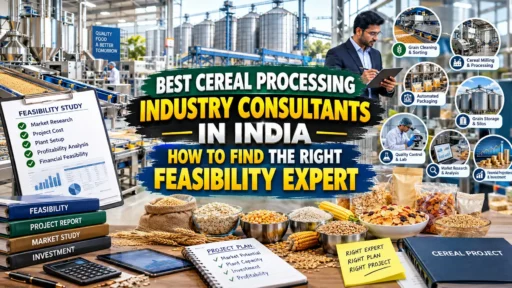
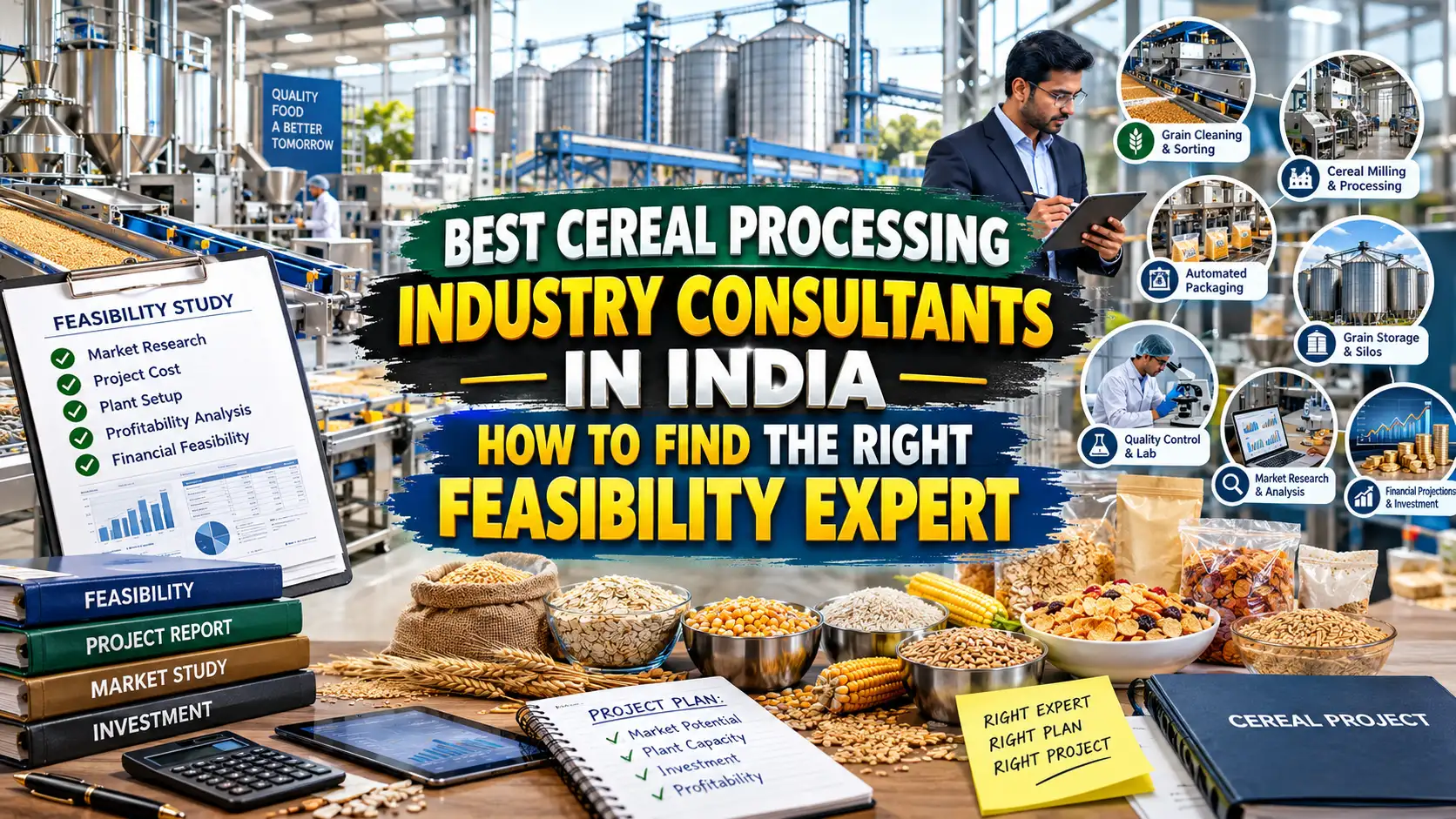

India’s cereal processing industry finds itself in a very interesting position. As one of the world’s largest producers of rice, wheat, maize, pulses, and millets, vast amounts of grain pass through processing facilities of all sizes across India, from basic rice hullers to large flour and dal milling complexes. But for every operational unit running smoothly today, there’s a story of entrepreneurs that got off the ground without the right technical guidance, paying dearly in wasted resources during commissioning. This is why the best cereal processing industry consultants in India are in such high demand as this moment.
India’s cereal processing sector produces a diverse range of products. These include milled rice, parboiled rice, wheat flour (atta, maida, suji), dal and split pulses, oat-based products, sugar and jaggery, breakfast cereals, extruded products, fortified flours, and instant-cook cereals. Each of these product categories comes with its own unique process engineering, machinery, and food safety requirements as per the FSSAI.
Consultants have a vital role to help entrepreneurs navigate through these requirements. One of the most expensive mistakes first-time entrepreneurs make is to overlook the value consultancy can bring in early project identification and techno-commercial due diligence.
Government schemes such as the Production Linked Incentive Scheme for Food Processing Industry (PLISFPI) by the Ministry of Food Processing Industries (MoFPI) and the Pradhan Mantri Kisan Sampada Yojana (PMKSY) have opened up new avenues of subsidised capital for cereal processing units. However, to get access to these incentives, promoters need to prepare properly structured Detailed Project Reports (DPRs) and bankable feasibility studies, the preparation of which only cereal processing consultants can help with. That is why this guide walks you through everything you need to know to find and engage the right consulting partner.
What Cereal Processing Industry Consultants Actually Do
Many entrepreneurs conflate cereal processing consultants with generic business advisors. In reality, specialist cereal processing plant consultants deliver a technically demanding multi-layered service that goes well beyond the purchase of machinery.
Beyond that, DPR preparation, top cereal processing consultants also provide techno-economic feasibility studies. These studies evaluate the viability of a proposed project given a specific local raw material scenario, market competition, power and water availability, and product pricing. Furthermore, process engineering consultants go another step further. They provide design-level detail on the process flow and engineering parameters for each unit operation (cleaning, dehusking, milling, polishing, grading, packing). In addition, they also provide PFDs (Process Flow Diagrams) and plant layout drawings.
Beyond that, DPR preparation, top cereal processing consultants also provide techno-economic feasibility studies. These studies evaluate the viability of a proposed project given a specific local raw material scenario, market competition, power and water availability, and product pricing. Furthermore, process engineering consultants go another step further. They provide design-level detail on the process flow and engineering parameters for each unit operation (cleaning, dehusking, milling, polishing, grading, packing). In addition, they also provide PFDs (Process Flow Diagrams) and plant layout drawings.
EPC (Engineering, Procurement, and Construction) consultants take up projects end-to-end. Moreover, they handle the design and procurement of machinery, and civil construction supervision to trial-runs of the plant. Finally, process plant consultants specialising in compliance can help apply for FSSAI licences, State Pollution Control Board consents, BIS certifications (when applicable), and GST registration. Therefore, the best consulting firms offer all of the above services under one roof. As a result, this drastically cuts down the promoter’s coordination work.
Why India Is a Hotspot for Cereal Processing Investment
India’s position in the world cereal production is unrivalled. Based on data from APEDA’s cereals category, India is the world’s largest producer of rice (contributing 26.52% to global production), the second-largest producer of wheat (14.19%), the third-largest in sorghum, and fifth in maize. During 2024-25, domestic production of rice, wheat, maize and nutri-cereals stood at 150.18 MT, 117.95 MT, 43.41 MT, and 18.6 MT respectively. This is a significant competitive advantage that any cereal processing investor in India can leverage.
Domestic consumption is no less impressive. Cereals and cereal-based products are the backbone of India’s food basket that supplies the needs of more than 1.4 billion people. With urbanisation comes a shift towards packaged and value-added cereal products. Branded atta, fortified flours, breakfast cereals, instant noodles, and extruded products are all premium options compared to bulk commodity milling.
On the export front, APEDA’s cereal preparations category includes bakers’ wares, malted milk foods, biscuits, corn flakes, couscous, crisp bread, pasta, papads, and extruded products. The USA, UAE, UK, Nepal, and Canada are the key destinations for India’s cereal preparation exports. India is the world’s largest exporter of basmati and non-basmati rice and rice accounts for nearly 95% of total cereal exports.
Government policy provides an additional tailwind. The PLI scheme for food processing has an outlay of ₹10,900 crore targeting global champions in food manufacturing. The PM Formalisation of Micro Food Processing Enterprises (PMFME) scheme assists unorganised micro units with credit-linked subsidies and capacity building. Mega Food Parks are enabling world-class processing infrastructure in agri-rich zones. According to IBEF’s food processing industry data, the Indian food processing market is valued at ₹30,49,800 crore (US$ 354.5 billion) and is poised to grow at a CAGR of 8.38% through 2033. The sector contributes about 7.9% to manufacturing GVA and roughly 13% of India’s total exports.
How to Evaluate Cereal Processing Industry Consultants in India
The choice of the right consultant for a cereal processing project goes way beyond fees. The evaluation must look deeper at domain expertise, track record, technical capability, and post-project support. The following criteria should be considered by every entrepreneur looking for the best cereal processing industry consultants in India.
Domain Expertise in Grain and Pulse Processing
Cereal grain processing encompasses various sub-sectors. These include rice milling, roller flour milling, dal milling, oat processing, millet processing, and integrated sugar-cereal plants. The best top cereal processing industry consultants in India will have demonstrated experience in one or more of these grain-based processes. This is better than relying on generic food processing experience. Ask the consultant to show you DPRs or project references that correspond specifically to your product category. A consultant who has designed multiple rice parboiling lines or multi-product wheat flour mills has valuable grain-specific knowledge to bring to your project.
DPR and Feasibility Track Record
A bankable DPR is the most important deliverable a cereal processing consultant provides. Review sample DPRs carefully. They should contain a detailed manufacturing process section that shows the consultant understands unit operations. These include cleaning, conditioning, tempering, milling, sifting, purification, polishing, grading, and packing, rather than describing them in generic terms. Financial projections must be based on real market data and realistic capacity utilisation assumptions. Poor DPR quality is the most common reason lenders reject project financing applications, so this evaluation step is critical.
Engineering and EPC Capability
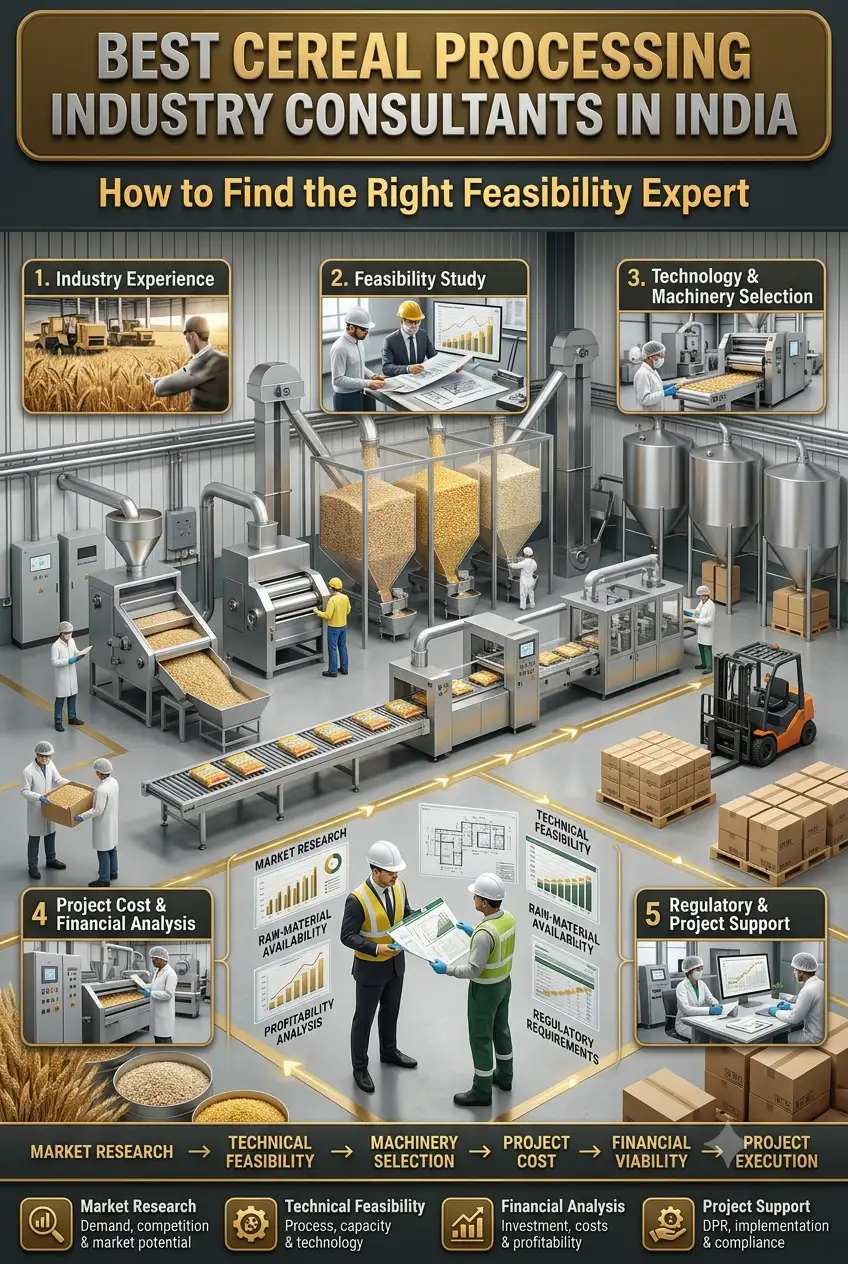
The most capable process engineering consultants can provide plant layout drawings, material balance calculations, utility load estimates, and equipment selection matrices in addition to the DPR. If your project requires civil construction, MEP design, or EPC oversight, confirm that the consulting firm has these capabilities in-house. Alternatively, confirm that they have credible EPC partners that they work with.
A consultant who can accompany you through the procurement process adds huge value beyond the paper deliverable. They can compare machinery quotations, verify technical specifications, and witness factory acceptance tests.
Regulatory Knowledge and Compliance Advisory
Cereal processing units in India operate under a multi-layer regulatory framework. FSSAI licensing is mandatory under the Food Safety and Standards Act, 2006. The FSSAI has a three-tier licensing system – basic registration for small operators, state licences for mid-sized businesses, and central licences for units with turnover above ₹50 crore or engaged in inter-state trade. Depending on scale and product category, units may also require BIS certification for standardised products, consent to establish and consent to operate from the State Pollution Control Board, and factory registration under the Factories Act, 1948. GST registration, MSME registration, and state-specific food processing approvals add further complexity. The right consultant guides you through all of these proactively to ensure your project does not face commissioning delays due to licensing gaps.
Client Base and Reference Network
The strongest indicator of consulting quality is a verifiable client portfolio. Ask for references from past clients in the cereal, rice, flour, or pulse milling space. Consulting firms with a wide client base across multiple states and plant scales understand how to calibrate project design to budget realities and local market conditions. These range from 5 TPD mini flour mills to 200 TPD integrated cereal complexes. A consultant with national presence also brings better intelligence on regional raw material pricing, logistics costs, and state government scheme eligibility.</p>
Role of NPCS in Cereal Processing Project Consultancy
NPCS has assisted a wide range of clients in the cereal and grain processing sector across India. M/s. Brahmani Food Pvt. Ltd. of Firozabad, Uttar Pradesh engaged NPCS for a Project Feasibility Report on a Roller Flour Mill. M/s.
TSI Engineering Industries Pvt. Ltd. of Guwahati, Assam commissioned a Comprehensive Project Report on Grain Processing. It covers Grading, Cleaning, and Packaging of Rice and Pulses. M/s. As Real Infra Pvt Ltd of Katni, Madhya Pradesh engaged NPCS for a Comprehensive Market Research Report. It covers rice milling market potential and production feasibility. M/s. Shine Agrotechnology Pvt. Ltd. of Navi Mumbai, Maharashtra relied on NPCS for a Project Feasibility Report on Dal Mill for industrial applications.
Mr. Abhishek Nair of Jamnagar, Gujarat worked with NPCS on a Detailed Feasibility Study on Pulse processing. M/s. Jindal Traders of Sirsa, Haryana engaged NPCS for a Pre-Feasibility Report on Rice Milling. M/s. Shree Chandel Roller Flour Mills Pvt. Ltd. of Kanpur, Uttar Pradesh commissioned a Comprehensive Project Report on Pasta and Macaroni – a value-added cereal product. M/s. Gourmet Preparations of Howrah, West Bengal worked with NPCS on an Industrial Project Report on Gourmet Popcorns.
M/s. Reverence Bio Energy Pvt Ltd of Bagalkot, Karnataka commissioned a Project Report on Maize Starch. M/s. Malook Chand Oil Co. of Aligarh, Uttar Pradesh engaged NPCS for a Project Planning and Feasibility Report on Maize Starch and Liquid Glucose. M/s. Vakrangee Packaging LLP of Raipur, Chhattisgarh used NPCS for a Comprehensive Market Research Report on Maize Starch. Mr. Tosif Halani of Anand, Gujarat commissioned a Detailed Feasibility Study on Maize and its By-Products including Maize Starch, Sorbitol, Liquid Glucose, Dextrose, and Gluten.
M/s. Dhampur Sugar Mills Limited of Bijnor, Uttar Pradesh engaged NPCS for a Techno-Economic Project Study on Potato Starch. M/s. Gupta H.C. Overseas (I) Pvt. Ltd of Agra, Uttar Pradesh relied on NPCS for a Techno-Economic Feasibility Report on Pasta manufacturing. M/s. Om Parboiling Rice Mill of Sonitpur, Assam engaged NPCS across multiple assignments including a Detailed Project Report on Particle Board from Rice Husk and an Industrial Project Report on Aqua Fish Feed – demonstrating NPCS’s integrated advisory reach beyond primary milling.
NPCS has published a comprehensive printed reference book on cereal processing covering technology, market analysis, investment parameters, and manufacturing processes in depth — the printed book: Handbook on Drying, Milling and Production of Cereal Foods (Wheat, Rice, Corn, Oat, Barley and Sorghum Processing Technology).
For a detailed techno-economic Project Report on setting up a manufacturing business in this sector — including plant economics, machinery lists, financial projections, and applicable government incentives — the NPCS Project Report: Wheat Flour Mill (Atta, Maida & Suji) — Manufacturing Plant, Detailed Project Report, Profile, Business Plan.
Best Cereal Processing Industry Consultants in Delhi and the India Consultancy Landscape
Delhi and the National Capital Region (NCR) serve as the nerve centre of industrial consultancy in India. Most of the country’s leading boutique management consulting firms in India specialise in food and cereal processing. Many are based here, and for good reason. Delhi offers immediate proximity to the northern grain belt. This includes the Punjab-Haryana-UP wheat and rice corridor, which produces the bulk of India’s tradable grain surplus. For entrepreneurs setting up cereal processing projects in northern, central, or western India, working with the best cereal processing industry consultants in Delhi often means faster site visits. It also means closer market intelligence and better relationships with the machinery ecosystem. This ecosystem is concentrated in cities like Ludhiana and Jalandhar.
Beyond Delhi, India’s consultancy landscape for cereal processing is geographically distributed. Hyderabad and Chennai-based consultants often focus on rice and pulse processing in Andhra Pradesh, Telangana, Tamil Nadu, and Karnataka. Mumbai and Pune-based firms are strong in food technology consulting and export-oriented cereal product development. Kolkata-based consultants are active in the rice and jute-belt processing corridor covering West Bengal, Odisha, and the Northeast. The All-India Food Processors’ Association (AIFPA) – established in 1943 and India’s oldest food processing industry body – connects food processing entrepreneurs with industry bodies and policy makers, and is a useful reference point for identifying credible consultants and technology providers in your region.
For NRI investors and overseas entrepreneurs looking at India entry in the cereal processing sector, working with a Delhi-based India consultancy firm with an established international portfolio is strongly advisable. As the Invest India food processing sector page confirms, India is the world’s largest producer and exporter of cereal products, with rice accounting for nearly 95% of cereal exports – making it one of the most investment-attractive food sectors for both domestic and overseas capital.
Consulting Service Types: Deliverables and Best-Fit Client Profile
| Service Type | Key Deliverables | Best-Fit Client |
| DPR / Feasibility Consulting | Detailed Project Report, techno-economic feasibility study, market research, financial projections, payback analysis | Entrepreneurs seeking bank finance, PLI/PMKSY applicants, NRI investors doing pre-entry due diligence |
| Process Engineering Consulting | Process flow diagrams, equipment selection, material balance, plant layout drawings, utility calculations | Promoters building greenfield units who need technical design before procurement begins |
| EPC Consulting | End-to-end project execution: design, procurement, civil supervision, trial commissioning | Investors with strong capital but limited technical bandwidth; first-time plant builders |
| Food Technology Consulting | Product formulation, grain processing R&D, HACCP and food safety systems, recipe and process optimisation | Entrepreneurs entering value-added cereal products: breakfast cereals, extruded snacks, fortified flours |
| Regulatory & Compliance Advisory | FSSAI licensing, SPCB consent, BIS certification, Factory Act compliance, GST and MSME registration support | Existing units scaling up, new units preparing for first inspection or audit |
| Market Research & Export Advisory | Demand mapping, pricing analysis, competitor landscape, export market entry strategy, APEDA registration support | Units targeting branded or export markets; entrepreneurs diversifying product mix |
Conclusion: Practical Next Steps for Cereal Processing Project Entrepreneurs
India’s cereal processing sector offers one of the most resilient investment propositions in the country’s manufacturing landscape. Furthermore, the raw material base is abundant, domestic consumption is structurally growing, and export demand is strong. Moreover, Government policy support has also never been more comprehensive. However, the gap between a viable business idea and a commissioned, profitable plant is bridged almost entirely by the quality of technical and consultancy guidance you access at the outset.
Therefore, the most important step a cereal processing entrepreneur can take is to commission a high-quality DPR before any other commitment. Specifically, this means before selecting a site, approaching a bank, or purchasing machinery. In addition, a good DPR forces rigorous thinking on product mix, capacity, market, machinery, and finance. Furthermore, it also often identifies optimisations that significantly improve project economics. Also, it also acts as the primary instrument for engaging lenders and government scheme authorities.
When selecting a consultant, prioritise domain-specific experience over general consulting credentials, examine sample DPRs critically, and verify client references.
Whether you are evaluating the top cereal processing industry consultants in India for a first project or diversifying an existing processing business into value-added cereal products, the right consulting partner can pay for itself. Indeed, it will pay for itself many times over.
As a result, this can help in avoiding mistakes, achieving faster commissioning, and improving project economics. For further context, explore APEDA’s cereal and cereal preparations export data for further market context. Also, review the Invest India food processing sector overview to understand the policy architecture supporting your investment.
Your Investment Deserves the Right Opportunity
Every serious investment begins with choosing the right sector and the right business model. With hundreds of industrial opportunities available across India’s manufacturing and clean-energy landscape, making the most informed choice is critical. Niir’s Startup Selector tool helps entrepreneurs, MSMEs, and investors identify the most suitable business opportunities based on their investment capacity, location, and interests – so your capital is directed toward a venture with the strongest fit and potential.