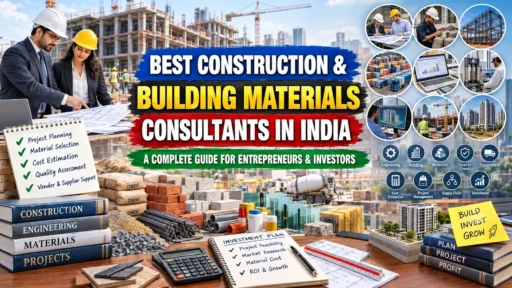
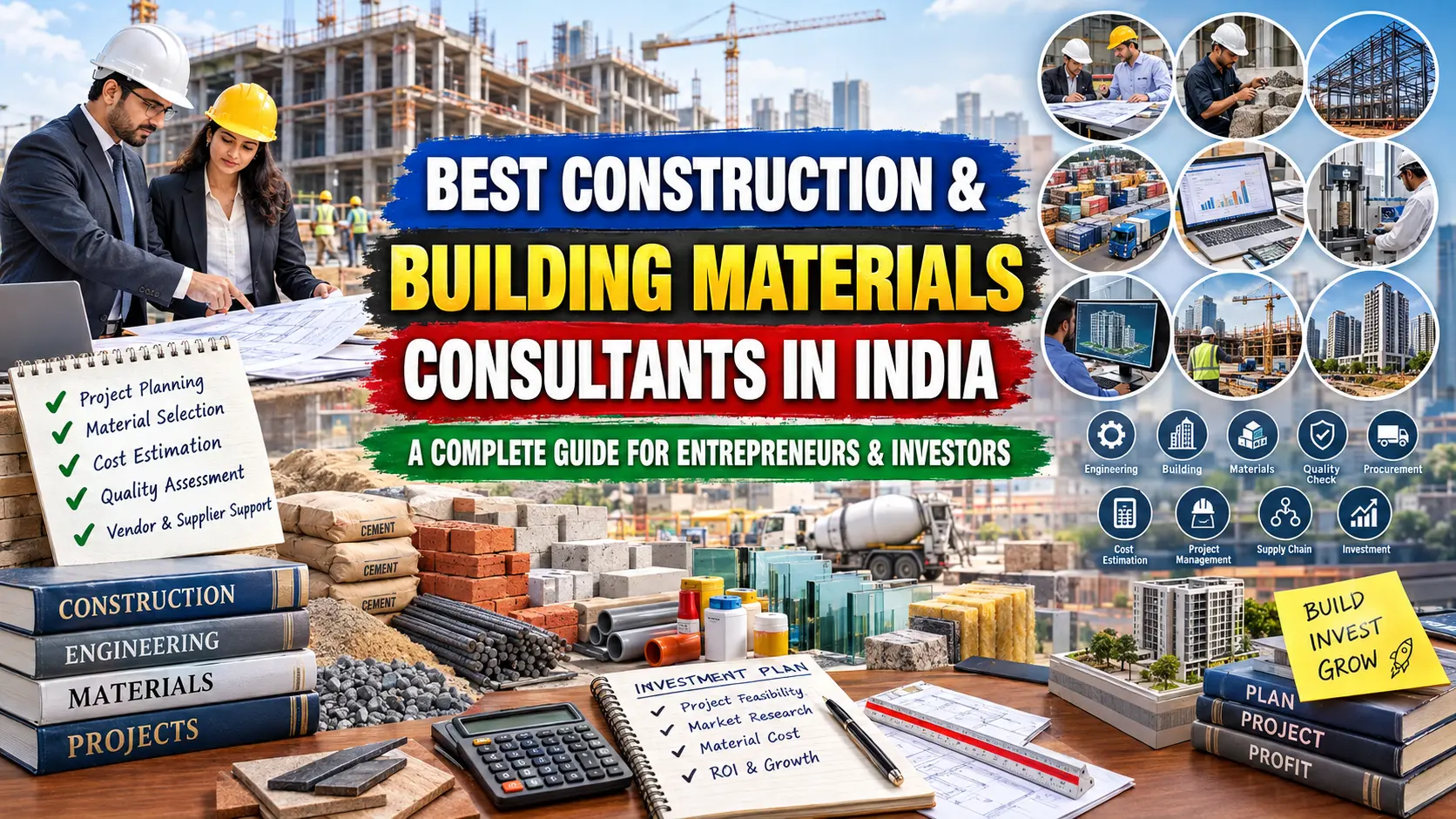

India’s construction and building materials industry is at a turning point. Infrastructure investment, urbanisation and manufacturing policy incentives have combined to generate a national trend of new project investments. The contribution of the best consultants in the construction and building materials sector in India is becoming increasingly vital. They help entrepreneurs and investors looking to navigate this sector. The key difference between a project that will roll on to scale profitably and one that will languish at the feasibility stage lies in the right consultant.
The construction and building materials industry comes in a variety of forms – such as cement, bricks, tiles, fly ash products, AAC blocks, paints, glass, stone, aggregates, roofing materials and structural steel products, and more. Specific process needs, capital structures, and regulatory responsibilities exist in each sub-sector. The challenge of navigating this complexity requires a specialised domain knowledge that general management consultants don’t always have.
This article looks at the scope of work that a top construction and building materials industry consultant in India does, how to assess them, and the reasons why India is an attractive investment opportunity. It also explores how leading construction and building materials industry consultants such as the National Consultants and Scientists Society (NPCS) have enabled entrepreneur/ project investors in this sector to create bankable, technically sound manufacturing projects.
What Construction & Building Materials Consultants Do
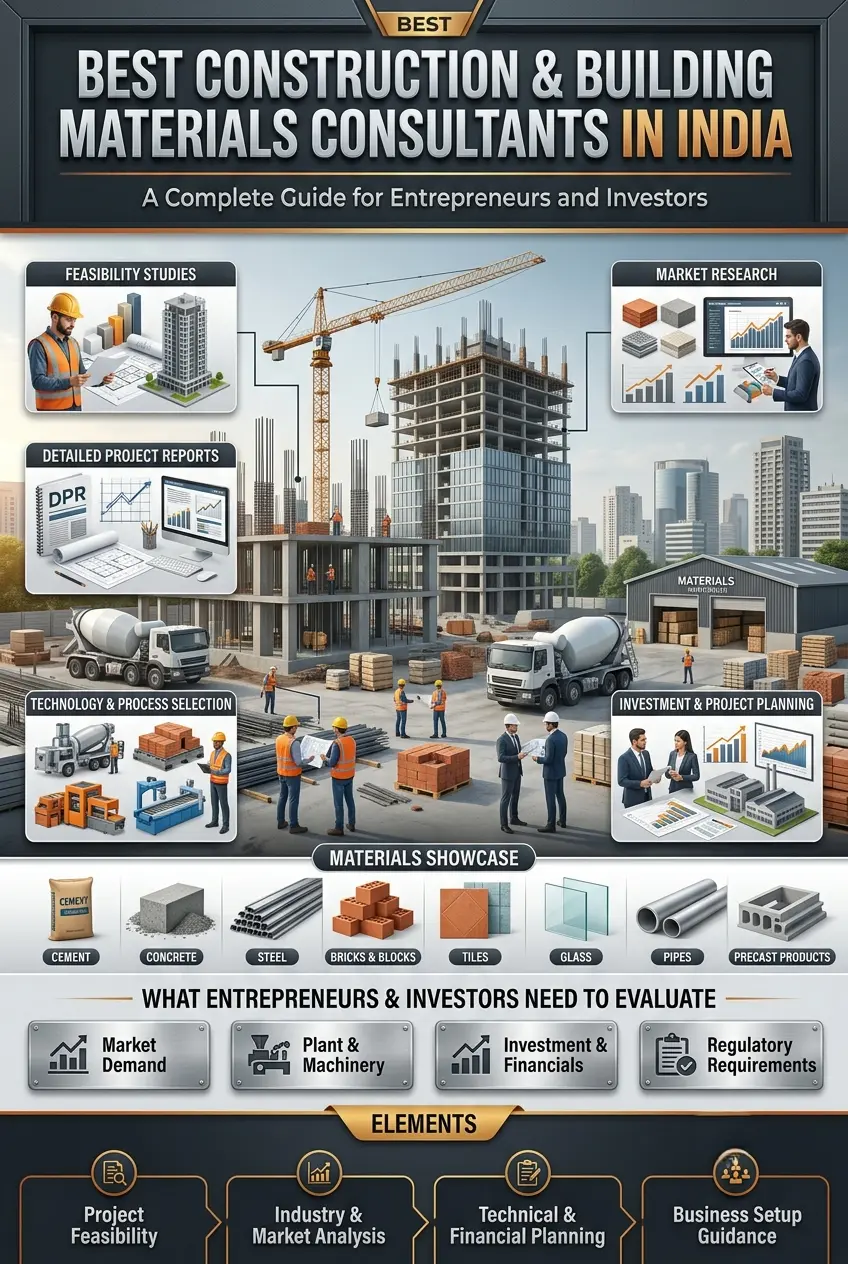
The job of a specialist in construction and building materials isn’t just desk research. In actuality, these professionals are like project architects that shape a manufacturing opportunity from concept to commissioning ready detail. They provide solutions across four main categories – feasibility and DPR preparation, engineering and process design, regulatory compliance advisory and project financing support.
The basic document for any manufacturing investment in this sector is called Detailed Project Report (DPR). It includes machine selection, raw material procurement, process selection, plant layout, workforce planning, cost estimation and multi-year financial modelling. A good DPR serves as a document for the construction materials project, say an AAC block unit or a ceramic tile plant, that you submit to the bank or financial institution for the purpose of sanctioning a term loan. High quality directly impacts on the cost and time of fund mobilisation.
In addition to DPR, process plant consultants in this field also help in EPC contracting and vendor selection. They also help with quality benchmarking with Bureau of Indian Standards (BIS) codes. Moreover, they assist in abiding by the norms of the State Pollution Control Board. The building materials industry is a multi-layered regulated one. It ranges from the Factories Act to environmental clearance and IS standards enforced by BIS that are relevant to products. By working with experienced process engineering consultants, clients can navigate this without the hassle and expense of delays.
Why India Is a Hotspot for Building Materials Investment
India has emerged as the world’s third largest construction market, and it is projected that it will continue to be one of the fastest-growing in the world. According to Invest India, the construction materials market is expected to increase at a 10.6% CAGR to reach USD 82.5 billion by 2028. Construction activities have a multiplier effect of ₹2.5 to ₹3.5 per rupee invested across 250-plus related industries such as steel, cement, glass, wiring and more.
The government’s National Infrastructure Pipeline (NIP) and continuous capital expenditure (CPEC) under various Union Budgets have ensured a steady demand for building materials. The government’s National Infrastructure Pipeline (NIP) and continuous capital expenditure (CPEC) through various Union Budgets have created a steady demand for building materials. Moreover, material consumption in the residential segment remains strong thanks to the Pradhan Mantri Awas Yojana (PMAY) and urban housing schemes. According to IBEF estimates overall decorative construction material market, ranging from paints, ceramic tiles to engineered wood panels, is expected to grow to around USD 100 billion by the end of this decade.
Another strong demand is importing substitution. India is presently importing considerable amount of the specialised building material and construction technology inputs. Domestic compliance mandates for various categories of products, including gypsum boards and ceramic tiles, as stipulated by Quality Control Orders (QCOs) issued by BIS, further bolster the competitive edge for the Indian manufacturers that have the right process and certification set up.
The green building materials sector provides additional momentum. According to the analysis of IBEF on the green building materials market, the Indian green building materials market size is expected to grow from Rs 6.15 lakh crore to Rs 7.03 lakh crore (USD 70-80 billion) by 2030. The demand for low VOC paints, eco-certified tiles and fly ash based masonry products is very high with developers looking for green rating, such as GRIHA, and IGBC. The market changes are opening up all new investment corridors which enterprising individuals can utilize at an early stage with the assistance of an expert consultant.
How to Evaluate the Best Construction & Building Materials Consultants in India
When it comes time to hire a consultant for a construction and building materials project, it is a decision that can have tangible financial repercussions. However, as in other sectors where generic consulting can contribute, building materials manufacturing demands process technology skills. It also requires knowledge of raw material variations and regional supply chains. The following are the criteria that should be used in evaluating.
Domain-Specific Track Record
There is a strong correlation between a boutique management consulting firm with a deep sector understanding and better performance on a building materials project. Find consultants who have experience in projects of a similar product type and investment size as yours. This could be a fly ash brick plant in Eastern India or a ceramic sanitaryware plant in Rajasthan. Request DPRs that they have already created for similar projects. Make sure that these documents represent actual manufacturing parameters—not copy and pasted documents…
Engineering and Process Design Capability
The foremost construction and building materials consultants in India should be able to accurately define manufacturing processes. This involves choosing the best kiln technology for a tile plant, the best autoclaving cycle for an AAC block plant, or the best grinding circuit for a blended cement plant. Consultants who are not process plant specialists tend to generate feasibility reports that can make sense in theory. However, they are not realized during equipment procurement or plant trials. EPC consultants with a construction materials background can also take charge of plant erection and commissioning directly. This helps minimize technology to execution gaps.
Regulatory and Compliance Knowledge
The building and construction industry is a compliance-driven one. Dozens of product categories are required to be BIS certified. The number continues to grow in the Quality Control Orders. A consultant can save you months of project time in a variety of ways. These include environmental clearance, consent to operate from State Pollution Control Boards and GST classification for certain materials. The top engineering consulting firm in India that deals in this area will have its own staff. They already know the BIS application process, factories act requirements for manufacturing premises, and the testing procedures for the products.
Market Intelligence and Demand Analysis
A good construction and building materials consultant will base all their projects on a realistic evaluation of market demand. This involves analysing the local demand-supply mismatch of a particular product. It also involves analysing the competitor capacity in the target area. In addition, it involves benchmarking the pricing realisation with the existing market rates. Financial projections that do not stand up to bank scrutiny is another frequent failing mode in DPRs submitted to financial institutions. This is the moment that consultants fall short, as they fail to take the time to conduct this step….
Financial Modelling Depth
The funding logic of a building materials manufacturing business needs to consider raw material price fluctuations. It also needs to consider the sensitivity to fuel costs—especially in the cement manufacturing industry and in tile manufacturing. This is due to the high energy consumption of these processes. It must also consider the need to build in stages.
The best consultants in this area create financial models for all scenarios – conservative, base and optimistic. This allows investors to be aware of the project risks. Any DPR that only offers one IRR without sensitivity testing is almost certainly not prepared well…
Best Construction & Building Materials Industry Consultants in Delhi and Across India
Delhi and the NCR region is home to some of the top project consultancy firms in the construction and building materials industry in India. The location of the capital city is conducive to the establishment of consultancy activities. This is due to the presence of support infrastructure from MSME, regulatory authorities and financial institutions in the city. Today, however, the best construction and building materials industry consultants in Delhi offer services to customers all over the country. These range from cement works in Chhattisgarh to tile making units in Gujarat, to roofing material factories in Maharashtra.
Other such industrial consultancies that specialize in process engineering, boutique management consultancies that specialize in MSME manufacturing, and full-service industrial consultancies that prepare DPR’s and also provide EPC support, form a wider consultancy landscape for this industry. NAREDCO and The investor side of the construction and building materials market in India has a wide range of advisory support, ranging from the developer and real estate end, represented by CREDAI, to the industrial end represented by industrial consultancies such as NPCS, which represents the manufacturing and plant-setup side.
The cement industry, a good indicator of the building materials industry in India, provides a good example. Cement Manufacturers’ Association (CMA) is the body representing the major cement producers accounting for almost 70% of the installed capacity. The landscaper of consolidation and capacity growth in the cement industry is now unfolding in the neighbouring markets, which is giving a chance to the entrepreneurs for new project investments in scope.
Role of NPCS in Construction & Building Materials Project Consultancy
NPCS has helped various and varied clients in setting up construction and building materials manufacturing units throughout India. For example, Mr. Anubhav Agrawal, Lucknow, Uttar Pradesh hired NPCS for the Detailed Project Report (D.P.R) of Gypsum Plaster Board. Similarly, M/s. D Chandresh Steels Pvt Ltd., Mumbai, Maharashtra commissioned a Detailed Feasibility Study for Continuous Sandwich Panels, a high growth prefabricated building component. Furthermore, M/s. The collaboration between RVPR Constructions Private Limited, Hyderabad, Telangana and NPCS was for Bankable Project Report (BPR) for Fabrication and Painting of Industrial Steel structures using Pre Assembly Line. In addition, M/s. Shree Industries Pvt Ltd, Dadar, Gujarat called NPCS to prepare a Techno-Economic Project Report for Ready Mix Plaster, Block Jointer, Tile Adhesive, and M20 Concrete.
Moreover, M/s. A Detailed Feasibility study was ordered by UAL Industries Ltd Kolkata, West Bengal for Calcium Silicate Insulation Board. Likewise, M/s. Sharadaa Ceramics Private Limited of Tiruvellore, Tamil Nadu engaged NPCS for a Calcium Silicate Blocks Project Investment Report. Additionally, M/s. Magadh Ecobrick Pvt. Ltd., Patna, Bihar approached NPCS for a Comprehensive Market Research Report on AAC Blocks. Similarly, M/s. Jugnu Construction Company of Bokaro, Jharkhand commissioned a Techno-Economic Project Report on Prestressed Concrete Sleepers. Furthermore, M/s. Ishvaara Resorts LLP, Sundargarh, Odisha awarded the NPCS to carry out a Market Research Report on Prestressed Concrete Railway Sleepers.
In addition, NPCS worked with the Shyam Steel Manufacturing Limited, Bankura, West Bengal for a Techno-Economic Project Study on Low Relaxation Prestressed Concrete Steel Strand. Similarly, M/s. A Project Report for Mini Steel Plant (Billets and TMT bars) was prepared for Megacity Engineering of Kolkata, West Bengal. Furthermore, Agra, Uttar Pradesh based Mr Abhishek Goyal has hired NPCS for Detailed Project Report (DPR) of India TMT Bar Market and TMT Bar manufacturing. Additionally, M/s. Vensar Constructions Company Limited, Bhopal, Madhya Pradesh collaborated with NPCS for an Investment and Project Report for HDPE Pipes. Likewise, Mr. Adesh K. Behera of Kendrapara, Odisha commissioned a Techno-Economic Project Study on HDPE Pipes and Fittings. Moreover, M/s. NPCS was commissioned by Chandel Agro Industries Private Limited, Rajasthan for Detailed Project Report (DPR) of Toughened Glass.
Furthermore, M/s. K S Energy Pvt. Ltd. of Panchkula, Haryana commissioned a Detailed Project Report on Float Glass. Similarly, M/s. Goyals Group of Indore, Madhya Pradesh engaged NPCS for a Techno-Economic Project Study for manufacturing Glass Fibre Reinforced Polymer (GFRP) components for construction and automotive. In addition, Mr. Kishan Ukani of Vadodara, Gujarat commissioned a Comprehensive Market Research Report on Light Weight Bricks (EPS Bricks).
Finally, Mr. Raj Palanivel, Cuddalore, Tamil Nadu had prepared an Investment and Project Report on the Recycling of Fly Ash for eco-friendly bricks with NPCS. Moreover, For a construction finishing product, Paint Rollers, Mr. Rehan Ansari, Gurgaon (Haryana) and Mr. Shahnawaz Ahmad, New Delhi both hired NPCS individually for Project Reports.
NPCS has published a comprehensive printed reference on this subject: the The Complete Book on Construction Materials — covering technology, market analysis, investment parameters, and manufacturing processes for the full range of building material categories including stone, bricks, lime, mortars, concrete, metals, and architectural paints in depth.
For entrepreneurs seeking a detailed techno-economic Project Report on setting up a construction materials manufacturing business — including plant economics, machinery lists, financial projections, and applicable government incentives — the NPCS Project Report on AAC Blocks (Autoclaved Aerated Concrete Blocks) Manufacturing is one of the sector’s most in-demand project reports, covering this high-growth building material in full technical and financial detail.
Comparing Construction & Building Materials Consulting Service Types
The following table summarises the key types of consulting services available in this sector, their typical deliverables, and the client profiles they best serve.
| Service Type | Core Deliverable | Best For | Typical Engagement |
| Detailed Project Report (DPR) | Full techno-economic feasibility study | First-time entrepreneurs, bank loan applications | One-time, pre-investment |
| Process Plant Consultancy | Process design, equipment selection, plant layout | New plant setups and capacity expansions | Project inception to commissioning |
| EPC Consultancy | End-to-end engineering, procurement, and construction | Turnkey project investors | Full project lifecycle |
| Market Research & Demand Study | Market sizing, competition mapping, pricing analysis | Investors evaluating entry into new product lines | Pre-DPR or standalone |
| Regulatory & Compliance Advisory | BIS certification, environmental clearances, GST structure | Units facing certification or expansion approvals | Ongoing or project-specific |
| Techno-Economic Feasibility Study | Technology evaluation + financial projections | NRI investors and institutional backers | Pre-investment decision stage |
Construction & Building Materials Consulting in Delhi and Key Manufacturing Hubs
Delhi and the NCR belt serve as the consulting nerve centre for India’s construction and building materials sector. Most leading project consultancy firms — including NPCS — maintain their primary operations here, benefiting from access to industry associations, regulatory offices, and a dense network of engineering expertise. For investors based outside India, Delhi-headquartered consultancies often serve as the first point of contact for Indian market entry. Invest India’s construction sector portal provides useful entry-level data on FDI norms and investment climate for international investors considering the building materials space.
Beyond Delhi, key manufacturing clusters for building materials are located in Gujarat (ceramics and tiles), Rajasthan (marble and stone processing), Tamil Nadu (cement and roof tiles), Uttar Pradesh (fly ash bricks and AAC blocks), and Andhra Pradesh (fibre cement sheets and construction chemicals). A consultant familiar with the regulatory environment, raw material availability, and logistics infrastructure of these regions adds measurable value to a project’s viability assessment.
The Ministry of Housing and Urban Affairs (MoHUA) continues to set policy direction for construction activity across urban India, while the National Building Code (NBC) — maintained by BIS — establishes technical standards that define product specifications for key construction materials. Consultants with working familiarity with both the policy and technical framework operate at a significantly higher effectiveness level than those who focus only on financial modelling.
Conclusion: Getting Your Construction & Building Materials Project Right
India’s construction and building materials sector offers genuine and substantial opportunity for entrepreneurs, MSMEs, and project investors. Moreover, the structural drivers — urbanisation, infrastructure investment, housing demand, and green building momentum — are not cyclical. Instead, they represent a multi-decade shift in how India builds. However, realising value from this opportunity requires disciplined project planning, accurate feasibility assessment, and specialised guidance from consultants who understand the sector deeply.
For example, whether you are evaluating a fly ash brick unit, a ceramic tile plant, an AAC block manufacturing facility, or a specialised construction chemical operation, the quality of your initial project report matters. Ultimately, it will determine how smoothly — or how painfully — the rest of the project unfolds.
Therefore, finding the best construction and building materials industry consultants in India is therefore important. Furthermore, engaging them at the pre-investment stage is not an optional step. Instead, it is the foundation on which everything else is built.
NPCS, with its three-decade track record, broad sector coverage, and bankable DPR capability, remains one of the most credible choices for entrepreneurs and investors entering this space. In addition, pair specialist consultancy support with a clear understanding of the market, the regulatory environment, and the technology. As a result, the construction and building materials sector becomes one of India’s most accessible and rewarding manufacturing investment destinations.
Your Investment Deserves the Right Opportunity
Every serious investment begins with choosing the right sector and the right business model. With hundreds of industrial opportunities available across India’s manufacturing and clean-energy landscape, making the most informed choice is critical. NIIR’s Startup Selector tool helps entrepreneurs, MSMEs, and investors identify the most suitable business opportunities based on their investment capacity, location, and interests — so your capital is directed toward a venture with the strongest fit and potential.