
How Anil Agarwal’s Historic Green Energy Investment is Opening New Business Doors Across the Industrial Landscape of India.
India’s decarbonisation goals have just gained a big boost in the industry. The $1 billion pledges by Vedanta Group Chairman Anil Agarwal to the cause of net zero carbon and acceleration of green energy is a game-changer not just for the mining giant but for the entire ecosystem of its suppliers, manufacturers and startup founders, as reported by Jagran.com. This investment is more than just a corporate sustainability statement. This is a market indicator. A billion US dollars invested by one of India’s biggest diversified natural resource firms in clean energy changes procurement dynamics, supply chains and technology usage in dozens of industrial sectors.
The impact of Vedanta’s commitment will be felt across businesses of all sizes, from providing green hydrogen infrastructure and carbon-monitoring equipment to supplying materials for emission reduction and renewable energy components. This is one of the biggest supply chain opportunities of this decade for Indian MSMEs, entrepreneurs and manufacturing startup.
What the Jagran Report Means for Indian Business
Earlier, the business desk of Jagran.com reported about the billion-dollar green commitment made by Vedanta, which directly correlates the vision of ‘Net Zero Carbon’ by Anil Agarwal with a push towards greater investments in clean and renewable energy across various business operations of Vedanta in aluminium, zinc, copper, oil and gas, and steel. Vedanta has earlier pledged to cut its carbon emission intensity by 25% by 2030 and become a carbon neutral company by 2050. This $1 billion tranche now provides these goals with a runway and a procurement engine.
It has a direct meaning for entrepreneurs. Vedanta has over 20 large-scale industrial plants in India (in Odisha, Rajasthan, Goa, Gujarat and Jharkhand). Each facility will now be able to increase their use of renewable energy supplies, improve their emission control systems and install new green technology systems. It generates multi-layered demands – for equipment, for services, for materials and for digital monitoring solutions.
This investment is also in sync with the Government of India’s 500 GW of renewable energy capacity target by 2030 and Net Zero Carbon emission by 2070, as Jagran.com reported. Vedanta’s journey is fastening the pace of industrial India’s response to this national target. All entrepreneurs, MSME manufacturers, and startups in the adjoining industrial sectors should tune in to the next wave of procurement spending — this is where it will go.
Get Detailed Project Report (DPR): Renewable Energy Projects and Green Power
Why This Green Energy Market Is Growing Fast
The green journey of India is no longer a dream; it is an institution. The Ministry of New and Renewable Energy (MNRE) has set renewable energy procurement targets for large industries and the National Green Hydrogen Mission has allocated ₹19,744 crore of public investment to transform India into a global leader in green hydrogen. The Bureau of Energy Efficiency (BEE) requires energy audits and compliance with ESG framework for large industries, and the Ministry of Environment, Forest & Climate changes energy reporting requirements every year.
In this backdrop, the $1 billion plan of Vedanta (as reported by Jagran.com) will be a catalyst to attract several hundred ancillary businesses to the Green Industrial Supply Chain. The cumulative investment India needs to reach net zero by 2070 is estimated to be $10 trillion. The role of the leaders of the private sector, such as Vedanta, is expected to be crucial in bringing about the industrial transformation. This translates to their investment announcements directly impacting procurement cycles, which begins with Indian manufacturers and MSMEs.
Government Policies and Incentives Driving This Opportunity
The business creation spurred by Vedanta investment is directly supported by several government programmes. These programmes enable creative entrepreneurs to join the green manufacturing and clean energy business ecosystem.
Ministry of New and Renewable Energy (MNRE):
The MNRE provides incentives on production, manufacturing and viability gap funding for renewable energy component manufacturers such as solar modules, wind turbine components, electrolyser components, and energy storage systems.
National Green Hydrogen Mission
The National Green Hydrogen Mission has a policy framework and budgetary support of ₹19,744 crore to create an ecosystem of green hydrogen (GH). This is being supported by the Strategic Interventions for Green Hydrogen Transition (SIGHT) programme, which provides financial assistance for domestic electrolyser production.
Ministry of MSME – PMEGP & CGTMSE
Collateral-free credit for first generation entrepreneurs who are entering into a manufacturing business under green supply chain with loans of up to ₹ 50 lakh for micro units of the ministry of MSME.
Startup India – DPIIT Recognition
80% of the income tax exemption for 3 years for the recognised Startup India with business in the field of Cleantech / Green manufacturing, fast-track patent processing, access to Fund of Funds (FoF) for VC support.
Under Make in India Renewable Energy, reduced customs duty and prioritised facilitation of FDI to manufacturers of solar panels, wind turbine blades, inverters, battery storage and emissions monitoring equipment.
BEE: Energy audit services along with energy audit equipment suppliers will keep on being in demand with the increased energy audit services and mandates from the Bureau of Energy Efficiency for energy auditing of large industrial units and their compliance with PAT scheme, and reporting of energy consumption.
6 Manufacturing Business Opportunities Triggered by Vedanta’s Green Investment
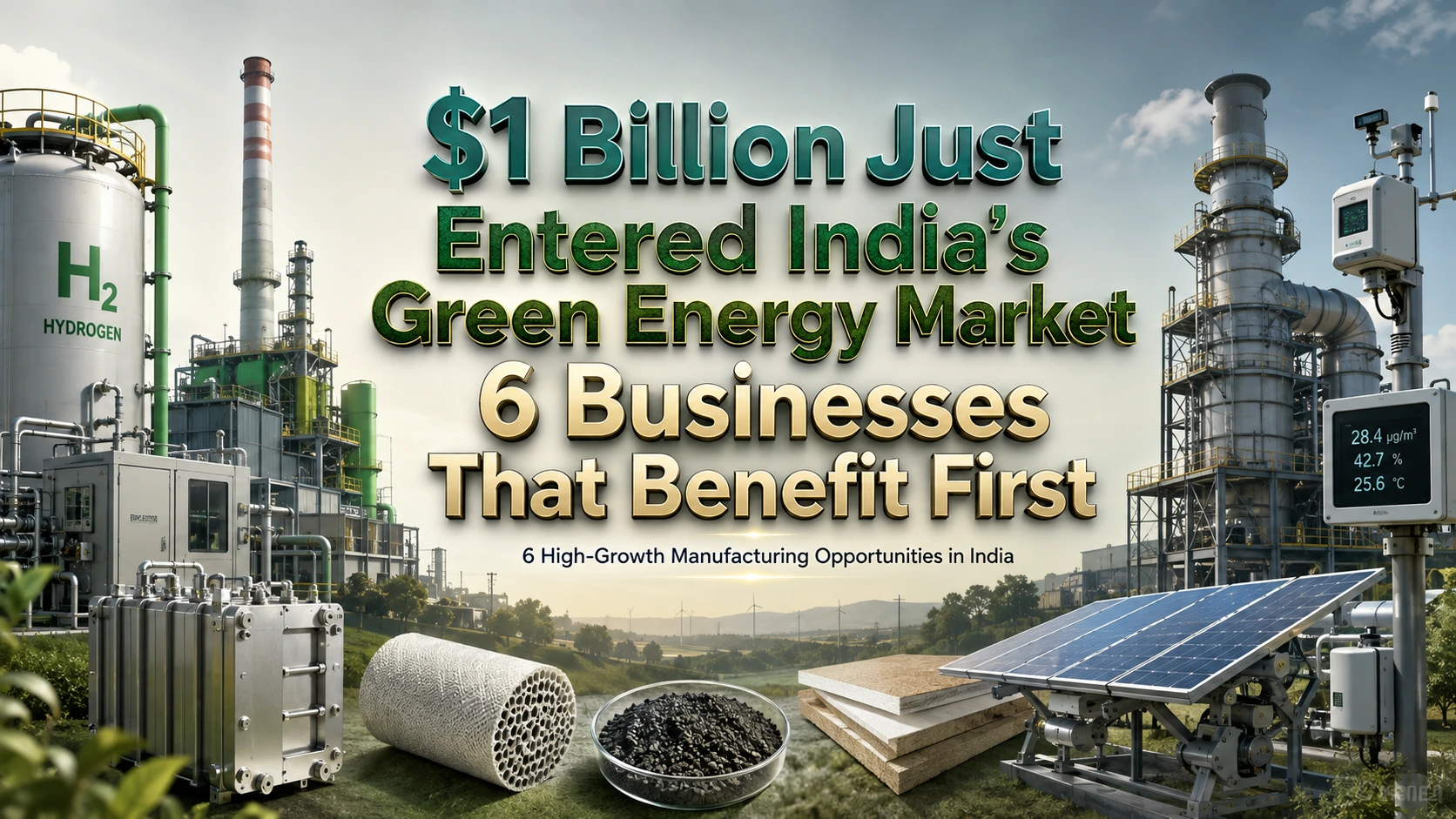
As reported by Jagran.com, Vedanta’s $1-billion pledge towards net-zero carbon brings a direct and substantial procurement cycle for the company across various industrial segments. If you are looking to start a manufacturing firm, read on to find six companies to consider investing in now:
1. Electrolyser Component Manufacturing for Green Hydrogen Plants
Vedanta’s net zero strategy comprises the shift of energy intensive processes, especially aluminium smelting, to green hydrogen as a reductant and fuel. This can directly drive the need of electrolyser parts, such as titanium-coated electrodes, membrane assemblies, bipolar plates and pressure vessel fittings. Currently, India imports most of these parts from Germany, China, and the USA. A domestic manufacturer who can offer nickel-coated electrodes or PEM membrane frames can earn premium margins and help in the import substitution programme (SIGHT) of the National Green Hydrogen Mission. An MSME unit manufacturing sub-components of the electrolyser can start at a capital investment of ₹50–₹80 lakh and grow depending on the demand from large-scale green hydrogen plant developers who are already getting incentive from the government. This segment is particularly easy to follow for entrepreneurs with an electrochemical, precision machining, or polymer processing background.
Related Article: Green Hydrogen, Methanol & Syngas Manufacturing Guide
2. Flue Gas Desulphurisation (FGD) Equipment and Scrubber Manufacturing
As part of its efforts to achieve a carbon neutral footprint, Vedanta has to cut SO2, NOX and PM emissions from their smelting and refining plants. The investments that need to be made at every Vedanta plant – and at hundreds of other large industrials on similar compliance trajectory – are flue gas desulphurisation (FGD) scrubbers, activated carbon injection systems and bag filter units. The production of FGD equipment or Venturi scrubbers for industrial stacks is a high return business. The investment in a fabrication unit for the stainless-steel FGD scrubber can be done at about ₹1-₹3 crore. This segment is untapped by Indian MSMEs, though there is tremendous demand from industries which come under the umbrella of MOHFCC.
3. Carbon Capture Material and Sorbent Manufacturing
Carbon capture systems use chemical sorbents, which is one of the least congested and highest-potential green transition supply chain opportunities. Direct air capture and post combustion carbon capture are the processes that use zeolites, activated alumina, amine-functionalised silica and potassium carbonate sorbent pellets. A market for activated zeolite pellets and amine impregnated silica for pilot scale carbon capture project exists at an early stage but is growing very fast. The initial investment is ₹40 to ₹60 lakh in a simple chemical processing and pelletisation plant. R&D based cleantech manufacturing is supported by the Ministry of New and Renewable Energy and Science and Technology through different types of grants.
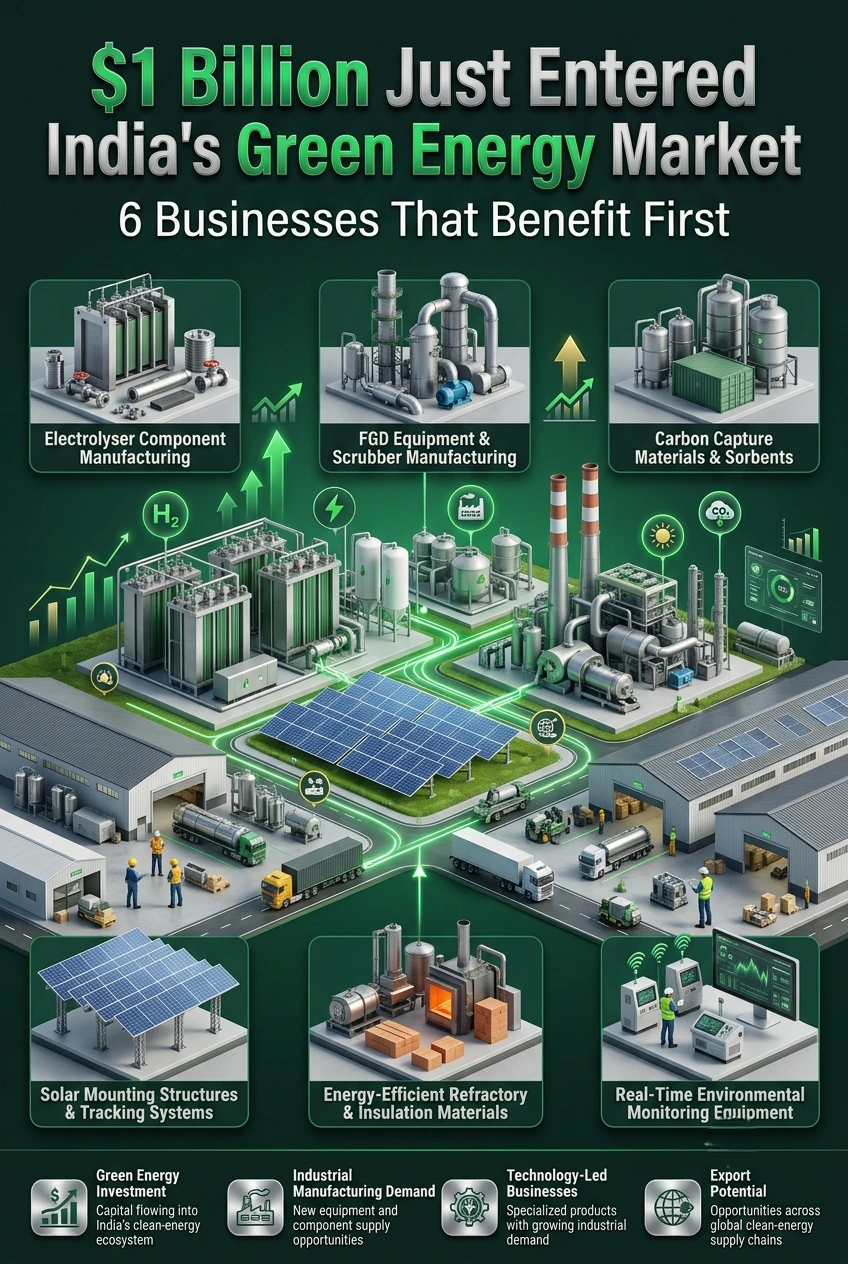
4. Industrial Solar Mounting Structures and Tracking Systems
Vedanta is already one of India’s biggest green power purchasers via the Indian Energy Exchange. It will significantly increase its renewable energy generation onsite by investing a total of $1 billion on its commitment to ‘net zero’. The investments will be spread across various captive solar power plants such as Jharsuguda, Lanjigarh and others. Each MW of Solar Power Plant needs around 8–12 tonne of galvanised steel structures for mounting. A steel fabrication facility with a hot dip galvanisation plant can cater to all of Vedanta’s in-house solar projects and serve the renewable energy market, driven by the Make in India Renewable Energy programme. Capital investment varies from ₹75 lakh to ₹2.5 crore depending on the in-house galvanisation or job-work.
Read the Complete Book Here: Solar PV Power and Solar Products Handbook
5. Energy-Efficient Refractory and Insulation Material Manufacturing
The key to reducing carbon intensity in metal smelting operations is large capital expenditure on thermal efficiency improvement, and this implies replacing conventional refractories with high performance (low thermal mass) insulating materials. Vedanta’s aluminium Smelters at Jharsuguda, zinc Smelters at Rajasthan, and copper operations at Tuticorin require advanced insulation products such as Insulating Firebricks, Ceramic Fibre Blankets, Micro porous Insulation Panels, and Castable Refractory Mixes. Indian MSMEs can address the niche of manufacturing energy-efficient refractory products specifically formulated for the Non-Ferrous Metal Smelting industry. To support cleantech material manufacturers, government of India has launched a programme called Startup India which offers tax exemptions and funding. The minimum capital required for small-scale ceramic fibre blanket plant is ₹60 lakh.
6. Real-Time Environmental Monitoring Equipment Manufacturing
The ESG reporting commitments of Vedanta along with the Continuous Emissions Monitoring Systems (CEMS) requirement from MoEFCC have generated significant real-time air quality, stack emission monitoring, water discharging and noise monitoring instrument needs. Currently, India imports 60-70% of the CEMS equipment from the European and American manufacturers. The market can directly serve a domestic manufacturing plant producing UV-DOAS sensors, dust concentration analysers, or IoT-based effluent quality sensors. A one-stop MSME unit can provide environmental sensor assembly and after-sale services for large industrial clients. This can provide good recurring revenue through annual recalibration requirements. The unit can also benefit from credit access provided by the MSME Ministry.
Import–Export Opportunity Analysis
Next, Import Substitution: India imports most of the parts of the electrolyser systems, the FGD system and advanced carbon monitoring instruments. In addition, to meeting the demand from Vedanta’s investment, these green industrial raw materials will reduce India’s reliance on Chinese and European suppliers. As a result, This supports the Make in India vision and the government’s self-reliance policy.
Finally, International Green Tech Partnerships: Vedanta’s commitment to net zero puts it in a favourable position to partner with international technology providers in the field of carbon capture, energy storage, and hydrogen production.
Stop guessing—choose the right business with confidence
Indian MSME Success Stories in the Green Industrial Space
Epsilon Carbon, Nagpur (Chhattisgarh)
Epsilon Carbon is one of India’s first vertically integrated carbon material companies. It produces coal tar pitch, carbon black, and advanced carbon materials for aluminium smelters. These include Vedanta’s Jharsuguda facility. Starting as a midsize chemical manufacturer, the company now supplies critical materials to the aluminium smelting industry. At the same time, it invests in green chemistry processes to reduce its own emissions. Their success demonstrates that domestic chemical material suppliers can grow alongside large industrials committed to clean transition. Founders can register their manufacturing startups under the Ministry of MSME portal to access similar credit and support pathways.
Gravita India Ltd, Jaipur (Rajasthan)
Gravita India is a listed Indian company that started as a small lead recycling MSME in Rajasthan and has grown into one of Asia’s leading metal recycling groups, with operations across India, Africa, and Southeast Asia. Gravita’s business model — circular economy metal recovery — is precisely what corporates like Vedanta need as they accelerate their net-zero commitments. Entrepreneurs can explore similar circular metal processing opportunities with project feasibility guidance from Niir Project Consultancy Services.
Ujaas Energy Ltd, Indore (Madhya Pradesh)
Ujaas Energy began as a small solar energy solution provider for industrial and commercial buyers in Madhya Pradesh. It has grown into a company supplying captive solar power solutions to large manufacturing plants. As more corporates like Vedanta procure captive solar capacity to meet net-zero goals, the solar EPC and equipment supply chain businesses that Ujaas represents will become increasingly relevant. This trend can benefit MSME founders across industrial states like Odisha, Rajasthan, and Gujarat. New entrants can explore project viability through detailed reports at Entrepreneur India (NPCS).
About Niir Project Consultancy Services (NPCS)
Niir Project Consultancy Services (NPCS) is India’s premier industrial consultancy, feasibility study, and project report preparation firm, with over 45 years of experience serving entrepreneurs, MSMEs, investors, and government bodies across 500+ industry sectors.
For entrepreneurs looking to enter green manufacturing — whether in emissions control equipment, electrolyser components, carbon monitoring instruments, or renewable energy mounting systems — NPCS offers:
Detailed Project Reports (DPR): Complete techno-commercial feasibility reports with plant layout, machinery list, raw material sourcing, financial projections, and ROI analysis — accepted by SIDBI, nationalised banks, and PMEGP nodal agencies.
Market Research Reports: Sector-specific market sizing, demand forecasting, competitive landscape analysis, and import-export data for green industrial segments.
Technology Consultancy: Process technology selection, equipment specifications, and manufacturing protocol development for cleantech and green chemistry projects.
Bank-Linkage Project Reports: Reports formatted for MSME loan applications under PMEGP, MUDRA, and CGTMSE schemes.
Explore NPCS’s full library of 6,000+ project reports at www.niir.org and www.entrepreneurindia.co.
Business Opportunity Data Table: Vedanta Green Investment Ecosystem
| Parameter | Details |
| Industry | Green Energy Manufacturing, Emissions Control Equipment, Carbon Monitoring, Clean Metal Processing |
| News Trigger | Vedanta Group $1 Billion Net-Zero Carbon Investment – Reported by Jagran.com |
| Market Driver | Corporate ESG commitments, BEE/MoEFCC mandates, CBAM-driven export demand for green metals |
| Investment Range (MSME) | ₹40 Lakh – ₹3 Crore (entry level); ₹10 Crore+ (mid-scale manufacturing) |
| MSME Opportunity | Electrolyser components, FGD scrubbers, carbon sorbents, solar mounting structures, advanced refractories, CEMS instruments |
| Export Potential | High — EU CBAM premium for low-carbon aluminium, copper, zinc; growing demand for Indian cleantech exports |
| Government Support | MNRE SIGHT programme, National Green Hydrogen Mission ₹19,744 crore, PMEGP, CGTMSE, BEE PAT, Startup India |
| State Opportunity | Odisha, Rajasthan, Gujarat, Goa, Jharkhand (states with major Vedanta operations) |
| Risk Level | Medium — dependent on sustained corporate ESG capex and government policy continuity |
| Growth Outlook | High — India net-zero by 2070 requires sustained green industrial investment through 2040s; early entrants build strong competitive moat |
Conclusion: The Green Industrial Window Is Open Now
Vedanta’s $1 billion commitment to net-zero carbon — covered in detail by Jagran.com’s business reporting — is not a distant corporate pledge. Instead, It is an active procurement signal. As a result, industrial regions across Odisha, Rajasthan, Gujarat, and Jharkhand will see increased demand. This investment will create purchase orders for equipment, materials, and services. Indian MSMEs and startups can fulfil these orders right now.
Furthermore, The government’s framework — from the National Green Hydrogen Mission to BEE’s energy efficiency mandates to MoEFCC’s environmental compliance requirements — provides the regulatory backdrop that makes these business opportunities durable and long-term. This is not a trend. Rather, It is a structural shift in how India’s largest industries source, produce, and account for their energy and emissions.
Therefore, For entrepreneurs ready to act, the window is open today. To begin, Start with a well-researched detailed project report from NPCS, register under Startup India or the Ministry of MSME’s PMEGP scheme, and approach Vedanta’s vendor development programmes with documented manufacturing capability. Ultimately, The billion-dollar investment has been announced. Now is the time to claim your share of it.