
Author: Niir Board | Publisher: Asia Pacific Business Press Inc. (NPCS) | Price: ₹1,100 / US$ 125
Chemistry at the Core of Every Industry You Can Name
Imagine the product you have used this morning — your toothpaste, your clothing’s fabric, the fertiliser that grew your food, the ink on the carton your milk came in, the fuel in the vehicle you took to work — each traces back, somewhere upstream, to an industrial chemical. To manufacturers, process engineers, and entrepreneurs, it is the backbone of modern economic life.
The global chemical industry transforms raw materials into over 70,000 distinct products that feed into agriculture, construction, textiles, pharmaceuticals, electronics, and every other manufacturing sector. The industry itself consumes around 26 percent of its output — a measure of how integrated chemical production is in the broader economy.
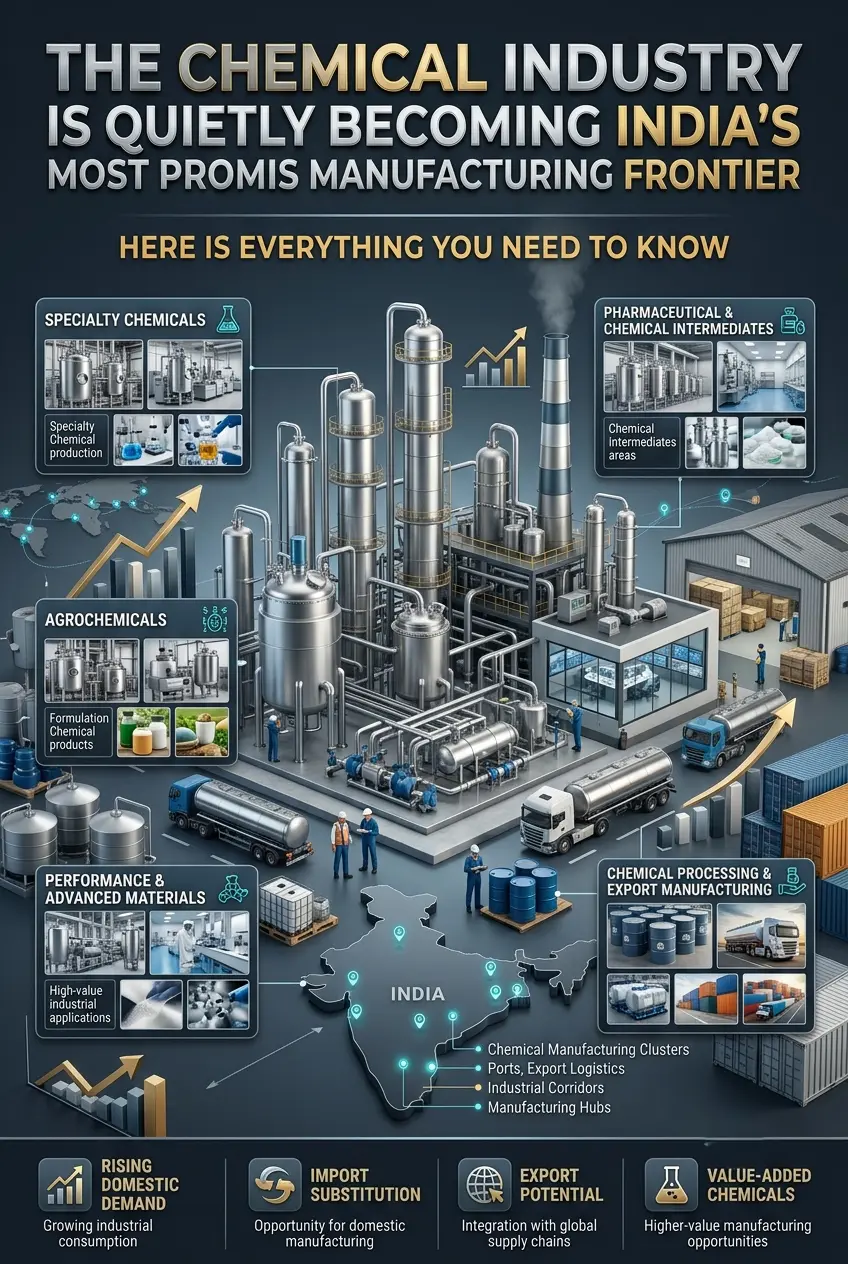
In India, the picture is particularly striking. The chemical sector is one of the oldest established industries and is a strategically important sector. It accounts for close to 13 percent of total national exports and has been growing at a rate between 10 and 12 percent annually — outpacing many other manufacturing segments. For investors, MSMEs, and entrepreneurs looking to enter manufacturing, industrial chemicals represent an area of proven demand, multiple entry points, and institutional support.
What Is Driving Growth in the Industrial Chemicals Sector
Demand for industrial chemicals in developing countries, India prominently among them, has been on a sustained upward curve for over two decades. Several factors are driving this growth concurrently.
The urbanisation and rising incomes are expanding the consumer goods market, which in turn is driving demand for the chemical inputs that go into packaging, personal care products, cleaning agents, construction materials, and processed foods. Agricultural intensification — the pressure to raise yields from finite land — sustains demand for fertilisers, agrochemicals, and soil amendment products. The rapid growth of sectors like textiles, pharmaceuticals, and specialty manufacturing pulls in demand for dye intermediates, specialty solvents, and process chemicals.
Concurrently, global supply chains are being restructured. Export restrictions from China, European regulatory tightening on certain chemicals, and the strategic push to develop domestic manufacturing capacity have created a significant opening for Indian chemical producers to capture both domestic and international market share. The government’s Production Linked Incentive (PLI) schemes and the Petroleum, Chemicals and Petrochemicals Investment Region (PCPIR) policy framework have given this shift institutional impetus.
For a small or medium manufacturer, the implications are practical. The addressable market for industrial chemicals produced in India — for domestic as well as for export — is larger now than at any previous point. The technical knowledge needed to enter this sector competitively is accessible. What has been missing is a reliable, consolidated reference on both the chemistry and the commercial manufacturing reality of the most important industrial chemical products.
The Business Opportunity in Industrial Chemicals — Specific, Not Generic
The phrase ‘chemicals industry’ can sound abstract when you are actually trying to identify a viable business project. What makes the sector tangible is the specificity of individual products. Industrial chemicals are not one market — they are hundreds of distinct product markets, each with its own raw material base and process technology.
Consider a few examples across the spectrum: Carboxymethylcellulose (CMC) — used as a thickener, stabiliser, and detergency improver across food processing, pharmaceuticals, and industrial applications — has seen consistent demand growth driven by the growth of processed food and personal care sectors. Hydroquinone, used in photographic chemicals, rubber antioxidants, and cosmetic skin-care formulations, has a stable industrial buyer base. Calcium cyanamide remains a commercially important nitrogen fertiliser and chemical intermediate. Allethrin, a synthetic pyrethroid insecticide, serves both agricultural and public health pest control markets.
Formaldehyde from methanol, granulated fertilisers, fine chemicals from coal, acetophenone for perfumery and pharmaceuticals, chemicals derived from agricultural raw materials like oranges, milk, and wood — these represent entry points across a wide range of capital scales, technical requirements, and market sizes. A small MSME unit does not need to enter the entire chemical sector; it needs a well-chosen product with understood process technology, defined raw material supply, and identifiable buyers. That is exactly what a good technical reference enables.
The Underappreciated Angle: Chemicals from Agricultural Raw Materials
One of the most interesting and commercially underexplored areas covered in a comprehensive industrial chemical’s handbook is the extraction of chemicals from agricultural and food-processing raw materials — milk, fats, oranges, wood, and coal.
India generates enormous amounts of agricultural processing waste and byproducts that contain recoverable chemical value. Citrus peel, for instance, is a source of orange oil, pectin, bioflavonoids, and livestock feed products. Dairy processing generates casein, lactose, whey proteins, and tyrosine with industrial and pharmaceutical applications. Lignosulfonates from wood pulping, vanillin from spent liquor, fine chemicals from coal pyrolysis — these are models of circular chemistry that transform waste into commercial products.
For entrepreneurs in agricultural states, this angle is particularly relevant. The raw material is available locally and at low cost, and the chemical products command industrial pricing. The manufacturing processes are well-defined and do not require exotic equipment. The markets are stable. What is needed is process knowledge — and that is what a well-structured technical handbook provides.
Modern Technology of Industrial Chemicals: What This Book Actually Covers
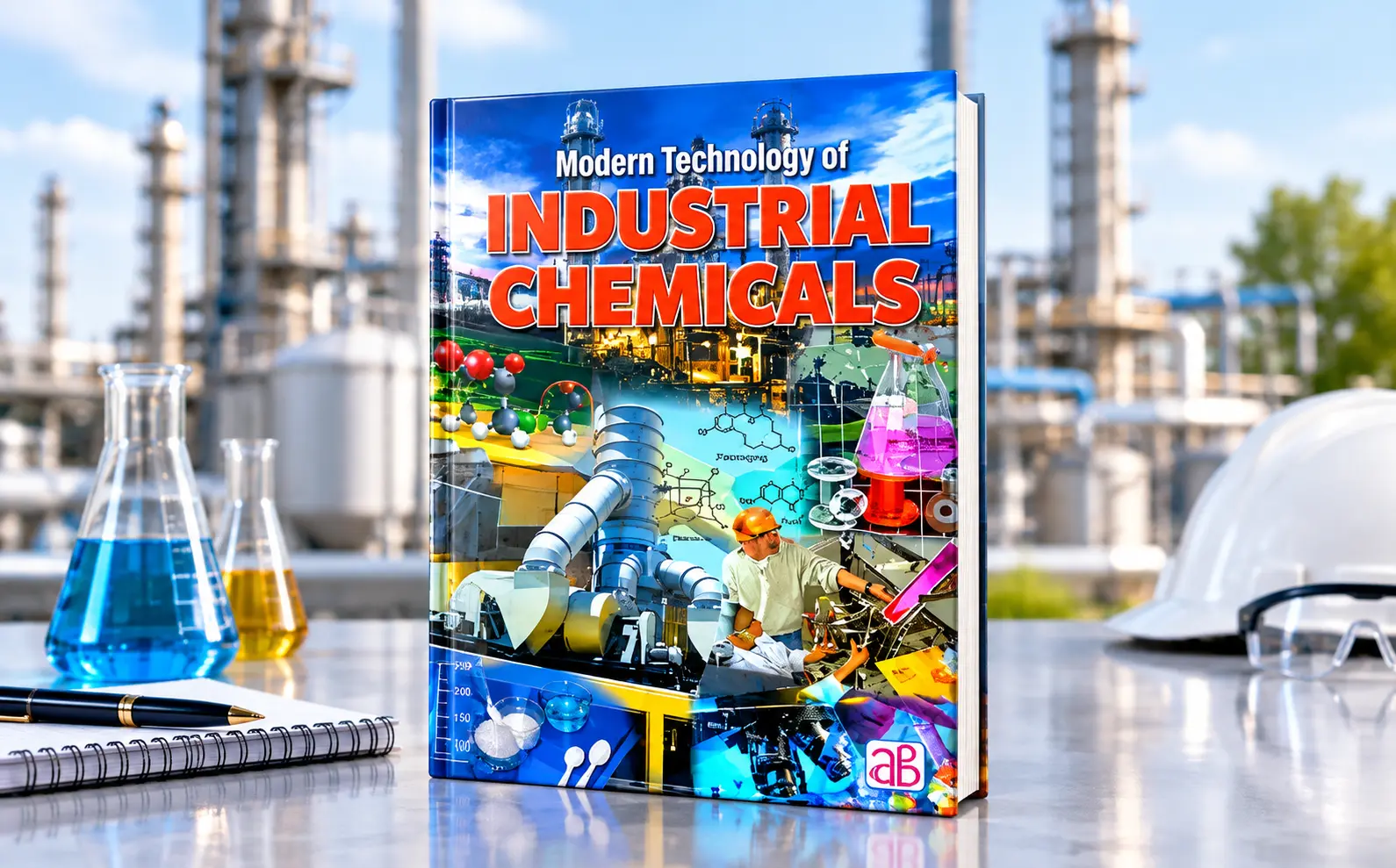
Published by Asia Pacific Business Press Inc., an associate of NIIR Project Consultancy Services, this 550-page handbook’s purpose is a straightforward one: to give manufacturers, entrepreneurs, and technical professionals a thorough, process-level account of how major industrial chemicals are produced commercially.
Across 23 product chapters, the book covers properties, formulae, manufacturing processes, purification methods, equipment, chemical control procedures, safety provisions, and market prospects for each product. This is not a textbook in the academic sense — it is a process engineering and business reference for people who intend to actually make these products.
What the 23 Product Chapters Cover
The handbook spans a deliberately broad cross-section of the industrial chemicals universe. Organised by product, each chapter follows a consistent structure: commercial context and market relevance, chemistry and process fundamentals, plant-scale manufacturing procedure, equipment and instrumentation, quality control, safety provisions, and future market outlook. Products covered include:
- Acetophenone — used in perfumes and as an intermediate in continuous styrene production, with full coverage on purification and dehydrogenation process
- Allethrin — synthetic pyrethroid insecticide, with multi-phase synthesis from chrysanthemum acid chloride and allethrolone
- Carboxymethylcellulose (CMC) — batch and continuous processes, with coverage of both German and US commercial methods
- Calcium Cyanamide — from calcium carbide production through cyanamide processing and milling
- Hydroquinone — quinone preparation, reduction, purification, and commercial derivatives
- Formaldehyde from Methanol — commercial processes, air supply systems, and analytical control
- Dye Intermediates and Dye Manufacture — covering azo dyes, anthraquinone dyes, sulfur dyes, triphenylmethane dyes, and reactive dyes across all major textile fibre types
- Granulated Fertilisers — continuous ammoniation and granulated triple superphosphate processes
- Fine Chemicals from Coal — benzoic acid, sodium benzoate, benzene hexachloride from coal-based feedstock
- Chemicals from Milk — casein, lactose, whey proteins, milk protein powder, and protein hydrolysates with detailed plant-scale process descriptions
- Chemicals from Fats — fatty acid chemistry, Armour process developments, processing and product applications
- Chemicals from Oranges — juice, orange oil, pectin, bioflavonoids, and feed products from citrus processing
- Chemicals from Wood — lignosulfonates and vanillin from spent pulp liquor
- Chemical Explosives and Rocket Propellants — TNT, RDX, PETN, nitroglycerin, composite propellants, and liquid propellants with full chemistry and classification
- Amyl Compounds, Anthracene, Barium Potassium Chromate Pigment, Carotene and Chlorophyll, Calcium Magnesium Aconitate, Chloroquine, and Alcohols by Sodium Reduction
Who Should Read This Book
The handbook is positioned for a practically minded audience:
- Entrepreneurs evaluating entry into industrial chemical manufacturing — the product chapters give them process and market context to evaluate feasibility
- MSME chemical manufacturers looking to diversify their product range or optimise their existing processes
- Process engineers and plant technologists who need reliable reference data on manufacturing procedures
- Project consultants and investment analysts preparing feasibility reports for chemical manufacturing projects
- Research scholars in chemical engineering, industrial chemistry, and process technology
- Technical libraries, industry training centres, and management institutions offering chemical industry programmes
What Makes This Reference Stand Out
There is no shortage of chemistry textbooks. What is rare is process-level, commercially grounded technical literature on industrial chemicals that bridges the gap between lab chemistry and actual plant operation.
The NIIR Board of editors has compiled this handbook specifically to bridge that gap. The result is a reference that is wide in scope — covering 23 product categories across fine chemicals, agricultural chemicals, dye chemistry, explosives, and bio-based chemicals — and deep in technical detail on each. The consistent chapter structure across all 23 products means you can quickly find the specific information you need on any given chemical — its chemistry, its manufacturing sequence, its equipment requirements, its quality testing approach, and its commercial prospects.
For project feasibility work, the book’s breadth is invaluable. A consultant or entrepreneur assessing a chemical manufacturing project needs to understand the complete process picture — not just the reaction chemistry, but the purification steps, the equipment, the control points, and the safety requirements. This handbook provides all of that in a single, navigable reference.
The book also reflects the reality of how Indian chemical manufacturers actually operate. Processes are described at plant scale, not lab scale. Safety provisions are noted. Materials of construction are specified where necessary. These are practical details that make the difference between a process description that is theoretically correct and one that is actually usable in a manufacturing context.
Book Details at a Glance
| Book Title | Modern Technology of Industrial Chemicals |
| Author | NIIR Board |
| Publisher | Asia Pacific Business Press Inc. (NPCS) |
| ISBN | 8178330695 |
| Pages | 550 |
| Format | Paperback |
| Price | ₹1,100 (India) | US$ 125 (International) |
Get Your Copy Today
Modern Technology of Industrial Chemicals
If you are evaluating a chemical manufacturing project, working in the sector, or advising clients who are, this handbook belongs in your reference library. At 550 pages covering 23 product categories — from fine chemicals and fertilisers to dye intermediates and bio-based chemicals — it represents one of the most comprehensive single-volume treatments of industrial chemical manufacturing technology available in this format.
The process descriptions are at plant scale, not laboratory scale. The safety provisions and quality control points are noted for each product. The market prospects sections give you a commercial context, not just a chemistry lesson. For ₹1,100, this is one of the more cost-effective technical investments available to a chemical industry practitioner or entrepreneur in India.
Price: ₹1,100 (India) | US$ 125 (International)
| 🌐 Buy from NIIR.org | 🛒 Buy on Amazon India |
| https://www.niir.org/books/book/modern-technology-industrial-chemicals/isbn-8178330695/zb,,50,a,0,0,a/index.html | https://www.amazon.in/dp/8178330695 |
Published by Asia Pacific Business Press Inc. | NIIR Project Consultancy Services (NPCS)
106-E Kamla Nagar, New Delhi — niir.org | entrepreneurindia.co | npcsblog.com
30+ Years in Consulting | 150,000+ Projects | 85 Countries | ISO 9001:2015 Certified
Your Investment Deserves the Right Opportunity
Every serious investment begins with choosing the right sector and the right business model. With hundreds of industrial opportunities available across India’s manufacturing and clean-energy landscape, making the most informed choice is crucial. Niir’s Startup Selector tool helps entrepreneurs, MSMEs and investors identify the most suitable business opportunities based on their investment capacity, location and interests, ensuring their capital is directed toward the venture with the best fit.