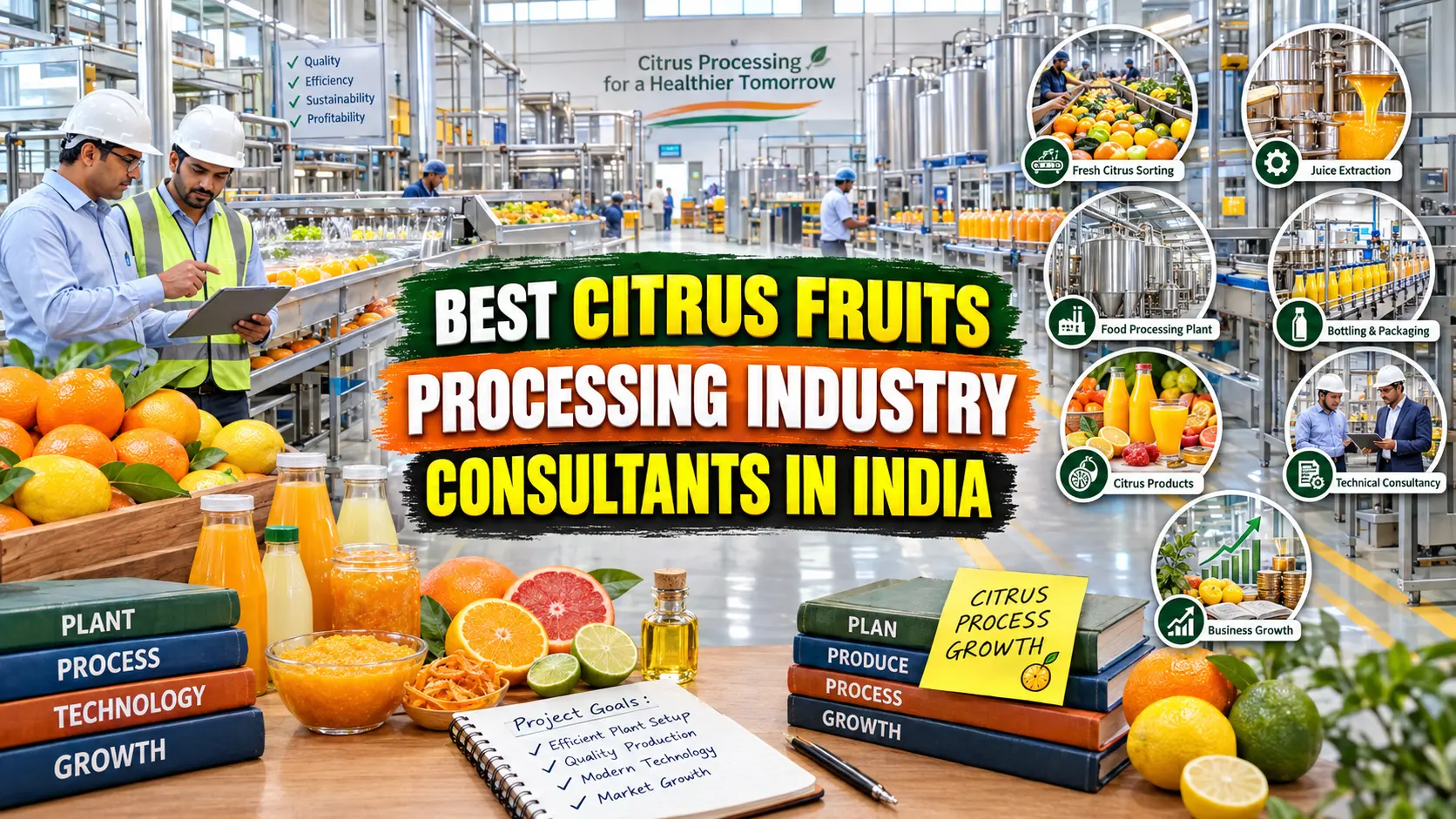

India is one of the largest producers of citrus fruits – oranges, lemons, limes, kin now, grapefruit, and sweet mosambi. These fruits are grown in millions of hectares in Punjab, Maharashtra, Andhra Pradesh, and across the country. A lot of processing happens in this industry. However, a lot less of the harvest makes it into consumer goods in comparison. It’s where the top citrus fruits processing industry consultants in India come in handy. For any entrepreneur, MSME investor or manufacturing group looking to set up a juice plant, marmalade unit, citrus essential oil facility, or integrated processing line, the quality of industrial consultancy they engage is what decides the viability of their project.
The Indian citrus fruits processing sector is at an inflection point. Consumer demand for processed items from this sector is surging. Policy reforms and PLI scheme incentives in food processing are converging to make this a high-potential investment window. A well-equipped techno-commercial expert is the one who can best navigate such complex environments.
What Citrus Fruits Processing Industry Consultants Actually Do
Consultants working in the citrus fruits processing space do much more than prepare a document. First, Their engagement starts with market research, assessing the demand for orange juice concentrates, kinnow squash, lime pickle, lemon essential oil, pectin, and pineapple-based beverages. Finally, It ends with every technical and financial aspect of the proposed plant. Moreover, The core deliverable for most clients is a Detailed Project Report. In addition, It lays out the entire manufacturing roadmap in bankable form.
A well-prepared DPR for a citrus processing project covers the entire manufacturing process. For example, This includes fruit reception, washing, juice extraction, pasteurisation, evaporation, and aseptic filling. Additionally, It also covers the bill of machinery, raw material sourcing plan, plant layout, manpower structure, and utilities requirement.
The DPR also includes complete project financials. These include, capital cost estimation (civil, plant and machinery, pre-operative expenses), working capital requirements, projected profitability, break-even analysis, and return on investment. Therefore, For bank financing or MSME loan applications, this level of structured analysis is non-negotiable. Besides, the DPR, citrus processing plant consultants also aid with EPC contracting, vendor identification, regulatory liaison, and FSSAI licensing guidance.
Process engineering consultants specialising in this sector advise clients on the right technology, such as hot fill vs. aseptic filling, single-strength vs. concentrate production, batch vs. continuous lines, for their chosen market and investment capacity. Furthermore, The technology decision has major downstream implications on capital cost, operating efficiency, and product shelf-life. Therefore, Getting it right, with the help of experienced guidance, is always far more cost-effective than retrofitting later.
Why India Is a Compelling Investment Destination for Citrus Processing
India ranks among the top 5 citrus-producing nations in the world. The country produces over 13 million metric tonnes of citrus fruits annually, ranging from oranges, kinnow, mosambi, lemon and lime across diverse agro-climatic regions. Andhra Pradesh, Maharashtra, Punjab, Rajasthan and Madhya Pradesh account for the bulk of the production. Despite this, the processed fruits and vegetables export, overseen by APEDA under the Ministry of Commerce, is relatively underdeveloped, presenting a huge headroom for investors.
The Government of India’s Production Linked Incentive scheme for food processing, administered by the Ministry of Food Processing Industries, specifically includes processed fruits and vegetables as an eligible category. With a scheme outlay of ₹10,900 crore, this PLI programme offers a fiscal incentive for entrepreneurs investing in juice, concentrate or ready-to-drink beverage manufacturing units. Along with the Mission for Integrated Development of Horticulture (MIDH), which provides capital subsidy and technology adoption support, the policy environment is unusually investor-friendly.
The National Horticulture Board (NHB), under the Ministry of Agriculture and Farmers’ Welfare, actively supports post-harvest infrastructure, including pack houses, cold storage, and processing units for citrus and horticultural produce. Entrepreneurs setting up citrus processing plants can access NHB’s Commercial Horticulture Development scheme for capital subsidy support. This institutional backing reduces risk for first-generation entrepreneurs entering the sector.
From a market perspective, IBEF data on food processing confirms that processed fruits and juices generated a revenue of ₹7,898.8 crore in FY25, with consistent year-on-year growth driven by urbanisation, health consciousness, and increased retail penetration of packaged beverages. Only 4.5% of India’s fruit production is currently processed, compared to 65% in the United States – a gap that represents one of the most significant industrial opportunities in the country’s agri-processing landscape.

How to Evaluate the Best Citrus Fruits Processing Industry Consultants in India
Selecting the right consultancy partner is one of the most consequential decisions an entrepreneur makes before project execution. The citrus processing sector is technically specific with its food-grade engineering, regulatory compliance with multiple agencies, cold-chain logistics planning, and commodity-linked raw material economics. A generalist consultant without sector depth can create a technically credible DPR which is operationally unworkable or financially optimistic. Here is what to assess seriously before engagement.
Domain Expertise in Food and Beverage Manufacturing
Look for a consultancy with a demonstrable experience in designing food processing plant designs. Ask specifically about citriculture technology – the engineering discipline covering citrus-specific processes such as juice depectinisation, essential oil recovery from peel, pectin extraction, and limonene processing. A firm that has worked on actual juice plants in India will have calibrated cost benchmarks and machinery vendor relationships. It will also have knowledge of local technology suppliers that a general management consulting firm simply will not have.
Track Record in DPR and Feasibility Report Preparation
Ask for samples of completed DPRs in the food processing sector. A high-quality DPR is not a template filled with generic data – it is a client-specific, market-validated, process-engineered document. It should feature primary market research on the demand for the specific product (not generic food market size), a process flow diagram specific to the planned facility, machinery specifications (with identified vendors and indicative quotations), and financial projections (with clearly stated assumptions). The consultant should also be able to explain and defend every number in the report.
EPC Capability and Engineering Support
For larger investments, clients benefit from consultants who can offer EPC consulting – engineering, procurement, and construction advisory. This means the consultant can help specify equipment, evaluate vendor bids, review plant layouts, supervise installation, and support pre-commissioning activities. Process plant consultants who understand both process engineering and project implementation are significantly more valuable than those who stop at the DPR stage. This is especially important for citrus processing projects. Equipment selection, such as pasteuriser type, evaporator configuration, and filling line format, directly affects product quality and operating efficiency.
Regulatory Knowledge Across the Compliance Chain
A citrus processing unit in India must navigate multiple compliance requirements. FSSAI (Food Safety and Standards Authority of India) licencing is mandatory – and the specific requirements for juice manufacturers, concentrate producers, and beverage blenders differ from those for dry food manufacturers. Beyond FSSAI, the plant must comply with the Factories Act for safety and labour norms, State Pollution Control Board requirements for effluent discharge and waste management, and BIS standards for food containers and packaging. A consultant familiar with this compliance ecosystem will save the client considerable time and legal risk during project setup.
Client Base and Sector References
The depth of a consultancy’s client portfolio in your target sector is one of the most reliable indicators of its real-world capability. Ask for project references specifically in food processing, horticulture processing, or agri-based manufacturing. Ask not just for testimonials but names, states and types of projects completed. A firm that has assisted multiple citrus, juice, or beverage manufacturing clients in different states will have practical knowledge of regional raw material dynamics, state-specific incentive schemes, and local infrastructure realities. These add immediate value to your project planning.
Role of NPCS in Citrus Fruits Processing Project Consultancy
NPCS has supported a range of entrepreneurs and investors across India and internationally in the citrus fruits processing and allied sectors. For example, Mr. Rajiv Chowdary of Nellore, Andhra Pradesh engaged NPCS for a Project Investment Report on Hesperidin and Pectin. These are two high-value citrus bioactives which have pharmaceutical and food industry applications. Similarly, Vishnu Vardhana Reddy Tetali of Visakhapatnam, Andhra Pradesh commissioned a Detailed Project Report on Pectin from Citrus, Lemon, and Oranges. Furthermore, He commissioned it for a new manufacturing unit. Likewise, Mr. Sridhar Ramaraj of Tenkasi, Tamil Nadu worked with NPCS on a Techno-Economic Feasibility Report on Dry Lemon Powder manufacturing. In addition, M/s. Indian Potash Limited of Coimbatore, Tamil Nadu engaged NPCS for a Techno-Economic Feasibility Report on Citric Acid, Acetic Anhydride, and Furfuryl Alcohol.
Moreover, M/s. Kampla Eco Frend Plastic LLP of Hyderabad, Telangana commissioned a Lemon Processing Project Investment Report. Similarly, M/s. Best Polymer of Bangalore, Karnataka worked with NPCS on a Techno-Economic Project Study on Dry Lemon Powder and Lemon Oil. In addition, M/s. Mayuresh Developers of Navi Mumbai, Maharashtra engaged NPCS for a Citric Acid Monohydrate Project Investment Report. Furthermore, M/s. Alfa Corporation of Rajkot, Gujarat commissioned a Techno-Economic Feasibility Report on Fruit Juice and Fruit Pulp with Packaging. Likewise, M/s. Nakshatra Infrastructures of Nagpur, Maharashtra engaged NPCS for a Techno-Economic Feasibility Report on Banana, Onion, Orange, and Tomato Powder.
Additionally, M/s. JayBee Energy Private Ltd. of Guwahati, Assam commissioned an Investment and Project Report on Fruit Juices Processing. Similarly, M/s. Digi Drives Private Limited of Palwal, Haryana worked with NPCS on a Technical and Financial Feasibility Report on Fruit Processing. Furthermore, M/s. Innopolis Bio Innovation Pvt. Ltd. of Ernakulam, Kerala engaged NPCS for a Bankable Project Report and Techno-Economic Project Study on Bromelain Enzyme from Pineapple Stems. In addition, M/s. Acid India of Chennai, Tamil Nadu relied on NPCS for an Industrial Project Report on Citric Acid manufacturing. Meanwhile, Internationally, DS Bio ve Nano Teknoloji of Ankara, Turkey engaged NPCS for a Project Feasibility Report on Citric Acid.
Additionally, NPCS has published a comprehensive printed reference book on citriculture, post-harvest management and oil extraction for the citrus sector – the Handbook on Citrus Fruits Cultivation and Oil Extraction. Furthermore, This 544-page technical reference by the NPCS Board of Consultants and Engineers covers botanical classification of citrus varieties, citriculture and cultivation practices, post-harvest technology, juice and essential oil extraction processes, kinnow utilisation, spray-drying technology and value-added product development. Therefore, It is a must-have reference for project investors, food technologists, and plant engineers.
Finally, For a detailed techno-economic Project Report on setting up an orange juice manufacturing business – including plant economics, machinery lists, financial projections and applicable government incentives – the NPCS Project Report on Orange Juice Manufacturing provides a bankable, investor-ready document with complete technical and financial specifications.
Best Citrus Fruits Processing Industry Consultants in Delhi and Across India
Delhi has historically been the nexus of India’s industrial consultancy infrastructure. The city’s proximity to policy and access to financial institutions make it a natural headquarters for process engineering consultants and boutique management consulting firms in India. These firms serve manufacturing clients nationwide. The concentration of talent further supports this model. NPCS, headquartered in Delhi, exemplifies this approach. Its consulting team advises clients from Punjab’s kinnow belt to Nagpur’s orange-producing districts and Tamil Nadu’s pineapple clusters.
The best citrus fruits processing industry consultants in Delhi typically have sector-specific technical knowledge and financial advisory capability. They can help clients access institutional financing through NABARD’s agri-processing schemes, MSME Ministry credit guarantee mechanisms, and state industrial finance corporations. They can also assist with FSSAI registration, APEDA export registration for juice and concentrate exporters, and BIS product certification services.
Across India, Invest India’s agri-processing sector data confirms that fruit and vegetable processing is one of the most active segments for new MSME registrations. Consultants who understand state-specific incentive schemes – including Maharashtra’s food processing policy, Punjab’s agri-export zone provisions, Andhra Pradesh’s horticulture mission, Rajasthan’s agri-business promotion framework – add direct financial value by helping clients structure their projects to maximise available state government support.
Consulting Services Comparison: Citrus Fruits Processing Industry
| Service Type | Key Deliverables | Best Suited For | Typical Duration |
| Detailed Project Report (DPR) | Process design, machinery specs, financials, market analysis | First-time investors, bank/MSME loan applications | 3–6 weeks |
| Techno-Economic Feasibility Study | Viability assessment, demand study, ROI analysis | Pre-investment evaluation, NRI investors | 2–4 weeks |
| EPC Advisory / Process Plant Consulting | Equipment procurement, vendor evaluation, plant commissioning support | Mid-scale to large capex projects | Project duration |
| Regulatory and Compliance Advisory | FSSAI licensing, BIS certification, pollution control board NOC | All citrus processing startups | 4–8 weeks |
| Market Research and Demand Study | Demand forecasting, competitor analysis, export market assessment | Diversification decisions, product mix planning | 2–3 weeks |
| MSME Scheme Linkage and Loan Facilitation | Subsidy identification, DPR for bank submission, scheme applications | MSMEs seeking government financial support | Concurrent with DPR |
Conclusion: Choosing the Right Consultancy Partner for Your Citrus Processing Project
India’s citrus fruits processing sector is one of the most investable and tangible opportunities in the country today. The raw material base is vast, the policy environment is supportive, the consumer market is expanding, and the export potential is real. However, to convert these macro-level advantages into a successful, profitable plant, the entrepreneurial project requires specialist knowledge at every step – from product selection and process design to regulatory compliance, machinery procurement, and financial structuring. That is the value the best citrus fruits processing industry consultants in India bring to the table.
Whether you are evaluating a small-scale kinnow juice unit in Punjab, a lemon essential oil extraction facility in Rajasthan, or an integrated orange processing plant in Maharashtra, engaging a firm with deep sector experience, a proven DPR track record, and strong project consultancy credentials is the single most important decision you will make. It determines the quality of your project plan, the accuracy of your financial projections, your ability to access institutional finance, and ultimately, the operational success of your citrus processing unit.
NPCS has over 30 years of consultancy practice, 150,000+ projects across 85 countries, and deep expertise in food processing plant design and feasibility studies. It is one of the most credible and experienced top citrus fruits processing industry consultants in India. Their comprehensive project reports, printed technical handbooks, and end-to-end consultancy services provide entrepreneurs and investors with the structured, bankable foundation their projects need.
Your Investment Deserves the Right Opportunity
Every serious investment begins with choosing the right sector and the right business model. With hundreds of industrial opportunities available across India’s manufacturing and clean-energy landscape, making the most informed choice is crucial. NIIR’s Startup Selector tool helps entrepreneurs, MSMEs and investors identify the most suitable business opportunities based on their investment capacity, location and interests, ensuring their capital is directed toward the venture with the best fit.