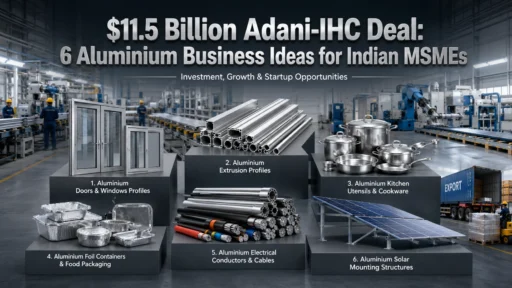


Aluminium Business Ideas for India MSMEs
A Signal India’s Manufacturing Sector Cannot Ignore
Economic Times reported on July 2, 2026, that Adani Enterprises and Abu Dhabi’s International Holding Company (IHC), via its natural-resources holding International Resources Holding, have inked a memorandum of understanding with the Odisha government to construct an integrated aluminium project valued at around $11.5 billion. This is not a typical industry announcement. It is being touted as the country’s biggest foreign direct investment ever in the field of metallurgy and it is a sign of a paradigm shift in India’s approach towards its own aluminium consumption.
The project consists of a 4-million tonne alumina refinery, a 2-million tonne aluminium smelter, a 4,000-megawatt captive power plant and a 1-million tonne downstream manufacturing park. If a founder or MSME has a large number on the headline, that is not as important as the numbers that follow: a mega-project of this size brings the whole ecosystem of ancillary suppliers, logistics partners, fabrication units and export-oriented manufacturers into its orbit. It is here that the true startup opportunity lies.
What Recent Economic Times Reporting Means
The Odisha project, Economic Times and trade sources confirm, is a 50:50 joint venture and is divided into two phases, each of which is valued at around ₹66,000 crore. This investment on aluminium is a natural extension of an existing industry in Odisha, with more than 50% of the national production taking place in the state.
It is a simple shift in the market. Indian production is around 4.2 million tonnes per year, and consumption is around 5.5 million tonnes per year with expected significant growth in demand to 8.5 million tonnes by FY30. While one mega-project will help to close the supply gap, it will also create demand for all the other components of the whole package, including equipment to extract the aluminium and packaging for the final products. This is the opportunity signal for MSMEs: large capital projects engender small-business ecosystems before the plant is even up and running.
Get Detailed Insights from This Book: The Complete Technology Book on Aluminium and Aluminium Products
Why the Aluminium and Metals Industry Is Growing Right Now
There are three forces that are coming together. The first one is that, India’s per capita consumption of aluminium is 3.4-3.9 kg per person compared with the global average of 8-12 kg per person, which has huge space for growth as the construction, automotive, aerospace and electronics industries grow. Second, the global value chains are becoming more diversified such that investors like IHC are now looking at India more as a long-term manufacturing base and less as a chance to make a quick buck. Third, the Government is actively encouraging value added manufacturing over raw mineral exports through policy and other incentives.(Aluminium Business Ideas for India MSMEs)
This is one of the positive growth signals for the critical minerals, metals, and industrial infrastructure sectors that Economic Times has highlighted throughout the year. When a sovereign-backed investor like IHC invests in an industry, it is often seen as a strong validation of that sector. It also signals that mid-sized manufacturers can consider investing and expanding their production capacity.
Government Policies and Incentives Supporting This Opportunity
Founders can enter the aluminium value chain without having to do it alone. In this area, there are several government platforms which actively support manufacturing and export oriented MSMEs:
- The MSME ministry provides credit linked capital subsidy schemes, cluster development support and technology upgradation funding for small manufacturing units in metal fabrication.
- Tax benefits, fund support and ease of compliance for new businesses developing ancillary businesses around large industrial projects available on Startup India
- The Invest India platform serves as a dedicated platform of the government for investments and to link manufacturers with incentive schemes, including production linked incentives for metals and downstream manufacturing.
These platforms combine to make it easier for MSMEs interested in participating in such a project, but without the balance sheet of a big conglomerate.
Access Complete Business Plan: Aluminium and Aluminium Downstream Projects

6 Business Ideas Emerging from This News
1. Aluminium Scrap Recycling and Secondary Smelting
The higher the volume of primary production, the greater the volume of scrap produced in the fabrication and construction process. The cost of capital requirement is far less in these secondary aluminium recycling units as compared to primary smelters and they can provide the very manufacturing park being planned in Odisha.(Aluminium Business Ideas for India MSMEs)
2. Precision Component Fabrication for Downstream Users
A 1-million-tonne manufacturing park below the project will require feeder units for extrusions, sheets and machined components for automotive, packaging and construction customers in the immediate vicinity.
3. Industrial Logistics and Cold-Chain-Style Bulk Transport
This requires specialized freight, warehousing and port-connected logistics service which many regional transport MSMEs can develop to move bauxite, alumina and finished aluminium.
4. Captive Power and Renewable Energy Ancillary Services
The plant’s 4,000 MW captive power plant, with a renewable element, provides room for local contractors to participate in solar EPC and in the construction of transmission infrastructure, as well as in power equipment maintenance.
5. Skilling and Workforce Training Institutes
There is definitely a need for private industrial training centres in the area of smelting, heavy equipment operation and electrical maintenance, as there are approximate 53,500 jobs available within construction and operation.(Aluminium Business Ideas for India MSMEs)
6. Manufacturing of aluminium products for export.
Value adding products like aluminum extrusions, foils, alloy wheels etc. can be produced in-house and exported due to close proximity to Dhamra port, as there is global demand for lightweight metals.
Identify high-growth industries before others do
Import-Export Opportunity Analysis
Despite India being the second-largest producer of aluminium in the world, the domestic consumption of aluminium is greater than its production so India is a net importer of aluminium. This structural deficiency is exactly why the Odisha project is relevant for the trade-focused entrepreneurs. On one hand, local alumina production capacity has increased and MSMEs can now import less semi-finished aluminium products; on the other, once the local supply stabilises, MSMEs can also develop export capabilities for value added goods in the downstream area.
Pioneers in this line of business are advised to check with the Directorate General of Foreign Trade for the latest export licensing and documentation requirements and get to know the various Industry bodies like FICCI for sectoral trade intelligence, connect with buyers and support on policy advocacy relevant to exporters of metals and manufacturing.
Indian MSME Success Stories in Metals and Manufacturing
India’s metals ecosystem already has examples of small manufacturers scaling into serious players by aligning with larger industrial cycles. Ancillary units around established smelting hubs in Odisha, Chhattisgarh, and Gujarat have grown from single-shed fabrication shops into multi-crore turnover businesses by supplying components, packaging, and logistics services to nearby large plants. The consistent pattern is early positioning: MSMEs that identified upcoming capacity expansions and built relationships with anchor investors before construction began captured the most durable long-term contracts.(Aluminium Business Ideas for India MSMEs)
How Niir Project Consultancy Services Can Help
For founders evaluating a move into aluminium ancillary manufacturing, feasibility planning matters as much as enthusiasm. Niir Project Consultancy Services (NPCS) works with entrepreneurs and MSMEs on detailed project reports, feasibility studies, and market assessments across metals, manufacturing, and allied sectors. Given the scale of the Adani-IHC investment and the ecosystem it will create, this is a practical moment for founders to commission a feasibility study before committing capital to plant, machinery, or working capital financing.
Related Article: Aluminium Value-Added Manufacturing in India: A High-Growth Startup Opportunity
India’s Aluminium Demand-Supply Snapshot
| Metric | Current (FY25) | Projected (FY30) |
| Domestic Production | 4.2 million tonnes | Capacity expansion underway |
| Domestic Consumption | 5.5 million tonnes | 8.5 million tonnes |
| Per Capita Consumption | 3.4–3.9 kg | Rising toward global average |
| New Investment Announced | — | $11.5 billion (Adani-IHC, Odisha) |
| Expected Jobs Created | — | ~53,500 |
Frequently Asked Questions for Founders
1. Is the Adani-IHC aluminium project already approved for construction?
Not yet. At the date of this report, it is an MoU. The next phase includes purchase of the land, acquisition of statutory approvals and elaboration of the project design and planning to commence construction.
2. Can small manufacturers realistically supply a project this large?
Yes, the areas of ancillary or downstream supply chain participants, not direct competition. For the purpose of scrap recycling, component fabrication, and transportation, we don’t need big, big capital.
3. What government scheme should MSMEs check first?
To begin with, look into the credit-linked subsidy schemes of the MSME Ministry. Next, check the sector-specific incentives on the Invest India portal.
4. Does this project affect aluminium import prices?
The more a country increases its domestic production capacity, the less it needs to rely on imports. However, costs will still play a role, as commodity prices and energy-related costs remain important factors.
5. How long before ancillary business opportunities become active?
Large industrial projects typically generate contractor and logistics demand during the construction phase itself, well before commercial production starts.
6. Where can founders verify ongoing project updates?
Track continuing coverage on Economic Times and official Odisha government industrial announcements.
Conclusion: Why Timing Matters Now
The Adani-IHC aluminium project, as reported by Economic Times, is more than a headline about a large company’s investment plan. This market signal is that India’s metals ecosystem is entering a multi-year growth cycle fueled by sovereign capital and government policy backing. If founders and MSMEs enter early in logistics, fabrication, recycling, and skilling, they can secure contracts before larger players begin organizing the ecosystem. Waiting for construction to finish takes too long. The opportunity window opens well before producers manufacture the first tonne of aluminium.