Introduction: Transforming Farm Waste into Industrial Wealth
Agricultural waste business in India is becoming a profitable venture as the country produces millions of tonnes of agricultural residue every year—rice husk, wheat straw, sugarcane trash, maize cobs, cotton stalks, and groundnut shells. For a long time, these residues were seen as waste, often burned in fields or discarded, causing air pollution, economic loss, and soil degradation.
But the world is seeing this issue differently now. Agricultural waste is considered an industrial raw material of great value, and it is also the source of power for businesses in construction, chemicals, energy, fertilizers, and bio-based manufacturing. There are entrepreneurs as well as micro, small and medium enterprises (MSMEs) turning crop residues into products like rice husk ash, biochar, biomass fuel, organic fertilizers, activated carbon, and other valuable items.
Moreover, both market and policy factors have made the transition from waste to wealth possible. As a result, Crop residue has changed from being just an environmental issue to a renewable low-cost resource that can support scalable businesses, rural employment, and energy security.
Why Crop Residue Businesses Are Growing Rapidly
Several factors make agricultural waste-based manufacturing particularly attractive:
- The very nature of the agricultural cycle makes the raw material widely available and recurring.
- There is a growing price of conventional materials such as coal, chemical additives, and imported silica.
- Environmental laws prohibiting the burning of crop residue have become strict and enforced.
- The government is supporting waste-to-wealth and the circular economy projects with funds.
- The industries are asking for sustainable substitutes to be imported that replace the unsustainable ones.
Moreover, this is a good scenario for the entrepreneurs—a combination of predictable inputs, repeat demand, and government support exists, which means low risk and high scalability are rare together.
Read More: Modern Technology of Agro Processing & Agricultural Waste Products
Manufacturing Opportunities Built on Crop Residues
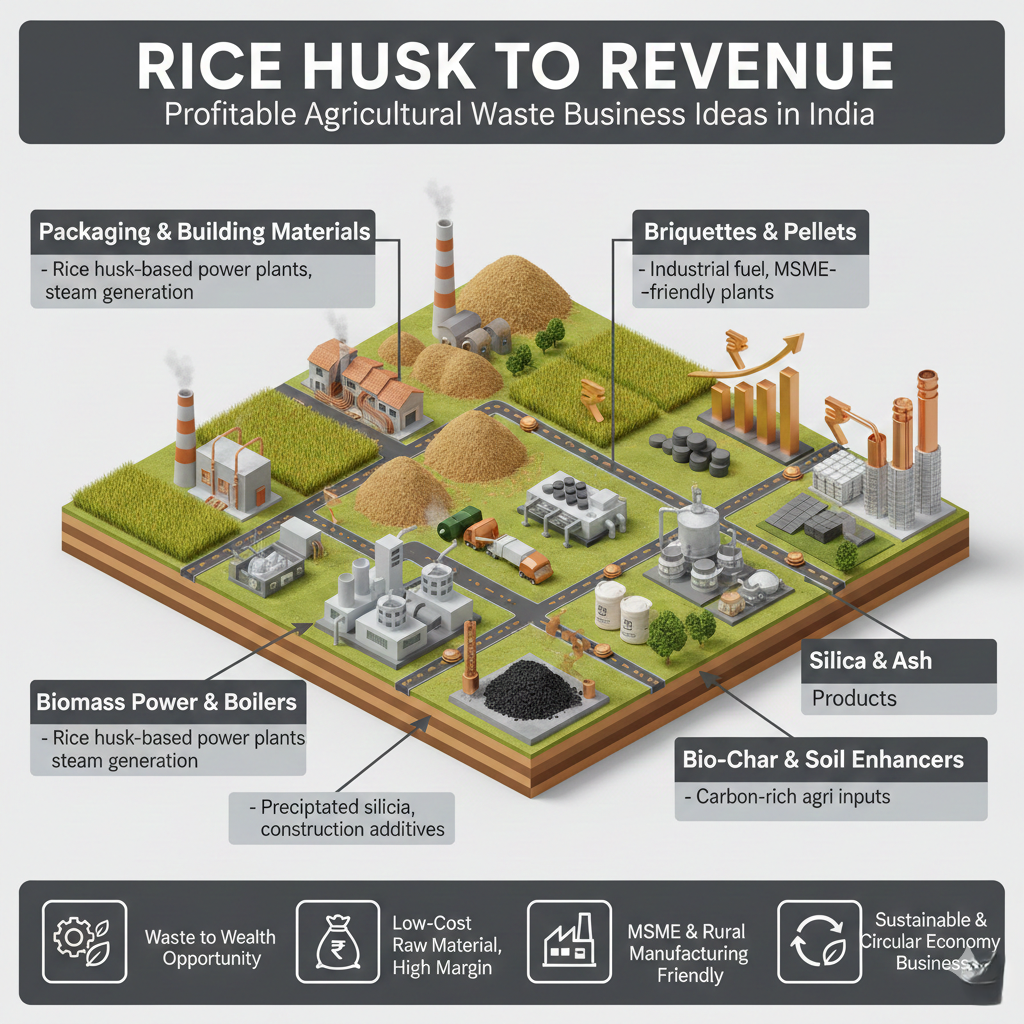
Rice Husk Ash (RHA) and Silica
Moreover, silica is present in significant amount inside rice husk. By placing the husk in a controlled environment and burning it will produce amorphous silica which is one of the best silica types in the cement, rubber, paints, coatings, and specialty industrial applications.
Businesses can focus on:
- Raw RHA collecting and grading
- Industrial usage refined silica processing
- Construction and chemical industries specialty silica supply
The upside is evident: a low-cost raw material, high domestic market, and low dependence on imports.
Read More: From Seed to Success: A Startup’s Guide to Dominating India’s Vegetable Seed Market
Biomass Briquettes and Pellets
For example, leftover crops like rice husk, sawdust, sugarcane trash, and cotton stalks can be made into the form of briquettes or pellets, which are then being used as a source of fuel for industries. As a result, the industries are continuously replacing coal and furnace oil and thus controlling costs while also complying with emission standards.
Key benefits include:
- Easy technology and quick setup
- Industries such as food processing, textiles, and brick kilns have a constant demand
- Compatible with renewable energy initiatives
Moreover, this model is perfect for new entrepreneurs who want to enter the market with a small investment and high demand business.(Agricultural Waste Business India)
Biochar Production
Biochar is a carbon-rich substance obtained from biomass pyrolysis. It has the ability to make soil more fertile, hold water better and capture carbon dioxide.
Applications of biochar include:
- Conditioner for soil in farms and plantations
- Carbon offset and climate-linked projects
- Industrial absorbents and filtration media
Biochar obtains premium pricing and fits perfectly with the organic farming and sustainable agriculture market trend.
Read More: Products From Waste (Industrial & Argo Waste) 2nd Edition
Organic Fertilizers and Soil Inputs
As a result, Use of chemical fertilizers to such an extent has harmed the soil, which in turn has provided a strong demand for bio-based and organic inputs. Residues of crops can be composted, fermented, and enriched to create organic manure of good quality, granulated fertilizers, and conditioners for soil.
Benefits for entrepreneurs:
- Not much investment required
- Established rural market connection
- Possibilities of exporting organic inputs
Biomass-Derived Chemicals and Activated Carbon
Crop residues are being advanced processed to produce:
- Bio-based chemicals and organic acids
- Industrial fillers and additives
- Activated carbon for filtration
India is a big importer of these materials. Local production not only substitutes imports but also enhances sustainability. Entrepreneurs can initiate with small pilot plants and later expand to specialty markets.
Read More: Profitable Agro Based Projects with Project Profiles (Cereal Food Technology) (2nd Revised Edition)
Strategic Advantages for Entrepreneurs
Crop residue-based manufacturing offers unique benefits:
- Cheap, renewable and available locally as raw materials
- Industrial market that is repeat-driven and non-discretionary
- Environmental compliance as a business facilitator
- A single feedstock leading to many product streams
Indian MSMEs have demonstrated that success is dependent on operational efficiency, supplier networks, and the early engagement of industrial buyers, rather than branding hype.
The government offers technical help, grants, and policy incentives to lower project risk through the Ministry of New and Renewable Energy, Ministry of Agriculture, state renewable agencies, and pollution control boards.(Agricultural Waste Business India)
Read More: Transforming Rice Husk into Profitable Particle Boards
Practical Opportunities and End-Use Industries
The picture of revenue from the various crop residues is very simple and straightforward:
- Rice husk → Silica / RHA: cement, rubber, chemicals
- Crop stalks → Briquettes / Pellets: industrial fuel
- Mixed biomass → Biochar: agriculture, carbon markets
- Organic waste → Fertilizers: farming, horticulture
- Biomass waste → Activated carbon: filtration and industrial use
The technical and capital requirements of the different sectors vary, yet, they all present large opportunities for scale-up.
Conclusion: The Future Lies in Biomass Manufacturing
Agricultural waste is a thing of the past; it has turned out to be an industrial resource that can be renewed. The entrepreneurs who take the plunge into investing today for biomass fuel, crop residue processing, and bio-based plastics will create not only profitable but also scalable and eco-friendly businesses.(Agricultural Waste Business India)
India’s next and the future’s most successful industrial start-ups may not come from urban centers or software industry parks. Instead, they may come from the ears, husks, stalks, and residues that are waiting to be turned into value. The extravagant entrepreneurs are now the ones who will transform farm waste into profit.
FAQs About Agricultural Waste Businesses
Q1. Is an agricultural waste business profitable in India?
Yes, in fact, the expensive industrial markets, forecasted demand, and low cost of raw materials are the main contributing factors for their profitability.
Q2. Which business is easiest for beginners?
The production of briquettes, organic fertilizers, and rice husk ash processing are the best suitable options for the new entrants.
Q3. How much investment is needed?
Miniature projects: ₹15–40 lakh; advanced processing plants: ₹30 lakh–₹2 crore.
Q4. Are subsidies available?
Yes, Financial and Technical support is provided by MNRE, state renewable agencies, and waste-to-wealth programs.
Q5. Can these products be exported?
Yes, the demand for biochar, activated carbon, organic fertilizers, and silica globally is continuously growing.