
Author: NPCS Board of Consultants & Engineers | Publisher: Asia Pacific Business Press Inc. | Price: ₹1,575 / US$ 150 | Pages: 544 | ISBN: 9788178331133
A Quiet Revolution on the Farm
For most of the twentieth century, chemical pesticides were considered a given in the production function of modern agriculture. They were convenient, scalable, and yielded the crop output figures needed for a growing world. But years of indiscriminate use have resulted in negative fallout that is now hard to ignore – degraded soils, groundwater pollution, the rise of pesticide-resistant pests, and food chains carrying pesticide residue that is of concern to both regulators and the consumer.
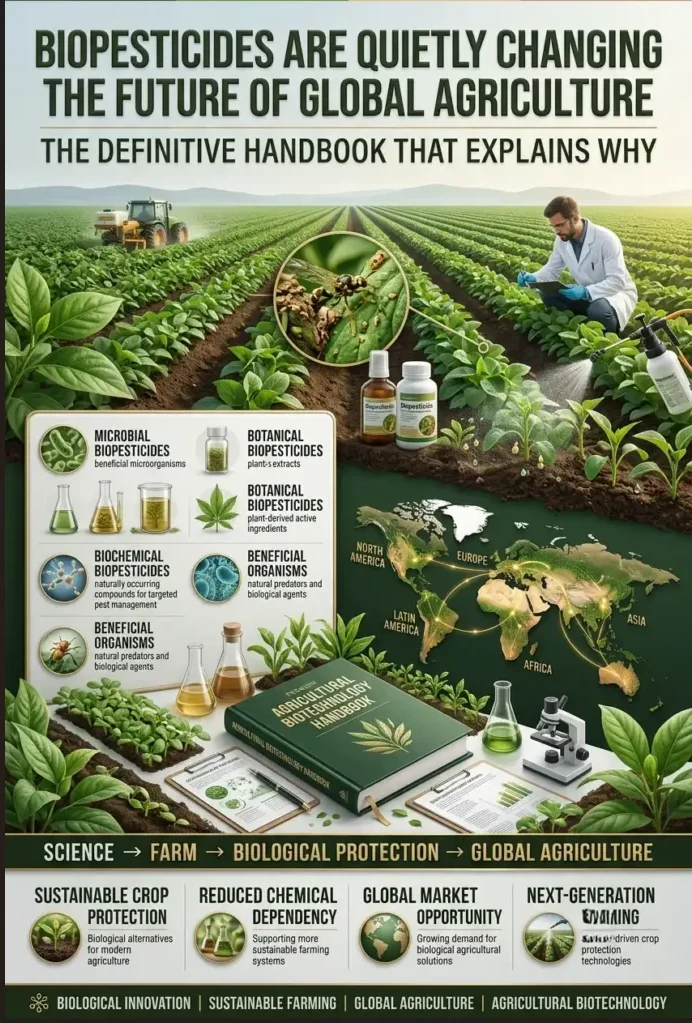
The response to this reckoning has been incremental, and biopesticides are at the forefront of the change. Made from natural materials – bacteria, fungi, plant extracts, certain minerals – they promise a different relationship with the ecosystem. They target specific pests and leave birds, mammals and beneficial insects relatively untouched. They are quickly broken down, leaving far smaller residual footprints. Used wisely as part of an Integrated Pest Management (IPM) framework, they reduce the overall chemical load on a cropping system.
This is not just a topic of interest now – it is at the intersection of food security, environmental policy, export compliance, and consumer preference, and is giving rise to commercial opportunity.
Market Demand and Industry Growth
The global biopesticides market has been one of the consistent growth areas in the agrochemical sector. Valued at several billion dollars, has been enjoying compound annual growth rates that beat out the rest of the pesticide market, reflecting regulatory pressures to bring down chemical residue on import in key markets, and the burgeoning organic and certified produce markets.
India has a strong position in this space, backed by a deep R&D base of agricultural universities, bio-control labs and supportive policy environment. The infrastructure for promoting bio-pesticides, from the MSME sector to big agri-input companies, has evolved significantly over the past two decades.
Several factors are coming together to catalyse this growth. The maximum residue limits (MRLs) set by importing countries – particularly in Europe, the Middle East, and Southeast Asia – are forcing Indian exporters to consider reducing their pesticide load. There is rising consumer awareness on the home front, and government initiatives are promoting the move towards sustainable agriculture.
The Science Behind Biopesticides: What Makes Them Work
Bio-pesticides are a broad category of compounds, spanning a range of materials and mechanisms. Microbial pesticides are living organisms – bacteria like Bacillus thuringiensis, entomopathogenic fungi – that act on pest biology. Biochemical pesticides are plant extracts or substances like pheromones or fatty acids. Plant incorporated protectants (PIPs) are plant-produced pesticidal molecules, obtained from genetically modified crops.
The research frontier in synthetic biopesticides lies in synthetic analogy of natural compounds, heterocyclic chemistry and structure-activity studies.
Triazino-benzimidazoles, thiadiazolo-triazine compounds, benzoylphenyl Reas (insect growth regulators), substituted pyrazoles, hydroxy acetophenones and hydroxy acetophenone derivatives, imidazole derivatives are a few classes of compounds. These compounds have been studied for antimicrobial, antifungal, insecticidal and herbicidal activity.
These compounds exert their pesticidal effect through mechanisms that are different from traditional organophosphate or carbamate chemistry. They are valuable from a resistance- and environment management perspective.
Interpretation of structure-activity is critical to understanding how the modification to a given molecular fragment can affect its activity. A chloro/fluoro substituent on a phenyl ring may lead to enhanced fungitoxicity, while a methylene spacer in a particular location in the molecule of a BPU (benzoylphenyl urea) changes its insect growth regulating properties.
Business Potential and Opportunities for Entrepreneurs, MSMEs, and Investors
For entrepreneurs and smaller manufacturers, in particular, biopesticides are a sector that is accessible to entry, with several unit operations that fall within the technical and financial capability of MSMEs. Moreover, the Government has also provided a slew of financial and policy support measures to promote MSME participation in agri-business, and particularly in biopesticides – through the MSME ministry, the Department of Agriculture and Farmers’ Welfare and various state-level initiatives.
Furthermore, opportunities for MSMEs include formulation for ready-to-use products for direct sale to farmers, contract manufacturing for larger agri-input companies, crop-specific blends for value-based horticultural and export crops, and collaboration with research institutions. Additionally, these can help develop and commercialise novel compounds. Similarly, building distribution and supply chain links with formal input retail networks is another opportunity. Therefore, well-funded MSMEs can gain a foothold here.
Meanwhile, for research scholars, the field of synthetic heterocyclic chemistry and structure-activity studies in biopesticides is a rich area where commercial opportunities and publishing potential coincide. For example, novel heterocycles with pesticidal properties, resistances-breaking approaches, and bio-herbicides are all areas of focus.
Finally, investors in agri-inputs stand to gain significantly from the confluence of regulatory, export, policy and consumer trends in the biopesticides space. Consequently, companies with differentiated formulations and novel synthesis approaches are well-positioned to capture market share.
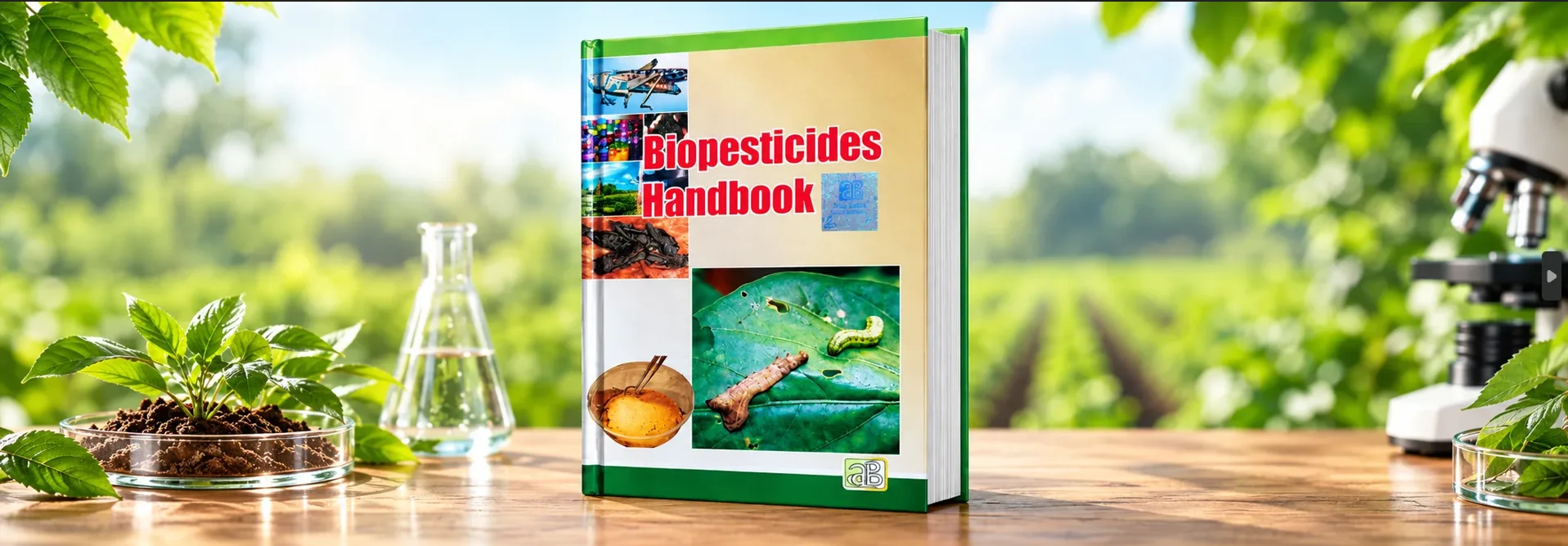
Biopesticides Handbook by NPCS covering biopesticide research, technology, pest management and sustainable agriculture.
India’s Unique Position and the Role of Traditional Knowledge
India’s extensive traditional knowledge about the use of plants to control pests is an asset that is leveraged by few others. Neem derivatives, botanical extracts and traditional crop management practices are well-documented areas that offer opportunities for commercialisation. Turning this traditional knowledge into registered, quality-assured products is an area of significant opportunity.
Indigenous technology-based formulation approaches can offer cost-effective, effective products that balance between rural development and commercialisation, and can be leveraged by MSMEs with an eye on both.
Introducing the Biopesticides Handbook
By NPCS Board of Consultants & Engineers | Asia Pacific Business Press Inc. | 544 Pages | ISBN: 9788178331133
When the NPCS Board of Consultants & Engineers compiled this handbook, the charge was to deliver a resource that covered the field of biopesticides with depth, was of use to practitioners and researchers, and stood out from what was available. This 544-page resource delivers on all three fronts.
This is touted as the first book providing different parameters about biopesticides across a spectrum. It is a valid claim. The book covers everything from synthesis and characterisation of certain compounds to their biological evaluation. It also covers mechanisms of action and practical implications of formulation and use.
What the Book Covers: A Chapter-by-Chapter Overview
The scope covered by the handbook is extensive. Some of the important topics covered are:
- Synthesis of Triazino-Benzimidazol as Biopesticides – tautomeric analysis and antimicrobial screening of triazino-benzimidazol, structure elucidation data.
- Studies on Coumarin Derivatives – synthesis of naphthopyran compounds and related structures and their biological activity.
- Synthesis and Insect Growth Regulating Activity of Benzoylphenyl Reas – larvicidal spectrum data of various BPUs against mosquito vectors and cost comparison.
- Synthesis and Pesticidal Activities of Thiadiazolo-Triazine and Imidazole Compounds – fungicidal, bactericidal and herbicidal activity screening data.
- Synthesis and Fungicidal Activity of Thiazolidine and Indole Compounds – oxadiazine and spiro heterocyclic system studies.
- Synthesis and Biological Activity of Benzothiazoles, Benzoxazoles, Benzimidazoles and Imidazolidines – antifungal, antibacterial evaluation.
- Antimicrobial Agents – novel imidazole derivatives, in vitro antifungal activity against dermatophytes, yeasts, systemic fungi.
- Synthesis and Antimicrobial Activities of Pyrazoles – sulphonamide-linked pyrazoles, screening against E. coli, Pseudomonas, Aspergillus species.
- Synthesis and Insecticidal Activity of Substituted Hydroxy acetophenones – organophosphate-linked compound, intramolecular hydrogen bonding.
- Syntheses of Sulfanilyl Derivatives – biological screening against Streptococcus, Clostridium, Botrytis, Rhizoctonia, Pythium.
- QSAR of Fluridone – quantitative structure-activity relationships for this phytoene desaturase-inhibiting bleaching herbicide.
- Absorption and Metabolism of Clomazone – metabolite characterisation in soybean and velvetleaf suspension cultures.
- Antidote Mode of Action (BAS 145 1383 and Metazachlor) – mechanism for safener protection, GST activity, GSH levels, herbicide mobility.
- Diclofop Resistance in Avena fatua – biochemical basis for resistance, ACCase sensitivity, metabolism studies.
- Propanil Degrading Amidase Activity, Bleaching Herbicide Mode of Action, KDR-Type Resistance in German Cockroach – and many more.
This wide scope makes the handbook useful to a variety of readers. An organic chemist working on new pesticidal compounds will find the synthesis and structure-activity information handy. An agronomist or IPM consultant will find the mechanistic and field-related content valuable. An entrepreneur assessing the business opportunity in biopesticides will use the information on compound profiles and applications to understand the market opportunity.
Who Should Read This Book
- Entrepreneurs and MSME promoters: looking to enter the biopesticide manufacturing space
- Research scholars and post-graduates: in agricultural chemistry, plant pathology and applied entomology, needing a comprehensive reference
- Technocrats and chemical engineers: exploring process development and formulation options for biopesticide products
- Agronomists and IPM consultants: looking to deepen their mechanistic understanding of compounds used in recommendation
- Investors and business development professionals: exploring the sustainable agriculture inputs market
- Agricultural policy professionals: working on regulatory development and promotion of sustainable pesticide alternatives
What Sets This Handbook Apart
There are books that cover the fundamentals of biopesticides – typically as a chapter in a textbook in agronomy or plant protection. What this handbook provides is a concentration of depth of technical information in a single resource. The protocols and data – from synthesis to spectral characterisation (IR, PMR, 13C NMR, mass spectra), biological activity and QSAR analysis, and resistance mechanisms – are valuable, and not easy to put together without access to a library of journal articles.
The NPCS Board of Consultants & Engineers brings to this project a reputation for producing content that serves the practicing professional – and that is the ethos that informs this handbook. The content is curated not for academic interest alone, but to provide value to a practitioner.
Get Your Copy of the Biopesticides Handbook
Author: NPCS Board of Consultants & Engineers | Publisher: Asia Pacific Business Press Inc. | Price: ₹1,575 / US$ 150 | Pages: 544
If you work in agriculture, agri-input manufacturing, agricultural chemistry research, or sustainable farming — or if you are evaluating a business opportunity in the biopesticide sector — this handbook belongs on your reference shelf. Its depth and specificity are difficult to find elsewhere in a single volume.
Available for immediate dispatch in hardcover (usually ships within 5 days) and as a downloadable PDF. Order directly through the NPCS website for the full range of purchasing and format options.
Purchase Links:
NPCS Website: https://www.niir.org/books/book/biopesticides-handbook/isbn-9788178331133/zb,,14b,a,0,0,a/index.html
Amazon India: https://www.amazon.in/dp/8178331136
Flipkart: https://www.flipkart.com/biopesticides-handbook/p/itmdyugjm5pdx3fr?pid=9788178331133
ORDER NOW — and take the next step toward mastering the science, business, and future of sustainable agriculture.
Distributed by Niir Project Consultancy Services (NPCS) | 106-E, Kamla Nagar, New Delhi – 110007 | www.niir.org | www.entrepreneurindia.co
Your Investment Deserves the Right Opportunity
Every serious investment begins with choosing the right sector and the right business model. With hundreds of industrial opportunities available across India’s manufacturing and clean-energy landscape, making the most informed choice is crucial. NIIR’s Startup Selector tool helps entrepreneurs, MSMEs and investors identify the most suitable business opportunities based on their investment capacity, location and interests, ensuring their capital is directed toward the venture with the best fit.