
Every time a Cannery throws away a ton of fruit peels, a dairy plant flushes effluent down the drain or a meat processor throws out bone and fat, it is walking away from money. The global food processing industry generates hundreds of millions of tonnes of solid and liquid waste annually. For decades it was regarded purely as a cost and a compliance headache. This is rapidly changing, and businesses taking notice are reaping competitive advantages that extend well beyond being good corporate citizens..
Waste in food processing is no longer just a regulatory problem. It is an untapped resource.
A Growing Industry With a Growing Waste Problem
The global food processing market is one of the largest and fastest expanding industries in the world, and according to the Food and Agriculture Organization of the United Nations (FAO) roughly one third of all food produced globally is lost or wasted, with a significant chunk coming from processing waste. In India alone the food processing sector is among the top 5 industries in terms of production, consumption, and export and waste generation scales directly with production volume.
As demand for processed foods, packaged goods, beverages, canned products, dairy items and meat products surges, waste also increases across urban and semi-urban markets. Processing residues include fruit and vegetable pomace, dairy whey, bone meal, spent brewery grains, coffee grounds, and tea waste. These materials often end up in landfills or waterways, creating both environmental and significant financial loss.
Environmental Legislation Is Forcing the Issue
Across most markets, especially in India, the EU and North America, environmental regulations are tightening. These changes are forcing food processors to rethink their waste disposal strategies. Compliance with environmental regulations is no longer an option. Effluent treatment, solid waste management, and pollution control norms have become stricter. Non-compliance penalties are also substantial.
But here’s the kicker: compliance driven waste management and profit driven waste utilization aren’t mutually exclusive. The most forward-thinking food companies have realized that the same waste stream they must legally treat can, with the right technology, become a revenue-generating by-product or a raw material for another industry.
From Disposal Cost to Value-Added Product: The Business Case
Consider the following examples that illustrate the commercial opportunity:
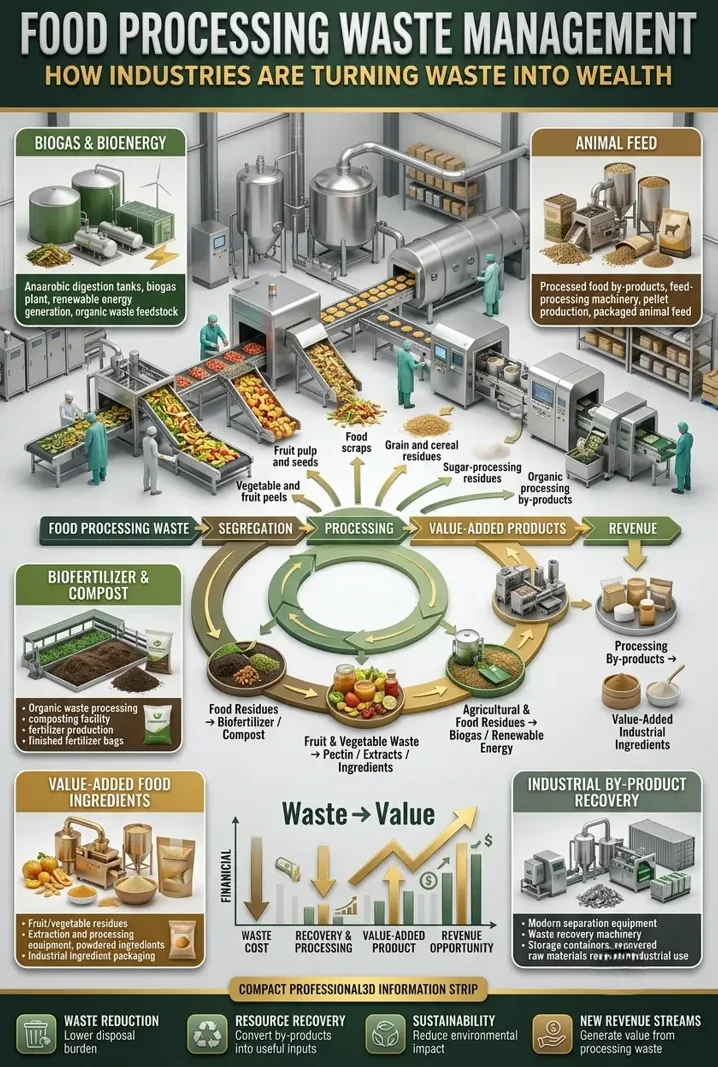
Fruit and vegetable processing waste (peels, seeds, pulp) contains pectin, dietary fibre, natural pigments, and essential oils that can be screened, separated and processed into marketable ingredients for the food, cosmetics, and pharmaceuticals industries.
Dairy waste streams (especially whey) contain high-quality proteins that industries can recover and turn into whey protein concentrate and isolate, some of the most commercially valuable protein supplements in the world.
Meat processing by-products (fat, bone, offal) can be converted into edible products, animal feed ingredients, gelatin, and bone meal fertilizer. Mechanical recovery of meat from bones boosts yield from each carcass and reduces disposal costs simultaneously.
Spent grains, malt, and brewing residues are rich in protein, fibre, and micronutrients, making them a great fit for inclusion in animal feed and high-protein human food products.
Coffee and tea processing waste (grounds, husks, stalks) contain bioactive compounds with antioxidant properties that can be used in functional food formulations, composting, and energy generation.
The commercial logic is compelling. Every kilogram of waste that gets converted into a by-product saves disposal cost and potentially generates revenue. A lot for an industry with slim margins and rising input costs where that math matters a lot.
Technology Is Making It Practical
The barrier to entry for waste valorisation has dropped considerably in the last two decades. Moreover, techniques that used to require large scale infrastructure (ultrafiltration, anaerobic digestion, aerobic biological treatment, enzymatic processing, protein texturization) are increasingly available to medium and even small food manufacturers. Furthermore, affordable membrane technology, modular biogas units, and enzyme preparations are now available. As a result, many of these solutions have become accessible to MSMEs. In addition, this also applies to those operating at modest production capacities.
According to the World Resources Institute (WRI), every dollar invested in food waste reduction generates an average return of approximately fourteen dollars across the value chain.
Therefore, that figure, conservatively extrapolated to an Indian MSME context, is a persuasive case for embracing waste management as a business strategy. In fact, it is more than a mere operational necessity…
What Entrepreneurs and Startups Need to Know
For entrepreneurs entering the food processing sector or for existing operators seeking to diversify and bolster margins, therefore, waste stream valorisation is an opportunity ripe for exploitation.
Furthermore, starting a unit focused purely on recovering and processing food industry by-products would require a working understanding of the technologies involved, process parameters, economics, and market linkages. For example, these include protein concentrates from dairy waste, pectin from citrus peel, animal feed from cannery residues, and biogas from organic effluent. However, this isn’t easy to piece together from scattered sources. Therefore, it is exactly the kind of comprehensive, applied reference that food industry professionals and new entrants need.
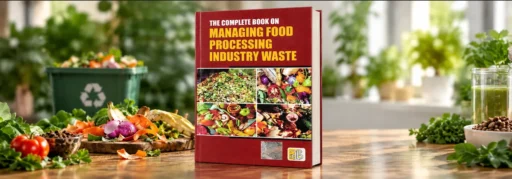
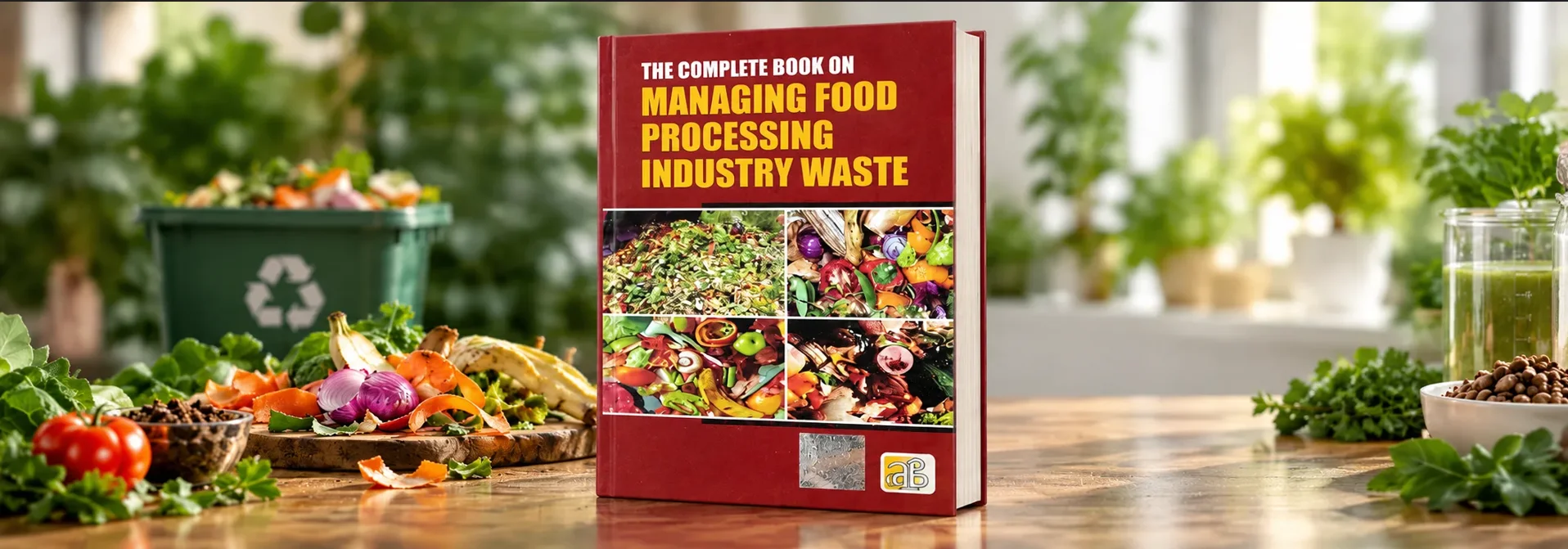
Introducing: The Complete Book on Managing Food Processing Industry Waste
Author: H. Panda | Publisher: Asia Pacific Business Press Inc. | Price: ₹1,275 / $33.95 | ISBN: 9788178331454
For anyone serious about food processing waste management (technologist, plant operator, entrepreneur, consultant), this 400-page handbook by H. Panda is one of the most comprehensive technical references available on the subject.
The book opens with a broad treatment of food industry waste utilization principles. It then delves into specific recovery technologies and streams. Ultrafiltration as a technique for recovering valuable components from waste water is covered in detail. This is important for any dairy, beverage, or starch processing operation. Recovery of fruit and vegetable wastes addresses one of the largest and commercially promising areas of by-product utilization in the food sector.
Subsequent chapters tackle protein recovery and its various industrial applications, fat extraction, and treatment of fatty effluents. They also cover the conversion of bone to edible products – an area relevant for meat and poultry processors seeking to boost yield and reduce waste simultaneously.
The book’s coverage of waste utilization in animal feeds is thorough and commercially grounded. Given the rapid expansion of the organized animal feed industry in India and Southeast Asia, this section alone provides actionable insight for processors seeking to establish lateral supply relationships with feed manufacturers.
More specialized topics give the book genuine depth for technically oriented readers. These include the production of earthworm proteins, the role of pectate gelling agents, anaerobic treatment of food processing wastes and agricultural effluents, aerobic processes for wheat starch effluent, and texturization of recovered proteins.
The by-products chapter covers malting, brewing, and distilling residues. It also includes dedicated sections on coffee and tea waste, underutilized proteins for beverages, and microbiological and enzymatic agents in waste upgrading. It is a genuinely cross-sector resource.
The handbook rounds out with chapters on silage production, mechanical meat recovery, recovery from effluents, pet food applications for food waste, canning and food processing wastes as feedstuffs and fertilizer – ensuring that the full spectrum of food processing sub-sectors are represented.
According to the Ellen MacArthur Foundation, a transition to a circular economy in food systems could unlock over $700 billion in annual value globally. Waste valorisation sits at the heart of that transition. Books and knowledge resources help practitioners understand and implement these technologies. They are part of how that transition actually happens at the business level.
For additional reference on waste-to-resource frameworks, view the World Bank food systems resources and research from the Food Industry Association (FMI).
Purchase / Call-to-Action
Get Your Copy — The Complete Book on Managing Food Processing Industry Waste
| Title | The Complete Book on Managing Food Processing Industry Waste |
| Author | H. Panda |
| Publisher | Asia Pacific Business Press Inc. |
| ISBN | 9788178331454 |
| Pages | 400 |
| Price (India) | ₹1,275 |
| Price (International) | $33.95 |
Whether you are a food technologist looking to optimize your plant’s waste streams, an entrepreneur evaluating entry into the waste utilization space, or a consultant building feasibility reports for food processing projects, this book belongs on your reference shelf.
It is one of the few comprehensive handbooks available. It combines process technology, by-product recovery, effluent treatment, and commercial application across the full breadth of the food processing industry.
Order Now
Buy from Niir.org (Official Publisher): Click Here
The book is also available on Amazon India: Click Here
Buy on Flipkart: Click Here
Your Investment Deserves the Right Opportunity
Every serious investment begins with choosing the right sector and the right business model. With hundreds of industrial opportunities available across India’s manufacturing and clean-energy landscape, making the most informed choice is critical. NPCS Startup Selector tool helps entrepreneurs, MSMEs, and investors identify the most suitable business opportunities based on their investment capacity, location, and interests — so your capital is directed toward a venture with the strongest fit and potential.