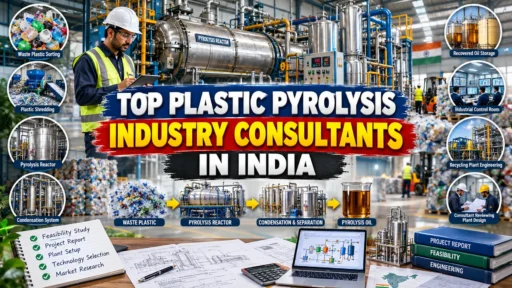
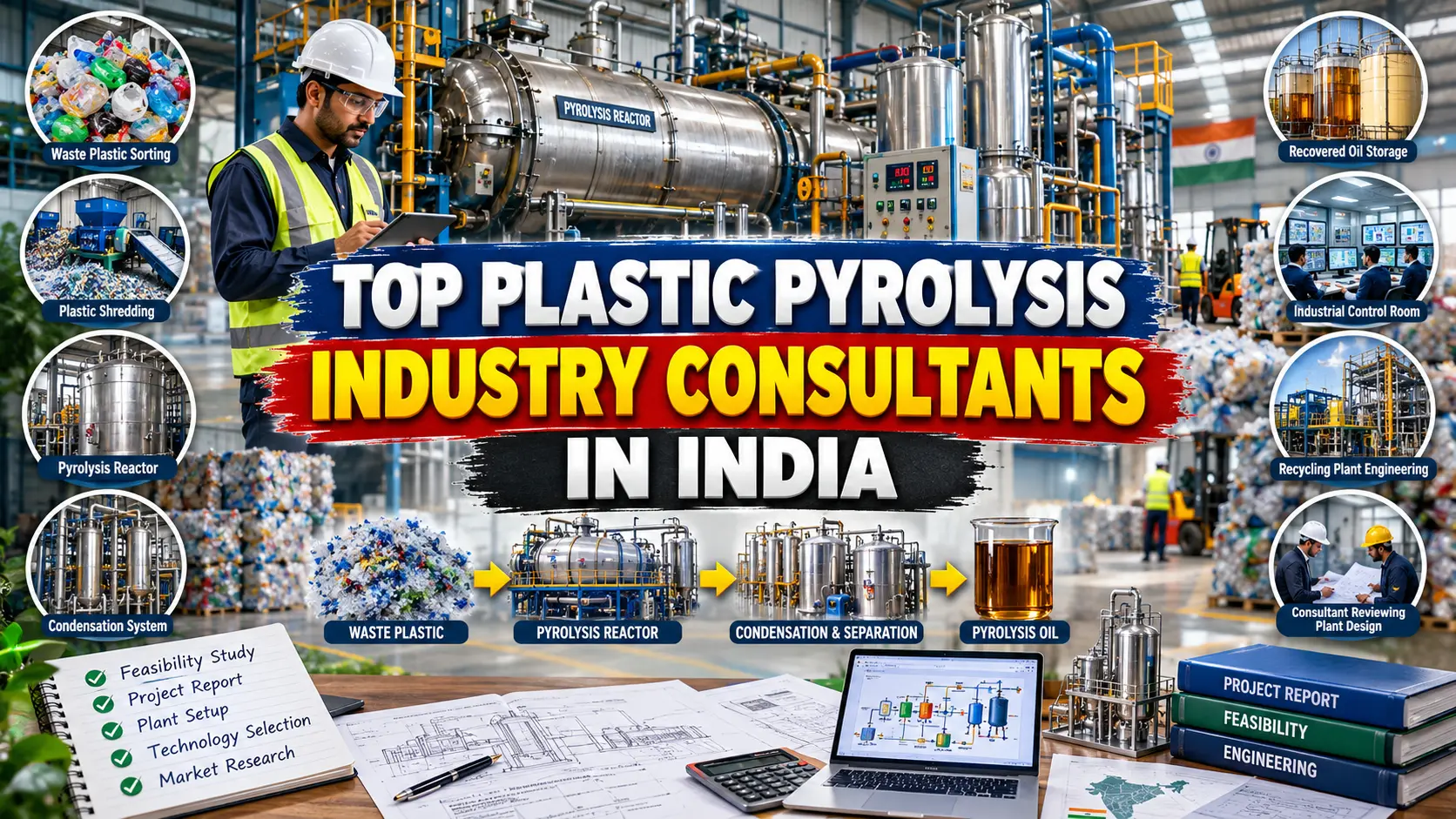

India’s daily plastic waste generation exceeds 25,000 tonnes, with a significant portion classified as mixed, contaminated, thermocole, and non-recyclable composites. Such plastic waste types are inaccessible to conventional mechanical recycling. Pyrolysis technology, however, can transform this landfill-bound waste into pyrolysis oil, carbon black and syngas. For entrepreneurs and industrial investors assessing the entry into the plastic pyrolysis industry sector, the realisation of the market’s potential is unambiguous. The challenge lies in technical and regulatory complexity. That is where the value of top plastic pyrolysis industry consultants in India comes in.
Choosing the right consultant determines whether your project clears CPCB compliance hurdles quickly, whether your Detailed Project Report (DPR) is satisfactory to bank scrutiny, and whether your pyrolysis reactor design is sized correctly. The plastic waste to oil conversion sector in India is evolving rapidly under the MoEFCC’s Plastic Waste Management Amendment Rules 2026, tightening Extended Producer Responsibility (EPR) obligations and increasing industrial demand for alternative fuel sources. The best plastic pyrolysis industry consultants in India understand this landscape and know how to translate it into bankable, operable projects.
What Plastic Pyrolysis Industry Consultants Do: Core Services Explained
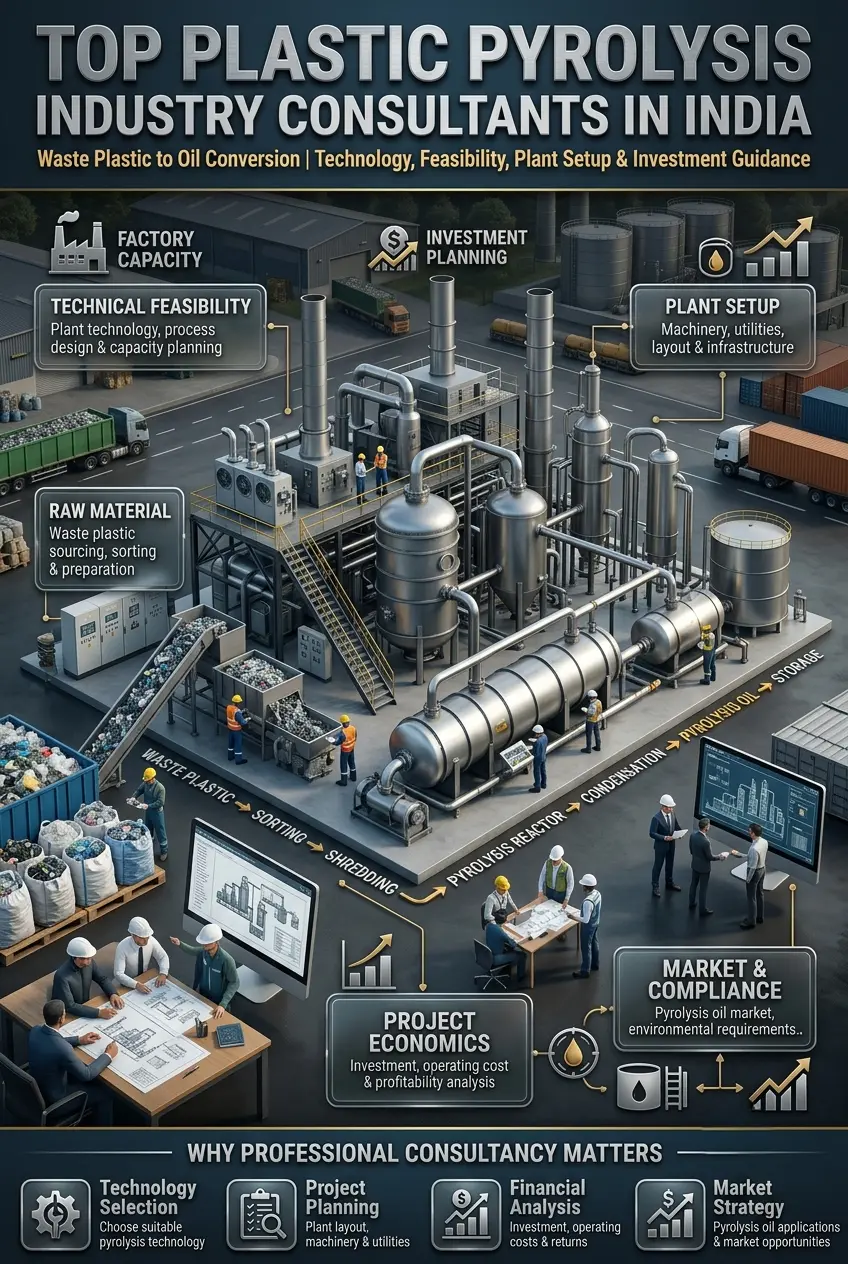
The scope of a competent plastic pyrolysis plant consultant goes well beyond preparing a market study. At the technical core, consultants prepare comprehensive Detailed Project Reports (DPRs). These cover feedstock assessment, reactor selection, process flow design, and product yield projections. Furthermore, they also include complete financial modelling, including capital cost estimates, operating expenditure, and projected profitability at various throughput levels. Therefore, a well-prepared DPR is the first document any lender, private equity partner or MSME scheme evaluator will scrutinise.
On the engineering side, top consultants provide EPC (Engineering, Procurement and Construction) support. In addition, they guide clients through reactor procurement, installation vendor selection, utilities planning, and site layout. Moreover, it is especially important in pyrolysis where reactor design choices (batch versus continuous, fixed-bed versus rotary kiln) directly affect yield, operating cost and compliance with emission norms under India’s Environment Protection Act, 1986 and the Factories Act. As a result, compliance advisory is therefore an integral part of the engagement. In particular, it spans consent to establish (CTE), consent to operate (CTO), and EPR registration under CPCB’s plastic waste management portal.
Additionally, process engineering consultants also help clients with feedstock sourcing strategy. They identify reliable waste plastic aggregators, set pre-treatment requirements (shredding, drying, sorting), and establish offtake arrangements for pyrolysis oil and carbon black. However, this commercial structuring work is often underestimated by first-time investors. Nevertheless, it is critical to project viability in the Indian market, where feedstock quality and product off-take terms materially affect the business model.
Why India Is a High-Priority Market for Plastic Pyrolysis Investment
India’s plastic to fuel market is projected to reach USD 551 million by 2030, growing at a compound annual rate of over 30%. The country accounts for over 16% of the global plastic to fuel market, a significant share that reflects both the scale of India’s plastic waste problem and the policy momentum building around chemical recycling solutions. Pyrolysis dominates the India waste plastic recycling market with 26% treatment share, driven by its ability to handle contaminated, mixed and non-recyclable plastics that mechanical recycling simply cannot address.
The policy tailwind is substantial. Under the MoEFCC’s Plastic Waste Management (Amendment) Rules 2026, producers, importers and brand owners face escalating EPR obligations, and certified pyrolysis operators are positioned to absorb this compliance demand directly. The amended rules have created a formal carve-out for chemical recycling, providing the regulatory recognition that the sector was long seeking. Meanwhile, furnace oil and diesel prices remain elevated, and pyrolysis oil, priced at a 20-30% discount to conventional fuel, commands robust industrial demand from cement kilns, captive power plants, and boilers.
The Government of India’s Production-Linked Incentive (PLI) scheme, its broader push under Swachh Bharat Mission and MSME financial support through schemes like CGTMSE have further de-risked pyrolysis investment. Invest India actively promotes waste-to-energy ventures as part of India’s sustainability and clean manufacturing agenda. For NRI investors and foreign collaborators, the sector offers a particularly compelling combination: strong fundamentals, regulatory backing and a fragmented market where organised, technically sound operators can differentiate sharply.
How to Evaluate the Best Plastic Pyrolysis Industry Consultants in India
Domain Expertise in Pyrolysis Technology
Plastic pyrolysis is not a generic manufacturing process. The thermal cracking of polyethylene, polypropylene, and polystyrene occurs at temperatures of 300-600°C, in an oxygen-free environment. It involves precise control of reactor temperature profiles, residence time, catalyst selection, and condensation systems.
Therefore, the first criterion for evaluating any plastic pyrolysis plant consultant is demonstrated, hands-on familiarity with pyrolysis reactor engineering. General chemical engineering credentials are not enough. Ask for case studies where the consultant has supported projects from concept to commissioning. These should include reactor vendor short-listing and yield validation.
DPR and Feasibility Track Record
A bankable DPR for a plastic pyrolysis project needs to address several site-specific parameters. These include feedstock composition and availability in the project’s catchment zone. It should also cover municipal and industrial waste sourcing logistics. Product quality benchmarks for pyrolysis oil vis-à-vis BIS fuel oil standards are also important. Realistic capacity utilisation assumptions should also be included.
Consultants who draft generic, template-driven DPRs create problems at the loan appraisal stage. The best plastic pyrolysis industry consultants in Delhi and across India will show you samples of previously submitted DPRs. These samples should have successfully secured project finance or MSME scheme approvals.
Regulatory and Compliance Depth
Any plastic pyrolysis unit in India operates under the oversight of the Central Pollution Control Board (CPCB) and the relevant State Pollution Control Board (SPCB). CPCB registration is mandatory for plastic waste processors. Pyrolysis units must obtain environmental clearances, air emission approvals, and EPR-linked authorisations. Consultants who lack direct regulatory experience create costly delays and compliance risks. The same applies to consultants who are unfamiliar with CPCB’s EPR portal, consent-to-operate workflows under the Environment Protection Act, and emission norms specific to thermal treatment of plastics. Always verify that the consultant team includes a regulatory specialist, not just a process engineer.
EPC and Process Engineering Capability
Beyond feasibility studies, investors scaling beyond 2-5 TPD (tonnes per day) capacity often need EPC guidance- procurement support for reactors, heat exchangers, condensers, oil storage and emission control systems. Top engineering consultants and process plant consultants in India provide techno-commercial bids management, factory acceptance testing oversight, and commissioning support. This end-to-end capability significantly reduces project execution risk, especially for first-generation investors who lack in-house engineering teams. Boutique management consulting firms in India focusing on industrial projects often combine DPR expertise with EPC advisory, making them particularly useful for MSME-scale projects.
CIPET Linkage and Technical Standards Alignment
The Central Institute of Petrochemicals Engineering & Technology (CIPET) under the Ministry of Chemicals and Fertilizers operates 47 centres across India playing a central role in training, technology support and testing for the plastics and polymer processing sector, including waste-to-energy applications such as pyrolysis. Consultants who maintain working relationships with CIPET and align their project designs with CIPET’s technical standards for plastic waste processing provide superior quality assurance for investors. CIPET’s Plastics & E-Waste Management Centres provide testing and pilot-scale process development. They also provide regulatory liaison support that well-networked consultants can leverage effectively on behalf of their clients.
Role of NPCS in Plastic Pyrolysis Project Consultancy
Niir Project Consultancy Services (NPCS) www.niir.org is one of India’s most established industrial consultancy firms, founded in 1994 and headquartered in Delhi. Over three decades, NPCS has completed over 150,000 successful projects across 85 countries, establishing itself as a credible reference partner for entrepreneurs, MSME investors and development banks evaluating manufacturing and waste-to-energy projects across India.
NPCS has delivered feasibility and DPR engagements for plastic pyrolysis and waste recycling projects across multiple Indian states. M/s. Ayasya Infrastructure LLP of Malkajgiri, Telangana engaged NPCS for a Comprehensive Project Report on Plastic Pyrolysis (Waste Plastic to Oil Conversion). M/s. Bhagwandas Gopicharan Marketing of Akola, Maharashtra commissioned a Pre-Feasibility Report on Plastic Pyrolysis. M/s. Hem Agro Pvt. Ltd. of Jodhpur, Rajasthan worked with NPCS on a Plastic Waste Pyrolysis Project Investment Report covering plant economics and financial projections. M/s. Bhartiya Samuruddhi Investment and Consulting of Hyderabad, Telangana engaged NPCS for a Plastic Waste Recycling Project Investment Report.
M/s. Raamsi Industries of Visakhapatnam, Andhra Pradesh commissioned an Investment and Project Report on Plastic Waste Recycling. M/s. Kaysam Enterprises of Imphal, Manipur relied on NPCS for a Detailed Project Report on Plastic Waste Recycling for a new manufacturing unit. In the waste tyre pyrolysis and crumb rubber segment, a closely allied sector, NPCS has assisted M/s. Noor Infrastructure of Nagpur, Maharashtra with a Comprehensive Project Report on Crumb Rubber Powder from Waste Tyre. M/s. Shri Krishna Tyres of Bangalore, Karnataka commissioned a Comprehensive Project Report on Recycling Waste Tyres into Crumb Rubber. M/s. Gupta Tyres of Jalgaon, Maharashtra engaged NPCS for a Pre-Feasibility Report on Crumb Rubber Powder.
M/s. Sunway Exports of Hospet, Karnataka worked with NPCS on a Techno-Economic Project Study on Waste Tyre Pyrolysis. M/s. Ratnawali Infrastructure Ltd. of Jaipur, Rajasthan engaged NPCS for a Project Feasibility Report on Waste Tyre Pyrolysis. M/s. Road Cargo Movers Pvt. Ltd. of Kolkata, West Bengal commissioned a Rubber Granules from Waste Tyre Project Investment Report. Mr. Pawan Gopalam of Hyderabad, Telangana engaged NPCS for a Rubber Powder from Waste Tyres Project Investment Report. NPCS has also assisted clients evaluating carbon black recovery as a co-product revenue stream helping them model the dual-revenue economics of fuel oil and carbon black together to optimise unit-level profitability.
NPCS has published a comprehensive printed reference book on plastic waste management and recycling technology, covering pyrolysis processes, investment parameters, regulatory frameworks and market analysis in depth-the printed book: Medical, Municipal and Plastic Waste Management Handbook.
For a detailed techno-economic Project Report on setting up a plastic pyrolysis manufacturing business in India, including plant economics, reactor and machinery lists, financial projections and applicable government incentives, the NPCS Project Report: Plastic Pyrolysis (Waste Plastic to Oil Conversion) – Detailed Project Report.
Best Plastic Pyrolysis Industry Consultants in Delhi and Across India
Delhi and the National Capital Region (NCR) serve as the primary hub for best plastic pyrolysis industry consultants in India. Moreover, the region has a dense concentration of industrial consultancy firms, process engineering specialists, EPC advisors and boutique management consulting firms. In addition, these firms serve the waste-to-energy sector. Furthermore, Delhi’s consultants benefit from proximity to central government regulatory bodies including MoEFCC, CPCB and MSME ministry offices. Therefore, these bodies matter for projects requiring environmental clearances and government scheme applications.
Meanwhile, outside Delhi, Mumbai and Pune host a growing cluster of pyrolysis project consultants. In addition, they serve Maharashtra’s active industrial investor base. Meanwhile, Ahmedabad has seen significant consultancy activity linked to Gujarat’s emergence as one of India’s largest plastic pyrolysis markets. Furthermore, the state’s pro-industry regulatory environment and large industrial consumer base for pyrolysis oil make it an attractive geography for new plant setups. For example, these consumers include cement manufacturers, steel re-rollers and textile processors.
Similarly, Chennai-based consultants serve the Tamil Nadu market. Moreover, the state has significant municipal solid waste volumes and active MSME investment. As a result, these factors create strong demand for plastic pyrolysis feasibility studies.
The All-India Plastic Manufacturers’ Association (AIPMA) and the Confederation of Indian Industry (CII) are the two key industry bodies that investors should engage to connect with sector practitioners, process technology suppliers and consultancy firms active in the plastic pyrolysis space. These associations also provide advocacy linkages to CPCB and MoEFCC on EPR compliance and chemical recycling policy matters.
Comparison of Plastic Pyrolysis Consulting Service Types
The following table outlines the primary consulting service categories available in India’s plastic pyrolysis sector, their key deliverables, and the client profiles they best serve:
| Consulting Service Type | Key Deliverables | Best Fit For |
| Techno-Economic DPR | Market analysis, process selection, CAPEX/OPEX model, financial projections, break-even analysis | First-time investors, MSME promoters, bank loan applicants |
| Feasibility Study (Pre-DPR) | Site assessment, feedstock availability, regulatory pre-check, indicative project cost | Entrepreneurs in concept/evaluation stage |
| EPC Consultancy | Reactor sourcing, vendor management, installation oversight, commissioning support | Investors scaling to 5–30 TPD, groups without in-house engineering |
| Process Engineering Consulting | Reactor design, yield optimization, process flow diagrams, emission control design | Technology-focused operators, plant upgrades |
| Regulatory and Compliance Advisory | CPCB/SPCB consent applications, EPR registration, Environmental Impact Assessment | All project types — mandatory before construction |
| Market Research Reports | Demand analysis, pricing trends, competitive landscape, offtake opportunity mapping | Private equity, strategic investors, market entrants |
| Carbon Black Co-product Strategy | Product quality assessment, customer identification, revenue modeling for carbon black | Operators seeking dual-revenue stream optimization |
Conclusion: Practical Next Steps for Entrepreneurs Seeking Plastic Pyrolysis Consultancy
Furthermore, Your practical first step is selecting a consultant who combines pyrolysis-specific technical knowledge and familiarity with your target state’s regulatory framework, and a proven DPR preparation track record. Additionally, Verify references, review sample project profiles and ensure your consultant has direct experience with CPCB’s Plastic Waste Management compliance portal and the specific consent processes of your target state’s SPCB. For investors who need a comprehensive starting point, NPCS’s project profiles catalog and printed references on plastic waste technology offer structured, independently researched frameworks for initial due diligence, saving weeks of foundational research before your engagement with technical consultants begins.
Meanwhile, the market is moving fast. Regulatory pressure on plastic waste generators is intensifying. Industrial buyers for pyrolysis oil are actively seeking reliable certified suppliers. Moreover, project finance availability for waste-to-energy ventures is improving. Ultimately, the question is not whether to enter this sector. It is whether you will do so with the technical and advisory foundation needed to succeed.
Your Investment Deserves the Right Opportunity
Every serious investment begins with choosing the right sector and the right business model. With hundreds of industrial opportunities available across India’s manufacturing and clean-energy landscape, making the most informed choice is critical. NIIR’s Startup Selector tool helps entrepreneurs, MSMEs and investors identify the most suitable business opportunities based on their investment capacity, location and interests so your capital is directed towards a venture with the strongest fit and potential.