BESS Container: What Is Inside, Sizes, Cost and How to Make One in India
Contents 9 sections
- What is inside a BESS container, and who makes each part?
- BESS container size, capacity and weight: what datasheets show
- What does a BESS container cost in India in 2026?
- How a BESS container is manufactured, step by step
- Machinery for a BESS container assembly line
- Which layer of a BESS container should an Indian manufacturer make?
- Approvals and certificates buyers check before ordering
- Next steps for a BESS container project
- BESS container questions people ask
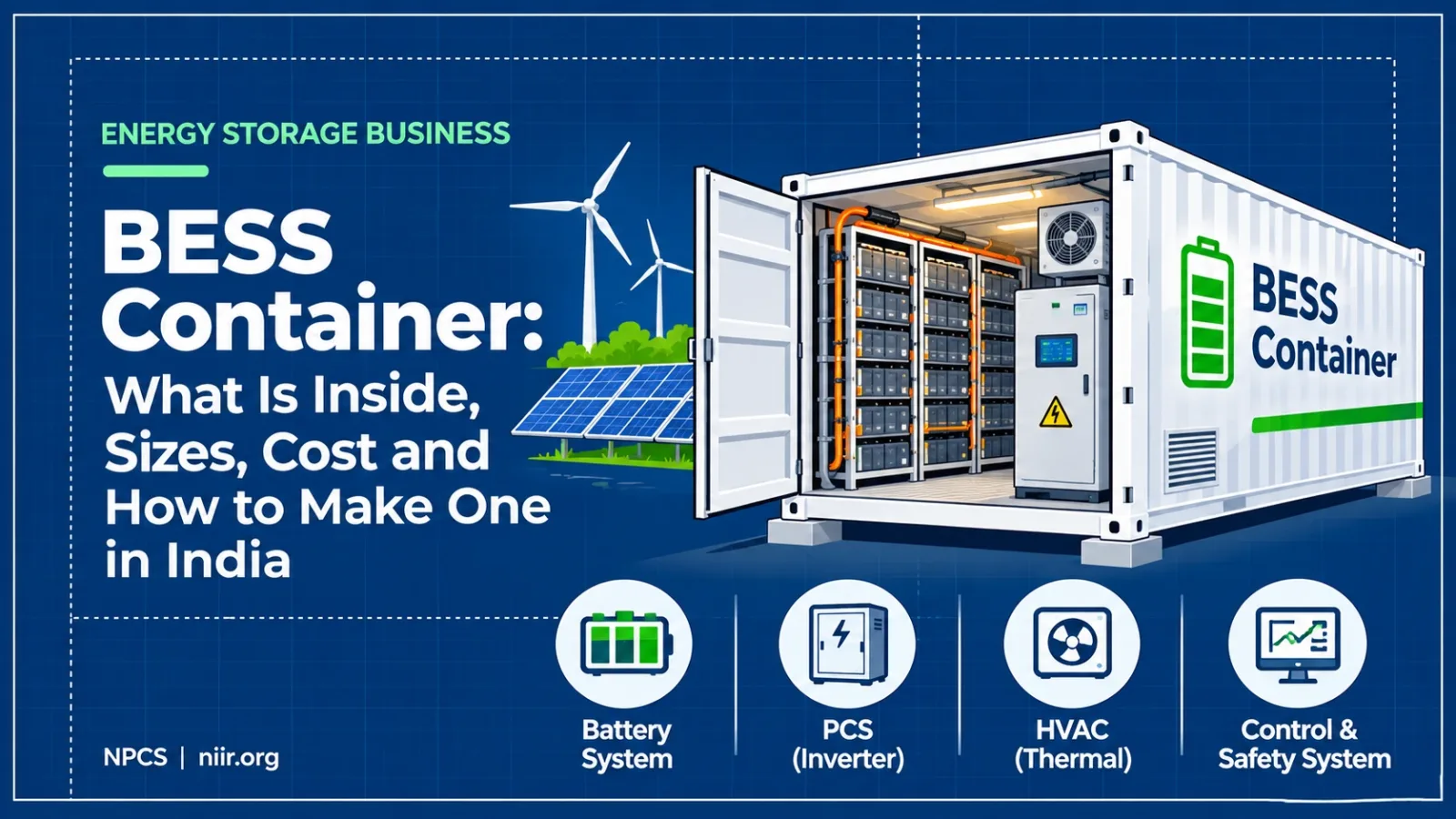
A BESS container is a shipping-container-sized steel box holding a ready-to-connect battery bank: lithium iron phosphate (LFP) cells in racks, electronics that watch every cell, a liquid-cooling loop, gas detection and fire suppression. It is factory-built and tested, then trucked to site. Today's common 20-foot unit stores about 5 MWh and weighs around 45 tonnes, so the crane plan and foundation matter as much as the battery.
For a manufacturer, the real decision is which layer to make. Steel shells are easy to start but earn little. Cell making is a separate, far bigger business. The middle layer, turning bought-in cells into tested racks inside a finished container, is where new Indian factories are going, helped by a storage scheme that rewards Indian content.
What is inside a BESS container, and who makes each part?
Seven subsystems share the box, and buyers judge how well they work together, not the steel.
|
Part |
What it does |
Note for a manufacturer |
|
LFP cells and packs |
Store energy in packs and racks |
Largest cost item, bought in |
|
Battery management system (BMS) |
Watches every cell and trips a string on a fault |
Buy or develop in-house |
|
Thermal management |
Chiller and cooling plates hold cell temperature |
Liquid cooling on 5 MWh units |
|
Fire safety |
Gas detection, suppression, water-spray inlet, venting |
Must match fire test reports |
|
Power conversion system (PCS) |
Converts DC to grid AC and back |
Inside only in small all-in-one units |
|
Energy management system (EMS) |
Decides when to charge and discharge |
Integrator's software |
|
Steel enclosure |
Insulated, coated shell |
Close to shipping container fabrication |
BESS container size, capacity and weight: what datasheets show
A 20-foot footprint holds about 5 MWh of batteries alone, or about 2 MWh with the inverter inside, so ask which one a quote covers.
|
Format |
Energy per unit |
What is inside |
Example datasheet |
|
20-ft DC block, liquid-cooled |
5.015 MWh |
Cells, BMS, cooling, fire suppression; PCS outside |
Suntech STE-5ML-DC: 6,058 x 2,438 x 2,896 mm, 45 t |
|
20-ft high-cube, all-in-one AC |
633 kWh to 2,280 kWh |
Batteries, PCS, isolation transformer, cooling, fire suppression |
Cummins BESS bulletin, February 2026 |
|
10-ft all-in-one AC |
211 kWh or 422 kWh |
Same, for factories and commercial sites |
Cummins BESS bulletin, February 2026 |
The Suntech unit reaches 5 MWh with large 314 Ah cells. Cell size drives cost: in BloombergNEF's 2025 survey, systems using 300 Ah or larger cells were about half the price of those with smaller cells, and blocks of 4 MWh or more about 39% cheaper than smaller blocks. Designs built around older cells lose on price.
What does a BESS container cost in India in 2026?
There is no list price, but four public benchmarks frame it.
|
Benchmark |
Figure |
What it covers |
|
CTUIL benchmark project cost |
₹0.80 crore per MWh |
Full standalone project, used in grid connectivity checks |
|
CTUIL land benchmark |
1.2 acres per 100 MWh |
Site land for a BESS project |
|
BloombergNEF global average, 2025 |
US$117 per kWh (4-hour systems US$110) |
Turnkey storage system; China averaged US$73 |
|
Viability Gap Funding (VGF), November 2026 |
₹14,500 crore for 92 GWh, including 30 GWh of BESS |
Capital support to distribution companies, FY2026-27 to FY2030-31 |
At the Central Transmission Utility's 2026 benchmark, a 50 MWh site, about ten 5 MWh containers plus power equipment, is taken as roughly ₹40 crore. Price moves with cell size, cooling, whether the PCS is included and the tender's Indian content rule.
NPCS, which has prepared project reports since 1994 across more than 40 sectors, puts the indicative investment for a BESS assembly unit at about ₹20 crore to ₹300 crore excluding land, for roughly 100 MWh to 2 GWh of output a year. That places it among large-scale business ideas.
How a BESS container is manufactured, step by step
An assembly plant buys cells and turns them into a tested system.
1. Incoming inspection: measure each cell's voltage and internal resistance and sort cells into matched groups.
2. Pack assembly: stack and compress cells with insulation, laser-weld busbars, fit BMS boards and cooling plates.
3. Pack test: insulation and high-voltage checks, coolant leak test, short charge-discharge run.
4. Shell preparation: fabricate or buy the shell, then insulate, coat and fit cable trays.
5. Rack integration: load packs into racks and connect DC cabling, rack BMS, fuses and contactors.
6. Fit-out: install the chiller, HVAC, gas detection, suppression and communication panels.
7. Factory acceptance test: run the full container and test interlocks and communication, usually with the buyer watching.
8. Commissioning: place on the plinth and connect to the PCS and transformer.
Do not rush step 1: the weakest cell sets the limit for its whole string.
Machinery for a BESS container assembly line
Plan the test bay first: it needs the plant's largest power connection. Several suppliers also serve electrical and electronics manufacturing.
|
Machine |
What it does |
|
Cell tester with sorting line |
Grades and groups matched cells |
|
Stacking station and module press |
Compresses cells with insulation |
|
Laser welder with vision check |
Welds busbars and inspects each joint |
|
Pack end-of-line and leak tester |
Checks insulation and coolant sealing |
|
Overhead cranes and roller conveyors |
Move heavy packs and loaded containers |
|
Shell fabrication bay |
Only if you make enclosures |
|
Charge-discharge test bay with load bank |
Runs acceptance tests at rated power |
Which layer of a BESS container should an Indian manufacturer make?
Each route needs different money and customers.
|
Route |
What you make |
Main buyer |
Entry barrier |
|
Enclosure maker |
Insulated, coated steel shells |
Integrators |
Lowest; fabrication skills |
|
DC block integrator |
Packs and racks in a finished container |
EPC contractors, developers |
Cell supply contracts, test bay, certificates |
|
Full AC integrator |
DC blocks plus PCS, EMS and service |
Utilities, large industrial users |
Grid-scale track record |
Neuron Energy's planned Talegaon, Maharashtra plant is a ₹100 crore, 7-acre, 5 GWh robotic facility. Powertrac Group's ₹600 crore, 1 GWh a year unit covers packs, in-house BMS and 1 MWh to 5 MWh containers. Waaree ESS commissioned a 5.15 GWh container plant at Rola, Valsad, Gujarat in July 2026. Transformer manufacturing firms already supply the AC side.
Start as a DC block integrator unless you have grid-scale references. NTPC Green Energy's November 2026 tender for about 40 GWh of containers asks direct suppliers for 4,000 MWh supplied in three years; other Indian firms must partner with a qualified container manufacturer. Demand is not the worry: the National Electricity Plan estimates that India will need 236 GWh of BESS by 2031-32, and the November 2026 VGF scheme sets a 40% minimum domestic content for BESS projects. That rule gives local integrators their edge.
Approvals and certificates buyers check before ordering
Plant approvals are routine: factory licence, pollution board consent and fire NOC. You must also register as a battery producer on the Central Pollution Control Board's portal under the Battery Waste Management Rules, 2022.
Buyers look harder at product certificates. Datasheets list IEC 62619 (safety of industrial lithium batteries), UL 9540A (how fire spreads between cells and racks) and UN 3536 (transport of batteries installed in a container).
Next steps for a BESS container project
1. Pick your layer and ten target buyers before pricing machinery.
2. Get datasheets and warranty terms from three cell suppliers.
3. Read the eligibility clauses of three recent utility tenders, and budget for certification tests.
4. Size working capital for cells, which you pay for long before customers pay you, and line up project funding.
5. Prepare a detailed project report for lenders once the route is fixed.
An NPCS project report for a BESS assembly unit sets out machinery with suppliers, component sourcing, layout, manpower, project cost, working capital and break-even for your capacity. Compare it with a battery manufacturing plant or other renewable energy manufacturing ideas.
BESS container questions people ask
Is there a subsidy for setting up a BESS container factory?
Not directly. Viability Gap Funding goes to the distribution companies and developers that buy storage, not to the factory that assembles containers. The PLI scheme for advanced chemistry cells targets cell manufacturing. For an assembly unit, check your state industrial policy for capital subsidy and power tariff benefits.
How long does a BESS container last?
On paper, over 20 years. Current LFP datasheets, such as Suntech's 5 MWh unit, list at least 8,000 cycles, which is about 22 years at one full cycle a day. Real life depends on depth of discharge, temperature control and the capacity guarantee in the warranty.
Does a BESS container need air conditioning?
Yes. Large units cool cells with a liquid loop and chiller; Cummins containers, for example, pair glycol cooling for batteries with HVAC for the container air. For Indian sites, ask for the cooling rating at peak summer temperature, not at a mild test condition.
Can a BESS container work with a factory's solar plant?
Yes. A small all-in-one unit, such as a 10-foot container of 211 kWh or 422 kWh, can store midday solar output for evening peaks or outages. Check your distribution company's rules on behind-the-meter storage and export first.

Planning a new manufacturing unit?
NIIR prepares detailed project reports and feasibility studies for new projects. Share your requirement and the team will get in touch.