RCCB vs MCB: Difference, Working and How They Are Manufactured
Contents 8 sections
- RCCB vs MCB: what each one senses and trips on
- Which comes first in the board, MCB or RCCB?
- RCCB and MCB price: why one RCCB costs more than a row of MCBs
- Choosing ratings for a single-phase or three-phase board
- Indian rules for buying, installing and making them
- How MCBs and RCCBs are manufactured
- Next steps: a safer board at home, or a switchgear unit
- Frequently asked questions about RCCBs and MCBs
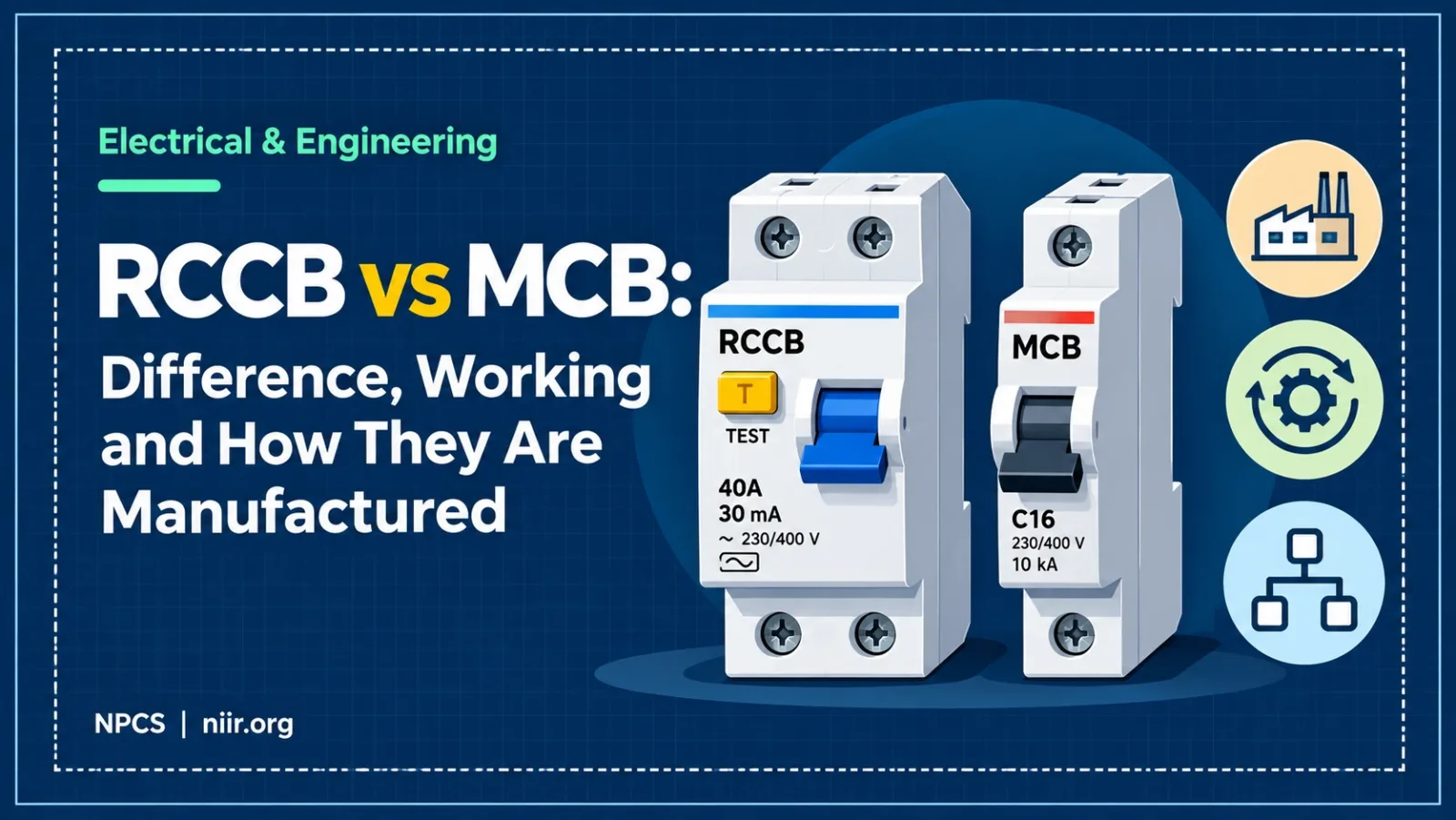
The RCCB and MCB in a distribution board guard against different faults, so most Indian boards carry both. The MCB (miniature circuit breaker) watches how much current flows and trips on an overload or short circuit, before the wiring overheats. The RCCB (residual current circuit breaker) watches where the current goes. It compares the current leaving on the phase wire with the current returning on the neutral, and if some escapes to earth through a damp wall or a person, it cuts the supply within a fraction of a second.
Neither does the other's job: an RCCB ignores an overload, and an MCB will not notice the small current that flows through a person during a shock. In a typical home, one RCCB rated at 30 mA, well below the danger limit for humans, protects a group of MCBs, one per circuit.
RCCB vs MCB: what each one senses and trips on
Inside an MCB, a bimetal strip bends under a sustained overload and unlatches the contacts; a magnetic coil acts instantly on a short circuit. An RCCB passes phase and neutral through a ring-shaped core, and any leakage upsets the balance and fires a trip relay. Its T button creates a small deliberate leakage to prove this works.
|
Point |
MCB |
RCCB |
|
Responds to |
Overload and short circuit |
Earth leakage |
|
Measures |
Size of the current |
Phase minus neutral current |
|
Mainly protects |
Cables and appliances |
People, and buildings from leakage fires |
|
Key ratings |
Amps, curve (B, C, D), breaking capacity (kA) |
Amps, sensitivity (mA), type (AC, A, B, F) |
|
Indian standard |
IS/IEC 60898-1 |
IS 12640 (Part 1) |
Both standards stop at 125 A; above that, boards use an MCCB (moulded case circuit breaker). Which device sees which fault:
|
Fault |
MCB |
RCCB |
|
Too many appliances on one circuit |
Trips |
No |
|
Phase touching neutral (short circuit) |
Trips instantly |
No: no current is lost |
|
Person touching a live wire |
No |
Trips |
|
Neutral touching earth, or two RCCBs' neutrals mixed |
No |
Trips repeatedly |
BCH Electric's wiring guidance traces many "nuisance" trips to that last row, so each RCCB must carry only its own circuits' phase and neutral.
Which comes first in the board, MCB or RCCB?
Both orders are used in India and work when ratings are matched.
|
Layout |
Order from the meter |
Suits |
|
RCCB as incomer |
Main switch or MCB, one RCCB, outgoing MCBs |
Most homes and shops |
|
RCCB per group |
Main MCB, separate RCCBs for wet areas, sockets, lighting |
Larger homes, so one leak does not black out all |
|
RCBO per circuit |
Main switch, one RCBO (RCCB and MCB in one body) per circuit |
Critical circuits |
Position matters less than protection. Because an RCCB has no overload release, an upstream device (main MCB or supply fuse) must stop overloads and short circuits reaching it. Pick an RCCB rated at least as high as the MCB feeding it, and check the maker's short-circuit coordination table.
RCCB and MCB price: why one RCCB costs more than a row of MCBs
ABB's India online store listed these prices (including 18% GST) in November 2026. Most brands show the same pattern: one RCCB costs more than several MCBs.
|
Device |
Rating |
Listed price |
|
MCB, 1-pole, C curve |
16 A |
₹173 |
|
MCB, 4-pole, C curve |
40 A |
₹1,624 |
|
RCCB, 2-pole, Type AC, 30 mA |
25 A |
₹2,125 |
|
RCCB, 4-pole, Type AC, 30 mA |
40 A |
₹2,159 |
|
RCCB, 4-pole, Type A, 30 mA |
40 A |
₹5,843 |
The Type A unit, which also detects the pulsating DC leakage of electronic loads, costs more than twice the Type AC unit of the same rating.
Choosing ratings for a single-phase or three-phase board
Your electrician sizes each MCB to its cable. The other choices:
|
Choice |
What to pick |
|
MCB curve |
B (trips at 3-5 times rated current) for lighting and heaters; C (5-10 times) for motors, pumps and ACs; D (10-20 times) for transformers and heavy starts |
|
RCCB sensitivity |
30 mA for homes, bathrooms, kitchens and sockets |
|
RCCB poles |
2-pole for single-phase, 4-pole for three-phase four-wire, so every phase and the neutral are switched |
|
RCCB type |
Type A where inverters and induction cooktops are common, as electronics can leak DC current a Type AC unit may miss; Type B only if an inverter or EV charger maker asks |
The curve bands follow the B, C and D tripping characteristics of IS/IEC 60898-1 in Havells' catalogue, which is why a B-curve MCB on a motor circuit can trip at start-up. RCCBs rated 100 mA or 300 mA serve other design goals and, as BCH Electric notes, are no substitute where 30 mA is required. For rooftop solar, follow the inverter maker's RCCB instruction (see the latest solar panel technology).
Indian rules for buying, installing and making them
MCBs and RCCBs are under compulsory BIS certification, so every unit sold in India, made here or imported, must carry the ISI mark under a BIS licence. BIS revised the RCCB standard, IS 12640 (Part 1), in 2024. The BIS note cited above also records that the Central Electricity Authority's 2023 safety regulations require a residual current device in installations, so a new or rewired house should have one as standard.
How MCBs and RCCBs are manufactured
An MCB is assembled from moulded, stamped and wound parts, and its quality is decided at calibration and testing:
1. Mould the housing halves and knob from flame-retardant plastic.
2. Press-stamp copper and steel terminals, latch parts and arc chute plates.
3. Join the bimetal strip to its copper braid and wind the magnetic coil.
4. Braze silver-alloy tips onto the contacts.
5. Assemble the mechanism into the housing, close it and rivet it.
6. Calibrate the thermal release at a set current until the trip time falls in its band.
7. Run routine tests, print the markings and pack.
An RCCB line adds the wound sensing core, trip relay and test circuit, which small units often buy ready-made at first.
|
Machine |
Job on the line |
|
Injection moulding machines |
Housings and knobs |
|
Power presses with progressive dies |
Terminals, latch parts, arc chute plates |
|
Welding and brazing units |
Contact tips, bimetal joints |
|
Coil winding machines |
MCB coils, RCCB cores |
|
Calibration and tripping test benches |
Setting and checking every unit |
The test benches matter as much as the presses: BIS's scheme of testing and inspection for IS/IEC 60898-1 requires a tripping test and an open-contact clearance check on every MCB. Short-circuit tests may be done at an independent laboratory, which keeps the costliest rig out of a first-phase budget.
In the NPCS project report on MCB manufacturing, a plant making 900 MCBs a day needs about ₹71 lakh of plant and machinery and a total capital investment of about ₹165 lakh, with a projected return of 56% and break-even at 40%. Automation and the share of bought-out parts move these figures. NPCS has prepared project reports in this format since 1994, across more than 40 sectors.
Next steps: a safer board at home, or a switchgear unit
• At home or in a shop, look for a device with a T button and an mA rating. If there is none, have a licensed electrician add a 30 mA RCCB; if there is one, press T at the interval its maker recommends.
• For a planned MCB or RCCB unit, fix the product range and make-or-buy list, then plan the BIS licence and test benches before ordering presses.
An NPCS project report on MCB manufacturing sets out the BIS specifications, process flow sheet, machinery with suppliers, raw materials, plant layout and the financials a lender reviews, from project cost to break-even and a 5 to 10 year cash flow.
Frequently asked questions about RCCBs and MCBs
Can I replace an MCB with an RCCB?
No. An RCCB has no overload or short-circuit release, so it will not stop a cable overheating or clear a short circuit; it only senses leakage to earth. Keep an MCB on every circuit and add the RCCB alongside, or use an RCBO for both jobs on one circuit.
Are an RCCB and an ELCB the same thing?
Not quite, though many shops still sell RCCBs as ELCBs. Older ELCBs were voltage-operated and depended on a healthy earth wire. An RCCB senses the phase-neutral imbalance directly, whatever path the leak takes. Either way, buy one marked to IS 12640 with the ISI mark.
Does an RCCB work without earthing?
It can still trip when current leaks through a person, because it only needs an imbalance. But earthing carries fault current away from a metal appliance body before anyone touches it, and BCH Electric's guidance says an RCCB must never be treated as a substitute for earthing.
Why does my RCCB trip when it rains?
Water is creating a leakage path, often in an outdoor light, terrace socket, damp wall or junction box. Switch off every MCB under the RCCB, reset it, then switch the MCBs back on one at a time. The circuit that trips it is the one to dry out or repair.

Planning a new manufacturing unit?
NIIR prepares detailed project reports and feasibility studies for new projects. Share your requirement and the team will get in touch.