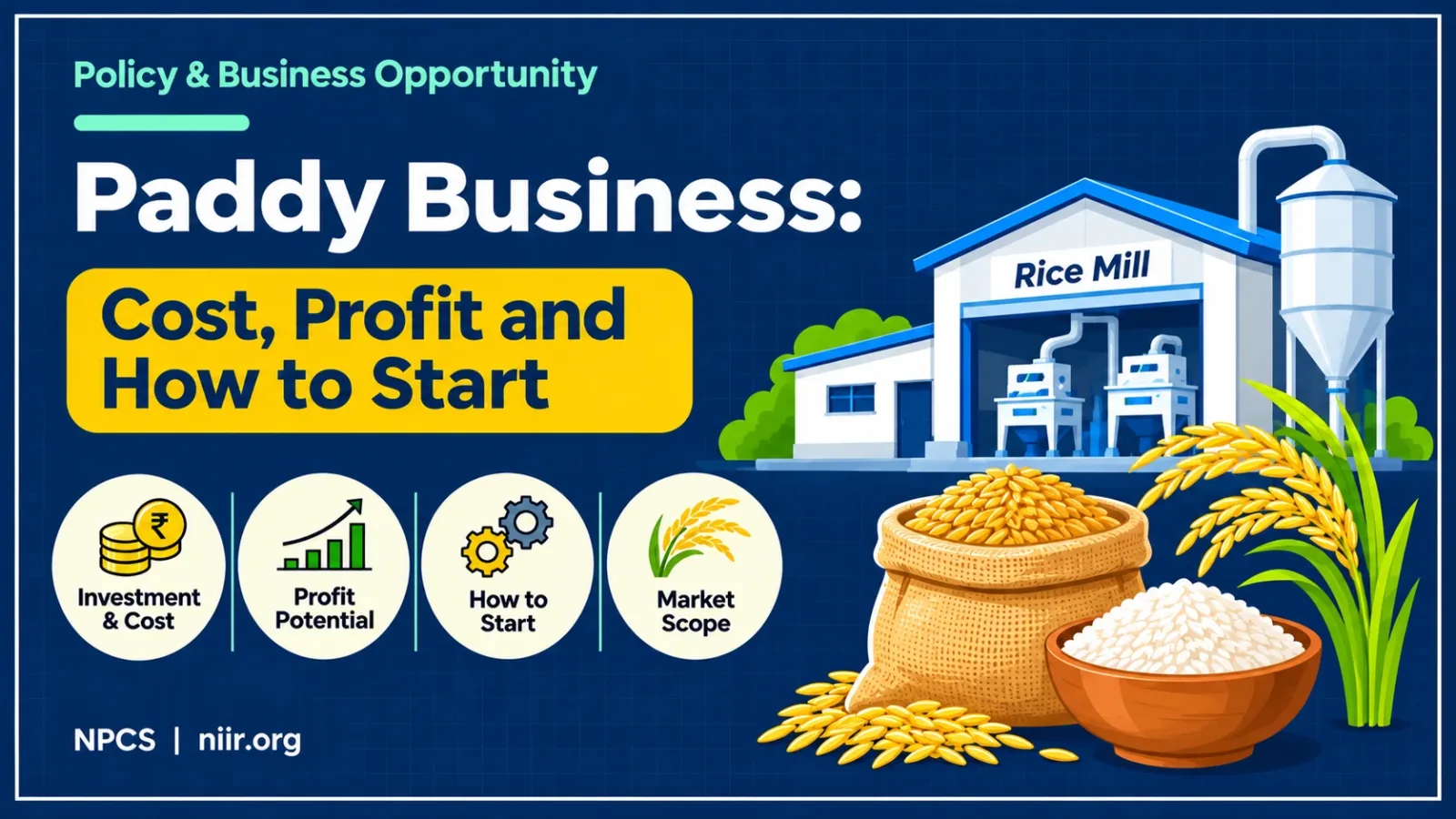
Paddy Business: Cost, Profit and How to Start
Contents 5 sections
A paddy business makes money at one of four points between the farm and the rice bag. You can grow paddy, buy it from farmers and sell it on, mill it into rice for yourself or for a government agency, or sell what milling leaves behind, such as husk, bran and straw. Each route needs a different amount of money and carries a different risk.
Trading needs cash more than machinery. Buying 100 tonnes of paddy at the 2026-27 support price of ₹2,441 a quintal ties up about ₹24.4 lakh until a mill pays you. Milling needs a plant, steady power and buyers for husk and bran. Custom milling for a state agency pays a fixed fee per quintal, while milling your own paddy earns the gap between what you pay for paddy and what rice sells for. The sections below set out what each route costs, the margins the government's own figures point to, and the quality rules and licences to sort out before your first purchase.
Paddy business models and what each one needs
|
Model |
What you do |
Main money needed |
How you earn |
Main risk |
|
Paddy farming |
Grow paddy and sell at the support price or to traders |
Land, seed, fertiliser, labour |
Price above your growing cost |
Weather and state purchase limits per farmer |
|
Paddy trading |
Buy from farmers or mandis, dry, clean and sell to mills |
Working capital, mandi licence, drying yard |
Trading margin, or a fixed commission on government buying |
Moisture loss and price swings |
|
Custom milling |
Mill a state agency's paddy and deliver the rice |
Rice mill, storage, bank guarantee |
Milling charge per quintal, plus husk and bran |
Missed deadlines and rejected rice |
|
Own-account milling |
Buy paddy, mill it, sell rice in bulk or under a brand |
Rice mill and months of paddy stock |
Paddy-to-rice spread plus by-products |
Rice prices falling while you hold stock |
|
Seed production |
Grow certified paddy seed for farmers |
Seed plots, processing, seed licence |
Selling as seed rather than grain |
Lots failing certification |
|
By-products |
Collect and sell husk, bran and straw |
Transport and storage |
Bran to oil mills, husk as fuel, straw to mushroom growers |
Supply only in milling season |
Trading and by-products need no plant, so they suit a first season spent learning local paddy supply and buyers. Milling is a factory decision with its own machinery and licences, covered in our guide on how to start a rice mill business.
Paddy business profit: what the official numbers show
The Centre's MSP decision for 2026-27 sets common paddy at ₹2,441 a quintal and Grade A at ₹2,461, the price government agencies pay farmers in procuring states.
|
Route |
Figure per quintal of paddy |
What it means |
|
Farming |
₹2,441 support price against a cost of ₹1,627 |
About ₹814 a quintal over cost at the support price |
|
Commission agent (arthiya) |
₹50.61 commission |
About 2.1% of the support price; ₹50,610 on 1,000 quintals |
|
Own-account milling |
₹2,441 of paddy gives 67 kg of raw rice |
About ₹3,643 of paddy per quintal of rice, before milling costs |
|
Custom milling |
Fixed charge set by the state |
Odisha pays ₹20 for raw rice and ₹40 for parboiled rice |
The cost figure, published with the support price, counts paid-out costs, rent on leased land and the value of family labour. The commission rates come from a Centre order effective from the 2026-27 season; cooperative societies get ₹35.30 a quintal.
How much rice and by-product comes from 100 kg of paddy
The government's milling norm, set by the Tariff Commission and reviewed by the CAG, expects 67 kg of raw rice or 68 kg of parboiled rice from 100 kg of paddy. FAO's Feedipedia puts husk at about 20% of paddy weight and bran at about 10%, varying with variety and polishing.
The milling spread in practice
On 27 November 2026, the Department of Consumer Affairs put the all-India average wholesale rice price at ₹4,360.79 a quintal. Against about ₹3,643 of paddy per quintal of rice, that leaves roughly ₹718 a quintal, or about ₹7 a kg, for power, labour, bags, interest and transport, before husk and bran sales. Open-market paddy often trades away from the support price, so redo this sum with your own mandi's prices.
Custom milling pays far less per quintal but ties up no money in paddy. The Centre's norm, fixed in 2005 at ₹15 for raw rice and ₹25 for parboiled rice, was still unrevised when the CAG audited it in 2015, and states now set their own rates. Odisha doubled its charges in June 2026, OrissaPOST reported.
Paddy quality rules and licences
Government agencies buy only fair average quality paddy, and private mills price against the same yardstick. The uniform specifications for KMS 2026-27, issued by the Department of Food and Public Distribution on 17 August 2026, set these limits:
|
Quality test |
Maximum allowed |
|
Moisture |
17% |
|
Foreign matter |
1% inorganic and 1% organic |
|
Damaged, discoloured and sprouted grains |
5% |
|
Immature, shrunken and shrivelled grains |
3% |
|
Admixture of a lower class |
6% |
Wet paddy loses weight as it dries, so test every lot with a moisture meter and price the loss into your bid. Paddy is Grade A when the grain is at least 2.5 times as long as it is broad, and Common below that.
Licences depend on the route:
• Trading: a trader or commission agent licence from the state agricultural marketing board, and GST registration.
• Milling: FSSAI registration or licence, state factory and pollution clearances, and Udyam registration for MSME benefits.
• Custom milling: empanelment with the state food department. In West Bengal, a mill's bank guarantee must match its milling capacity and caps the paddy it is allotted per shift.
• Seed: a dealer licence under the Seeds (Control) Order, 1983, plus field certification from the state seed certification agency.
How to start a paddy business, step by step
1. Pick one route for the first season. Trading and by-product supply suit a smaller budget; see our business ideas under ₹5 lakh if your capital is at that level.
2. Map paddy and buyers within trucking distance. Visit mandis at harvest, note arrivals and varieties, and list the mills, oil mills and boilers that buy paddy, bran and husk.
3. Get licences before you buy. Trading needs the mandi licence and GST first; milling adds FSSAI and state clearances.
4. Fix your quality checks. Buy a moisture meter, and agree in writing with each buyer how moisture and damaged grain will be deducted.
5. Run a small first lot. Buy, dry, store and sell one lot, and record weight lost, days your cash was tied up and the final margin.
6. Plan the by-products. Paddy straw is a common bed for growing mushrooms, as our mushroom farming guide explains, so mushroom growers can be buyers.
For more farm and food businesses, browse our how-to-start business guides.
Paddy business: frequently asked questions
How much rice do we get from 100 kg of paddy?
The government milling norm expects 67 kg of raw rice or 68 kg of parboiled rice from 100 kg of paddy. Most of the rest is husk, about 20 kg, and bran, about 10 kg, by FAO Feedipedia estimates. Variety, moisture and polishing shift your figure, so mill a few test lots before you price paddy.
Is a rice or paddy business profitable?
It can be, but margins per kg are thin. At late-November 2026 prices, wholesale rice sold for about ₹7 a kg more than the paddy it took to make it, at the support price, before milling costs. A commission agent earns ₹50.61 a quintal on government paddy. Profit comes from volume, low drying losses and good prices for husk and bran.
How much money do I need to start a rice business?
Trading needs working capital rather than machines. Each 100 tonnes of paddy at the 2026-27 support price costs about ₹24.4 lakh, though you can start with smaller lots, plus a mandi licence, a drying yard and moisture testing. A rice mill costs far more, adding machinery, buildings, power and months of paddy stock.
How much is 1 kg of rice in India?
On 27 November 2026, the Department of Consumer Affairs put the all-India average retail price of rice at ₹48.35 a kg, and wholesale at ₹4,360.79 a quintal. Prices vary widely by state and variety, so check the department's daily price data for your nearest centre before you set a selling price.
What is the MSP of paddy for 2026-27?
For the 2026-27 kharif marketing season, the support price is ₹2,441 a quintal for common paddy and ₹2,461 for Grade A, both up ₹72 from 2025-26. Government agencies pay it for paddy that meets the quality specifications. Private buyers are not bound by it, but farmers will compare every private bid with it.

Planning a new manufacturing unit?
NIIR prepares detailed project reports and feasibility studies for new projects. Share your requirement and the team will get in touch.