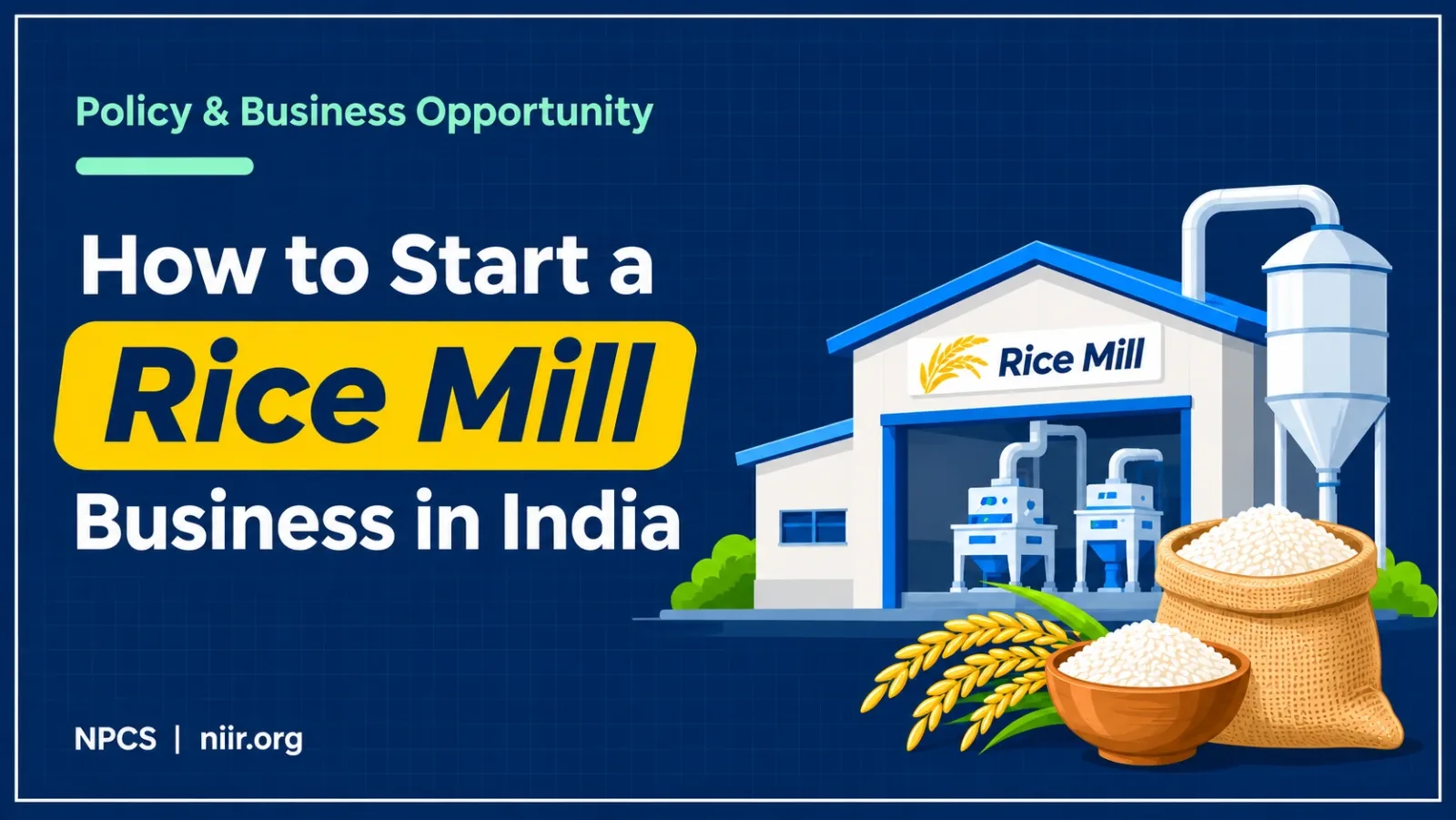
How to Start a Rice Mill Business in India
Contents 8 sections
- How much does a rice mill cost? Investment by capacity
- Is a rice mill business profitable? Outturn, by-products and margin
- Rice milling process, step by step
- Rice mill machinery and what each machine costs
- Where to set up a rice mill: paddy supply, custom milling and buyers
- Licences, pollution consent and subsidy for a rice mill
- Next steps before you buy rice mill machinery
- Rice mill business: frequently asked questions
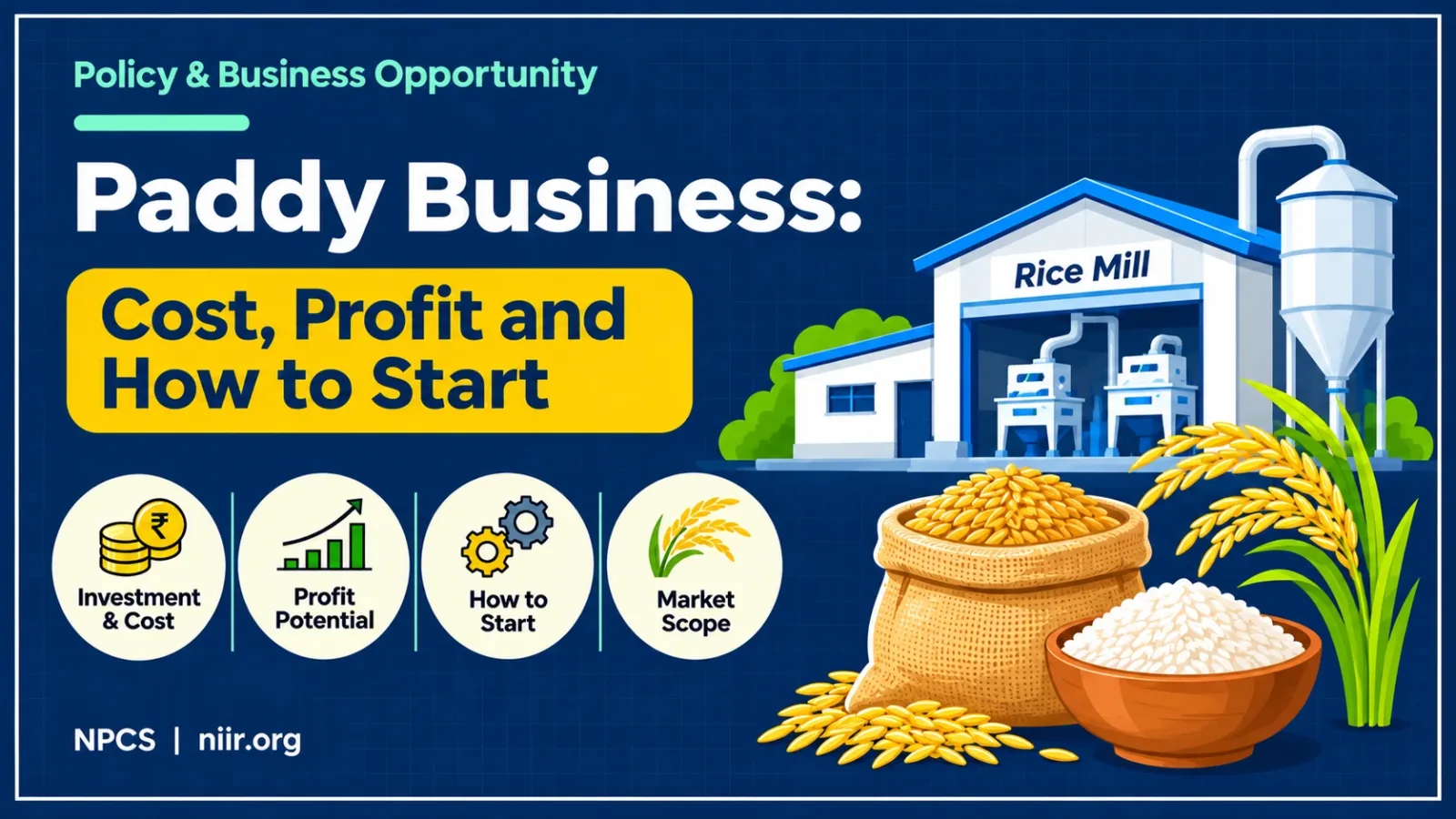
A rice mill business buys paddy, strips the husk, polishes the grain and sells white rice, with bran, broken rice and husk as by-products. The money sits in the gap between paddy and rice, and that gap is thin. In the NPCS sample report for a 15 tonne-a-day mill, net profit in the third year works out to about ₹3 per kg of rice.
Investment depends on scale. A mini rice mill costs about ₹50 lakh to ₹1 crore, a modern mill with a colour sorter about ₹4 crore, and a large mill with dryers and silos ₹8 crore to ₹15 crore. Paddy supply is not the constraint, since the Agriculture Ministry's third advance estimates put 2025-26 rice output at a record 1,540 lakh tonnes.
What decides profit is buying paddy well, getting more whole grains out of every quintal, and selling every by-product.
How much does a rice mill cost? Investment by capacity
The NPCS rice milling report gives three reference sizes. The table shows that machinery is less than half the cost; land, building and working capital make up the rest.
|
Mill type |
Capacity |
Total cost |
Machinery |
Land and building |
Working capital margin |
|
Mini rice mill |
0.3-0.5 tonne paddy per hour, no colour sorter |
₹50-100 lakh |
₹20-45 lakh |
₹15-35 lakh |
₹10-20 lakh |
|
Modern raw rice mill |
15 tonnes rice per day |
₹394 lakh |
₹182 lakh |
₹139 lakh |
₹33 lakh |
|
Large sorting mill |
2-4 tonnes paddy per hour, with dryer and silos |
₹8-15 crore |
₹3-6 crore |
₹2.5-5 crore |
₹1-2 crore |
The 15 tonne sample is funded 75% by a ₹296 lakh term loan and 25% by the promoter, plus a separate cash credit limit of about ₹100 lakh to carry paddy stock. First-time millers often leave this limit out.
Supplier quotes for a "1 ton" or "5 ton" mill usually mean tonnes of paddy an hour, while project reports state tonnes of rice a day. Convert before comparing: 1 tonne of paddy an hour for 20 hours gives about 13 tonnes of rice at a 67% outturn.
Is a rice mill business profitable? Outturn, by-products and margin
Profit comes from what each quintal of paddy turns into. The NPCS report's indicative outturn for 100 kg of paddy:
|
Output |
Kg per 100 kg paddy |
Who buys it |
|
Head (whole) rice |
55-62 |
Wholesalers, packers, government custom milling |
|
Broken rice |
5-12 |
Bagged separately at a lower price |
|
Bran |
8-10 |
Rice bran oil plants |
|
Husk |
20-22 |
Boilers and fuel buyers |
|
Dust, stones, moisture loss |
1-3 |
None |
Government custom milling expects more. The 2005 Tariff Commission norm, cited by the Comptroller and Auditor General (CAG), is 67 kg of raw rice or 68 kg of parboiled rice from 100 kg of paddy.
In the NPCS 15 tonne sample, rice sells at ₹41,700 a tonne ex-mill. Year 3 sales are ₹1,314 lakh and net profit ₹94 lakh, about 7% of sales. Return on investment is 24%, break-even comes at 37% of capacity, and payback takes about 3.4 years. Paddy is ₹926 lakh of the cost, so a 1% rise in paddy price that you cannot pass on cuts net profit by about a tenth.
Rice milling process, step by step
1. Pre-cleaning and destoning: straw, dust, stones and mud balls are removed.
2. Parboiling (parboiled mills only): paddy is soaked, steamed and dried, which hardens the grain so fewer kernels break.
3. Dehusking: a rubber roll husker strips the husk and an aspirator blows it away.
4. Paddy separation: grains that kept their husk go back to the husker.
5. Whitening: whiteners rub off the brown bran layer.
6. Polishing: a mist polisher gives the grain its shine.
7. Grading and sorting: a length grader separates brokens and a colour sorter rejects discoloured grains.
8. Weighing and packing.
Rice mill machinery and what each machine costs
The NPCS 15 tonne sample prices its plant at ₹181.93 lakh, and the whiteners and colour sorter take more than 40% of it.
|
Machine |
What it does |
Sample cost (₹ lakh) |
|
Pre-cleaner and destoner |
Cleans paddy |
21.83 |
|
Rubber roll husker with aspirator |
Removes husk |
25.47 |
|
Paddy separator |
Returns unhusked grain |
18.19 |
|
Vertical whiteners and mist polisher |
Remove bran, polish |
40.03 |
|
Rice and length grader |
Separates brokens |
14.55 |
|
Optical colour sorter |
Rejects off-colour grains |
36.39 |
|
Elevators, conveyors and bins |
Move and hold grain |
16.37 |
|
Weighing and bag stitching |
Packs rice |
9.10 |
A mill without a colour sorter mostly sells loose rice locally; packers buying for brands expect sorted rice. Rubber rolls are the part you will replace most often, so price them into running costs.
Where to set up a rice mill: paddy supply, custom milling and buyers
Set up close to paddy mandis and on a road trucks can use in the monsoon. Paddy arrives in a few harvest months but is milled all year, which is why stock finance matters. In rice belt states, our guide to business ideas in West Bengal covers other agro units that share the same supply.
Many mills also do custom milling. State agencies buy paddy at the minimum support price and pay mills to deliver rice at the outturn norm. The charges are small: the central rates fixed in 2005 were ₹15 a quintal for raw rice and ₹25 for parboiled, according to CAG, and states set their own. Odisha doubled its rates in June 2026 to ₹20 and ₹40, the Deccan Chronicle reported. The miller keeps the by-products, and those carry the margin.
Husk can feed your own boiler or be sold as fuel; our page on biomass pellet uses explains one outlet. For branded retail packs, see starting a packaging business.
Licences, pollution consent and subsidy for a rice mill
The NPCS sample lists these approvals:
• Udyam (MSME) and GST registration
• FSSAI registration or licence, depending on turnover
• Legal Metrology registration for packed rice
• Factory licence or labour registration where worker thresholds apply
• Fire NOC and local trade licence
• Consent to establish and operate from the State Pollution Control Board
The Central Pollution Control Board's February 2025 list puts raw rice mills (no soaking or steaming) in the Green category, according to its 2025 reply to the National Green Tribunal. Parboiling mills must get both consents before they operate.
For finance, the Agriculture Infrastructure Fund guidelines list cereal hulling, milling and parboiling as eligible primary processing, with 3% interest subvention on loans up to ₹2 crore for seven years. Those guidelines set disbursement until 2025-26, so confirm with your bank that it still sanctions new loans. The PMFME scheme gave micro units a 35% credit-linked subsidy up to ₹10 lakh; its last extension ran to September 2026, PTI reported, so check pmfme.mofpi.gov.in before counting on it.
Next steps before you buy rice mill machinery
1. List the paddy varieties grown within easy trucking distance and get a test milling done on each, so you know your real head rice yield.
2. Decide raw or parboiled from local demand, not from the machinery brochure.
3. Line up buyers for bran, brokens and husk before commissioning.
4. Apply for the cash credit limit together with the term loan.
An NPCS project report for a rice mill covers the paddy buying plan, outturn, machinery with supplier names, licences, means of finance, five-year profitability, DSCR and break-even. NPCS has prepared over 5,000 project reports since 1994, in the format banks typically ask for. Figures still vary with land price, machine make and whether you add a dryer or parboiling section.
Rice mill business: frequently asked questions
How much electricity does a rice mill use?
In the NPCS 15 tonne sample, power and fuel cost ₹28.49 lakh in year 3, about 2.2% of sales. Parboiling adds steam for soaking and drying, which many parboiled mills raise by burning their own husk. Apply early for a three-phase industrial connection sized to your machinery load.
What is the difference between raw and parboiled rice milling?
Raw milling dehusks and polishes dry paddy directly. Parboiled milling first soaks, steams and dries the paddy, so the grain hardens and fewer kernels break, and the government outturn norm rises from 67 kg to 68 kg per 100 kg of paddy. Parboiling adds a boiler, soaking tanks and dryers, more water, and wastewater to manage.
Can I start a rice mill with ₹10 lakh?
Not a full mill. The NPCS mini rice mill range starts at about ₹50 lakh including shed and working capital, and that size has no colour sorter. With ₹10 lakh you can at most run a small huller doing job-work for local farmers, which earns milling fees rather than a margin on rice. Job-work needs no paddy stock.
How many workers does a rice mill need?
The NPCS 15 tonne sample employs 25 people: 4 in management and administration, 9 skilled workers and operators, and 12 semi-skilled and unskilled workers. Wages come to about ₹52 lakh in year 3. A mini mill runs with far fewer, but someone must still know how to set rubber roll gaps and whitener pressure, because that skill decides breakage.

Planning a new manufacturing unit?
NIIR prepares detailed project reports and feasibility studies for new projects. Share your requirement and the team will get in touch.