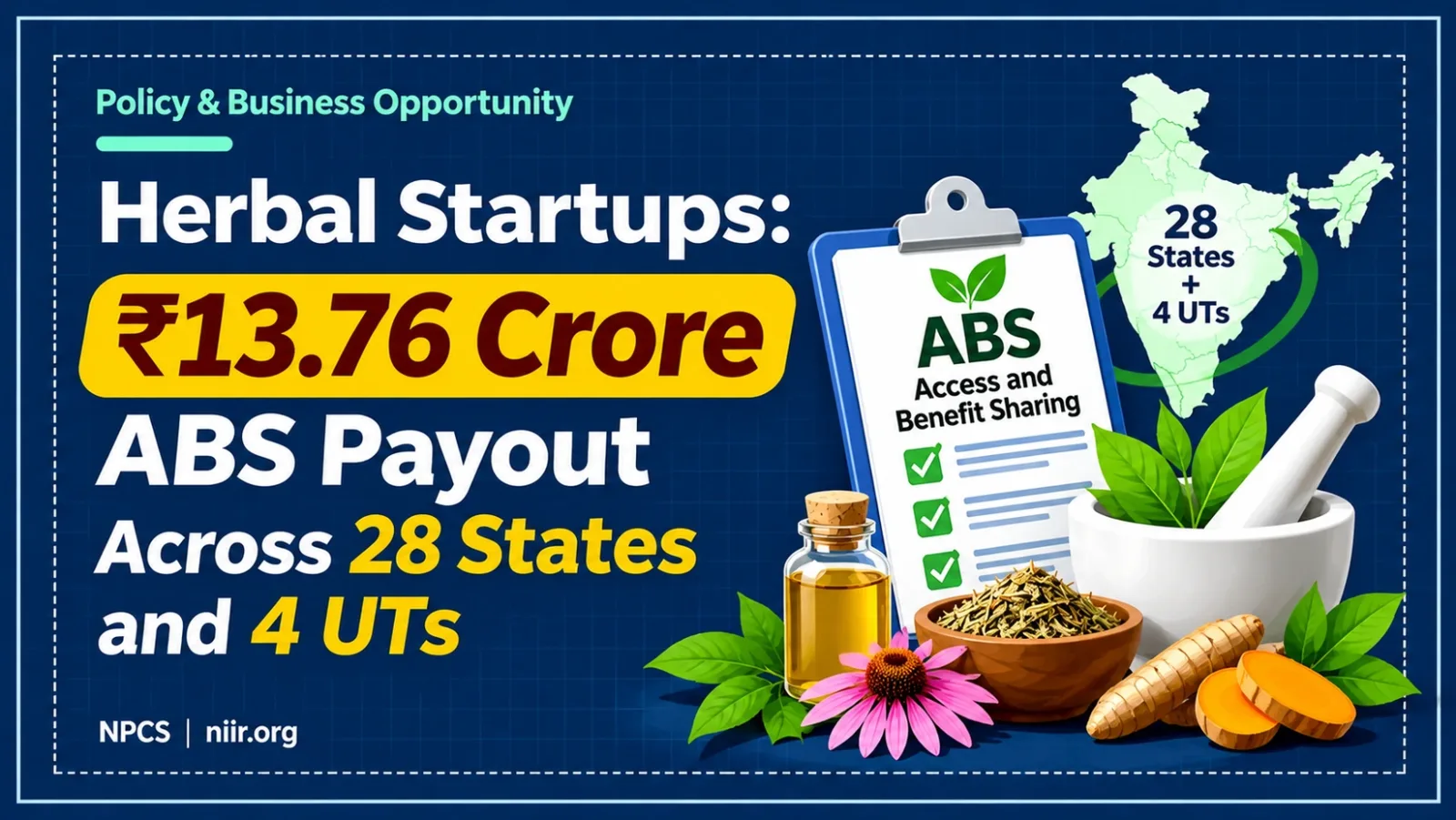
Herbal Startups: ₹13.76 Crore ABS Payout Across 28 States and 4 UTs
Contents 6 sections
The National Biodiversity Authority (NBA) has paid out ₹13.76 crore across 28 states and 4 union territories, money that AYUSH companies paid for using 234 medicinal plant species. For herbal startups, the release is a map of demand: ten herbs, led by guggul and ashwagandha, made up ₹6.45 crore of the total. A startup with turnover under ₹5 crore pays no benefit share under the 2025 access and benefit sharing (ABS) rules, though it must file a yearly statement once turnover passes ₹1 crore. Cultivated medicinal plants are exempt from prior intimation, which favours startups that source from farms.
28 November 2026: updated after the NBA payout announced through PIB on 27 November 2026. Next milestone: further payouts and the Ministry of Environment's list of exempt products.
Confirmed so far
•Benefit sharing by turnover slab under the 2025 ABS regulations, notified on 29 April 2025.
•An annual statement is due from users with turnover above ₹1 crore.
•Cultivated medicinal plants notified under the Act are exempt from prior intimation to State Biodiversity Boards.
Still awaited
•The Ministry of Environment's list of products using both cultivated and wild plants that will pay no benefit share.
Where the ₹13.76 crore ABS payout went
The ₹13.76 crore came from three applications by AYUSH manufacturers covering 234 species, and ten species alone accounted for ₹6.45 crore: guggul, ashwagandha, bhringraj, punarnava, sarpagandha, kalmegh, black pepper, amla (Indian gooseberry), gokhru and shalparni. Because these plants are bought through traders and markets, the NBA could not trace individual collectors. It split the money by each state's forest cover and the occurrence of the plants.
|
State |
ABS share |
|
Maharashtra |
₹1.75 crore |
|
Arunachal Pradesh |
₹93.75 lakh |
|
Andhra Pradesh |
₹88.08 lakh |
|
Karnataka |
₹87.15 lakh |
|
Kerala |
₹79.30 lakh |
|
Odisha |
₹78.55 lakh |
|
Madhya Pradesh |
₹69.90 lakh |
|
Tamil Nadu |
₹63.03 lakh |
|
Other states and UTs |
₹6.41 crore |
The NBA has collected ₹278 crore in ABS so far and disbursed ₹218.86 crore.
Herbal startup ideas from the ABS payout
The ten species named in the release show where AYUSH makers are buying, and the cultivation exemption rewards supply that can be traced to a farm.
|
Opportunity |
What the unit does |
Why ABS rules help |
Suits |
|
Contract cultivation of high-demand herbs |
Grows ashwagandha, kalmegh or shalparni for AYUSH buyers |
Cultivated medicinal plants are exempt from prior intimation |
Farmers, FPOs |
|
Drying, grading and primary processing |
Cleans, dries, grades and packs raw herbs |
Buyers need clean, traceable raw material |
Rural entrepreneurs, SHGs |
|
Standardised herbal extracts |
Ashwagandha, amla or guggul extracts |
Higher value than raw herb |
Small chemical and food units |
|
AYUSH contract manufacturing |
Tablets, churnas, capsules for brands |
No benefit share under ₹5 crore turnover |
First-time manufacturers |
|
Black pepper and amla processing |
Grading, powders, candy and juice |
Both are among the ten top species |
Food processing units |
AYUSH companies above ₹1 crore turnover must report the biological resources they use each year. This suggests that a supplier offering cultivated, traceable material with clean purchase records will be easier for them to buy from.
Support and finance for herbal startups
Each route funds a step in the herbal supply chain.
|
Route |
Who it suits |
What it offers |
Where to apply |
|
e-CHARAK portal |
Growers and processors |
Trade platform with fortnightly prices for 100 medicinal plants from 25 herbal markets |
NMPB, Ministry of Ayush |
|
Mission for Integrated Development of Horticulture (MIDH) |
Growers and post-harvest units |
Horticulture support that includes medicinal plants, in all states and UTs |
State horticulture department |
|
Micro and small processing units |
Guarantee on collateral-free credit up to ₹10 crore |
Member lending banks |
|
|
Mutual Credit Guarantee Scheme (MCGS-MSME) |
MSMEs buying machinery |
60% guarantee on loans up to ₹100 crore; machinery at least 60% of project cost |
Banks and lenders registered with NCGTC |
NPCS has prepared more than 150K project reports across 40+ industries since 1994, and its research process is ISO 9001:2015 certified.
Lenders appraise a herbal unit on its project report. An NPCS report covers the process, market survey, machinery, raw materials and financials up to break-even. It supports a loan application but does not guarantee approval.
ABS rules every herbal startup should know
For an Indian-owned company, ABS means a notice before sourcing and a turnover-linked payment after selling.
|
Annual turnover |
Benefit share (% of annual gross ex-factory sale price, excluding taxes) |
|
Up to ₹5 crore |
Nil |
|
Above ₹5 crore to ₹50 crore |
0.2% |
|
Above ₹50 crore to ₹250 crore |
0.4% |
|
Above ₹250 crore |
0.6% |
These slabs come from the Biological Diversity (Access to Biological Resources and Knowledge Associated thereto and Fair and Equitable Sharing of Benefits) Regulations, 2025, which replaced the 2014 guidelines. Two other rules matter to a manufacturer:
•Annual statement. Users with turnover above ₹1 crore file Form A within three months of finalising their income tax return.
•Exemptions. The 2023 amendment to the Act, in force from 1 April 2024, frees codified traditional knowledge, cultivated medicinal plants and their products, local growers and registered AYUSH practitioners from prior intimation to the State Biodiversity Board.
What a herbal startup should prepare
1.Map your biological inputs, and whether each is cultivated or wild-collected.
2.Keep purchase and origin records for the annual statement and any cultivation claim.
3.Track turnover against the slabs: ₹1 crore triggers the statement, ₹5 crore the 0.2% share.
4.Register on the NBA portal before your first statement or payment falls due.
New rules, exempt-product lists and disbursements are published by the National Biodiversity Authority (nbaindia.org) and in PIB releases from the Ministry of Environment, Forest and Climate Change.
Frequently asked questions about access and benefit sharing
When does a herbal startup have to pay ABS?
Once annual turnover crosses ₹5 crore, you pay a share of the ex-factory sale value of products made from biological resources: 0.2% up to ₹50 crore, 0.4% up to ₹250 crore and 0.6% above. Below ₹5 crore nothing is payable, though a statement is due above ₹1 crore.
Who has to comply with ABS rules?
Anyone using Indian biological resources or associated knowledge commercially. Indian-owned firms give prior intimation to their State Biodiversity Board; foreign-controlled firms need NBA approval. Codified traditional knowledge, cultivated medicinal plants, local growers and registered AYUSH practitioners are exempt from prior intimation.
Are AYUSH products made from cultivated herbs exempt from benefit sharing?
Cultivated medicinal plants notified under the Act are exempt from prior intimation. For products that mix cultivated and wild plants, no payment will be due on products the Ministry of Environment notifies with the NBA and the Ministry of Ayush, but that list has not yet been published.
Which herbs earned the most in the ₹13.76 crore ABS payout?
Ten species accounted for ₹6.45 crore of the ₹13.76 crore: guggul, ashwagandha, bhringraj, punarnava, sarpagandha, kalmegh, black pepper, amla, gokhru and shalparni. The payout covered 234 species in all. These are the herbs AYUSH companies are buying, which makes them a sensible starting point for a cultivation, processing or extract startup.

Planning a new manufacturing unit?
NIIR prepares detailed project reports and feasibility studies for new projects. Share your requirement and the team will get in touch.