
A consultant’s view of where heritage strength meets modern demand in Indian textiles.
India has been weaving cloth for thousands of years. This heritage is evident in the present-day, one of the largest textile industries in the world. As a first-time founder, textile business ideas represent an intriguing opportunity with a unique combination of deep raw-material strength, strong domestic demand and export base, and a chance to build a differentiated position in the market. Whether you have a vision for a small processing unit or a branded garment line, the sector provides scope for a disciplined newcomer.
We will study the sector as a feasibility consultant would. We will assess demand drivers as well as existing schemes and evaluate five practical manufacturing routes for new entrants, while studying trade opportunities and Indian success stories that new founders can learn from.
Why Textiles Remain a Strong Sector to Enter
Domestic Demand and Export Strength Together
There is strong domestic demand for textile products ranging from basic cloth to branded fashion. As clothing and home textiles are everyday necessities, the demand for such products remains fairly resilient. As such, even a small unit is poised to find a market fairly quickly, particularly as it can offer consistent quality.
Further, the export strength provides a second engine for growth. Indian manufacturers are major suppliers of fabric, yarn, and garments internationally. Further, many buyers in the China+1 sourcing strategy are looking to India as an alternative supplier base.
A Value Chain With Multiple Entry Points
The value chain in textiles is broad, ranging from fibre, yarn, fabric, processing, and garments, allowing any founder to pick the entry point that suits them and their resources. Sector support from the Ministry of Textiles and Textile Commissioner provides critical support in terms of understanding demand and compliance.
Government Policies and Incentives
The government has multiple initiatives to promote the industry, such as PM MITRA Mega Textile Parks and the PLI Scheme for Textiles, which promote manmade fibre and technical textile manufacturing, and offer significant benefits.
Founders should take advantage of initiatives such as registering on the Udyam portal to gain access to collateral-free credit and priority sector lending. The cluster development push from the Ministry of MSME will benefit smaller units. Export incentives via the Apparel Export Promotion Council (AEPC) also provide significant advantages, with access to market intelligence and buyer outreach.
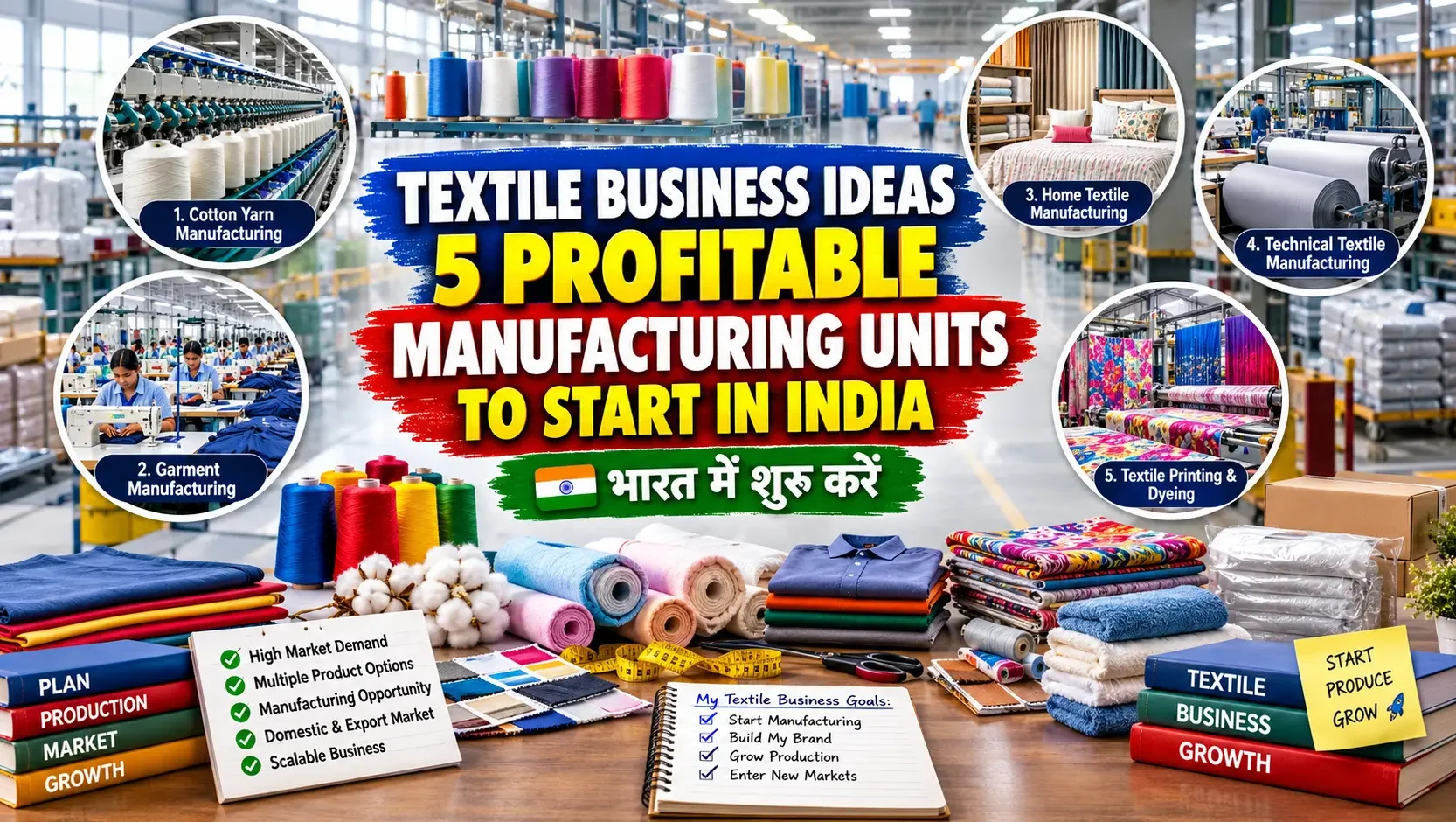
5 Textile Business Ideas for Startups
Idea 1 — Yarn Spinning Unit
Spinning units are the backbone of the textile industry. The demand for yarn is constant, since every fabric maker requires it to create fabric. A founder can enter the industry with a spinning unit and begin building recurring revenue with fairly low capital. A founder can begin by focusing on a specific fibre, such as cotton or polyester, and build experience and expertise. The count and strength are vital, since fabric manufacturers will buy based on specifications. Having a local spinning unit reduces delivery time and costs for the weaver and mill, a significant advantage in the competitive textile space. Furthermore, the range can be expanded to include blended or specialty yarns, which offer better margins. Additionally, high-quality Indian yarn is in demand on the international market, and the unit can use this as a second revenue stream.
Idea 2 — Technical Textiles Manufacturing
Technical textiles have diverse applications, including in agriculture, healthcare, construction, and safety equipment, which gives the space significant demand diversity. While fashion textiles face the risk of changing trends, technical textiles represent a stable demand base. A manufacturer that can create technical textiles can target a specific application, such as geo-textiles, medical textiles, or protective fabrics, and build expertise. The PLI Scheme for technical textiles provides substantial incentives. The main priority is on quality, since buyers require performance reliability. Furthermore, technical textiles are an area of significant focus from the government, and there are opportunities in import substitution with regard to technical textile components. A focused technical textile manufacturing unit has the potential to build a stable, long-term client base.
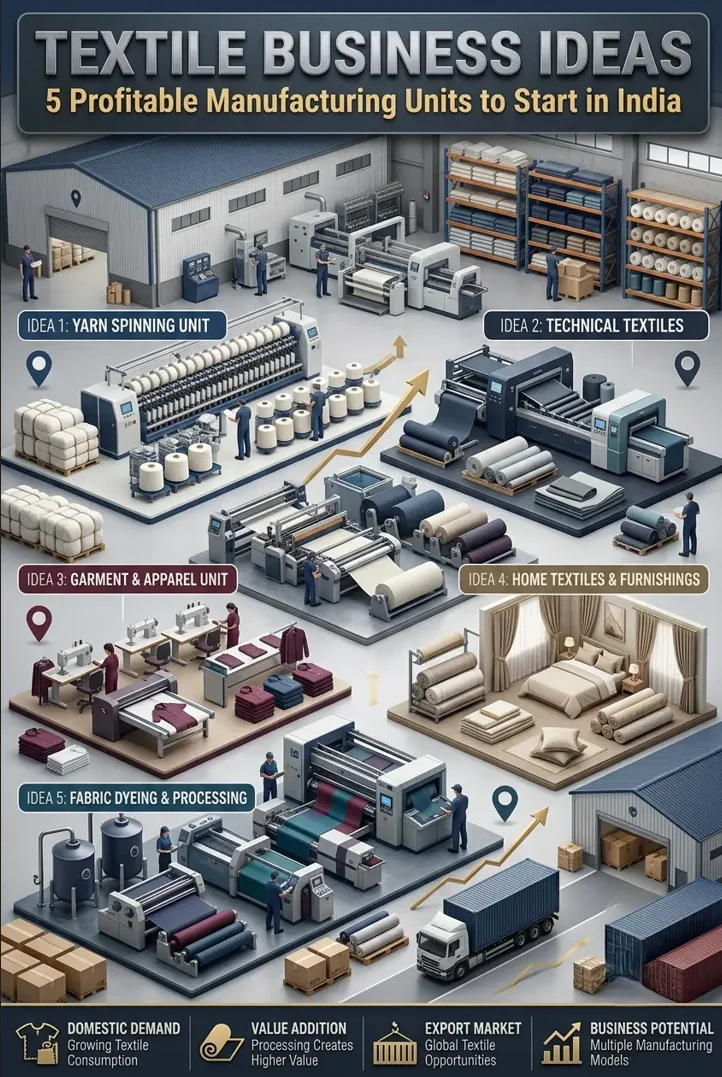
Idea 3 — Garment and Apparel Unit
Garment manufacturing represents the largest end-market for textile manufacturers, ranging from mass retailers to branded fashion houses. A garment unit can target one category, such as workwear or children’s apparel, and build a consistent offering. Fast delivery and consistent quality are key differentiators, since buyers such as brands and exporters require reliability. A local garment manufacturing unit is well-positioned to capture global orders due to the China+1 strategy. Additionally, government export schemes can benefit new exporters, and a garment manufacturing unit that provides consistent quality has the potential to scale both domestically and internationally.
Idea 4 — Home Textiles and Furnishings
Home textiles and furnishings enjoy stable domestic and export demand. As home textiles are essential items, buyers tend to reorder consistently. Export demand is particularly strong for Indian home textiles, which are known for their quality and desirability. A unit that focuses on creating high-quality home textiles with appealing designs is poised to capture both domestic and international demand. It is useful to begin with a specific category such as towels or bed sheets and build expertise. Additionally, e-commerce and brand partnerships open new distribution channels. A home textile unit that focuses on quality and appealing designs can leverage its offering to gain both domestic and global buyers.
Idea 5 — Fabric Dyeing and Processing Unit
Processing units are critical enablers for any fabric or garment manufacturing unit, which makes them an attractive entry point. A processing unit can focus on a specific fibre and serve weavers and garment manufacturers in the local area. Processing services can include dyeing, finishing, and other specialities, and the most important factors are consistent quality and fast turnaround. It is important to comply with effluent norms, and a sustainable, environmentally-friendly approach is a significant long-term advantage. The entry-level focus can be on a specific type of fibre, after which the unit can expand its client base and range of fabrics processed. Further processing value-adds such as water-repellent or anti-microbial finishes can be offered to enhance margins.
Import-Export Opportunity Analysis
Trade dynamics strongly favour Indian textile manufacturers. India is a major exporter of fabric and garments. The China+1 strategy represents a significant opportunity, as textile buyers seek alternative suppliers. Additionally, technical textile components and other specialist fibres are imported, and local manufacturers can substitute these imports.
In terms of exports, quality, compliance, and documentation are critical to securing buyers. The AEPC and Textile Commissioner provide significant support in terms of documentation and buyer outreach, and a unit aimed at both domestic and international supply chains has benefits from both sides, as supply and demand are both strong.
Indian MSME Success Stories Worth Studying
Vardhman Group, founded by the Oswal family, is a prime example of a successful textile business that began its journey as a single spinning mill and grew to be a large textile conglomerate by focusing on quality investment and patience. The company demonstrates the value of reinvestment in the long-term growth of the business.
While Raymond and Welspun are both major players in the fabric and home-textile space, respectively, they share similar success mantras. These have allowed them to scale significantly: careful focus on quality and distribution networks.
Newer entrants can learn from these companies’ success stories by identifying a niche area. They can focus on delivering high quality and slowly building their distribution base. This can help them gain a strong reputation in the market place.
About NPCS
We at Niir Project Consultancy Services (NPCS) provide professional consulting for the preparation of Market Survey cum Detailed Techno-Economic Feasibility Reports (DPRs) for setting up new industries or businesses. Our reports include detailed manufacturing processes, market research and demand analysis, process flow diagrams, product mix and capacity planning, machinery and raw material details, and complete project financials with profitability analysis. Our objective is to help entrepreneurs evaluate feasibility, profitability, and long-term scalability before investing.
NPCS has published a comprehensive printed reference book on textile manufacturing, covering technology, market analysis, investment parameters, and manufacturing processes in depth — the printed book: The Complete Technology Book on Textile Spinning, Weaving, Finishing and Printing
For a detailed techno-economic Project Report on setting up a manufacturing business in this sector — including plant economics, machinery lists, financial projections, and applicable government incentives — the NPCS Project Report: Explore the Technical Textiles Projects
Conclusion
Textiles reward founders who combine consistent quality with disciplined operations and smart use of export policy. Demand is vast, schemes are real, and China+1 opens new global doors. Therefore, the winners are those who pick a focused segment, master quality, and build distribution steadily. A detailed feasibility report converts that plan into a fundable, bankable reality.
Your Investment Deserves the Right Opportunity
Every serious investment begins with choosing the right sector and the right business model. With hundreds of industrial opportunities available across India’s manufacturing and clean-energy landscape, making the most informed choice is critical. Niir’s Startup Selector tool helps entrepreneurs, MSMEs, and investors identify the most suitable business opportunities based on their investment capacity, location, and interests — so your capital is directed toward a venture with the strongest fit and potential. Explore your best-fit business opportunity today.