

Introduction: Textile Manufacturing Business Ideas in India
Textile and fabric industry is one of the most diversified and job making industries in India. It encompasses small units of handloom, as well as large units of industrial manufacturing. The most appealing aspect of this sector is the fact that it permits entrepreneurs to begin small and grow slowly without the huge capital at the outset.
The current market has seen an increase in the demand of textile products which has been fuelled by domestic demand as well as exports to the international markets. An increase in population, fashion consciousness, growth of the e-commerce industry and the sustainability trends are generating on-going opportunities under various categories.
The main reasons why the textile manufacturing business is such a good option are:
- Continuous year-round demand
- Low medium investment options.
- Strong export potential
- MSME schemes by the government.
- Small unit can be readily scaled to large factory.
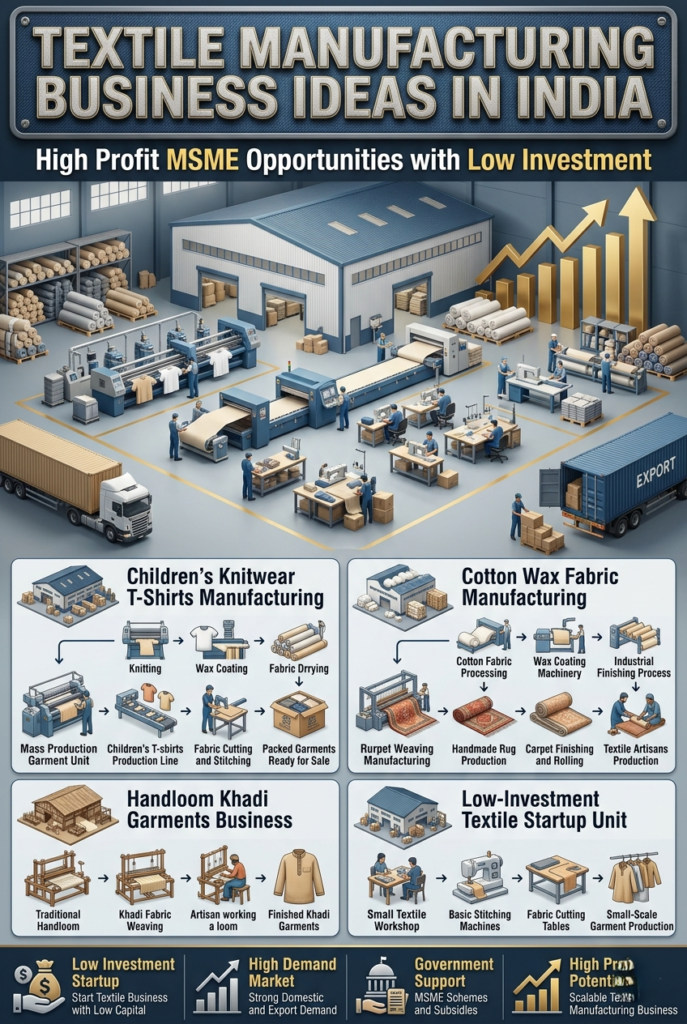
Children’s Knitwear T-Shirts Manufacturing
One of the most consistent and timeless market in textile industry is children knitwear. In contrast to the fashionable apparel markets, the kids wear is founded on the necessity since children are always growing bigger than their clothes.(Textile Manufacturing Business Ideas)
The Indian kids wear market is already huge and is expanding at a consistent rate particularly in the tier-2 and tier-3 cities where brand penetration is still in its early stages. It provides a good chance to local manufacturers and own labels.
A small factory can simply begin with knitting machines, stitching devices, and sourcing of fabric in the textile centers such as Tiruppur or Ludhiana. When the production level is stabilized, entrepreneurs will be able to enter the branding and online sales channels.
Get Detailed Insights from This Book: Modern Technology of Textile Dyes & Pigments (3rd Edition)
Cotton Wax Fabric Manufacturing
Cotton wax fabric or Ankara or African print fabric is a highly design oriented textile product which has acquired a high degree of recognition all over the world. It is commonly applied in fashion clothes, ethnic clothing and designer clothing.
Its production consists of specialised printing methods which produce bright and vivid designs on cotton cloth. Although it has certain technical requirements, it is not too complicated in the case of MSMEs.
Why this business is attractive:
- High export level within the African and European markets.
- High design value imparts high pricing.
- Increased trend in fashion and cultural apparel.
This part gives credit to innovativeness, with distinctive designs having a direct effect on sales and profit margins.
Rugs and Carpets Manufacturing
India has been a major producer and exporter of carpets and rugs in the world. Other areas such as Bhadohi, Jaipur, Agra, and Kashmir have established reputations in the world as the source of both handmade and machine-made carpets.
There are various points of entry in this industry based on the capital and level of expertise.
- Luxury export carpets that are hand knotted.
- Large scale machine tufted carpets.
- Eco-friendly jute and cotton rugs.
The export market is also very robust, and consumers in the USA, Europe, and Middle East are leading to steady demand. Growth in real estate and interior design trends are also contributing to domestic demand.
Get Detailed Project Report (DPR): Textile Processing and Auxiliaries
Handloom Khadi Garments Business
One of the most culturally relevant textile products in India and highly backed by the government is Khadi supported by KVIC. It is also being repositioned now as a high end sustainable fashion product.(Textile Manufacturing Business Ideas)
Low entry cost and government support is one of the greatest strengths of this segment. The entrepreneurs are able to begin with low infrastructure and be able to increase production in stages.
The main advantages of khadi production:
- Subsidies and support from KVIC
- Low investment requirement
- Good environmental positive brand value.
- Availability of institutional buyers.
Kurtas, sarees, jackets are some of the khadi products that are gaining popularity among urban consumers who seek sustainable fashion.
Undergarments Manufacturing Business
The Indian innerwear market is expanding fast and has become one of the most promising textile industries. The industry is estimated to be worth tens of thousands of crores and is growing as a result of the changing lifestyles and rising brand consciousness.
This industry comprises of male, female and child undergarments and the market demand is stable throughout the year.
Why this business works well:
- Frequent repeat purchase.
- Huge unorganised market that is untapped.
- Increased needs of comfort and branded products.
The small manufacturing unit may begin with knitting, cutting, stitching, and finishing. This is a very stable business with recurring income once distribution channels have been established.
Fabric Whitener Manufacturing
Fabric whitener is a product that is made of chemicals that are used in homes, laundry shops, hotels and hospitals to improve the brightness of fabrics. It operates based on optical brightening agents that enhance the look of white garments.
It is a high-speed product that has a stable demand both in the retail and industrial market.
Business highlights:
- Low setup price as compared to textile manufacturing.
- Continuous demand throughout the year
- Appropriate in both FMCG and B2B.
Manufacturing entails mixing, blending and packaging of chemicals. Consistency and branding of products is a key to success in this segment.
Related Article: 20 Textile Business Ideas for Entrepreneurs
Sewing Thread Manufacturing
One of the most essential inputs to the whole textile ecosystem is sewing thread. All the garment and upholstery products, as well as all the industrial fabrics, need thread, and that is why this is a very stable business.(Textile Manufacturing Business Ideas)
The Indian sewing thread market is huge with a consistent growth because of the growth of garment production and exports.
Key advantages:
- Continuous industrial demand
- Good B2B customers.
- Repeat orders when trust established.
Winding and finishing are usually the initial stage of the entrepreneurial venture, after which full dyeing and twisting facilities are added. The most significant success factor in this business is consistency of quality.
Recycled Textile Fibre Manufacturing
One of the rapidly developing sustainable industries in the world is the recycled textile fibre. It entails recycling old clothing and textile wastes to usable fibre in making blankets, insulation, yarn and industrial purposes.
India and Panipat in particular is already a world center in textile recycling.
Why this sector is booming:
- Growing attention to sustainability in the world arena.
- Laws in the EU which require recycled material.
- Plentiful availability of raw material in India.
This involves sorting, shredding, and fibre regeneration with special machines. Margins are favourable because of low prices of raw materials and high demand of exports.
Role of NPCS (NIIR Project Consultancy Services)
Proper planning is very crucial to entrepreneurs venturing into the textile manufacturing industry. One of the critical stakeholders in this field is NPCS (niir.org), which offers a comprehensive project report and feasibility study.
With these reports, entrepreneurs are able to know:
- Machinery requirements
- Investment structure
- Raw material sourcing
- Production process flow
- Break-even and profitability analysis.
NPCS has been helping MSMEs and first-generation entrepreneurs throughout decades in India. Their reports minimize risk and aid in making informed investment decisions prior to initiating a business.
Find the most profitable startup for your investment range
Conclusion: Future of Textile Manufacturing in India.
The textile manufacturing sector in India presents a unique opportunity to find stability, scalability and diversity. Small khadi units, and the large scale recycled fibre plants have prospects of all levels of investor.
The possibility to integrate the ancient craftsmanship with the industrial development is what makes this sector particularly strong. Meanwhile, increased demand of sustainable and low-cost textiles in the world is creating more opportunities to export.
Quality, planning, and consistent execution are key elements of entrepreneurship that enable entrepreneurs to create long-term profitable business in this industry. Textile production remains one of the most promising industrial opportunities within India in the next few years through the assistance of the government and increasing market demand.
Frequently Asked Questions (FAQ)
Q1. Is manufacturing of textile a profitable business in India?
Yes, the textile industry is very lucrative since there is consistent demand, there is a possibility of exporting goods and the government is providing support to MSMEs.
Q2. What is the amount of investment needed to begin a textile business?
Investment varies widely:
- Small unit: ₹2–5 lakh
- Medium unit: ₹10–50 lakh
- Large factory: ₹1 crore and above
Q3. What is the most beginner textile business?
Easy entry points are:
- Kidswear manufacturing
- Sewing thread business
- Khadi garments
- Fabric whitener production
Q4. Which is the most profitable textile unit?
High-profit segments include:
- Export-quality carpets
- Recycled textile fibre
- Branded undergarments
- Designer fabrics
Q5. Are textile MSMEs supported by government?
The government programs which offer MSME subsidies and KVIC support together with export incentives are available to textile entrepreneurs.
Q6. Can I be a textile business in the house or in a small area?
The statement is correct that various enterprises including stitching units and kidswear production facilities and small-scale garment operations can start their business activities from small towns.