
Paper may be one of the oldest materials humans have manufactured, but the industry that produces it today is anything but static. Across India and globally, a confluence of forces is reshaping the pulp and paper sector: a growing population and rising demand for packaging, education and office paper; environmental regulations that push the paper industry towards the use of recyclable inputs and processes; and a wave of technological innovation that makes it possible to create high quality papers from new raw materials that previous generations of paper-makers would never have considered, such as agricultural residues, bamboo, elephant grass, water hyacinth and even recyclable composites.
For entrepreneurs, investors and industrial professionals looking to enter or expand within the paper and paper conversion space, they can find opportunities to be had. But it requires technical knowledge beyond the level of general business planning. Paper industry requires understanding of the entire industrial system. This includes raw material selection, pulping chemistry, effluent management, machinery design and conversion technology. These topics have to be understood together.
A Market That Grows With the Economy
India’s paper industry has a direct documented correlation with economic growth. When industrial output rises, so does the demand for packaging paper. Marketing and retail activity expands, so does the demand for newsprint and coated paper. When educational enrolment and office activity grow, the demand for writing and printing paper moves in the same direction. India has been experiencing consistent growth in both.
India’s paper industry is one of the largest in the country by volume of output. Per capita paper consumption in India is still well below the global average. This means there is headroom for demand growth as incomes rise and consumption patterns develop.
The packaging segment in particular has been growing rapidly. E-commerce, organised retail, FMCG expansion, and the replacement of unpackaged goods with branded, packaged alternatives drive it.
In terms of raw material, the industry faces a structural challenge but also holds a significant opportunity. The traditional virgin wood fibre that goes into pulp and paper is scarce relative to demand. Forest cover remains limited and protected, and importing wood pulp creates cost and supply chain disadvantages. The industry has found itself in a position where the development of alternative raw material technologies is both commercially necessary and technically exciting.
Agricultural Waste: The Raw Material Revolution in Paper Manufacturing
Perhaps the most significant shift underway in the paper industry is the turning towards non-wood fibre and agro-waste. These are increasingly used as sources for paper production. Sugarcane bagasse, bamboo, rice and wheat straw, jute and sun hemp, and water hyacinth are increasingly evaluated and deployed as paper pulp raw materials.
This is not a niche curiosity – in countries where forest-based raw material is scarce but agricultural activity is abundant, agro-waste-based paper production is a genuine industrial strategy. Bagasse-based paper mills are already a commercial reality in several Indian states. Bamboo, which grows rapidly and can even be cultivated on non-agricultural land, is being developed as a dedicated industrial fibre crop. Rice straw, despite the silica challenges it poses during pulping, is attracting technical work to improve its processability.
The commercial logic is attractive. Farm waste that would otherwise be burned (a major source of rural air pollution) can be collected. It can be converted into a product with genuine market value. The input cost is lower than imported wood pulp. The environmental narrative around agro-waste utilisation is increasingly valuable for brands seeking to demonstrate sustainability credentials.
The Recycling Imperative — and the Technology Behind It
Paper recycling has moved from being an environmental ideal to an economic necessity. As the cost of virgin pulp rises and waste paper collection infrastructure improves, recovered paper represents a new cost-effective raw material for a growing range of paper grades. Recycled fibre is now the dominant input for corrugated packaging board, the fastest-growing segment of the Indian paper market.
Deinking – the process of removing printing inks from returned paper and creating clean pulp suitable for printing and writing grades – is one of the most technically demanding aspects of recycled paper production.
Flotation deinking and ultrafiltration for water loop management are important areas of process development. The challenge of handling flexographically printed newsprint also requires attention.
Getting deinking right makes the difference between producing recycled paper that can command a market premium and paper that can only be sold into low value board applications.
Beyond traditional paper recycling, there is also growing interest in composite products. These products use a mixture of waste paper and plastic to produce wood-equivalent composite boards and panels. They address the problem of contaminated mixed waste that cannot be recycled into paper. They also create a new category of materials with their own commercial value.
Opportunity Across the Paper Industry Value Chain
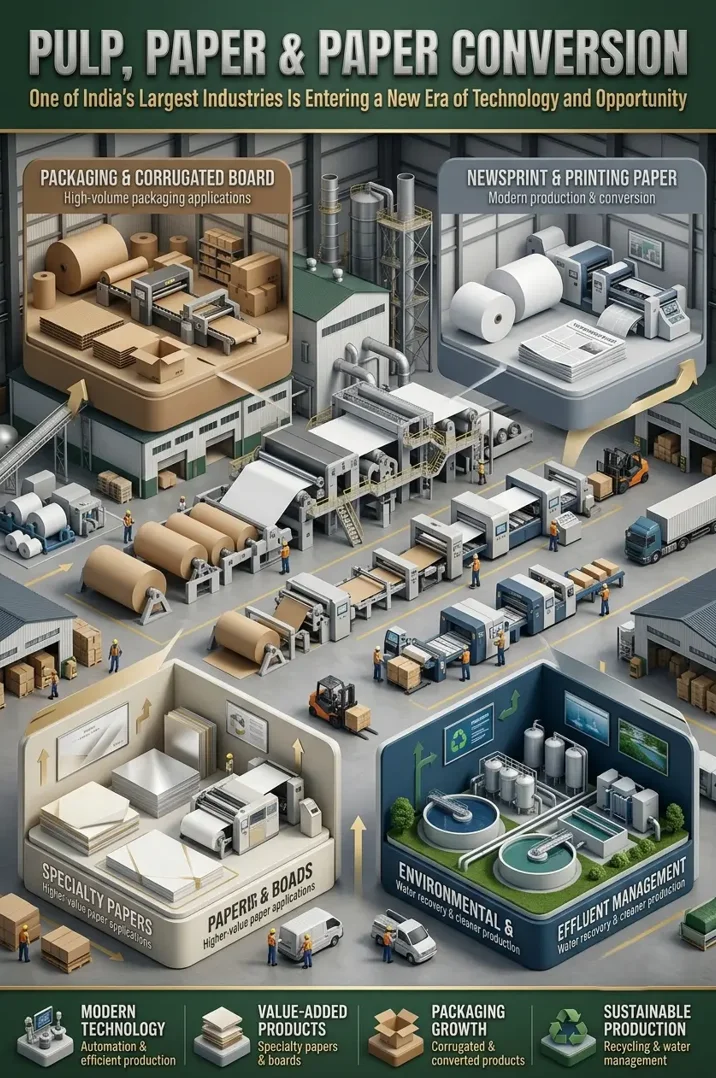
Packaging and Corrugated Board
Corrugated containers are the backbone of Indian industrial packaging and represent the segment most directly tied to e-commerce and FMCG growth. The demand for kraft paper (the raw material for corrugated sheets) has been growing steadily, and domestic production capacity has not kept pace. Entrepreneurs with access to agro-fibre raw materials and the technical knowledge to produce kraft-grade paper are entering a market with structural demand and improving margins.
Newsprint and Printing Paper
India is still a significant importer of newsprint, representing a gap that domestic manufacturers with appropriate technology can address. The transition from wood-based to agro-waste and recycled newsprint production is technically feasible and commercially attractive. However, producers must control pulp quality, brightness, opacity and printing performance. These factors require process knowledge and measurement capability.
Specialty Papers and Boards
Hard boards from recycled newsprint, abrasive base paper, boxboard, and specialty functional papers represent segments where value addition is possible. The margin structure is more attractive than commodity grades. These are products where technical differentiation (achieved through process knowledge, raw material selection, and quality control) translates directly into commercial advantage.
Environmental and Effluent Management
Paper manufacturing is water-intensive, and effluent management is one of the most significant operational and regulatory challenges the industry faces. Innovative approaches such as using treated mill effluent for crop irrigation (which simultaneously addresses industrial waste disposal and agricultural water needs) are developing and becoming standardised. Entrepreneurs and engineers who understand these systems have a clear advantage in regulatory compliance and operational efficiency.
What This Means for Indian MSMEs and Entrepreneurs
The paper industry is not solely the domain of large integrated mills. For example, small and medium paper manufacturers, conversion units (producing boxes, bags and specialty packaging) and agro-fibre pulp producers operating at MSME scale have a genuine place in the market. In particular, this applies to regions with strong agricultural raw material availability and proximity to packaging-intensive industries.
However, the challenge, as always, is technical knowledge. In addition, setting up a paper mill – even at small scale – requires understanding of pulping chemistry, fibre preparation, paper machine design, drying technology, effluent treatment and quality testing. As a result, getting any one of these wrong means poor product quality, high input waste or regulatory problems. Therefore, the entrepreneur who enters this space with solid technical grounding is in a fundamentally different position than one who is flying blind.
Introducing the Modern Technology of Pulp, Paper and Paper Conversion Industries
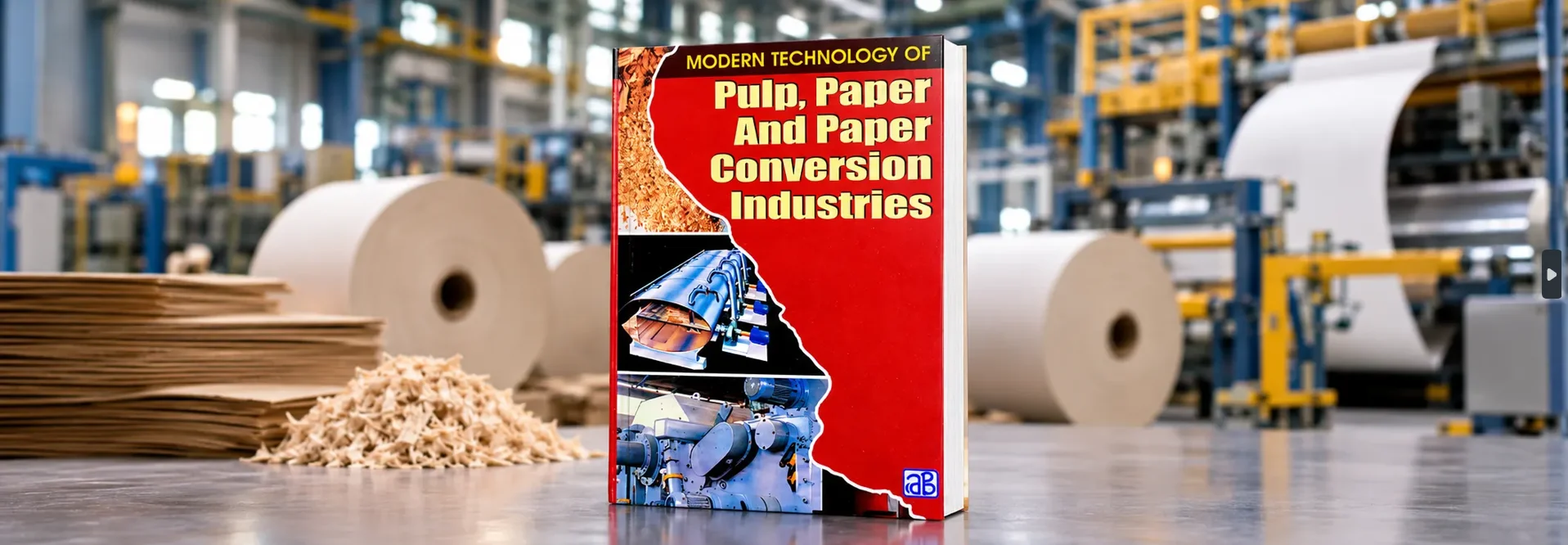
For anyone entering or working in the pulp, paper, and paper conversion sectors, the Modern Technology of Pulp, Paper and Paper Conversion Industries is highly useful. Published by Asia Pacific Business Press Inc. (APBP) and authored by the Niir Board of Consultants & Engineers, it provides comprehensive, technically grounded coverage that the industry genuinely needs. At 568 pages, it is one of the most thorough single-volume references available on this subject in the Indian market.
Author: Niir Board of Consultants & Engineers
Publisher: Asia Pacific Business Press Inc. (APBP)
ISBN: 817833044X
Pages: 568
Price: USD 100 (International) / USD 26.95 (Discounted)
Why This Book Stands Apart
The book addresses the full technical arc of paper manufacturing (from raw material sourcing and pulping, to paper machine design, paper drying, quality parameters, and conversion) without getting lost in academic abstraction. Each chapter grounds the discussion in process-level detail that practitioners can actually use.
The coverage of non-wood raw materials is particularly comprehensive and commercially relevant for Indian conditions. Individual chapters address pulping from eta reed, bamboo, bagasse, elephant grass, sesbania sesban, urena lobata and sun hemp. These chapters cover both the pulping chemistry and the process parameters for each, and this is the kind of raw-material-specific technical detail that an entrepreneur setting up a bagasse-based mill in Maharashtra or a bamboo paper unit in the Northeast needs. Broad generalities would be useless here – the book provides specifics.
On the recycling and deinking side, the chapters on flotation deinking with clay addition, deinking of flexographic newsprint, and the use of ultrafiltration to close the water loop represent the current state of the industry’s technical practice.
The discussion of quantification of plastics in pulp slurries and alternative use for waste paper in wood-based composite products reflects the reality of modern paper recycling. It involves managing contaminated mixed streams, not just clean wastepaper.
The environmental and water management sections are practically important for any manufacturer. These cover effluent treatment, sludge disposal, chemical recovery smelters, and treated wastewater use for irrigation. They help manufacturers navigate India’s increasingly strict environmental compliance environment. Understanding these systems is no longer optional; it is a basic requirement for operating a paper mill.
The book also covers paper machine design for non-wood fibres and concentrator systems for Indian raw materials. It also covers the technical specification of paper quality parameters, including brightness, opacity, tear strength and formation. These are all essential for a manufacturer trying to produce a consistent, market-acceptable product.
A particularly useful feature for entrepreneurs at the planning stage is the directory of manufacturers and suppliers. It covers plant and machinery, raw materials and imported pulp. The latter part of the book includes it. This kind of sourcing intelligence (knowing who supplies what, and where to find Indian agents for imported pulp) has real practical value. It can help anyone setting up a new facility.
Who Will Benefit Most from This Book
The book explicitly targets paper chemists, conversion industry professionals, entrepreneurs, and institutional libraries, and delivers on all four. For example, paper chemists will find the chapters on alkaline pulping chemistry and process parameters technically rigorous. Similarly, conversion industry professionals will value the chapters on corrugated containers, boxboard, paper machine forming sections and brightness and opacity measurement. Moreover, entrepreneurs will find the chapters on raw materials and process technology directly applicable to feasibility planning. Finally, institutional libraries at textile and paper technology institutes, agricultural universities and engineering colleges will find it a comprehensive reference across multiple relevant disciplines.
Furthermore, investors evaluating paper manufacturing projects will also find value here – the book provides the technical depth needed to assess whether a proposed production process is viable, and what the machinery and raw material requirements actually are, and where the key operational risks lie.
About the Publisher: Niir Project Consultancy Services
Niir Project Consultancy Services (NPCS), based in New Delhi, is one of India’s most established industrial consultancy and publishing organisations with over 30 years of experience. ISO 9001:2015 certified, NPCS has served clients across 85 countries and delivered more than 150,000 successful project reports spanning manufacturing, agro-processing, chemicals, food technology and industrial sectors. Its publications serve manufacturers, industrialists, project engineers, institutional researchers, and MSME entrepreneurs as authoritative references for industrial decision-making.
Get Your Copy Today
The Modern Technology of Pulp, Paper and Paper Conversion Industries is the kind of reference that earns its place in any serious industrial library. Whether you are planning a new paper manufacturing venture, working in an existing mill and looking to expand your technical command, advising MSMEs on feasibility, or evaluating an investment in this sector, this book gives you the technical foundation. It helps you make better decisions.
At 568 pages of process-level, industry-grounded technical content authored by the Niir Board of Consultants & Engineers, it covers a breadth and depth that few other volumes on this subject can match. It does so with the practical orientation that the Indian manufacturing context demands.
Order from your preferred platform:
Official Website (Niir): https://www.niir.org/books/book/modern-technology-pulp-paper-paper-conversion-industries/isbn-817833044X/zb,,68,a,0,0,a/index.html
Amazon India: https://www.amazon.in/dp/817833044X
Flipkart: https://www.flipkart.com/modern-technology-pulp-paper-conversion-industries/p/itmdyugjsguj3ksm
For media enquiries, bulk orders, or consultancy services:
Niir Project Consultancy Services (NPCS)
106-E, Kamla Nagar, New Delhi — 110 007, India
www.niir.org | www.entrepreneurindia.co
Your Investment Deserves the Right Opportunity
Every serious investment begins with choosing the right sector and the right business model. With hundreds of industrial opportunities available across India’s manufacturing and clean-energy landscape, making the most informed choice is critical. NPCS Startup Selector tool helps entrepreneurs, MSMEs, and investors identify the most suitable business opportunities based on their investment capacity, location, and interests — so your capital is directed toward a venture with the strongest fit and potential.