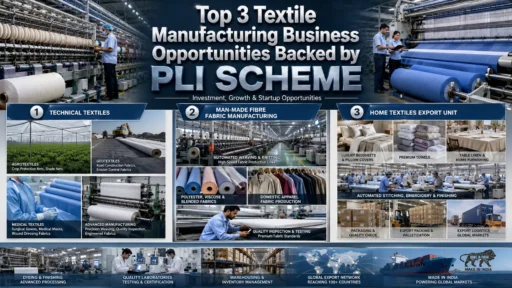


The textile industry is one of the most ancient industries and is quite strategically important of the national economy and for investors who have understood the basics of manufacturing, investing in a textile unit in Tier-2 city of India with an investment of Rs.15 Crore would be one of the most interesting business ideas available today. The Ministry of Textiles has been supportive of this sector through policy support schemes like PLI scheme, PM MITRA parks and TUFS interest subsidies, which are quite favourable and are not available for decades. Textiles have depth and longevity because of government support and robust domestic demand, plus the fact that the world is looking for more variety in its suppliers as buyers move away from China.
Why Tier-2 India Is the New Textile Manufacturing Hub
The business landscape with regard to textile production in Tier-2 cities is very appealing in comparison to established metros. Land value is reduced by 40-60%, labour is plentiful and state governments are fiercely competitive for the investment of manufacturing. This ‘China Plus One’ strategy pursued by global apparel brands has turned the interest towards Indian manufacturers. The India Brand Equity Foundation (IBEF) states India’s textile and apparel sector is one of the leading export sectors in the world and domestic market growth is an added benefit. Moreover, the domestic market of fabric and readymade garments is growing due to the rise in the income level of consumers from Tier-2 and Tier-3 areas and their awareness of fashion.
Get Detailed Insights from This Book: The Complete Technology Book on Textile Spinning, Weaving, Finishing and Printing
Government Schemes and Incentives for Textile Manufacturing
The Ministry of Textiles offers incentives through the Production Linked Incentive (PLI) Scheme for Textiles. The scheme provides incentives ranging from 15% to 11% over five years for incremental production of textiles made from man-made fibres and technical textiles. The Technology Upgradation Fund Scheme (TUFS) is an interest subsidy scheme for loans availed regarding modern textile machinery. Pradhan Mantri MEGA Integrated Textile Region and Apparel (PM MITRA) is creating seven integrated textile parks in India where the entrepreneurs can use the ready infrastructure at a discounted rate. There are additional incentives at the state-level. Consequently, MSME Ministry’s CGTMSE scheme is providing loans for working capital, which is very important as the textile industry is very intensive in working capital. Check Startup India for a complete list of the incentives that are offered.
Top 3 Business Ideas in Textile Manufacturing at Rs.15 Crore Scale
Technical Textiles: Agrotextiles, Geotextiles, and Medical Textiles
Technical textiles include specialty fabrics used in agriculture, construction, healthcare, automotive, and filtration. The New entrants can avail the R&D support, cluster development and market promotion support provided by the National Technical Textiles Mission by Ministry of Textiles. The technical textile unit costs Rs.15 Crore, with an emphasis on agrotextiles (shade nets and crop covers) and geotextiles (road and dam construction) aims for institutional customers such as government departments and developers of infrastructure project works. These products are not fashion based and thus the income is more stable.
Man-Made Fibre Fabric Manufacturing for Domestic Apparel Brands
Domestic consumption of man-made fibre fabrics, namely polyester, viscose and nylon, has been on the rise, surpassing cotton, owing to changing trends in urban fashion, which are increasingly favouring easy-care, affordable fabrics. Investment for Rs.15 Crore in rapier could lead to a medium scale investment in fabric manufacturing using air-jet weaving machine to produce 15,000 to 25,000 metres of value-added fabric per day. This segment directly gets PLI benefits for man-made fibre production under the Ministry of Textiles. Entrepreneurs in the textile sector need to leverage these opportunities for textile market data and connect with buyers regularly published by the Confederation of Indian Industry (CII).(Textile Manufacturing Business)
Get Detailed Project Report (DPR): Textile Bleaching, Dyeing, Spinning, Weaving, Printing, Finishing and Textile Auxiliaries Projects
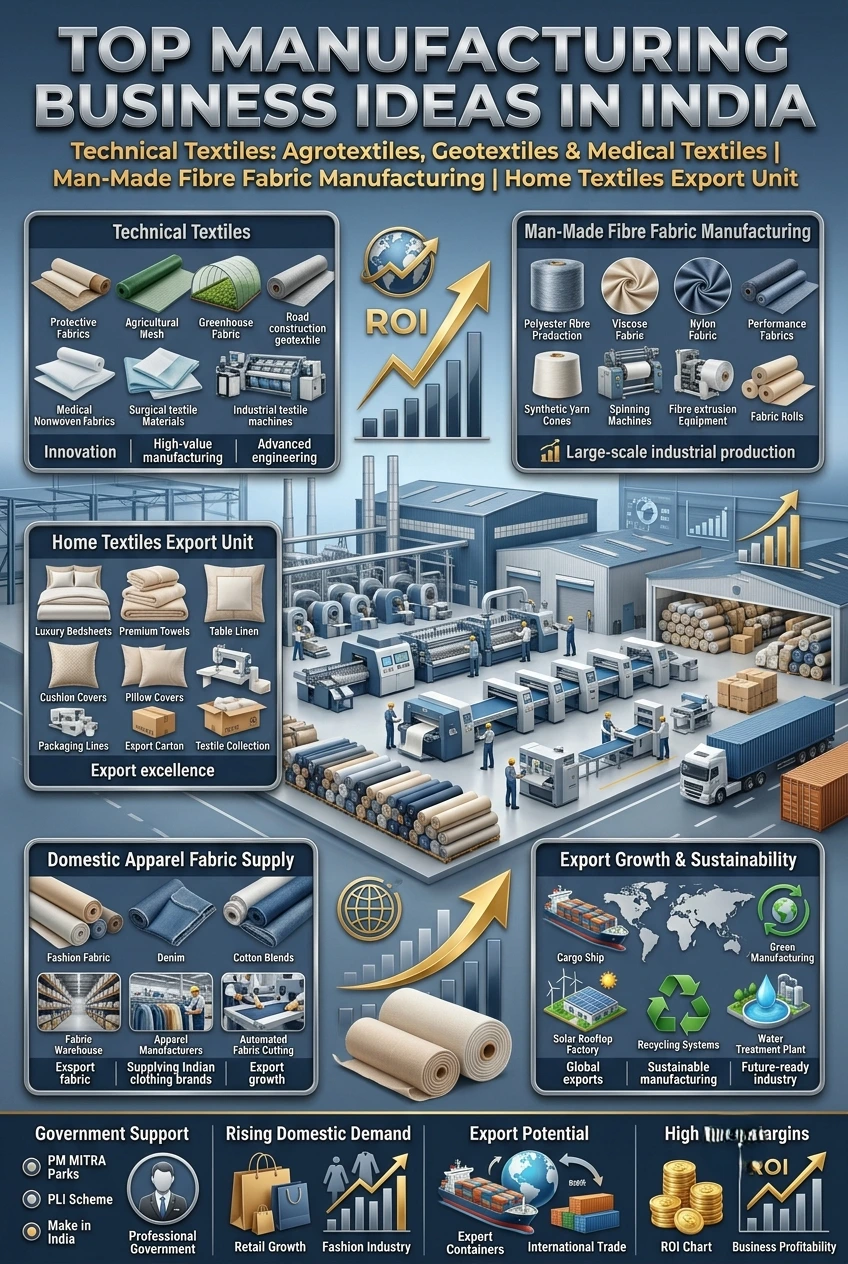
Home Textiles Export Unit: Bedsheets, Towels, and Table Linen
The bedsheets, towels, curtains, and table linen are some of the most successful exports categories in India and export markets for these are mainly in the United States and Europe. India is at par with Bangladesh, Pakistan and China in both price and quality in this category. Obtaining OEKO-TEX certification, meeting chemical usage standards, and maintaining quality in large production runs are key to winning international buyers. See APEDA for export promotion programmes geared towards home textile exporters such as international trade fairs and home buyer matching.
Import-Export Opportunity Analysis
India is a huge exporter of textile products with the USA, EU and UAE being the major destinations. India has recently signed a Free Trade Agreement with UAE which offers the exporters of textiles from India a preferential market access. The ‘Remission of Duties and Taxes on Exported Products (RoDTEP)’ scheme returns taxes levied on export products to exporters, enhancing the competitiveness of Indian exports. To get current export information and market access details see Ministry of Commerce and Industry. In case of IEC code and export documentation, register at the official portal of DGFT.
Indian MSME Success Stories in Textile Manufacturing
Vardhman Textiles: From Ludhiana MSME to Textile Giant
Established by SP Oswal in Ludhiana, Vardhman Textiles began as a modest spinning mill and has since risen to become one of the biggest textile conglomerates in India, thanks to smart investment decisions and constant technological innovation. One of the lessons for entrepreneurs is the company’s attitude of investing in new machinery rather than rightly rushing into early diversification. Vardhman’s manufacturing approach of serving high quality yarns enabled it to develop a premium positioning in both domestic and export markets, outcompeting commodity players.(Textile Manufacturing Business)
Discover business ideas that actually make money
Kitex Garments: Kerala’s Textile Export Success
Despite Kerala’s limited reputation in garment manufacturing, Sabu Jacob transformed Kitex Garments into a world-class exporter of infant garments, serving leading brands in the United States and Europe. The company’s investment in automation, compliance systems and worker welfare resulted in a production model compliant with the ethical sourcing standards of global retailers. Kitex proves that it’s not everything is location based when it comes to premium export markets, but it is all about operational discipline and quality compliance.
How NPCS Can Help You Get Started
At Niir Project Consultancy Services (NPCS) we are experts in preparing Market Survey cum Detailed Techno-Economic Feasibility Reports (DPRs) for any new industry or business setup. The report will contain detailed manufacturing processes, in-depth market research and demand analysis, process flow diagrams, product mix and capacity planning, details of machinery and raw materials and full project financials with profitability analysis. For every project report, please visit us at www.niir.org with more details about textile manufacturing units.
Conclusion
A Rs. 15 Crore textile manufacturing unit in Tier-2 India benefits from strong government support through the Ministry of Textiles. It also gains from rising domestic demand and growing global sourcing interest. The key is to choose the right product sub-segment, such as technical textiles, man-made fabrics, or home textiles. Base your choice on local ecosystem advantages and access to buyers. Entrepreneurs who view textile manufacturing as a long-term investment can achieve stable and growing returns through patient capital.(Textile Manufacturing Business)
Related Article: Technical Textile Manufacturing: The Export Opportunity Indian MSMEs Are Still Missing
Rs.15 Crore Textile Unit — Key Investment Parameters
| Parameter | Details |
| Total Investment Range | Rs.13 Crore to Rs.18 Crore |
| Land Requirement | 30,000 to 50,000 sq ft (owned or leased) |
| Key Government Scheme | PLI for Textiles + TUFS Interest Subsidy + PM MITRA Parks |
| Estimated Production Capacity | 15,000 to 25,000 metres/day of fabric or equivalent |
| Expected ROI Timeline | 4 to 6 years at 70%+ capacity utilisation |
| Employment Generation | 100 to 200 direct employees |
| Export Potential | USA, EU, UAE, UK — home textiles and garments |
| Key Licenses Required | Factory License, GST, MSME Udyam, OEKO-TEX, IEC Code |
Frequently Asked Questions (FAQ)
What government schemes support textile manufacturing?
The PLI Scheme for Textiles covers the man-made fibre and technical textile segments and provides incentives to manufacturers. The incentive under scheme shall be administered by Ministry of Textiles. TUFS provides interest subsidy on technology upgradation loans. PM MITRA parks provide ready industrial infrastructure. CGTMSE from MSME Ministry provides collateral-free working capital loans.
What certifications are required for textile export?
OEKO-TEX Standard 100 certification is essential for exporting textiles to the USA and EU. Manufacturers must obtain SA8000 certification to ensure worker welfare and comply with the social accountability standards that European buyers increasingly demand. REACH for European markets. Export Documentation basics include IEC Code from DGFT and AD Code registration with bank.
Is Tier-2 city location viable for textile manufacturing?
The Tier-2 cities actually excel in the textile sector from metro cities owing to the cheaper land and workforce. Cities like Tiruppur, Bhilwara, Panipat, and Surat possess complete textile ecosystems. The government supported PM MITRA parks across non-metro cities would further boost these clusters. The Textile sector report by IBEF also offers the cluster-wise breakdown of the sector.
How do I register as an MSME textile manufacturer?
Learn how to register for MSMEs through the Udyam Registration Portal and access benefits from PLI, TUFS, CGTMSE, and cluster development schemes. Udyam Registration is free and completely online.
Which products have the best export potential for Indian textile manufacturers?
Home textiles — bedsheets, towels, and curtains — have the most established export market. Technical textiles for international infrastructure projects represent a newer but high-growth export opportunity. Visit APEDA for product-specific export promotion programmes.
How much working capital is needed for a textile unit?
Textile manufacturing has a 60 to 90 day working capital cycle. A Rs.15 Crore textile unit typically needs Rs.3 to Rs.5 Crore in working capital. CGTMSE-backed loans from MSME Ministry can cover this requirement without collateral for eligible units.