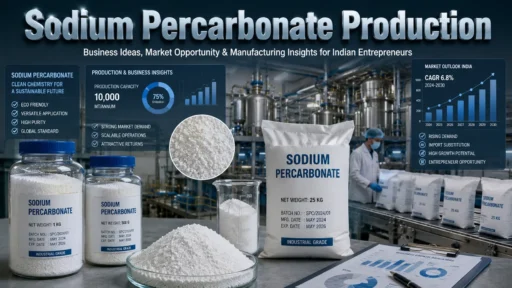


Sodium Percarbonate Manufacturing Business
A Quietly Booming Chemical Segment
Not all business ideas are wrapped in headline. There are some manufacturing jobs that are very solid and go unpublicized — filling a need in a sector that is always expanding. Sodium percarbonate is just such an opportunity. It is the active oxygen carrier used in oxygen bleach powder, ecofriendly laundry formulation and industrial cleaning agent. The demand is steadily increasing in the home care, institutional hygiene, textile processing and water treatment sectors, but domestic production is still light when compared to imports.
Sodium percarbonate manufacturing is an opportune investment for the MSMEs and startup entrepreneurs who are willing to enter into a business other than the saturated sectors. It’s a green chemistry investment opportunity that is a smart manufacturing bet due to its versatility, stable demand, and global shift towards green chemistry. In this article, we dive into the sector through the eyes of the founder – market forces, business models, policy support, and financial benchmarks – to help aspiring entrepreneurs make an informed decision.
Why the Sodium Percarbonate Sector Deserves Serious Attention
Sodium percarbonate (Na₂CO₃·1.5H₂O₂) is essentially a stable adduct of sodium carbonate and hydrogen peroxide. It liberates active oxygen in solution, so it’s a potent bleaching/oxidising agent. It does not contain toxic residue like chlorine-based bleaches. This eco-benefit has led to a steady shift away from chlorine bleach formulations and towards those with an oxygen base in global formulations.
Global sales of percarbonate products are seeing a robust growth, driven by rising demand from detergent manufacturers, health care facility managers, and food-processing companies. The home and personal care market is growing at a fast pace in India — even in Tier 2 and Tier 3 cities, the market is witnessing rapid growth in the consumption of high quality, eco-safe cleaning products. Specialty oxygenated chemicals are one of the most dynamic sub-segments within the overall chemical industry in India, according to the Chemicals and Petrochemicals Manufacturers Association (CPMA).
The nice thing about the economics is the relatively manageable input chain. The basic materials required for the production of soda ash (sodium carbonate), hydrogen peroxide and stabilisers can be obtained locally or by reliable trading circuits. Capital for small to medium plants is reasonable, margins are solid and the product is sold in B2B and private-label consumer segments. Moreover, India has an emerging contract manufacturing sector, which enables even the startups to supply to the established brands in a short time.
Get Detailed Project Report (DPR): Sodium Carboxy Methyl Cellulose Manufacturing Plant Report
Government Policies and Incentives Supporting New Manufacturers
The policy landscape in India has become more pro-chemical manufacturers, especially for specialty and green chemistry industry. The Ministry of Chemicals and Fertilizers is actively encouraging import substitution of specialty chemicals and sodium percarbonate is among them. There are a number of schemes that directly support new players in this area.
MSME Credit and Subsidy Support
The Credit Guarantee Fund Trust for Micro and Small Enterprises (CGTMSE) ensures that entrepreneurs can obtain collateral-free loans up to ₹2 crore, which is enough to invest in a small enterprise for producing percarbonate. Besides, the Ministry of Textiles administers the Technology Upgradation Fund Scheme (TUFS) offering capital subsidy to chemical plants engaged in the production of chemicals used in the textile industry as well as in the production of chemicals adjacent to textiles, which include bleaching chemical plants.(Sodium Percarbonate Manufacturing Business)
Startup India and DPIIT Recognition
DPIIT’s Startup India eases the tax burden on startups by providing them with income tax exemption for three consecutive years, ease in compliance and priority access to government procurement. If you have institutional customers, such as hospitals, laundries, and textile processors, as your target customer base, government procurement channels become a significant stream of revenue from the outset of your sodium percarbonate startup.
Production-Linked Incentive for Chemicals
The Government of India has identified specialty chemicals as a priority industry for PLI incentives. The government has not yet finalised a dedicated PLI for specialty oxygenated chemicals, while the overall chemicals PLI provides cash incentives for incremental sales directly to fast-growing producers. The structures will benefit the entrepreneurs who are able to scale in three to four years’ time.
Multiple Business Ideas Within Sodium Percarbonate Production
1. Direct Sodium Percarbonate Manufacturing
The simplest business plan is to establish a specific production facility for sodium percarbonate. The typical production method includes the controlled reaction of soda ash and hydrogen peroxide in an aqueous medium, followed by crystallisation, filtration and drying under controlled temperature conditions. With an annual capacity of 500–1,000 metric tonnes, the plant serves domestic detergent formulation companies as well as export customers. Initial investments are usually between ₹1.2 crore – ₹2.5 crore, depending on the level of automation and capacity. Margins are good — raw material cost is about 55-65% of selling price, with good margin for EBITDA. This model enables repeat sales revenue to institutional laundry chains, contract manufacturers and mid-size detergent brands.
2. Value-Added Oxygen Bleach Powder Formulation
A great business opportunity is to make ready-to-use oxygen bleach powder mixes, instead of selling sodium percarbonate as a commodity. This includes mixing percarbonate with tetraacetylethylenediamine (TAED) as an activator, optical brightener and anti-redeposition agents and fragrance compounds. As a result, the product is sold at a substantial mark-up on the price of the raw percarbonate, typically 2-3 times the per kg. price. Consumer market branded oxygen bleach is even more expensive. A unit with a B2B business with private label or medium-sized FMCG’s can go without lots of advertising but a very nice formulation margin. A great path for entrepreneurs who begin by producing raw percarbonate and then expand forward.
Get Detailed Insights from This Book: Soaps, Detergents and Disinfectants Technology Handbook

3. Contract Manufacturing for FMCG and Industrial Brands
The Indian FMCG industry is increasingly depending on third party manufacturers for specialty chemical needs. Laundry care companies, hospital linen handling firms, and food equipment cleaners are among the industries currently using sodium percarbonate, which they favour over having their own production. The idea of setting up a percarbonate based formulation GMP contract manufacturing unit is a relatively capital light business. The distinguishing factor is quality certification, with ISO 9001 and, for those seeking to appeal to healthcare buyers, ISO 22716 (cosmetics GMP). Having a couple of anchor contracts in place, capacity utilisation is quickly stable and working capital cycles become predictable.(Sodium Percarbonate Manufacturing Business)
4. Water Treatment Chemical Supply
Another under-exploited use of sodium percarbonate is in the area of bioremediation and water purification. The compound is used to release oxygen in polluted waters, which promotes aerobic microbial degradation of organic contaminants. Increasingly, the municipal water treatment plant, industrial effluent treatment plant and aquaculture operators are becoming buyers. Creating a supply chain geared specifically to this end-use segment will require CPCB registration for the formulation, as well as a basic understanding of environmental compliance — but the market size is significant. This demand stream benefits from strong commercial and regulatory tailwinds, as the National Mission for Clean Ganga and various state-level water body restoration programmes actively support it.
5. Export-Oriented Specialty Percarbonate Production
Import–Export Opportunity Analysis
India presently imports a significant quantity of sodium percarbonate from China, South Korea and Germany. Relying on Chinese supply is a major weakness — with geopolitical tension and freight price fluctuations already forcing some Indian detergent companies to actively look for domestic alternatives. This structural gap is well identified as an opportunity for new producers in India. DGFT trade data reveal that imports still outweigh domestic production in India’s specialty oxygenated compounds sector.(Sodium Percarbonate Manufacturing Business)
Demand from the Middle East’s cleaning product manufacturers and institutional hygiene operators in the Southeast Asia region is increasing steadily on the export side. India has the experience of handling logistics for bulk chemicals and has a cost advantage, which makes it a potential supplier. If the entrepreneur has got BIS certification and has got the quality standard certification from IEC/ISO, then it is sure that he can get the export market between 18-24 months after the commissioning of his plant.
Identify high-growth industries before others do
Indian MSME Success Stories in Specialty Chemical Manufacturing
Nirma Limited — The Pioneer of Cost-Effective Bleach Chemistry
Karsanbhai Patel started Nirma as a single-man detergent mixing unit and transformed it into one of India’s biggest consumer chemical companies. The learning of Nirma’s story is not only about cost leadership, but also the discipline of backward integration. Nirma has insulated its margins from commodity cycles by controlling its raw material inputs early. In the eyes of sodium percarbonate entrepreneurs, this means that business owners who achieve long-term supply contracts for soda ash or invest in hydrogen peroxide production within their premises reap in-depth competitive benefits. For any MSME chemical startup, Patel’s approach is a good learning curve to avoid temptations from premium brands and stick to business-to-business supply via volume.
Vinati Organics — The Specialty Chemical Scaling Blueprint
Vinati Organics, launched by Vinati Saraf Mutreja, is a marvelous instance of how a focused Indian MSME chemical company can become global leader in a specialty chemical. began with a single molecule (IBB — isobutyl benzene), grew into specialty monomers like ATBS and eventually became the world’s most important producer of ATBS. For producers of sodium percarbonate, the strategic lesson is that it is better to be very clear about the focus: one product or one product family. For the sodium percarbonate producers, the strategic lesson is that it is better to be very clear about the focus – one product or one product family – so as to create customer stickiness, pricing power, and ultimately export leadership. Vinati’s focus on process innovation rather than just cutting costs is also telling.
Aarti Industries — The Diversified Specialty Chemical Success
Aarti Industries promoted by the Gogri family, grew from simple intermediates to a global competitive specialty chemicals platform. They have used their business model to diversify in value added products and integrate backwards into the common raw materials flows, and have made outstanding returns as a result. The message for the percarbonate business owners is sequencing – build the core product first, balkanize cash flows, and then branch out into a related product. By consistently focusing on export-quality compliance, even while serving local markets, Aarti built the credibility that helped it secure contracts in Europe and North America.
How NPCS Helps Entrepreneurs Evaluate This Opportunity
A feasibility study is essential before any capital is devoted to any manufacturing enterprise. Niir Project Consultancy Services (NPCS) prepares Market Survey cum Detailed Techno-Economic Feasibility Reports (DPRs) for entrepreneurs who may be thinking of setting up a new industrial project, sodium percarbonate manufacturing among other industrial projects. Our reports cover the entire manufacturing process. They include detailed process flow diagrams, product mix, and capacity planning. We also cover sourcing of machinery and raw materials. In addition, we provide project financials with profitability analysis and other key insights. Creators can use NPCS reports as independent documents to review and evaluate feasibility. They can also assess the viability of their business models and test projections when approaching lenders or investors. Entrepreneurs serious about diving into the percarbonate space must first invest in a strong DPR. Visit NPCS – Project Consultancy Services for a complete list of reports and consulting services.
Related Article: How to Build a Profitable Sodium Metabisulfite Business
Key Project Parameters: Sodium Percarbonate Manufacturing Unit
| Parameter | Indicative Range / Details |
| Plant Capacity (Annual) | 500 – 2,000 Metric Tonnes |
| Project Cost (Small Unit) | ₹1.2 Crore – ₹2.5 Crore |
| Project Cost (Medium Unit) | ₹3 Crore – ₹6 Crore |
| Key Raw Materials | Soda Ash, Hydrogen Peroxide, Stabilisers |
| Typical Selling Price (B2B) | ₹55 – ₹90 per kg |
| Raw Material Cost Share | 55% – 65% of Revenue |
| Estimated EBITDA Margin | 18% – 28% |
| Payback Period | 3 – 5 Years |
| Key End-Use Sectors | Detergents, Textiles, Water Treatment, Healthcare |
| Export Markets | Middle East, SE Asia, East Africa |
| Regulatory Clearances Needed | PCB NOC, Factory License, BIS (for consumer grade) |
Frequently Asked Questions (FAQs)
1. What is sodium percarbonate used for, and why is demand growing in India?
Used as a oxygen releasing bleach/cleaning agent in laundry products, industrial cleaners, water treatment and personal hygiene products in hospitals etc, demand is gaining steam as it represents an eco-friendly, chlorine free solution at a time when India’s premium home care sector is burgeoning and compliance towards environmental regulations on users are on the rise.
2. How much investment is needed to start a small sodium percarbonate plant?
A typical unit of small-scale nature having annual capacity ranging 500 to 800MT, require investment of 1.2 crore to 2.5 crore. It includes: Equipment for process, Reactor systems, Drying and Packaging machinery, A basic Quality Lab. Raw materials working capital requires further investment from 20-40 lakh as per procurement cycle.
3. What are the most important quality certifications for selling sodium percarbonate in India?
The baseline quality credibility for industrial B2B supply is the ISO 9001 certification. The suppliers operating in the food equipment cleaning or healthcare industries will need ISO 22716 or FSSAI-compliant documentation. The suppliers of products sold on retail shelves that are meant for end consumption require a BIS certification. Those manufacturing to export must also conform to REACH compliant documentation for selling into Europe.
4. Which government schemes can a sodium percarbonate startup access?
CGTMSE collateral-free loans, TUS for machinery, Startup India Tax rebates under DPIIT registration, state industrial promotion subsidies in chemical producing regions like Gujarat, Maharashtra, AP, and also Credit Linked Capital subsidy Scheme (CLCSS) by MSME for technology upgradation.
5. Is export a realistic revenue option for a new Indian sodium percarbonate producer?
That’s correct, exports within 18 to 24 months post commissioning is viable for any producer who adheres to international standards of quality and also develops rapport with trading house or direct consumers in export market. The Middle East, Southeast Asia, and East African countries are natural target markets due to their proximity and the limited strength of their domestic markets for this product. DGFT export incentive schemes further enhance the economic attractiveness of these markets.
6. What are the main regulatory hurdles for setting up a sodium percarbonate plant?
Key Compliance requirements: Obtain ‘No Objection Certificate’ from the State Pollution Control Board (under both water and air acts), Factory licence from Factories act, explosive/hazardous chemical handling approvals if onsite large-scale storage of Hydrogen Peroxide, Entrepreneurs may also register with the local MSME district for benefits of Government Schemes.
Conclusion: A Window of Opportunity Worth Acting On
India’s efforts towards import-substitution in specialty chemicals; the global trend towards green/chlorine-free cleaning chemistry; and robust growth in institutional hygiene and high-end home care spending. The market is real, customers clearly demand these products, and a wide gap remains in domestic production.
For founders and MSME investors willing to do the groundwork — get a proper DPR, secure raw material supply agreements, and target the right buyer segments — this is a business idea with sound economics and multiple scale-up paths. The policy support is in place. The market is available. What the sector needs now is serious Indian manufacturing capacity. For detailed feasibility analysis and project planning, connect with Ministry of MSME, Government of India for scheme details and local advisory support.