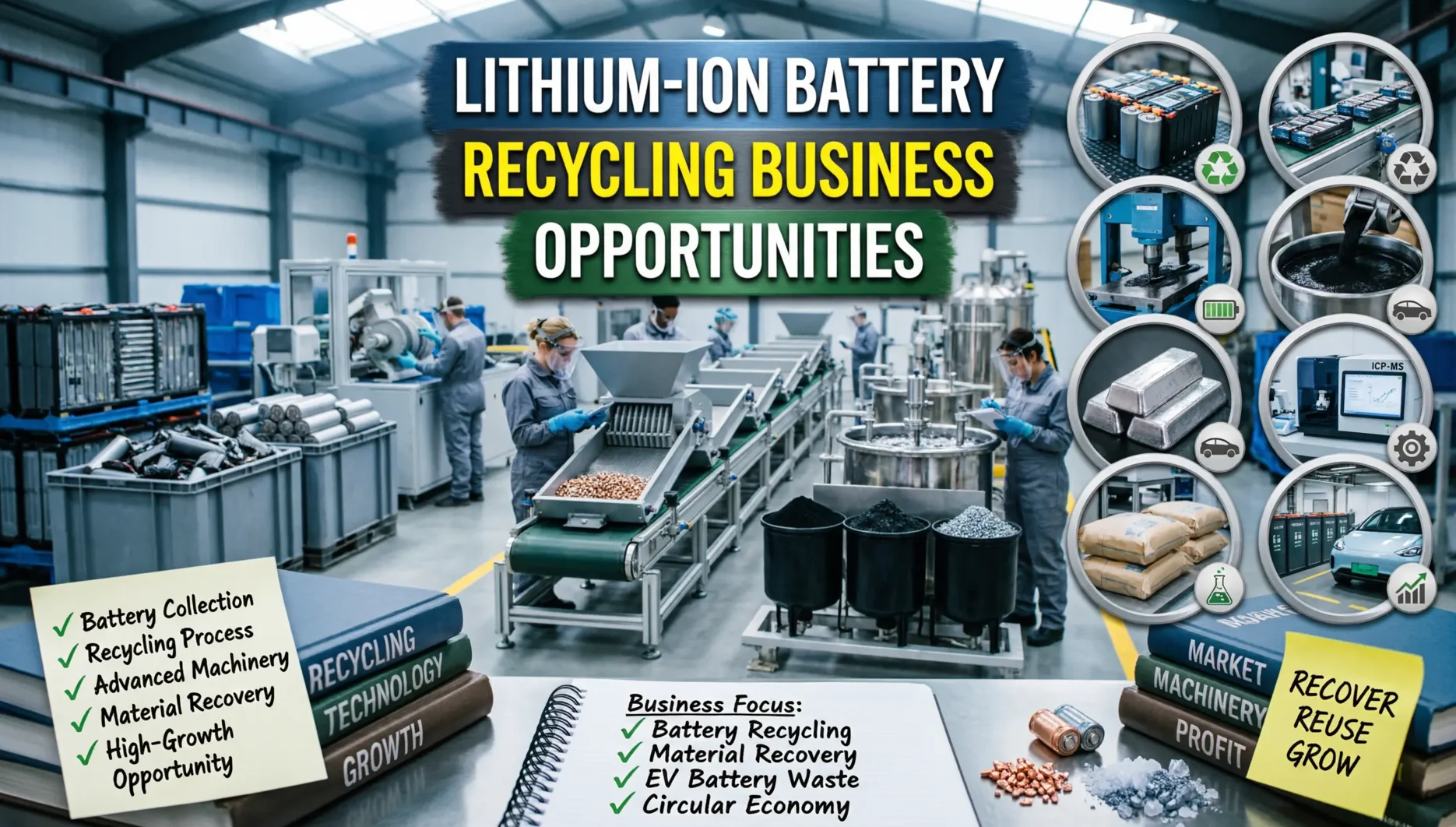

Electric vehicles, laptops and power banks are set to generate one of India’s most compelling emerging business opportunities: the end-market recycling of lithium-ion batteries. Battery recycling has transitioned from an environmental concern to an actual production sector, as recyclers can directly reprocess the metals extracted from spent cells into new batteries. This makes it an attractive entrée for entrepreneurs who have the technical know-how about the chemistry and compliance aspects of the business.
Why Lithium-Ion Battery Recycling Is a Smart Business Idea Right Now
India’s burgeoning EV market and consumer electronics base are set to generate large volumes of end-of-life batteries that will need recycling after five to eight years of usage. Since these batteries comprise critical metals like lithium and cobalt, recycling addresses strategic mineral security needs rather than competing with the battery-manufacturing industry. Additionally, stringent government oversight of unorganized and unsafe battery dismantling also drives demand from registered recyclers, who can better handle the process while satisfying regulatory requirements. For an emerging entrant, this is an advantage: while demand remains assured, technical and regulatory barriers to entry limit the supply of competitors.
Government Policies & Incentives
Battery Waste Management Rules, administered by the Central Pollution Control Board, make it mandatory for manufacturers to ensure that spent batteries are sold to registered recyclers. This provides an assured supply of feedstock to compliant units. Credit support from the Ministry of MSME, along with NITI Aayog advocacy, has made critical mineral recycling a strategic imperative. Consequently, state pollution control boards offer fast-tracks approvals to recyclers with demonstrated processing know-how, substantially reducing setup time on the ground. Several states also offer substantial incentives on land and power for such units, further improving the economics.
Multiple Manufacturing Business Ideas for Startups
Mechanical Shredding & Black Mass Recovery Unit
A relatively simple entry-level option for a new recycler is to setup a mechanical shredding unit that can safely discharge spent batteries, segregating them into black mass, plastics and metallic casings. Since this does not involve further downstream processing, the capital required is low. Black mass can then be directly sold to larger refiners who possess the equipment to extract valuable salts like lithium carbonate, cobalt and nickel. This is one of the fastest options to enter the sector with relatively low investment.
Hydrometallurgical Metal Recovery Plant
An alternate option is to set up a hydrometallurgical processing plant, where operators further process black mass to recover salts using acid baths. Since this requires additional processing, the margins are better compared to selling black mass. However, the capital and technical expertise required are also higher, while environmental clearances are more stringent. Technically competent entrepreneurs with prior experience in metal recycling and chemical processing will find this option most suitable.
Collection, Sorting & Reverse Logistics Network
Due to the dispersed nature of the Indian battery market, collection logistics constitute one of the most critical pillars of battery recycling in India. Consequently, a collection network that can aggregate large volumes of spent batteries from sources like e-commerce warehouses, EV taxi operators and other recyclers can be a viable business option, especially for entities that do not possess processing equipment. Due to the relative ease of aggregation, collection logistics can be a good entry-point option for entrepreneurs.
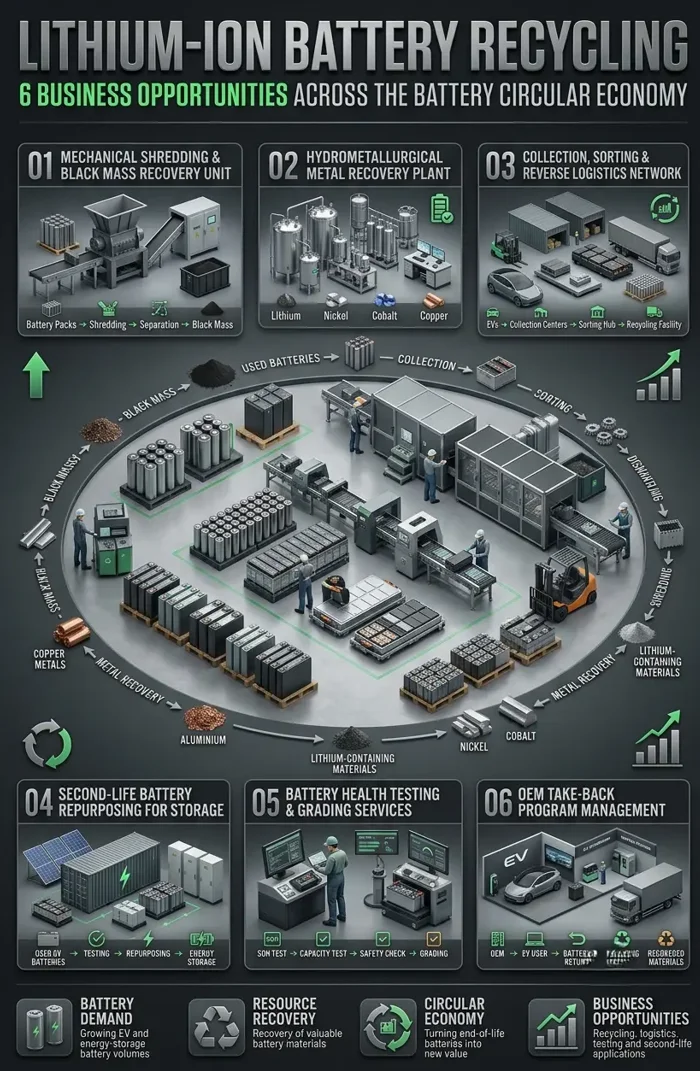
Second-Life Battery Repurposing for Storage
Many spent lithium batteries retain sufficient charge capacity for secondary applications, such as energy storage for telecom towers or solar backup, before recycling. This allows recyclers to derive additional revenue streams by tapping into the growing market for second-life battery storage solutions. This business model is more suited to larger recyclers with sufficient processing capacity, but can be extremely lucrative for entities that can directly integrate with downstream storage buyers.
Battery Health Testing & Grading Services for Resellers
While many spent Li-ion battery packs are directly sent to recyclers, many still possess sufficient health to be repaired, reconditioned and resold. This opens up an alternate avenue for revenue generation for recyclers who can invest in automated diagnostic tools to test the State of Charge (SOC) of spent batteries. Such entities can directly sell their inventory to refurbishers, who in turn sell the reconditioned batteries to secondary storage users or even direct consumers.
OEM Take-Back Program Management
Many consumer electronics and EV manufacturers have announced their intent to establish end-to-end battery recycling value chains, with a majority adopting Extended Producer Responsibility (EPR) norms that require them to directly oversee the collection process. Such firms would be willing to outsource collection and processing logistics to a third-party recycler, for which an entrepreneurial entity can devise a detailed take-back program management.
Import–Export Opportunity Analysis
Given that India imports the majority of its lithium, cobalt and nickel for battery manufacturing, domestic recycling constitutes a critical hedge against supply chain disruptions. Consequently, the Ministry of Mines periodically emphasizes domestic recycling as a means to reduce mineral import bills. Simultaneously, manufacturers in other countries that cannot meet their mineral needs due to geopolitical headwinds can import processed black mass and recovered salts from battery recycling.
Market Outlook & Scaling Roadmap
India’s growing EV market and consumer electronics base are set to drive demand for lithium batteries over the next decade, which in turn will increase recycling volumes. Early entrants who establish compliant recycling units are poised to benefit, as battery manufacturers look to vertically integrate their recycling value chains, with registered recyclers supplying the majority of the material rather than the open market. Units that establish collection logistics and processing capabilities alongside their recycling plants are likely to see faster growth trajectories than those that rely on the open market for feedstock.
Skills, Manpower & Quality Control
Battery recycling requires a blend of mechanical processing, basic chemistry and adherence to safety norms, due to the risk of fire incidents that can arise due to mishandling. The basic segregation processes required at entry-level recycling units need relatively rudimentary training, but managerial personnel who supervise discharge and shredding processes should have a core understanding of battery chemistry and thermal risks. Many recyclers hire engineering graduates with degrees in chemical or electrical engineering for supervisory roles. Additionally, hydrometallurgical processing plants require dedicated process engineers to ensure that metal recovery rates remain optimal.
Indian MSME Success Stories
Attero Recycling — Nitin Gupta and Rohan Gupta
The Gupta brothers pioneered the e-waste recycling sector in India, establishing Attero Recycling as a major player in the organized recycling space. Their success stems from an early emphasis on regulated recovery and value-added processing rather than basic dismantling. Newcomers to the sector would do well to follow their lead and invest in specialized extraction technologies to maximize profitability.
Lohum Cleantech — Rajat Verma
Lohum Cleantech founder Rajat Verma provides a useful template for recyclers looking to vertically integrate their operations. By emphasizing direct tie-ups with OEMs, his company ensures a steady supply of feedstock, as well as long-term offtake agreements for its processed materials. This approach to battery recycling is particularly useful for smaller recyclers aiming to scale.
How NPCS Can Help Entrepreneurs Evaluate the Opportunity
We at Niir Project Consultancy Services (NPCS) provide professional consulting for the preparation of Market Survey cum Detailed Techno-Economic Feasibility Reports (DPRs) for setting up new industries or businesses. Our reports contain detailed information on manufacturing processes, market research and demand, process flow diagrams, product mix and capacity, machinery and raw material requirements, and complete project financials and profitability analysis.
Entrepreneurs can rely on these reports to evaluate the business opportunity and understand the requirements, costs and revenues associated with the undertaking, which is vital in making an informed decision prior to setting up the unit. The reports are comprehensive and act as a guidebook for starting and operating the business, reducing the amount of guesswork involved at the critical project-launch stage.
Niir Project Consultancy Services (NPCS)
For an aspiring investor looking at Lithium-Ion Battery Recycling, we at NPCS recommend that you begin by understanding the basic manufacturing processes, and analyze the capital and manpower costs associated with the endeavor. Our reports on Battery Recycling can help you do just that: providing detailed information on the machinery required, the raw materials needed, the overall layout of a plant and the manpower costs incurred. Additionally, we also highlight government incentives, where applicable, and provide a thorough financial analysis on the potential profitability of the project.
In short, our Lithium-Ion Battery Recycling reports give you everything you need to determine whether such a project is financially viable and profitable. This, in turn, will greatly assist you in convincing banks, NBFCs, or state MSME departments of the creditworthiness of your project, if you intend to raise financing. Overall, working with an established firm like NPCS can cut down on your learning curve substantially: we already know what works and what doesn’t, based on our extensive experience in the field.
NPCS has published a comprehensive printed reference book on Lithium-Ion Battery Recycling, covering technology, market analysis, investment parameters and more in great detail. The printed book: Handbook on Production, Recycling of Lithium Ion and Lead-Acid Batteries.
If you need a detailed techno-economic Project Report on setting up a manufacturing business in this sector, including plant economics, machinery lists, financial projections and government incentives, the NPCS Project Report: Recycling of Lithium Ion Battery – Start Your Battery Recycling Business Today.
Common Pitfalls to Avoid
The biggest pitfall for newcomers is the lack of understanding of feedstock logistics. Many recyclers assume that their processing facilities will attract a steady stream of spent batteries, when the truth is that they need to establish collection logistics first. Another common error is skimping on fire-safety measures, especially at the initial stages, due to the high capital expenditure. This is a shortsighted move: fire hazards have forced many recycling units to halt operations, which not only damages the environment but also the recycler’s reputation.
Conclusion
Battery recycling is one of the few business ideas that combine both environmental and economic viability, making it an attractive entrée for entrepreneurs looking to get ahead of the curve. Setting up a compliant recycling plant is the surest way to attract large-scale institutional buyers of spent batteries, and entrepreneurs can do it with the right guidance. State governments also offer substantial support to battery recyclers, with Maharashtra’s MAITRI portal offering a single-window platform for all approvals.
Your Investment Deserves the Right Opportunity
Every serious investment begins with choosing the right sector and the right business model. With hundreds of industrial opportunities available across India’s manufacturing and clean-energy landscape, making the most informed choice is critical. NPCS Startup Selector tool helps entrepreneurs, MSMEs, and investors identify the most suitable business opportunities based on their investment capacity, location, and interests — so your capital is directed toward a venture with the strongest fit and potential.