
Lithium-Ion Battery Recycling Consultants
India is on the cusp of a battery recycling revolution. The demand for experts who can recycle lithium-ion batteries in India is more than ever as the number of EVs joining the market is increasing and customer electronics are creating increasing waste. For entrepreneurs, the technology options, regulations, and investment opportunities can be a tangled mess. Without the proper consulting help, it’s a risk that not many people can take.
The consequences are big. The critical minerals found within each lithium-ion cell, lithium, cobalt, nickel and manganese, are strategic resources, which India is currently importing in large quantity. The establishment of a domestic recycling industry is therefore not only an environmental target but a priority for national industry as well. The heart of any serious project in this field are the consultants who have an understanding of the entire picture, from the process design of hydrometallurgical recycling processes to compliance with Extended Producer Responsibility (EPR) for batteries according to the Battery Waste Management Rules (BWMR) 2022.
This guide aims to give the founders of startups, MSMEs and industrial investors a glimpse of what recycling of lithium-ion battery plant consultants do, how they can assess the top recycling of lithium-ion battery plant consultants in India and what regulatory and regional factors influence the consulting landscape today…
What Recycling of Lithium-Ion Battery Consultants Actually Do
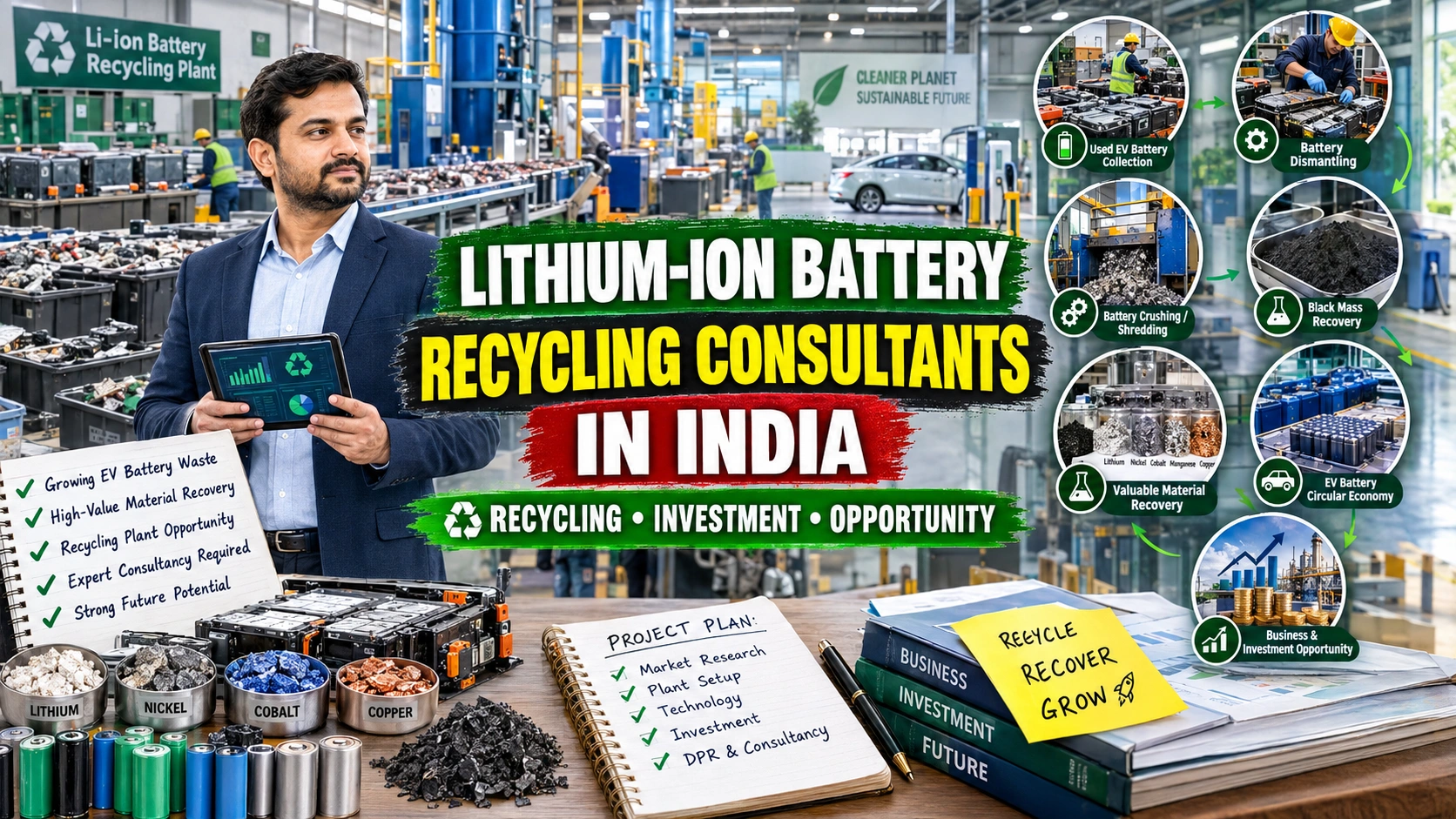
A project consultant is often mistakenly thought of by first-time investors as a person who compiles a cost estimate and then hands him or her a document. In fact, a lithium-ion battery consultant can work within the entire project life cycle, from concept to commissioning. Their work is divided into five separate domains.
Feasibility and Market Research: Prior to any commitment of capital a consultant will determine if the project is commercially viable. This involves a battery waste feedstock availability and local collection structure, pricing of metal commodities, and a competitive positioning. A good feasibility study will not only tell the entrepreneur if the project is technically feasible, it will also indicate if the project is economically feasible at a certain size in a certain location.
Detailed Project Report (DPR) Preparation: DPR is the basic document required for any serious industrial project. This report contains the selected lithium-ion battery recycling technology pathway, process flow diagram, plant layout, equipment specification, raw material sourcing, utility requirement, detailed financial model (capital expenditure, operating cost, revenue model, break-even analysis, IRR calculation). DPRs are necessary for project financing for banks and NBFCs and most state government incentive schemes.
The technology selection for battery recycling is particularly critical in the field of Process Engineering and Plant Design. Commercial recycling facilities in India increasingly use the chemical leaching process, known as hydrometallurgical recycling, to recover lithium, cobalt, nickel and manganese from black mass and achieve higher recovery yields. Process engineering consultants support clients in choosing the right technology partner, process flow design, equipment sizing and effluent treatment and hazardous waste management.
Get Detailed Insights from This Book: Lithium-Ion & Lead-Acid Battery Manufacturing Guide
All Indian commercial recyclers are regulated by Battery Waste Management Rules 2022, which were notified by the MoEFCC. The registration process on the Central Pollution Control Board (CPCB) EPR portal, collection and recovery obligations, Minimum Material Recovery Standards (MMRS), and the mandatory recycled content obligations (commencing FY 2027-28) all need expert guidance.
In addition to BWMR compliance, recycling units must obtain hazardous waste approval and secure Consent to Establish (CTE) and Consent to Operate (CTO) certification from the State Pollution Control Board under the Air and Water Pollution Acts. There are other requirements a consultant monitors for the client, such as registration under the Factory Act, MSME registration and GST registration.
EPC and Project Management Support: A few consultants will also provide you with Engineering, Procurement and Construction (EPC) support, which means they will assist you in finding the right equipment supplier, overseeing the procurement process, and managing the plant commissioning process. Especially helpful for the first-generation entrepreneurs who don’t have a project management team.
Why India Has Become a Hotspot for Lithium-Ion Battery Recycling Consulting
India is one of the most active markets for recycling of lithium-ion battery project consulting in Asia due to a number of converging factors. By knowing these drivers, entrepreneurs can better value the growing consulting ecosystem and why early movers in this space have an edge.
The BWMR 2022, and its subsequent amendments, which were framed by the MoEFCC and is monitored by CPCB, have established enforceable mandates for producers, importers and recyclers. Consequently, the EPR certificate trading mechanism and gradual increase in the annual number of batteries to recover (90% by FY 2026-27) have made battery recycling a business necessity. The regulatory clarity has garnered institutional capital and entrepreneurial interest at the same time.
It aims to generate 50 GWh of domestic battery manufacturing capacity with an investment of ₹18,100 crore in the PLI Scheme for Advanced Chemistry Cells (ACC). Invest India is monitoring and keeping it as one of the top manufacturing investment opportunities in the clean energy space. The government also announced a CMRIS to provide capex subsidies of 20% to recyclers of batteries, lithium, cobalt and nickel, which could be a major commercial boon for new players.
The India NITI Aayog estimates that by 2030 there will be around 128 GWh of battery waste that can be recycled, with the vast majority (46%) of this due to EV batteries. The operational recycling capacity is currently about 2 GWh, which means a scale-up of 40 times needs to be achieved in this decade. This capability gap is one of the biggest investment opportunities in the greenfield in the manufacturing sector in today’s Indian market. Demand for DPRs, feasibility studies and plant commissioning advisory is increasing in tandem with the growing interest of investors.
View Full Project Details: Battery Projects & Manufacturing Guide
India is over 80% dependent on imports for lithium-ion cells. Today, India imports more than 80% of its lithium-ion cells. The domestic recycling sector can be a source of critical minerals domestically. The government has designated lithium and cobalt as critical minerals, which will increase policy support for the battery recycling ecosystem, according to IBEF’s battery recycling coverage. The national priority means a lax climate for entrepreneurial projects that are well-structured.
Boutique management consulting firms in India focused on clean energy manufacturing are growing in number. However, only a small number combine deep process engineering capability — especially knowledge of hydrometallurgical recycling — with the regulatory fluency needed to navigate BWMR compliance and CPCB registration requirements. This gap between demand and truly specialised supply is precisely why identifying the best consultants matters so much.

How to Evaluate the Top Recycling of Lithium-Ion Battery Industry Consultants in India
The choice of the right consultant is perhaps one of the most crucial decisions an entrepreneur can make in the early phases of a business venture. A good consultant reduces project risk, increases financial returns and saves months of unnecessary project delays. So, here’s how to assess and whittle down the top Lithium-ion Battery industry consultants in India.
Lithium-ion Recycling Projects – General manufacturing consultants typically lack the expertise needed to handle an entire lithium-ion recycling project. Search for companies that have proven experience in the field of hydrometallurgical recycling processes, black mass characterisation, metal recovery chemistry and effluent treatment specific to battery waste. Inquire of potential consultants about the types of technology configurations they have considered and/or recommended in previous projects.
DPR & Feasibility Track Record: Ask for samples of DPRs for battery, e-waste, or allied manufacturing projects. Assess the quality of the reports and their ability to provide strong market analysis, realistic financial modelling with sensitivity ranges, and provide detailed descriptions of the processes — or whether they are generic and built around template language and assumptions. Smart consultants compile their DPRs using the most up-to-date primary data, not industry averages.
Technical Complexity: BWMR compliances, CPCB EPR portal registration, hazardous waste authorisation and environmental clearance process are quite complex, and so is the regulatory fluency. The most successful consultants keep good relationships with the state Pollution Control Boards, and know the real-life timeframes for securing critical approvals. They should also be knowledgeable about EPR credit trading initiatives and be able to advise their clients about their responsibilities as authorised recyclers.
Related Article: How to Start Lithium-Ion Battery Manufacturing Business in India: Market Demand, Setup Cost & Feasibility
Process Plant and EPC Capability: Review the ability of the company to design process plants, equipment vendor partnerships, especially for shredders, leaching reactors, solvent extraction units and precipitation systems for hydrometallurgical lines, and project management experience. Process engineering consultants and EPC consultants that have worked on a pilot or full-scale battery recycling facility offer a more depth than purely advisory firms
Client Base and References: Request references from those who have already ordered or implemented lithium-ion battery recycling facilities, or who have found project financing for these projects. A consultant who has helped to close several plants, guide several entrepreneurs through their start-ups and financial closure, and commission plants more powerfully than one who has only theoretical experience in the sector.
Delhi and NCR-based consultants tend to have more connections with the National level regulators and industry associations like India Energy Storage Alliance (IESA) and government ministries. The most effective recycling of lithium-ion battery industry consultants Delhi is those that have project experience as well as a national regulatory reach.
Role of NPCS in Recycling of Lithium-Ion Battery Project Consultancy
Of the established industrial project consultancy firms in India, Niir Project Consultancy Services (NPCS) is a unique company based in Delhi and started since 1994 in this field of feasibility and DPR preparation for manufacturing entrepreneurs. NPCS has one of the largest knowledge repositories of project profiles and techno-economic feasibility studies in India with over 30 years of expertise in industrial consulting, projects delivered to over 85 countries and over 150,000 projects.
NPCS helps the entrepreneurs in the recycling process of lithium ion batteries by providing them with a Detailed Project Report covering the entire process which a first generation entrepreneur needs: lithium ion battery recycling process from discharge, dismantling, black mass production, metal recovery, machinery and equipment specifications, raw material procurement and cost analysis, market research and demand outlook, process flow diagram, plant layout recommendations, product mix planning, and complete project financials including capital cost estimation, working capital assessment, profitability projections, break-even analysis, and cash flow statements.
This type of documentation is especially beneficial for entrepreneurs who are looking to get bank loans or avail of state government incentives for MSMEs or co-investment partners. The entrepreneur’s most important credibility document in all of these interactions is a well-prepared DPR by the established consultancy.
Even those looking for other aspects of the battery business to explore can surf the NPCS battery project profiles catalog and compare several project ideas throughout the battery manufacturing and recycling value chain, without having to decide on a specific investment direction. The catalog includes lithium-ion recycling, lead-acid battery recycling, battery plate manufacturing, battery separators and allied electrochemical products.
Choose the right startup backed by real market demand
Notably, NPCS tasks cover only identification, feasibility checking and preparation of DPR — the pre-investment/project structuring phase. Entrepreneurs who require continuing process plant engineering or EPC project management services beyond the DPR stage can use NPCS’s reports as analytical groundwork for making engineering/procurement decisions.
Best Recycling of Lithium-Ion Battery Industry Consultants in Delhi and the Broader India Landscape
Delhi and NCR continue to be the center for project consulting in industry in India. The concentration of regulatory bodies like MoEFCC, CPCB, Ministry of Heavy Industries and Invest India in the capital makes it easier for the consultants with their headquarter in Delhi to interact with national policy makers and the regulators. This is important for projects where approvals from central government, EV policy interfaces or compliance with the EPR at the national level are involved.
Outside of Delhi, the battery recycling consulting market is growing in Bengaluru, Hyderabad, Pune and Chennai, which are home to clusters of EV manufacturing and e-waste recycling facilities. The India Energy Storage Alliance (IESA) has also created the India Reuse and Recycling Council (IRRC) to establish a sustainable battery recycling ecosystem, and is an important networking and intelligence platform for both consultants and entrepreneurs. When assessing consultants, entrepreneurs should confirm if their consultant has engagement with IESA’s working groups as it’s an indicator of a sincere desire to know things about the sector.
The IBEF’s battery recycling coverage and Invest India’s sector intelligence provide good secondary sources to validate market claims that consultants make in project pitches. When considering investments, entrepreneurs must compare the market estimates of consultants with such authoritative sources to make an informed choice.
Comparison of Consulting Service Types for Lithium-Ion Battery Recycling Projects
| Consulting Service Type | Core Focus | Key Deliverables | Best-Fit Client |
| Feasibility & DPR Consultant | Pre-investment analysis, techno-economic validation, project structuring | Feasibility study, DPR, financial model, market analysis | First-generation entrepreneurs, NRI investors, MSME promoters seeking bank finance |
| Process Engineering Consultant | Technology selection, hydrometallurgical process design, equipment sizing, plant layout | Process flow diagrams, equipment specs, utility design, effluent treatment plan | Entrepreneurs with funding in hand, requiring technical design for plant setup |
| Regulatory & EPR Compliance Consultant | BWMR compliance, CPCB EPR registration, hazardous waste authorisation, PCB clearances | EPR registration support, compliance calendar, authorisation applications, audit readiness | New entrants and operational recyclers navigating BWMR 2022 obligations |
| EPC Consultant / Project Manager | Procurement, vendor management, construction oversight, plant commissioning | Procurement plan, vendor shortlist, site supervision, commissioning report | Investors with limited in-house engineering team, requiring end-to-end project delivery |
| Boutique Management Consulting Firm | Market entry strategy, business model design, partnership advisory, competitive intelligence | Market entry report, business plan, investor pitch deck, partnership mapping | Corporate investors, large MSMEs diversifying into battery recycling |
Conclusion: Practical Next Steps for Entrepreneurs
Moreover, India’s recycling of lithium-ion battery industry is moving from nascent activity to mainstream manufacturing investment in a compressed timeframe. In addition, Regulatory mandates from MoEFCC are creating commercial pull, critical mineral economics are creating financial incentive, and the EV boom is creating an increasingly abundant feedstock supply. Therefore, The entrepreneurs who act now — with well-prepared DPRs, sound technology selection, and robust regulatory compliance planning — stand to capture first-mover advantages in a market where recycling capacity is structurally scarce relative to demand.
Furthermore, The most important first step is engaging the right recycling of lithium-ion battery industry consultant — one who combines hydrometallurgical recycling expertise with BWMR regulatory fluency and a proven track record in DPR preparation. For entrepreneurs in the initial project exploration stage, accessing established DPR libraries and feasibility study frameworks from consultancies like NPCS can accelerate the identification of the right project size, technology choice, and investment structure.
For sector networking, the India Energy Storage Alliance (IESA) at indiaesa.info is the premier industry platform. Market intelligence, IBEF’s battery recycling coverage provides authoritative data. For compliance requirements, the CPCB EPR portal and MNRE are the official references. India’s battery recycling opportunity is as large as any greenfield manufacturing play this decade. Entrepreneurs who invest in rigorous project preparation — with the support of the best recycling of lithium-ion battery industry consultants in India — are not just entering a market. They are building the critical mineral infrastructure that India’s clean energy future depends on.