Milk Powder Manufacturing Business in India
The dairy industry in India is at a pivotal juncture. More and more investors are taking an interest in business concepts related to processed dairy products due to the increasing urbanization, changing food habits, and the expanding middle classes. One of the most scalable and shelf-stable dairy products a startup can manufacture is milk powder, also known as dried milk or powdered milk. It covers infant nutrition, confectionery, bakery, institutional catering, defence procurement and exports and is a versatile manufacturing opportunity.
The food processing industry is among the fastest-growing sectors in India and dairy processing holds a significant share of it, according to the Food Safety and Standards Authority of India (FSSAI). The milk powder business is profitable for the entrepreneur who has the ability to invest in infrastructure and quality systems, the raw materials supply chain is stable, and the milk powder market is composed of local distributors to foreign markets.
Why Milk Powder Manufacturing Is a High-Potential Industrial Opportunity
India is the biggest milk producer in the world, producing almost 24% of the world’s milk. But a significant amount of this milk is used in liquid or unprocessed form. Processing milk into value-added products such as skim milk powder (SMP), whole milk powder (WMP), and infant formula dramatically changes the economics.
The market demand for milk powder in domestic confectionery production, ready-to drink beverages, milk sweets and packaged food processing is particularly high. In parallel, India’s competitiveness in the export of SMP has been on the rise, particularly towards Southeast Asia, the Middle East and Africa. Major dairy states continue to have more liquid milk production than consumption, with powder plants playing a pivotal role as a buffer, turning perishable liquid milk into a high-value tradeable product.
The business also sees enhancement of cold chain logistics and increased awareness of nutrition products in tier 2 & tier 3 cities. Thus, new entrants have two avenues through which to achieve scale in the B2B ingredient market and the B2C retail channel.
Get Detailed Insights from This Book: Market Research Report on Milk Processing & Dairy Products in India (Butter, Yogurt, UHT Milk, Cheese, Ice Cream, Ghee & Other Products)
Government Policies and Incentives Supporting Milk Powder Startups
The Government of India has put in place an ambitious policy framework for the dairy processing industry. When considering the support mechanisms available to him, the founder in the milk powder industry should consider the following:
The Production Linked Incentive (PLI) Scheme for Food Processing provides attractive financial support to dairy manufacturers with minimum turnover limits. The scheme offers incentives for additional investments, and aims to encourage MSMEs and mid-scale investors to enter into processed dairy production.(Milk Powder Manufacturing Business in India)
Entrepreneurs are able to avail subsidised interest rate with less collateral for establishing dairy processing plant under Animal Husbandry Infrastructure Development Fund (AHIDF). The fund specifically supports milk powder manufacturing units, storage buildings, and associated processing equipment.
The Credit Guarantee Fund Scheme (CGFS) by MSME Ministry provides support for first generation entrepreneurs to avail working capital and term loans without putting up a significant amount of collateral. This makes the barrier to entry significantly lower in case of a small milk powder plant, of ₹1–2 crore.
Further, the National Dairy Development Board (NDDB) offers technical guidance, milk procurement connections and capacity building programmes to the dairy entrepreneurs. By partnering with NDDB-aligned cooperatives, the founders can secure a regular supply of raw milk at an affordable price, ensuring access to one of the most crucial inputs for any powder manufacturing business.
State subsidies under various milk-related schemes, such as the Rashtriya Krishi Vikas Yojana (RKVY), and specific allocations for food parks under the Mega Food Park Scheme of DPIIT further reduce the capital expenditure required for new milk powder plants.
Business Ideas for Milk Powder Manufacturing Startups
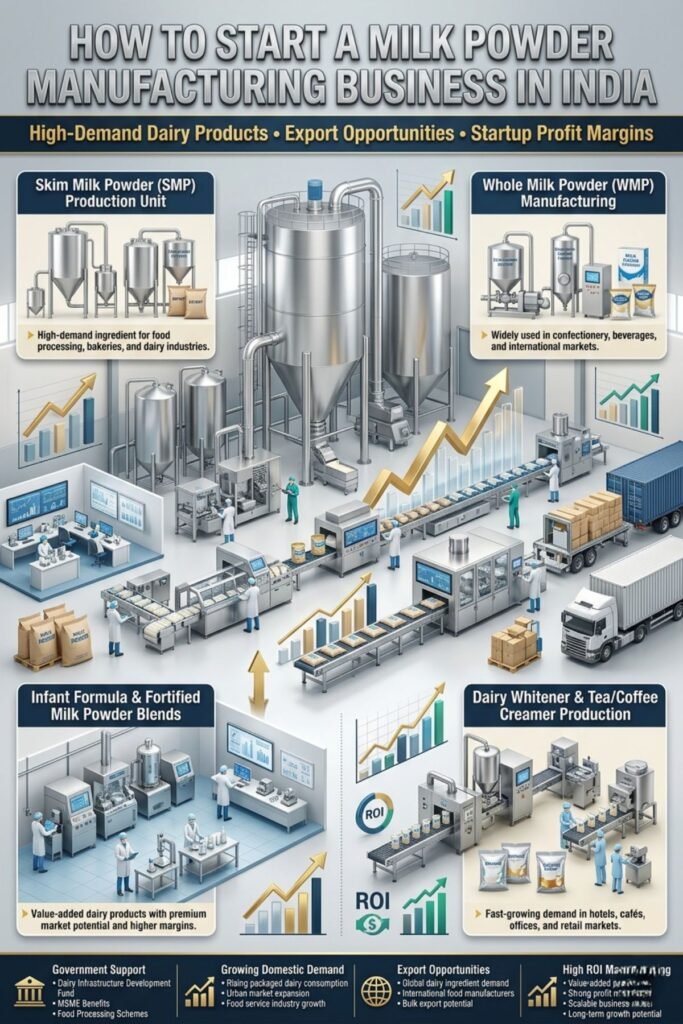
1. Skim Milk Powder (SMP) Production Unit
Among the more commercially successful entry points to the milk powder market is skim milk powder. The production of SMP involves the fat removal from fresh milk followed by spray-drying of the milk into fine SMP white powder. Subsequently, It is used widely in confectionery, the making of chocolate, bread-making, and institutional food systems, and with dairy products. Furthermore, The investment required for a small to medium size SMP unit, having a capacity of 500 to 1000 litres of milk/day, is between ₹70 lakh to ₹1.5 crore depending on the location and specification of the equipment.
The real competitive edge here is the consistent precision of fat removal and moisture control – these are the factors that make up product grade and shelf life. Founders who can access the local farmers or cooperatives for direct milk procurement thus have much lower input costs resulting in much better per kg margins. SMP is also ideal for B2B contracts with biscuit manufacturers, mithai chains and food processors as it has a shelf life of 12-24 months when stored appropriately.(Milk Powder Manufacturing Business in India)
2. Whole Milk Powder (WMP) Manufacturing
Whole milk powder does not have its milk fat content reduced, and therefore has a more rich-tasting milk profile and a higher caloric content than SMP. This is the go-to option for luxury chocolate makers, formula for babies and top-tier bakery facilities. In addition, WMP fetches a higher price than SMP both domestically and in the export market. The advantage of having more fat, however, is that they require the more advanced packaging system, such as nitrogen flushed or vacuum-sealed pouches, to prevent oxidation and rancidity.
For a commercially viable set-up, the minimum requirement of capital invested is around ₹1.5 – 2 crores, which calls for slightly more sophisticated spray-drying and packaging systems for a WMP unit. WMP certification by APEDA and adherence to Codex Alimentarius standards are crucial to open up buyers from the Gulf, Southeast Asia and Europe for the founder who are targeting export. The business has a high margin and can be scaled up with a good B2B and B2C potential after securing quality credentials.
Get Detailed Project Report (DPR): Dairy Products Processing and Manufacturing Guide
3. Infant Formula and Fortified Milk Powder Blends
Infant nutrition industry in India is rapidly expanding due to rise in knowledge of nutrition science among urban and semi-urban parents. Fortified milk powder products, which are vitamin DHA, calcium and iron enriched, are the fastest growing product shelf in this category. To set-up an infant formula or nutritional blend production facility, the Food Safety and Standards Authority of India (FSSAI) has laid down the Food for Special Dietary Use (FSDU) regulations, which are more stringent in terms of additional licensing and quality audits. Commodity SMP and WMP margins are significantly lower than in this segment, however.
It’s one of the most differentiated and premium business ideas in the milk powder market for a startup that has a clean-room facility, has a robust quality testing infrastructure and focus is either on natural or A2 milk-based formulations. The co-manufacturing agreements with established health food brands provide a lower risk entry point before development of a consumer product brand.
4. Dairy Whitener and Tea/Coffee Creamer Production
Dairy whitener is a unique and very well-established product segment in the milk powder market. Amulya and Everyday are such brands that are incredibly loyal and have established a huge brand equity in the institutional and domestic market in India. But there are still considerable gaps in the regions and private-label markets, especially in Tier 2 cities and smaller towns. A dairy whitener manufacturing unit is similar to a normal milk powder plant in terms of its process infrastructure, but with the inclusion of some process steps for creaminess, flowability and dissolution behaviour.
The retail market for dairy whitener is sufficiently big to sustain new regional brands and secure day one offtake agreements through private label contracts negotiated with hotel chains, airline caterers and corporate canteens. The business concept has a definite market for businessmen, distribution system and relatively low market education cost, so that it is attractive for first generation entrepreneurs who enter the manufacturing business.
Import–Export Opportunity Analysis for Milk Powder Businesses
India is a structurally surplus milk producer country and hence a very natural country to export SMP and WMP in the years of good monsoon and strong procurement. The Agricultural and Processed Food Products Export Development Authority (APEDA) actively engages in the export market development assistance and provides different kinds of facilitation to the dairy exporters. Indian milk powder exports to Bangladesh, Nepal, UAE, Vietnam and some African countries with high dependency on milk imports.
Furthermore, there is the import substitution potential for technically strong manufacturers for certain grades of specialty dairy powders, such as whey powder with high protein content and caseinates. A tropical heat-stable milk powder (or high protein fraction) producing start-up can find a niche in the domestic and export market. So, the milk powder startup company that starts exporting from the beginning enjoys better price realisation and protection from fluctuations in the domestic price.
Indian MSME Success Stories in Dairy Processing
The Param Dairy Limited (Rajasthan) promoted by Param Agri Biotech group is an interesting case study for MSME level milk powder production. The company developed a vertically integrated business model which involved acquiring milk from more than 50,000 farmers in rural areas of Rajasthan, processing it into SMP and WMP for sale in the country as well as exported to other country markets. The basic idea that helped them was to cut out the unreliable middleman and provide farmers a fixed price for their inputs all year round. Milk powder entrepreneurs need to take a closer look at this example since it illustrates how disciplined procurement results in a cost advantage which marketing and branding can never match up.
Build a profitable business with the right idea
From being a tiny ice cream joint, Hatsun Agro Product Limited run by R.G. Chandramogan has become one of the best privately owned dairy companies in India with milk powder being one of its important product lines. In commoditised areas, just as in other segments, positioning is crucial and Hatsun’s story emphasizes that it is quality first. Having invested in the technology earlier than the competition, they were able to practice flush farming in that they could take up milk surpluses and utilise the technology to convert milk into powder, instead of losing out on milk procurement.
She started a new venture “Heritage Foods Limited” in the Andhra Pradesh and Telangana region which grew at a breakneck pace with milk processing as its main business, with Chandrababu Naidu at the helm of the company, and is now under professional management. Their experience shows that during periods of rising demand for dairy powder, such as in summer, processors outside a given region can secure better terms because they have invested in drying capacity. By drying the product, they minimize the perishability risk that can be fatal for processors who do not dry it.
How NPCS Can Help You Launch a Milk Powder Manufacturing Business
The process of starting a milk powder plant is not as simple as designing a plant; it’s a process that involves a well-founded feasibility study, a realistic market analysis and an equipment plan that is both financially based and reflects your market. This is where Niir Project Consultancy Services (NPCS) makes measurable difference.
Market Survey cum Detailed Techno-Economic Feasibility Reports (DPRs) are prepared by us at NPCS to entrepreneurs entering into the dairy processing and milk powder industry. Our reports include detailed process flow diagrams, optimized for your milk production capacity, as well as specifications for the required machinery and raw materials, including current market prices, and project financials, with five-year profitability projections and working-capital needs as well as capital expenditure needs. Our aim is very simple; we want you to know whether to invest or not, how much to invest and where to invest—this before you invest even a single rupee in land or machinery.
Related Article: How to Start a Milk Powder Manufacturing Business: Smart Business Ideas, Investment Guide & Growth Potential
Milk Powder Manufacturing – Key Project Data at a Glance
| Parameter | Small Unit | Mid-Scale Unit |
| Milk Processing Capacity | 500–1,000 L/day | 5,000–10,000 L/day |
| Capital Investment (Approx.) | ₹70 L – ₹1.5 Cr | ₹3 Cr – ₹7 Cr |
| Key Output Products | SMP, Dairy Whitener | SMP, WMP, Infant Formula |
| Estimated Revenue (Annual) | ₹45 L – ₹1.2 Cr | ₹4 Cr – ₹10 Cr |
| Manpower Required | 8–15 persons | 30–60 persons |
| Primary Market | Local FMCG, Confectionery | B2B, Exports, Retail |
| Payback Period | 3–5 years | 4–6 years |
| Key Licence Requirements | FSSAI, MSME Udyam | FSSAI, BIS, APEDA (for export) |
Frequently Asked Questions (FAQ)
1. What is the minimum investment required to set up a milk powder manufacturing plant in India?
A small-scale milk powder plant of capacity 500-1000 liters per day would typically have a minimum capital investment ranging between 70 lakh and 1.5 crore which varies as per location, choice of machinery, costs incurred on buildings and the requirement of working capital (15-25 lakh). Raw milk and packaging material and the other expenses for initiating the operation forms part of the working capital.
2. Which licenses and registrations are necessary for the milk powder manufacturing business?
You are required to take an FSSAI manufacturing license under the Food Safety and Standards (Licensing and Registration of Food Businesses) Regulations. MSME Udyam registration, GST registration and No Objection Certificate from State Pollution Control Board (SPCB) is a mandatory thing for all business operations. If you are considering on exports, you must have the APEDA registration along with product testing as per Codex Alimentarius rules.
3. Are there any government subsidies available for setting up a milk powder plant?
The Animal Husbandry Infrastructure Development Fund (AHIDF) provides an interest subvention on loans given for dairy processing units. The Production Linked Incentive (PLI) scheme for Food Processing supports achievement of incremental revenue targets. The MSME Credit Guarantee Fund can be used to secure loans without collateral and the state-level Dairy Development Departments are usually providing capital subsidy of 15% – 25% under the schemes linked to National Programme for Dairy Development (NPDD).
4. How do I ensure a stable supply of raw milk for my milk powder manufacturing plant?
Continuous procurement of raw milk is the most critical element for success in this business. Some of the potential options for securing the milk include: becoming a bulk milk cooler operator and aggregating milk from individual farmers at village level, tying up with district level milk cooperatives or state Dairy Federations, partnering with the procurement network of National Dairy Development Board (NDDB) based procurement initiatives and building your own procurement routes with adequate incentives to farmers for providing quality milk. Initially, many entrepreneurs start with the cooperative route and build farmer networks as their capacity grows.
5. What are the differences between skim milk powder (SMP) and whole milk powder (WMP) in terms of business viability?
Being fat free the shelf life of SMP is higher and it is widely used in confectionery, bakery and institutional sectors because of its functionality and low price. All the fat is retained in WMP and thus it will fetch a higher premium and is popular among chocolate manufacturers and the upper segment of retail market. While starting off with SMP is comparatively easier for a new entrepreneur as storage is simpler; with WMP higher realisations are possible per kilo if packaging and quality are taken care to prevent fat oxidation.
6. Is exporting milk powder from India commercially viable for a medium scale enterprise?
Yes, this can be an appealing alternative, particularly if prices are good in the season of peak milk flush. India has the advantage of naturally low milk production costs and is able to export in specific windows. APEDA supports registered exporters for market development. However, exporting of SMP depends on international benchmark prices and freight costs, as well as on meeting the food safety standards of importing countries. Initially, exporting could be a secondary source of income for the unit, till quality is certified and stable and procurement is robust enough for both domestic and export sales.
Conclusion: A Manufacturing Sector Built for the Long Term
The milk powder manufacturing sector integrates India’s supply advantage with robust, diversified, and growing end-market demand. The array of business ideas ranging from plain, commodity SMP manufacturing to sophisticated, value-added infant nutritional blends, caters to different entrepreneurial risk profiles and capital investment appetites. Nevertheless, long-term success in this sector relies heavily on not only plant and machinery but the principles of procurement, quality control and establishing long-term relationships with buyers, both domestic and overseas.
For ambitious entrepreneurs in this sector, a well-prepared feasibility report is not just another formality but a critical input to guide every decision-be it about capital outlay, capacity or location and market positioning. Rigorous planning and patient execution are key to realizing the true potential of this sector.