

Walk into any paint factory, water treatment plant or oilfield service unit in India today and there is a good chance a water-soluble polymer is doing some of the heaviest lifting in the process. These materials rarely make headlines. They do not have the glamour of electric vehicle batteries or the policy attention of solar manufacturing. Yet they sit quietly at the centre of some of the country’s largest industrial supply chains, from the paint tin on a hardware store shelf to the drilling fluid used a few kilometres underground. For entrepreneurs scanning the chemical manufacturing landscape for a segment that is both technically approachable and commercially resilient, water-soluble polymers deserve a much closer look.
What Exactly Are Water Soluble Polymers, and Why Do They Matter So Much?
A water soluble polymer is, simply put, a polymer that dissolves in water, with or without the aid of co-solvents, to produce a clear or near-clear solution. That single property, solubility, is what makes this category so commercially versatile. These polymers fall broadly into two families, the fully synthetic polymers such as polyvinyl alcohol and polyacrylamides and the natural or semi-synthetic products such as starch derivatives, dextrin, gum acacia, guar gum and cellulose ethers like carboxymethyl cellulose and hydroxyethyl cellulose.
What unites these very different materials is function. They thicken, stabilise, bind and modify the flow behaviour of liquids. A latex paint stays smooth on a roller thanks to a water soluble polymer controlling its rheology. A drilling fluid maintains the right viscosity to carry rock cuttings out of a wellbore thanks to a similar mechanism. A packaged food stays stable on a shelf thanks to a hydrocolloid, technically the same broad category, doing quiet, unglamorous work behind the scenes.
A Market With More Depth Than It Looks From the Outside
India’s specialty chemicals sector, which includes water soluble polymers as a defined and tracked segment, had a value of around USD 67 billion in 2025 and is set to grow to roughly USD 93.4 billion by 2034, expanding at a compound annual growth rate of close to 3.65 percent. Within that broader basket, market analysts call out specialty polymers and water treatment chemicals as distinct, fast-moving categories rather than incidental line items.
Where the Demand Is Actually Coming From
The breadth of application is really what makes this segment interesting to a new entrant. A single manufacturing unit producing, say, modified starches or cellulose ethers can realistically supply four or five completely different industries without retooling its core processes.
Paints and coatings remain one of the largest consumers where water soluble polymers control viscosity, gloss, drying behaviour and film formation in both latex and water-reducible resin systems. The oil and gas sector is another significant buyer using these polymers in drilling fluids, well bore cementation, reservoir fracturing fluids, multistage production and refining operations, applications all calling for precise control of fluid flow characteristics. Municipal and industrial water treatment plants rely on them as coagulants and flocculants to clarify water at scale. Textiles, food processing, pharmaceuticals and construction chemicals round out a demand base that is genuinely diversified rather than dependent on a single downstream industry’s fortunes.
For an MSME assessing project economics, this diversification is key. A downturn in construction does not necessarily impact water treatment demand. A slow year in oilfield services does not necessarily affect the paints segment. That kind of built-in demand spread is not something every chemical sub-sector can offer.
The Opportunity for Indian Entrepreneurs and MSMEs
India’s push for self-reliance in specialty chemicals creates room for organised, quality-focused manufacturers. Rising domestic consumption of paints, packaged water treatment solutions and processed food also supports this space.
A large share of the water-soluble polymers segment in India still relies on imports for certain synthetic grades. A relatively small set of established players holds most of the formulation know-how for value-added, application-specific polymer blends.
That gap is precisely where a well-prepared new entrant can compete. This does not necessarily mean entering the largest bulk synthetic polymer lines. These lines require significant capital and technical scale. Instead, new entrants can focus on specialised, application-focused product lines.
These may include cellulose ether derivatives for construction and food use. They may also include natural gum-based thickeners or formulated water-reducible resin systems for regional paint manufacturers.
These are segments where technical clarity and process discipline matter more than sheer plant size. This is exactly the kind of opportunity that suits a serious MSME promoter rather than only large chemical conglomerates.
Government support for the broader specialty chemicals sector adds further tailwind. This includes production-linked incentives, MSME cluster schemes and export promotion for chemical products.
Steady growth in related sub-segments also supports the opportunity. These include water and wastewater treatment chemicals. The underlying business case is not speculative. It is visible in the numbers.
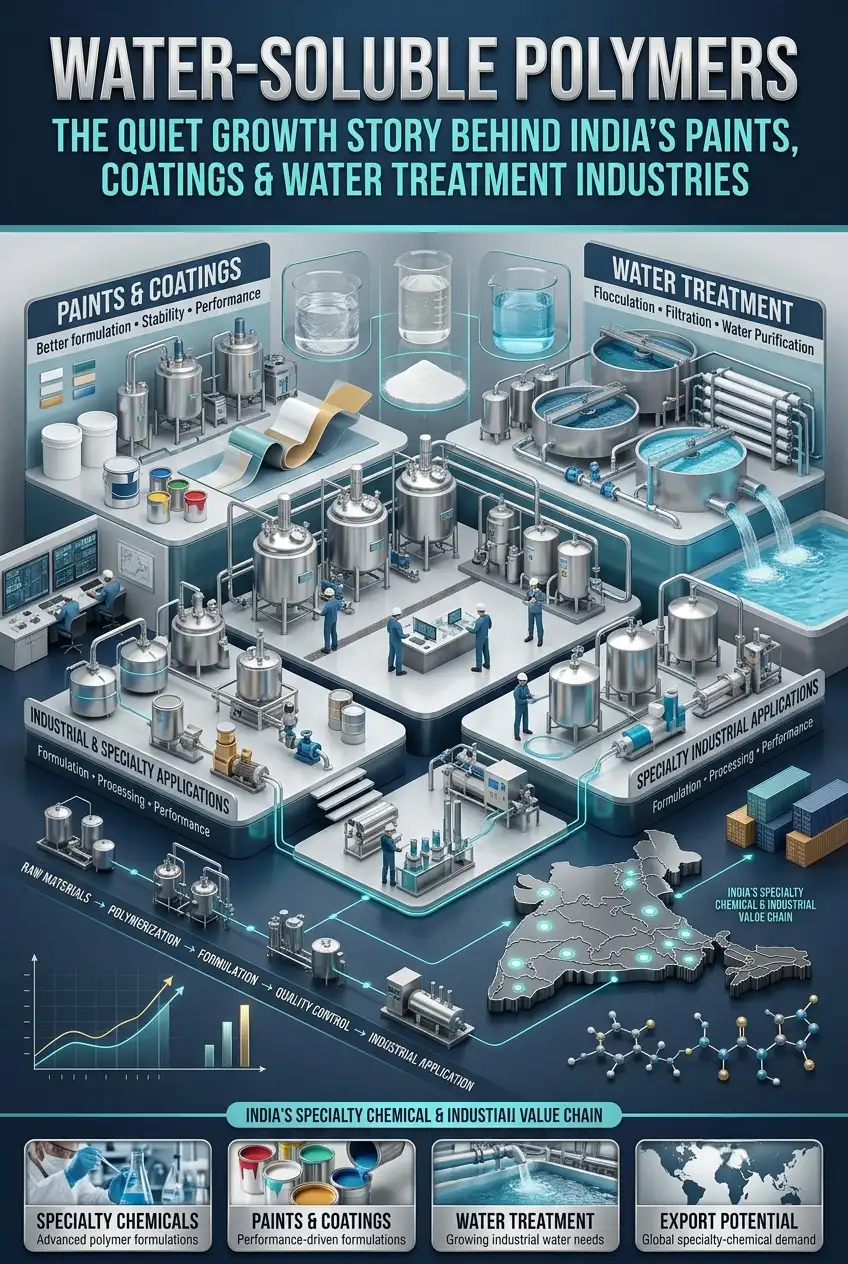
Water soluble polymers used in paints, coatings, water treatment and other industrial applications in India.
This Is Exactly Where “The Complete Book on Water Soluble Polymers” Becomes Relevant
Understanding that a market opportunity exists is one thing. Understanding the chemistry, classification, processing routes, formulation science well enough to act on it is another matter, precisely the gap that “The Complete Book on Water Soluble Polymers” by NPCS Board of Consultants & Engineers is built to fill.
This is not a light introductory pamphlet. Instead, It runs to 672 pages. Moreover, It was published by Asia Pacific Business Press Inc. Furthermore, Structured as a genuine technical reference. In fact, It is the kind an entrepreneur, plant manager or technical consultant would keep on their desk.
First, The book opens with a detailed treatment of water-soluble polymers themselves. In addition, It covers their classification into synthetic and natural or semi-synthetic types. Furthermore, Explains the properties of cellulose ethers, degree of polymerization and substitution, molar substitution and the rheological behaviour that underpins how these materials perform in real formulations. Also, It walks through flow characteristics and thixotropy. Moreover, It also covers specific application areas such as latex paints and emulsion polymerization. As a result, This provides a working understanding of why these materials behave the way they do. Therefore, It is not just a list of names and specifications.
Next, It moves on to methods of polymerization and acrylamide chemistry. It also Covers initiation methods, single-component and redox initiator systems. In particular, These are technical grounds often scattered across multiple academic sources. However, they are bundled into one coherent, industry-oriented reference.
Furthermore, A substantial section is devoted to water-reducible resins. In addition, It traces their history and covers maleinized drying oils, alkyd resins, acrylic-modified water-soluble alkyds, polyesters, silicone-modified alkyds and polyesters, epoxy resins, acrylics and amino resins. Moreover, Provides detailed formulation guidance on viscosity characteristics and the role of amines. It also covers drying behaviour, stability, gloss, foam control, colour retention and toxicity considerations.
Additionally, The book provides practical detail on cosolvents and driers for air-dry and force-dry systems. It also covers cross-linking of water-soluble coatings. Furthermore, Additives include surfactants, flow modifiers, thixotropes and thickeners. In fact, It even covers the formulation of water-soluble coatings. Finally, Troubleshooting topics include common problems such as vehicle separation and viscosity variation. Overall, These are hard-won details that usually take years of plant experience to accumulate.
Who Should Be Reading This Book
This reference is aimed squarely at people who need to act on this knowledge rather than admire it. New entrepreneurs assessing a water-soluble polymers manufacturing project will find the technical foundation needed to move from an idea to a workable process. Existing chemical manufacturing units looking to diversify into cellulose ethers, water-reducible resins, specialty coating additives can find formulation detail that shortens the usual trial-and-error curve. Technocrats, R&D professionals, paint or coatings formulators can find a structured single-source reference, whereas technical libraries, research institutions and consultancy firms working with MSME clients in the chemical sector can add it to their reference shelf.
Why This Book Is Worth Adding to Your Reference Shelf
There is no shortage of scattered information about individual polymers online, but what is really hard to find is a single, well-organised, industry-grounded source that binds chemistry, processing science and practical formulation troubleshooting in one place, the real value the book offers. It saves the time of piecing together fragments from technical papers, supplier data sheets and forum threads and presents a coherent story that an entrepreneur or technical professional can use to make decisions, whether it is about plant design, product formulation or simply understanding what a supplier’s specification sheet is really telling them.
For a business function where formulation know-how is often the real competitive advantage, this kind of consolidated reference has practical commercial value beyond its cover price.
How to Get Your Copy
“The Complete Book on Water Soluble Polymers” by NPCS Board of Consultants & Engineers is priced at Rs. 1,575 (approx. US$ 150) and is available in paperback, running to 672 pages.
Readers can purchase copies directly through the NIIR Project Consultancy Services website or through Amazon and Flipkart if they prefer those platforms. And with the depth of formulation detail and current momentum of India’s specialty chemicals and water treatment segments, it is a reference worth ordering before starting rather than running into a formulation problem mid-project.
For entrepreneurs, MSMEs, technocrats, and consultants planning a serious move into water soluble polymers manufacturing, this book offers the kind of grounded, structured technical foundation that generic online research simply cannot match. Order your copy today and build your project on a base of real formulation science, not guesswork.
Book Details & Purchase Section
| Book Title | The Complete Book on Water Soluble Polymers |
| Author | NPCS Board of Consultants & Engineers |
| Publisher | Asia Pacific Business Press Inc. |
| ISBN | 978-8178331232 (ISBN-10: 8178331233) |
| Format / Pages | Paperback, 672 pages |
| Price | Rs. 1,575 / approx. US$ 150 |
Purchase Links
- NIIR Website: https://www.niir.org/books/book/complete-book-on-water-soluble-polymers/isbn-9788178331232/zb,,16a,a,0,0,a/index.html
- Amazon: https://www.amazon.in/dp/8178331233
- Flipkart: https://www.flipkart.com/complete-book-water-soluble-polymers/p/itmdyugjbbugnhyz\
Your Investment Deserves the Right Opportunity
Every serious investment begins with choosing the right sector and the right business model. With hundreds of industrial opportunities available across India’s manufacturing and clean-energy landscape, making the most informed choice is crucial. Niir’s Startup Selector tool helps entrepreneurs, MSMEs and investors identify the most suitable business opportunities based on their investment capacity, location and interests, ensuring their capital is directed toward the venture with the best fit.