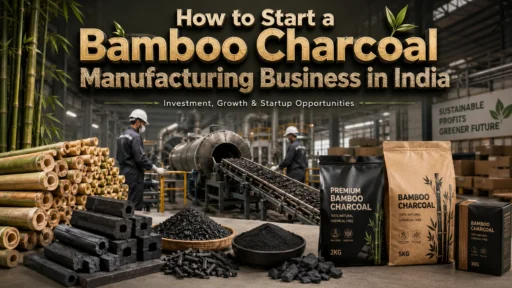
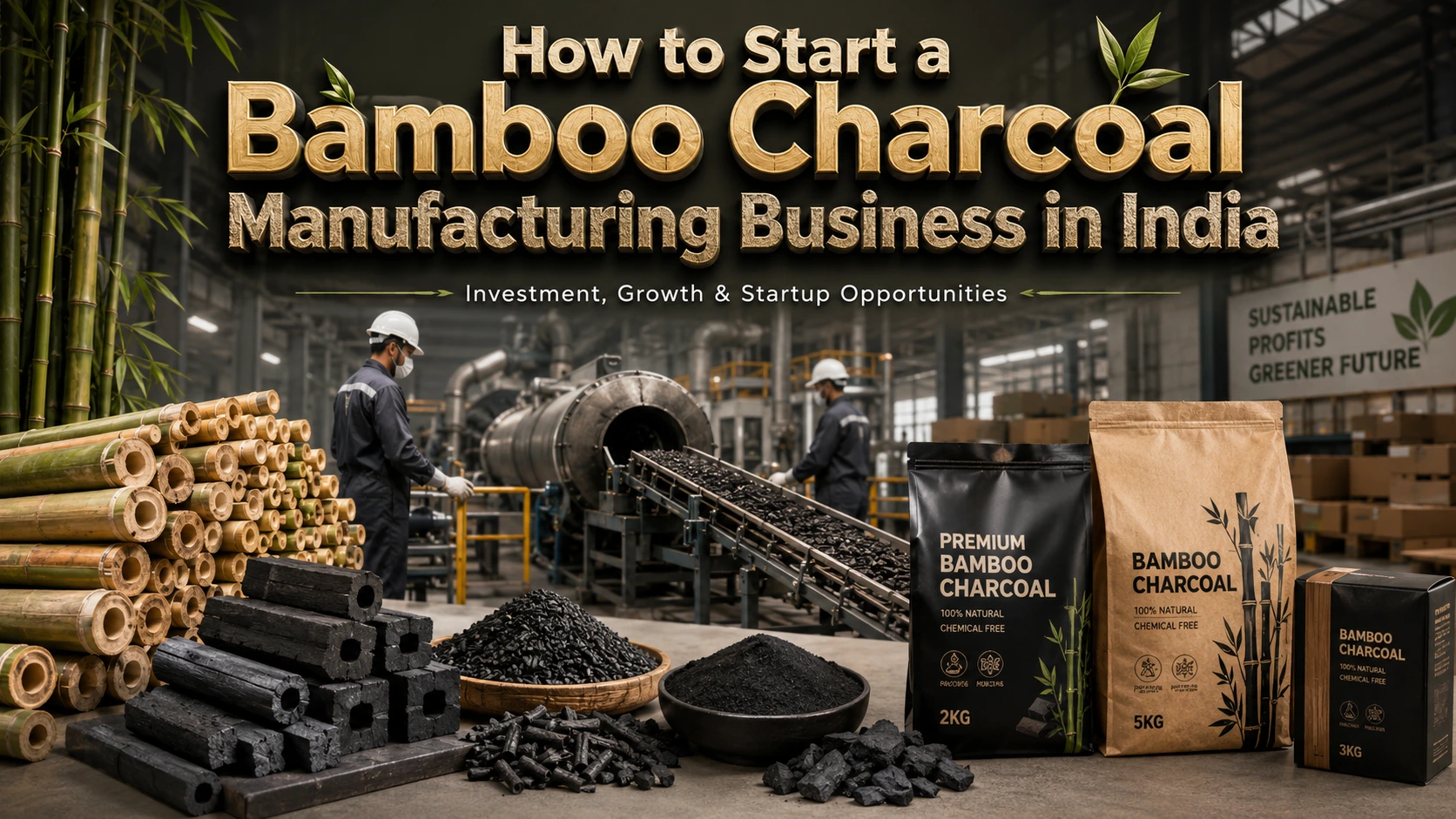

Entrepreneurs looking for high profit-making and low competition green manufacturing business ideas are always aware of the importance of bamboo charcoal. The worldwide market for activated carbon and specialty charcoal products is expanding rapidly as demand in water treatment, air purification, agricultural and cosmetic applications, and food grade applications increase. With one of the world’s largest bamboo reserves concentrated in the northeast and the central belt of India, the opportunity is right in the middle of the Indian continent — but most of its value remains untapped.
Bamboo charcoal is not the traditional fuel charcoal. It has excellent adsorptive ability, thermal stability and conductivity and is a high-performance, porous carbonised material. It has become the base for manufacturers to develop multi-million-dollar businesses in Japan, China and South Korea. Overall, the sector is still in its early stages in India, offering a great opportunity for entrepreneurs with knowledge, as well as higher margins and lower competition.
Why the Bamboo Charcoal Sector Is Growing Fast
The market demand of bamboo charcoal is home and abroad. Municipalities in India are making significant investments in water purification facilities. Industries use activated carbon for effluent treatment and air filtration in industrial applications. The organic farming movement strongly demands bamboo charcoal, also called biochar. These are not just trends that will go away. They are the reflection of actual procurement process by government agencies, agricultural cooperatives, and FMCG companies.
The National Bamboo Mission has reported India having more than 13.96 million hectares of bamboo plantation which is the second largest bamboo resource base in the world. However, the value added in the bamboo processing chain is still very low. Bamboo charcoal, however, fetches a higher price of ₹40–₹200 per kg, depending on the grade and usage of bamboo charcoal. The processing margin is structural in nature and it is not a cyclical margin.
Another dimension is the export markets. Many countries in the European Union and Japan are importing bamboo charcoal products for a variety of purposes, including health, cosmetics, and manufacturing. China is the dominant source of supply, but quality issues and diversification of supply chains are encouraging international buyers to buy from India. This provides an actual opportunity for Indian exporters to enter into the premium segment of the international market.
Get Detailed Project Report (DPR): Bamboo Charcoal Manufacturing Business
Government Policies and Incentives Supporting This Business
The Government of India has created a relatively robust policy framework on bamboo and green manufacturing. The government of India, Ministry of Agriculture, has national level scheme known as the National Bamboo Mission (NBM) that offers financial support to build bamboo plantations, process units and value addition. Subsidy for establishment of carbonisation kiln, drying unit, processing infrastructure will be available to entrepreneurs under the component of cottage industries and value-added products of NBM.
Credit linked subsidy is provided by the Ministry of MSME in the form of Credit Guarantee Fund Trust for Micro and Small Enterprises (CGTMSE) for small bamboo charcoal enterprise, which offers loans without any collateral. Prime Minister’s Employment Generation Programme (PMEGP) offers 25-35% capital subsidy for manufacturing units in the rural areas, especially bamboo states such as Assam, Manipur, Meghalaya and Odisha.
Besides this, the Make in India policy emphasises the importance of green manufacturing and forest-based industries. Start-ups setting up bamboo charcoal factories in aspirational districts could receive extra incentives from the state level such as rebates on electricity charges, industrial clearances, and land lease subsidies. The DPIIT Startup India portal also provides income tax exemptions for the first three years for startups recognised by DPIIT in this category.
Profitable Business Ideas Within Bamboo Charcoal Manufacturing
1. Activated Bamboo Charcoal for Water Purification
The most valuable of all bamboo charcoal applications, perhaps. The manufacturing process for activated bamboo charcoal involves two steps: first, carbonising bamboo at 700°C to 900°C, and then activating it using steam or chemicals to greatly increase its porous surface area. The product formed has the ability to adsorb heavy metals, chlorine and organic compounds faster than in many test conditions than a coal based activated carbon does. There are a number of active buyers including municipal water treatment plants, industrial effluent treatment systems, and manufacturers of household water filters.
A small-to-medium size unit, with the production capacity of 2-5 tonnes per day activated bamboo charcoal can meet the needs of regional industrial customers and provide filter manufacturers with activated bamboo charcoal by using the distribution network. Capital investment is moderate (a working unit can be built at ₹15 to ₹25 lakh) and its revenue structure is strong thanks to its repeat purchase cycles by institutional buyers.
2. Bamboo Biochar for Organic Farming
Overall, Agricultural biochar is one of the fastest growing markets in the market of organic farming inputs in India. Among its many attributes, bamboo biochar enhances soil porosity, improves the soil’s ability to retain water, increases microbial activity, and sequesters carbon. Farmers highly value these characteristics as they help them shift toward natural farming practices under the Parampara at Krishi Vikas Yojana and other government initiatives. Technically, producing activated charcoal is simpler than producing biochar: bamboo waste undergoes pyrolysis in a low-oxygen atmosphere at 350–600 °C to form stable biochar material. The product could be sold directly to farmer co-operatives, organic farming companies and agricultural input dealers. Prices may be enhanced with branding and certification (such as ECOCERT, India Organic). A very feasible rural enterprise model with minimal raw material cost particularly the states with abundant bamboo.
Get Detailed Insights from This Book: Bamboo Plantation and Utilization Handbook
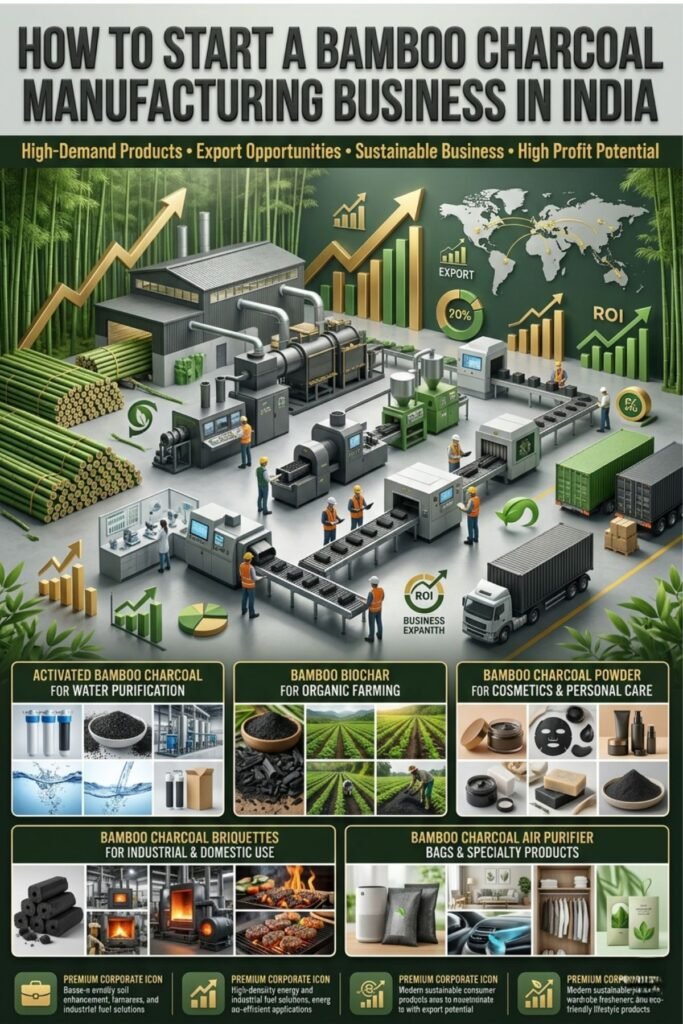
3. Bamboo Charcoal Powder for Cosmetics and Personal Care
Today, D2C e-commerce has become mainstream in India for charcoal skincare and activated bamboo charcoal personal care products like face wash, toothpaste, soap, face mask and shampoo are now part of the urban Indian consumer. Moreover, Industrial opportunity here is to provide the cosmetic formulation companies and contract manufacturers with finely milled bamboo charcoal powder. Furthermore, To make the powder, manufacturers use high-purity bamboo, process it at controlled temperatures, and grind it into specific mesh sizes such as 200 to 325 mesh for cosmetic use. Additionally, An entrepreneur having the basic carbonisation and milling plant can access this market by having relatively small MOQs from the buyer. The higher the quality of the bamboo charcoal powder, the more expensive it is, and the margins can be high, ranging up to ₹200–₹500 per kg for cosmetic grades.
4. Bamboo Charcoal Briquettes for Industrial and Domestic Use
Firstly, Charcoal briquettes are the most easy-to-access market for the first-generation entrepreneurs. Moreover, We can convert the fine and dust particles produced during the carbonization process into compressed briquettes using a binder and a hydraulic press. Additionally, Industries primarily use briquettes in industrial furnaces, while the barbecue and catering sector uses them, and peri-urban regions use them as a clean cooking fuel. However, The market is sensitive to price but trading volume oriented. The cost of setting up a briquetting unit is as low as ₹5-Lakh to ₹8-Lakh. The main strategic considerations are market positioning; industrial market requires constant calorific value and ash content; consumer market needs good packaging and reliable distribution. As a result, Entrepreneurs who combine briquetting as a downstream process with their main charcoal production venture can significantly boost cash flow and profitability by minimizing waste.(Bamboo Charcoal Manufacturing Business)
5. Bamboo Charcoal-Based Air Purifier Bags and Specialty Products
A product-led business idea in the space that’s on the exciting front is the bamboo charcoal dehumidifier and air purifier bag, a natural and reusable product that absorbs odours and purifies the air, in place of the chemical-based dehumidifiers and silica gel packets. Moreover, These are products which are popular in Japan and South Korea and are making inroads into the urban Indian health-conscious consumers. Additionally, The making process is simple, raw bamboo charcoal chunks or granules are poured into a porous textile purse. Furthermore, There is no chemical treatment necessary. The e-commerce, or B2B (business-to-business) sales-to-furniture companies, car accessories brands and home goods retailers are direct-to-consumer business models. Finally, The low capex, manufacturing ease and high brand distinguishing potential make this a great opportunity for any entrepreneur who has marketing skills to start a business.
Build a profitable business with the right idea
Import–Export Opportunity Analysis
There is a huge potential for India to export bamboo charcoal which is not fully utilised. Forest based product exports are still dominated by raw or semi processed products as per trade data compiled by the Ministry of Commerce and Industry. Transitioning to value-added charcoal products—including activated charcoal for industrial applications and specialty charcoals for cosmetics, etc.—creates an export value-added opportunity that exporters can strategically pursue.
As far as the world is concerned, Japan is still the most advanced bamboo charcoal market and has a long history of demands in the fields of wellness, construction and agriculture. Moreover, Activated carbon plays an important role in Europe’s water treatment and pharmaceutical manufacturing processes. In addition, Bamboo-based activated carbon is highly priced because it is certified as sustainable. Furthermore, Cosmetic grade bamboo charcoal powder is growing in popularity for the United States market of natural/ organic personal care.(Bamboo Charcoal Manufacturing Business)
The Indian exporter’s road starts with quality certification. The compliance milestones are: BIS standards for activated carbon and FSSAI certification for food-grade applications and organic certification bodies as per the APEDA framework. Exporters can avail export promotion support from the Federation of Indian Export Organisations (FIEO) which provides export market development assistance and grants to participate in trade fairs.
Indian MSME Success Stories in Bamboo-Based Manufacturing
A few Indian entrepreneurs have already proven that adding value to bamboo is possible, and that it is a viable, scalable business model. They are a great source of learning for new comers.
Phyto Chem India Ltd., based in Gujarat, established a substantial activated carbon business by first sourcing bamboo from the north-east region, and later processing them with locally developed technology for making rotary kilns. Technical differentiation was the key to the company’s success, with investments made in building supply relationships with water treatment companies and early investment in quality testing laboratories. The take-home message from this lesson is that it is more important to have consistent specifications than it is to pay a different unit price in an industrial market.
Sangita Thakur and her co-founders, from Assam, promoted Bamboo India Pvt. Ltd., which involved planting, processing and marketing the bamboo products. They provide biochar and charcoal products to organic agriculture businesses, and export them via trading partners. The vertical integration logic that their model presents—the ability to control the supply of raw materials in an area of the country with high levels of bamboo—is what makes it instructive.
Tora Bamboo, a business based in Mizoram, targeted the specialty product sector, such as charcoal based personal care inputs and developed a direct B2B supply chain with cosmetics manufacturers. They emphasize market positioning: being a specialty supplier, not a commodity producer, of charcoal enables them to command a better price and maintain longer buyer loyalty.
Related Article: Top 4 Manufacturing Opportunities in Drinking Water, Bamboo Charcoal, Aluminium Recycling & Rice Husk Biomass Pellets
How NPCS Can Help You Start This Business
As a bank financing and investor diligence partner, Niir Project Consultancy Services (NPCS) actively assesses manufacturing opportunities with a stringent approach. To produce bamboo charcoal, we produce Market Survey cum Detailed Techno-Economic Feasibility Report (DPR) which includes all the bamboo charcoal production process from bamboo procurement to carbonisation technology, activation, packaging and quality control.
We provide detailed specifications of machinery, raw materials and sourcing advice, process flow diagrams, capacity planning models, and complete financial models of your project with profitability forecasts. If you’re looking at a small biochar setup of ₹10 lakh or a medium-scale activated carbon plant of ₹1 crore, we take the sizing of the analysis into account based on your investment capacity and growth plans. Our goal is to give you the clarity you need when investing — with the return on investment, breakeven point and positioning in the market required for sustainable profitability.(Bamboo Charcoal Manufacturing Business)
Bamboo Charcoal Business: Key Data at a Glance
| Business Segment | Approx. Investment (₹) | Indicative Selling Price (₹/kg) |
| Activated Bamboo Charcoal (Industrial) | 15–25 Lakh | 80–150 |
| Agricultural Biochar | 8–15 Lakh | 25–60 |
| Cosmetic-Grade Charcoal Powder | 12–20 Lakh | 200–500 |
| Bamboo Charcoal Briquettes | 5–10 Lakh | 20–40 |
| Air Purifier / Dehumidifier Bags | 3–8 Lakh | ₹80–200/unit |
Note: Investment figures are indicative for small-scale units. Actual figures vary by location, capacity, and technology choice.
FAQs
Q1. Which raw material is required to make bamboo charcoal?
Mature bamboo culms, typically 3- to 5-year-old are the key raw material. Some commonly used species in India processing plants are Dendrocalamus strictus (male bamboo) and Bambusa balcooa. Bamboo waste generated from furniture manufacturing units and from the construction sector also provides a low-cost source of inputs.
Q2. What is the difference between bamboo charcoal and activated bamboo charcoal?
Bamboo charcoal is simply burnt in a low-oxygen atmosphere by burning in a retort, also called pyrolysis or carbonization. Activated bamboo charcoal involves an extra treatment (activation with steam or chemicals) that largely expands the available surface area. As a result, people use activated bamboo charcoal for water purification, air filtration, and even cosmetics, and it sells at a very high price.
Q3. How much land is needed to set up a simple bamboo charcoal plant?
A carbonization and packaging unit requires a covered shed space of at least 2,000 to 5,000 square feet, along with additional space for raw material storage. Usually, the small entrepreneur sets up his unit on the outskirts of his native district close to the supply clusters to cut down the cost of transportation of bamboo.
Q4. Which govt scheme is best for getting funds for this business?
The most suitable financing support for a novice entrepreneur is PMEGP scheme under Ministry of MSME, where you get 25-35% capital subsidy depending on SC/ST/women and balance is to be funded by bank. Subsidy is also available from National Bamboo Mission for project specific activities and for value addition purposes.
Q5. Is it worth exporting bamboo charcoal from India?
Yes, it is worth it to export Activated carbon or the cosmetic grade powder produced from bamboo charcoal from India. These materials fetch two to three times the price of same grades within India. Though you will require to achieve certain export certifications and also have connection with agents and trade association, FIEO affiliated for better market access to countries like Japan, Korea and EU countries.
Q6. How do you ensure consistent quality of bamboo charcoal production?
The consistency of the produced charcoal depends on three factors: the selection of bamboo species, the control of kiln temperature, and the testing of product quality after manufacturing. To achieve consistency, a small laboratory is set up to test the iodine number—which indicates adsorption capacity—and moisture content. This ensures batch uniformity according to the required customer or buyer specifications, especially for industrial and export applications.
Conclusion
The bamboo charcoal making industry has a unique and enviable niche in Indian industrial sector as it is resourceful, policy supported and demand driven by the international market. Entrepreneurs who focus on product–market clarity, invest in product quality, and maintain a disciplined approach—targeting either the domestic industrial segment or export markets—can build profitable and scalable businesses. There is no doubt about the opportunity. The raw material is plentiful, the market is genuine and the competition is limited. The difference between successful entrants and those who fail is in preparation – in the quality of the feasibility analysis, the accuracy of the capacity planning, and the realism of the financial projections. This is what NPCS works on helping entrepreneurs to establish.(Bamboo Charcoal Manufacturing Business)