Bamboo Activated Charcoal Manufacturing Business
A smart manufacturing business opportunity that has strong demand in the export market and is supported by the government.
Entrepreneurs seeking green manufacturing opportunities can explore bamboo-based activated charcoal as a profitable business option. It isn’t some esoteric curiosity; it’s a high-demand industrial feedstock for water treatment, pharmaceuticals, food processing, air purification and cosmetics applications. India has two distinct advantages: a large bamboo forest and expanding demand in the home and international markets for environmentally friendly carbon-related products. This manufacturing business is a rare opportunity for first-generation founders and MSME investors to enjoy low raw material costs, high margins, and a path for scalability.
Why the Bamboo Activated Charcoal Sector Is Gaining Momentum
Activated charcoal made from bamboo surpasses other activated charcoal, such as wood and coal for a number of reasons. It has a greater surface area per gram, short adsorption time, and a much cleaner process. Bamboo varieties are premium on export markets as the global buyers are turning towards sustainable purchase of Industrial Input. Demand is growing throughout Europe, Japan, South Korea, and the United States, where environmental sourcing is no longer a preference, it’s a requirement.
India is one of the world’s biggest bamboo producing country, producing more than 13 million tonnes of bamboo every year. A significant portion of it comes to be underutilized or exported as raw material at low prices. The production of locally activated bamboo charcoal not only increases the value of the bamboo product before it reaches the end user by several folds (usually 8-12-fold) but also provides a good source of income to the farmers. The value-added ratio is the one that is financially attractive for this manufacturing enterprise.
Read the Complete Book Here: Bamboo Plantation and Utilization Handbook
Government Policies and Incentives Supporting This Business
The Government of India has been actively promoting bamboo-based industries under the umbrella of the National Bamboo Mission through the Ministry of Agriculture and Farmers’ Welfare. The scheme offers financial support for bamboo cultivation and bamboo processing units and value addition products. Under this mission, the bamboo processing units can avail capital subsidy up to 50% on plant and machinery for the entrepreneurs.
Further, MSME Credit Guarantee Fund Scheme (CGTMSE) provides loans of up to ₹2 crore for eligible manufacturing startups without the need for collateral. The green chemistry and biomass-based manufacturing also benefit from the Production Linked Incentive (PLI) Scheme, and the Startup India initiative. Governments provide subsided power tariffs and priority sector lending to the MSME units throughout the country.
To know about the policy, visit the official portal of Ministry of MSME. Make in India should be explored for incentives for export-oriented manufacturing by the entrepreneurs as well.
Business Ideas for Startups in Bamboo Activated Charcoal Manufacturing
1. Powdered Activated Charcoal (PAC) for Water Treatment
Municipal water treatment, industrial effluent treatment and pharmaceutical production commonly use powdered activated charcoal. A PAC production unit consists of a carbonisation kiln, activation furnace, pulverising mill and packaging line. Investment of ₹40-60 lakh can be made in an entry level unit with a capacity of 500 kg/day. Domestically, the product commands prices from ₹80 to 150 per kg, while in the export markets, the realisations are 20–30% more. The major customers are municipal water boards, bottling companies and API manufacturers. If a founder can attract an institutional buyer prior to commissioning the unit, their working capital risk will be greatly reduced.
2. Granular Activated Charcoal (GAC) for Industrial Filtration
Chemical plants, refineries, and large food processing units use continuous-flow filtration systems using granular activated charcoal the most. The production process is similar to PAC, but needs extra equipment to granulate and size the product. However, GAC is more expensive per kg because of its longer service life in industrial applications. A mid-scale GAC unit can be used for bulk supply contracts to chemical manufacturers and water treatment equipment suppliers. It is an excellent business opportunity in the states which are rich in industrial clusters base such as Gujarat, Maharashtra, Tamilnadu and Andhra Pradesh.
Get Detailed Project Report (DPR): Bamboo Charcoal Manufacturing Business
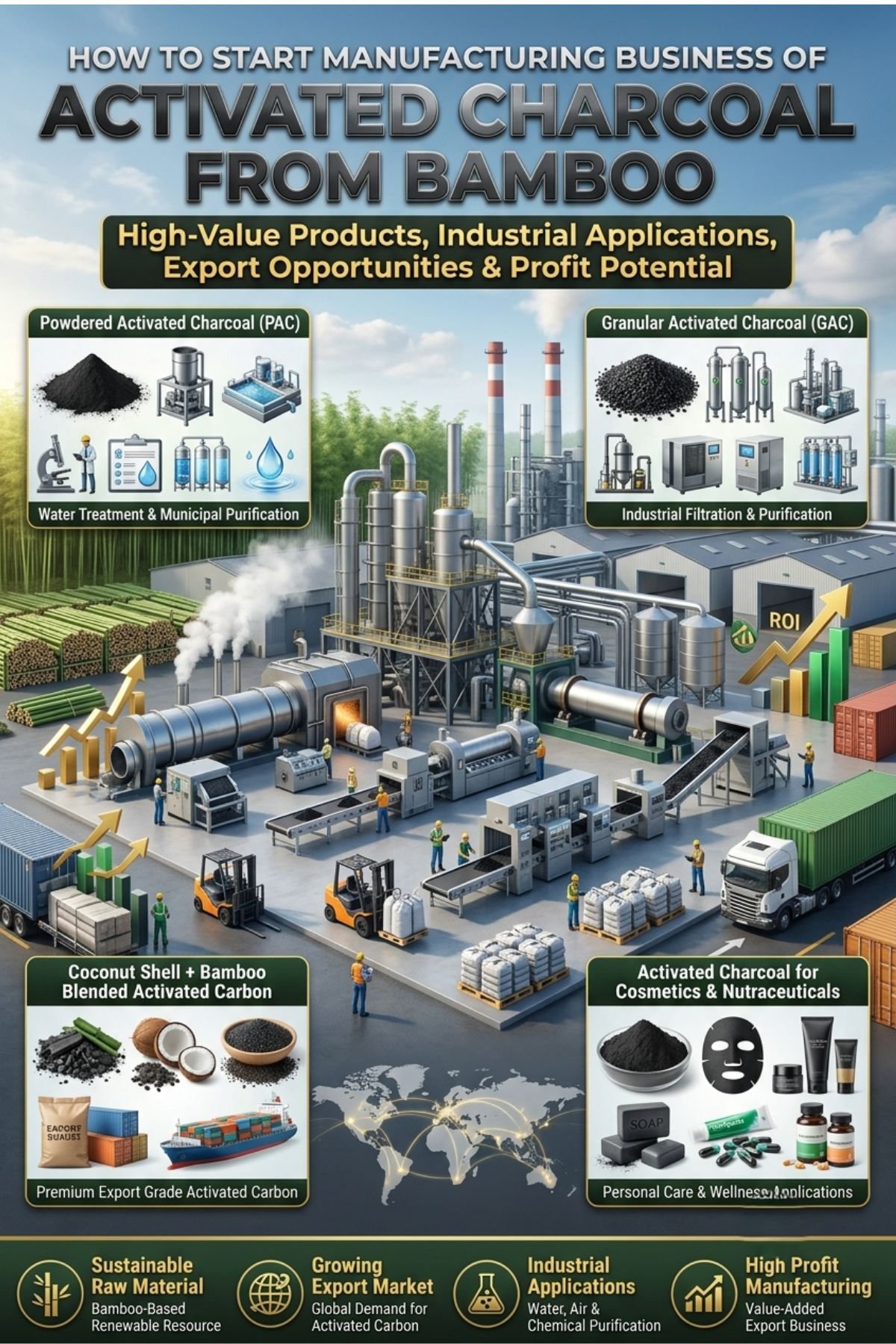
3. Coconut Shell + Bamboo Blended Activated Carbon for Export
A number of international buyers, especially from Japan and South Korea, choose blended activated carbon products that combine bamboo and coconut shell feedstock to achieve the desired adsorption profile. If they can access raw materials, startups can create their own blend of products and directly approach importers for selling these products. It’s an export driven business model that demands quality certifications like ISO 9001 and adherence to REACH standard requirements for European markets. The margin on export grade blended carbon is significantly larger than domestic grade carbon, so it’s a good product investment for the growth stage business.
4. Activated Charcoal for Cosmetics and Nutraceuticals
Activated charcoal is the most profitable product in this manufacturing industry, with two types that are used in the food and cosmetics industries. Their products range from activated charcoal powders for detox beverages to teeth whitening creams and face masks, and nutraceutical capsules. Production requirements are more stringent – GMP compliant facility, food grade processing practices and regulatory approvals from FSSAI and CDSCO as per end use. But the selling price of food grade bamboo activated charcoal is ₹ 400-900 per kg, whereas that of activated charcoal is ₹ 80-150 per kg. The following is a reverse integration that can be leveraged by founders who are interested in D2C health and wellness brands. Refer to Agricultural and Processed Food Products Export Development Authority (APEDA) for export compliance guidance.
Import–Export Opportunity Analysis
The export of activated carbon has increased gradually in India, due to the demand in the water treatment industry all around the world. The United States, Germany, Japan and South Korea are the preferred destinations. The exports of activated carbon are classified under HS Code 3802.10 by DGFT (Directorate General of Foreign Trade) and the product has relatively low tariff barriers in the major markets. India also has a demand for pharmaceutical grade activated carbon, indicating an import substitution potential for players with ability to produce the same with domestic capacity with pharmaceutical grade quality.
Export-oriented units can register with the Export Promotion Council for Chemicals and Allied Products (CHEMEXCIL) to receive market linkage support and attend international trade fairs. Founders should also consider the benefits of free trade agreements that India has with ASEAN and Japan, as these agreements offer import duty concessions on finished goods entering these markets.
Related Article: How to Start a Bamboo Charcoal Manufacturing Business in India
Indian MSME Success Stories in Activated Carbon Manufacturing
Jacobi Carbons India and Active Char Products
India has produced several successful mid-scale manufacturers in the activated carbon space. Companies like Jacobi Carbons India and Active Char Products have demonstrated that MSME-scale plants with export orientation can compete on quality and lead time. Their growth model consistently followed a similar pattern: start with industrial-grade product, build quality systems, obtain international certifications, and gradually shift the product mix toward higher-margin pharmaceutical or food-grade output.
Bamboo-Based Green Entrepreneurs from Northeast India
The Northeast India region, supported by the North Eastern Development Finance Corporation (NEDFi), has seen a new wave of bamboo processing entrepreneurs. Several small-scale founders in Assam and Tripura have built profitable bamboo charcoal and activated carbon units using government-subsidised machinery and raw material linkage from state forest departments. The lesson for new entrepreneurs is clear: locating near raw material sources can significantly reduce costs, while regional government schemes often provide better subsidy terms than central schemes for bamboo-specific businesses.
For comprehensive market data and sector benchmarks, the Confederation of Indian Industry (CII) and Federation of Indian Chambers of Commerce and Industry (FICCI) regularly publish green manufacturing sector reports that are valuable planning tools for new entrants.
Build a profitable business with the right idea
How NPCS Can Help You Set Up This Manufacturing Business
At Niir Project Consultancy Services (NPCS), we provide professional consulting for the preparation of Market Survey cum Detailed Techno-Economic Feasibility Reports (DPRs) for setting up new industries and manufacturing businesses. The DPRs for bamboo activated charcoal units contain specifics on manufacturing process details, process flow diagram, product mix and capacity planning, machinery and raw materials availability, market survey and demand analysis and comprehensive project cost with profitability estimates. Our intent is to assist aspiring entrepreneurs in determining feasibility, viability and scalability of the proposed project before investing hard-earned capital. Entrepreneurs who opt for a structured DPR can present their projects more effectively to banks and financial institutions when seeking project finance.
Project Cost and Revenue Estimates: Bamboo Activated Charcoal Unit
| Parameter | Small Scale Unit | Mid Scale Unit | Export-Oriented Unit |
| Daily Production Capacity | 200–500 kg/day | 1–2 MT/day | 3–5 MT/day |
| Capital Investment | ₹30–60 Lakh | ₹1.5–3 Crore | ₹4–8 Crore |
| Raw Material Cost (per kg) | ₹8–12 | ₹8–12 | ₹8–12 |
| Selling Price (per kg) | ₹80–150 | ₹120–200 | ₹200–400+ |
| Gross Margin (approx.) | 45–55% | 50–60% | 55–65% |
| Payback Period | 2.5–3.5 Years | 2–3 Years | 2–3.5 Years |
Note: Estimates are indicative. Actual figures vary based on location, product grade, and market linkages.
Frequently Asked Questions (FAQs)
Q1. What is the minimum investment to start a bamboo activated charcoal unit?
Entrepreneurs can set up a small-scale unit producing 200–500 kg per day with a capital investment of ₹30–60 lakh, covering plant and machinery, working capital, and license fees. For those in the northeast, subsidies under the National Bamboo Mission can also bring the real cost down.
Q2. What licences and approvals are required?
In addition to MSME (Udyam) registration, founders must obtain a factory licence under the Factories Act. They also need approval from the Pollution Control Board, generally under the Green or Orange category. Finally, they must obtain GST registration and any necessary product-specific clearances. Food- and pharmaceutical-grade products may require additional approvals from FSSAI or CDSCO.
Q3. Is bamboo activated charcoal different from coconut shell activated carbon?
Yes. Coconut shell is more often the standard for some filtration and many other applications but, when sourcing and application come into it Bamboo’s activated charcoal has greater surface area and a better sustainability record. When it comes to the cosmetics, nutraceutical and air purification market where the ‘renewable sourcing’ aspect matters, this is the ideal product.
Q4. What are the key export markets for this product?
The top importing nations for activated carbon are the USA, Germany, Japan, South Korea, and UAE. Export products must also comply with the quality purity as specified by buyer, which may need to include international standard certificate. Members of CHEMEXCIL, participation in the government-organised trade fair would enable you to venture in these markets.
Q5. How long does it take to set up a manufacturing unit?
It usually requires 8-14 months from planning to commissioning of a small to medium scale unit. The whole process involves site selection, statutory clearances, civil work, machinery procurement, trial runs, and finally testing the product. If a thorough project report is readily available, it drastically shortens the planning period.
Q6. What government schemes support bamboo-based manufacturing businesses?
Supporting schemes/resources are National Bamboo Mission, CGTMSE (Collateral Free Loan Guarantee), PMEGP (Prime Minister’s Employment Generation Programme), state level schemes for MSME subsidy. Entrepreneurs in special category states — including northeastern states, J&K, and Himachal Pradesh — receive enhanced subsidy rates under several central schemes.
Conclusion
The bamboo activated charcoal manufacturing business is one of those rare opportunities where environmental alignment and commercial viability point in the same direction. India has the raw material, the policy support, the export demand, and the manufacturing talent to build world-class units in this space. What most entrepreneurs lack is a clear, structured view of the financial model, the process requirements, and the regulatory pathway. Starting with a robust feasibility report, engaging with sector associations, and focusing on product quality from day one are the three decisions that separate successful manufacturing founders from those who struggle to scale.
For founders ready to move from idea to implementation, this manufacturing business deserves serious evaluation.