The infrastructure narrative of India is being crafted in concrete, steel and construction chemicals. With the growth of cities, the number of highways becomes more and more, and residential towers are being built in Tier-1 as well as Tier-2 cities, the need for high-performance specialty chemicals in the construction industry has never been greater. For entrepreneurs entering this field, the first choice is a key decision on who will help them take it from an idea to a commissioned plant. Finding the right construction chemicals industry consultants in India can make the difference between a profitable and bankable project, and a costly misadventure.
However, many first-generation entrepreneurs are underestimating what it will take to deal with this technically challenging and compliance-heavy industry. This article highlights the role and contribution of top construction chemicals industry consultants, why India has emerged as an interesting market, how to select the best construction chemicals consultant for your construction project and the role of reputed construction chemicals consulting firms in India in transforming an entrepreneurial idea into a professionally structured investors ready enterprise.
India’s Construction Chemicals Sector: A Market Worth Serious Attention
It’s an impressive set of numbers. The construction chemicals market in India is estimated at around USD 2.5 billion and could grow at a CAGR of more than 12%, surpassing USD 6.5 billion over the coming decade. Infrastructure-linked specialty chemicals will create a market opportunity of USD 28 billion by 2030, says IBEF (India Brand Equity Foundation) data. The government’s National Infrastructure Pipeline, Smart Cities Mission, AMRUT 2.0, and PM Awas Yojana are driving sustained long-cycle demand by emphasizing admixtures, waterproofing compounds, repair mortars, tile adhesives, grouts, sealants, and epoxy systems.
Construction chemicals are specialty chemicals that India has traditionally imported and relied on foreign technologies for. This is rapidly changing. Worldwide trend of diversifying supply chain from China towards Import substitution has created an authentic opportunity for Indian manufacturers along with the increased awareness of the quality of goods in the country. Entrepreneurs who move first — supported by a feasibility test and the structuring of the technology — are those who enter an environment where the basics are clearly in their favour for new capacity.
But this construction chemical technology is not easy at all. The process engineering, raw material sourcing and quality control practices for each product category – concrete admixtures, waterproofing, surface treatments and repair compounds, and flooring chemicals – are different. A number of categories are certified by the Bureau of Indian Standards (BIS) and the Department of Chemicals and Petrochemicals (DCPC), under the Ministry of Chemicals and Fertilizers, has been increasingly strengthening the Quality Control Orders (QCOs) to ensure compliance with IS standards before the products are put to domestic sale or export. That’s where construction chemicals consultants with experience come in handy.
Get Detailed Project Report (DPR): Construction Chemicals Projects
What Construction Chemicals Plant Consultants Actually Do
In the industrial context there are many different types of services that fall under the umbrella of consultant. Many entrepreneurs think that “consultant = consultant reports. The truth is more complicated — and how good it is, how bad it really determines success or failure of a project.
Feasibility Studies and DPR Preparation
A Detailed Project Report (DPR) for a construction chemicals plant is NOT a template document. The entrepreneur must determine the product mix, whether it includes polycarboxylate-based concrete admixtures, cementitious waterproofing compounds, epoxy flooring systems, or tile-fixing adhesives. The raw material needs, reaction processes or blending processes, machinery configuration, plant layout, utility load, storage needs, regulating needs, and financial profile differ for each of the products. The development of the product-specific, site-specific business case is the key to the product’s market validation, and it is what good construction chemicals consultants do.
Process Engineering and Plant Layout
Process engineering skills are added to the top construction chemicals plant consultants. They include the appropriate type of reactor, mixing systems, milling or grinding equipment, filling lines, and a quality control lab set-up. They determine the nutritional requirements (power, water, compressed air) and plan a plant layout according to the provisions of the Factory Act, Pollution Control Board norms and fire safety codes. Before a single brick lays down, process engineering consultants make sure that the production flow is efficient, scalable and meets all the required specifications.
EPC and Project Implementation Support
EPC (Engineering, Procurement & Construction) consultants offer an integrated agency solution for the entrepreneurs who require a single point agency from concept to commissioning. Consultants take care of vendor identification, equipment procurement, civil construction supervision, utility installation, plant commissioning and trial production. A few consultancies do not have a full EPC capability, but specialise in DPR and feasibility, referring to allied consultancies for EPC. The difference needs to be defined from the outset by entrepreneurs.
Regulatory Compliance Advisory
During construction, compliance is a multi-layered thing. The Construction Chemicals Manufacturers’ Association (CCMA) acts as the main industry association that helps in communication with the Bureau of Indian Standards (BIS), Indian Concrete Institute and regulatory bodies. It is mandatory to get the necessary BIS certificates for the products that fall under relevant IS codes such as IS 9103 for concrete admixtures, IS 2645 for the waterproofing compounds and IS 15477 for tile adhesive etc. for accessing the market. The other basic conditions that a competent consultant can maneuver for the client include SPCB consent to establish and operate as well as Factory Act registration and GST compliance.
Get Detailed Insights from This Book: Industrial Chemicals Technology Hand Book
Why India Has Become a Hub for Construction Chemicals Consulting
Indeed, there’s no coincidence in the growth of these boutique management consulting firms and specialised process engineering consultancies in India over the last decade or so. Moreover, The advisory environment for construction chemicals is very dynamic and highly evolved given multiple structural factors.
Firstly, The PLI schemes for specialty chemicals have stimulated new investments, attracting domestics and NRI entrepreneurs to make investment in specialty chemicals. Furthermore, The PLI schemes for specialty chemicals has spurred fresh investments, both domestic and NRI entrepreneurs coming to invest in specialty chemical manufacturing. Secondly, the government’s investment in infrastructure, including the Invest India directive to promote industrial investment, has produced a new breed of project promoters who require bankable feasibility reports for funding by financial institutions. Third, the global specialty chemical firms coming into India through JVs or technology transfer have a need for the local consulting partners who have technical and regulatory knowledge.
Moreover, India’s strong MSME base has historically engaged with construction chemicals at a small-scale level — as distributors, applicators, or contract manufacturers. The sector is now maturing, with MSMEs seeking to move up the value chain into primary manufacturing. This transition requires a level of DPR quality, process know-how, and compliance awareness that general business consultants cannot provide. It demands construction chemicals plant consultants with sector-specific depth.
The Indian Chemical Council (ICC) and the Federation of Indian Chambers of Commerce and Industry (FICCI) have both flagged construction chemicals as a high-growth niche within the broader specialty chemicals market. The sector’s strong domestic demand base — insulated from global export volatility — makes it particularly attractive for new manufacturing units in the ₹2–15 crore capital investment range.
How to Evaluate and Shortlist the Best Construction Chemicals Industry Consultants in India
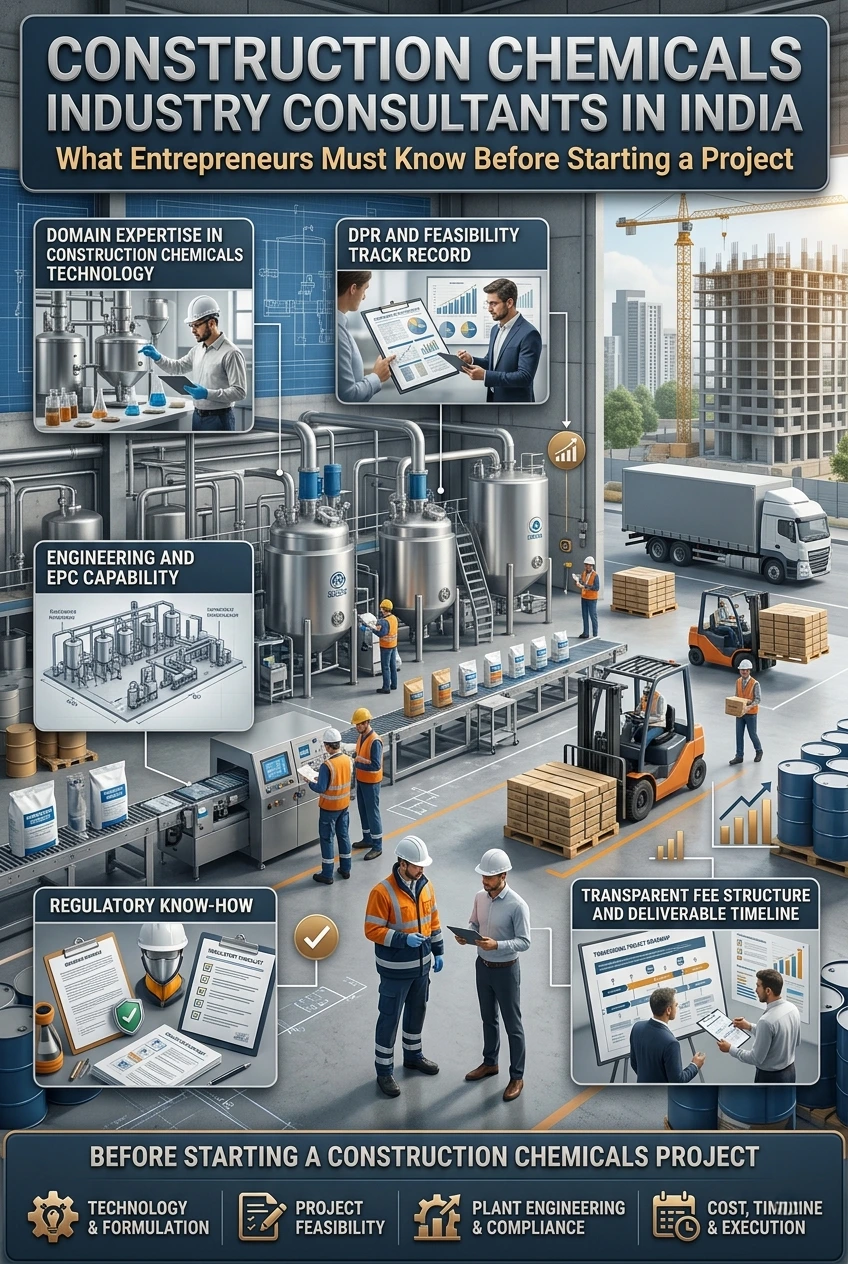
Choosing the right consultancy partner is not about procurement but a strategic choice. Many businessmen tend to shortlist on price only. The right evaluation is a mix of domain knowledge, track record, engineering skills and regulatory knowledge – all specifically in the context of construction chemicals, and not general chemicals or construction services.
1. Domain Expertise in Construction Chemicals Technology
Chemicals technology is a unique niche of the chemicals sector. Obviously look for consultants with a proven track record in admixture chemistry, waterproofing formulations, repair mortars, cementitious products, or epoxy/polyurethane systems, rather than merely organic or inorganic chemical process engineering. Request DPR samples or references for the products. An agrochemical or pharmaceutical consultant won’t be of much use in a construction chemicals feasibility study.
Related Article: Top 20 Construction Chemicals Manufacturing Business
2. DPR and Feasibility Track Record
Ask to see the consultancy’s track record of finished DPRs in the construction chemicals and specialty chemicals areas. Review and assess the document to see if it reflects true market demand analysis – primary data on product offtake, competitor mapping, price benchmarking – rather than generic sector overviews. The realistic capacity utilisation ramp-up, product-wise cost of production, break-even analysis, and sensitivity tables should form part of a credible DPR. Any projects that the consultant has successfully raised bank finance or MSME scheme assistance is an excellent positive indicator.
3. Engineering and EPC Capability
Specifically inquire about the preparation of the process flow diagram, sizing of the equipment, design of the plant layout, and estimation of the plant’s utility load. These deliverables can be offered in-house by top construction chemicals plant consultants. Firms that are less strong tend to sub-contract technical work to freelance contractors, which increases the likelihood of variations in quality and assumptions made by the DPR versus the engineering drawings. The consultants for EPC projects should not simply give a list of suppliers of machines from a reference book, but support with equipment specifications and vendor lists.
4. Regulatory Know-How
5. Transparent Fee Structure and Deliverable Timeline
Types of Construction Chemicals Consulting Services: A Comparison
The table below summarises the key service types available from construction chemicals industry consultants in India, their core focus areas, typical deliverables, and the best-fit client profile.
| Service Type | Core Focus | Key Deliverables | Best-Fit Client |
| Feasibility & DPR | Market, financials, process overview | DPR, cost of production, break-even, market demand study | First-generation entrepreneurs, NRI investors, MSME loan applicants |
| Process Engineering | Plant design, process flow, equipment sizing | PFD, P&ID, equipment list, plant layout, utility loads | Entrepreneurs with existing land/plant expanding into new products |
| EPC Consulting | End-to-end implementation | Procurement, civil supervision, commissioning, trial run | Turnkey project investors, JV partners with foreign technology |
| Regulatory Advisory | BIS certification, PCB consent, MSIHC compliance | Compliance calendar, application support, documentation | Existing manufacturers adding new product lines or upgrading units |
| Market Research | Demand assessment, pricing, competition mapping | Primary & secondary market research report, product-wise demand forecast | Strategic investors evaluating entry points, large industrial groups |
| Techno-Economic Studies | Combined technical + financial assessment | Techno-economic feasibility report for bank or PE fund submission | PE funds, banks, developmental finance institutions assessing proposals |
Role of NPCS in Construction Chemicals Project Consultancy
Niir Project Consultancy Services (NPCS) is a long-time established construction chemicals project advisory firm in Delhi having more than 3 decades of experience in industrial consultancy. Since inception in 1994, NPCS has had the privilege of serving clients in 85 countries and over 1,50,000 successful project reports and feasibility studies have been completed for manufacturing projects, including Construction Chemicals.
NPCS also creates Detailed Project Reports (DPRs) and techno-economic feasibility studies for construction chemicals projects that include the entire scope that an entrepreneur/investor may require, such as manufacturing process and reaction chemistry, machinery specifications and sourcing, raw material requirements and availability, market research and demand analysis, process flow diagrams, product mix and capacity planning, and comprehensive project financials including capital cost estimates, working capital requirements, projected profitability, IRR and payback period.
NPCS has a comprehensive construction chemicals project profiles and reports catalog of individual chemicals which will include all the specialty chemicals segment such as concrete admixtures, waterproofing chemicals, tile adhesives, epoxy flooring, sealants which will give the entrepreneurs an overview of the construction chemicals project opportunities available in India. For first-time promoters who are deciding which product to manufacture, this catalog may be especially helpful to compare the capital intensity, raw material sourcing and market demand for various project ideas before committing to a particular direction.
Build a profitable business with the right idea
What makes NPCS different is the technical consulting also combined with business intelligence. They are not just engineering plans, they are a case for investment, which a banker, financial institution and an MSME scheme evaluator can evaluate with confidence. NPCS is one of the comprehensive and qualified consultancy services firm for construction chemicals in Delhi NCR and across India that can make a difference when it comes to project consultancy from the beginning; minimizing the risk of costly changes during the design phase and rejection at the bank financing stage.
Best Construction Chemicals Industry Consultants in Delhi and the Broader India Landscape
Delhi NCR is the main center of industrial consultancy, feasibility studies, and techno-economic advisory companies in India. Moreover, this focus stems from the presence of financial institutions and development banks headquartered in the city, convenient access to the Ministry of MSME, DCPC, and BIS offices, and a strong supply of process engineering talent from IIT Delhi, Delhi College of Engineering, and affiliated institutions.
Furthermore, Delhi-based consultants have an edge when it comes to the north Indian market, which is one of the fastest-growing demand centres for construction chemicals, especially admixtures, waterproofing chemicals and repair chemicals, thanks to the rampant infrastructure and real estate activities in Uttar Pradesh, Haryana, Rajasthan, and the NCR. However, plants setting up operations in Gujarat, Maharashtra, Tamil Nadu, and the emerging industrial corridors of Telangana and Andhra Pradesh regularly engage the best construction chemicals industry consultants.
In addition, The Indian consulting landscape has matured considerably. Boutique management consulting firms in India now operate with domain depth comparable to international advisory firms, at a fraction of the cost. The key is identifying firms that combine sector-specific technical knowledge with business structuring capability — and that have verifiable project delivery experience, not just credentials. The CCMA and the Indian Chemical Council are useful starting points for identifying credible consultancy referrals within the construction chemicals ecosystem.
Conclusion: Your Next Step in the Construction Chemicals Business
India’s construction chemicals sector offers a genuinely compelling manufacturing opportunity — driven by sustained infrastructure spending, import substitution policy, and rising quality standards in construction. However, opportunity alone does not build a plant or generate returns. The right advisory partner does.
In addition, The best construction chemicals industry consultants in India bring three things that no entrepreneur can reasonably acquire independently: product-specific technical depth, market-validated financial models, and regulatory navigation capability that keeps a project compliant from concept through commercialisation. Whether you are a first-generation entrepreneur evaluating your first manufacturing project, an MSME promoter looking to scale, or an NRI investor exploring domestic manufacturing, partnering with the right process plant consultant transforms a business idea into a bankable, executable project.
First, Start by defining your target product clearly. Next, Research the raw material landscape. Then, Review available project profiles from established consultancies. After that, engage a firm that can deliver not just a document, but a credible, investment-grade project report — one that stands up to scrutiny from a banker, a PCFC lender, or a private investor. Finally, India’s construction chemicals window is open. Therefore, Explore NPCS’s construction chemicals project profiles to see the range of product opportunities available, and make your first move with confidence.