Layer Farming: Cost, Profit & How to Start
Contents 8 sections
- How a layer farm runs, from chick to spent hen
- Layer farming cost for a 10,000-bird unit
- Is layer farming profitable? The egg price decides
- Starting a layer farm: steps, breeds and equipment
- Subsidy and bank loans for layer farms
- Selling eggs, spent hens and manure
- Next steps
- Frequently asked questions about layer farming
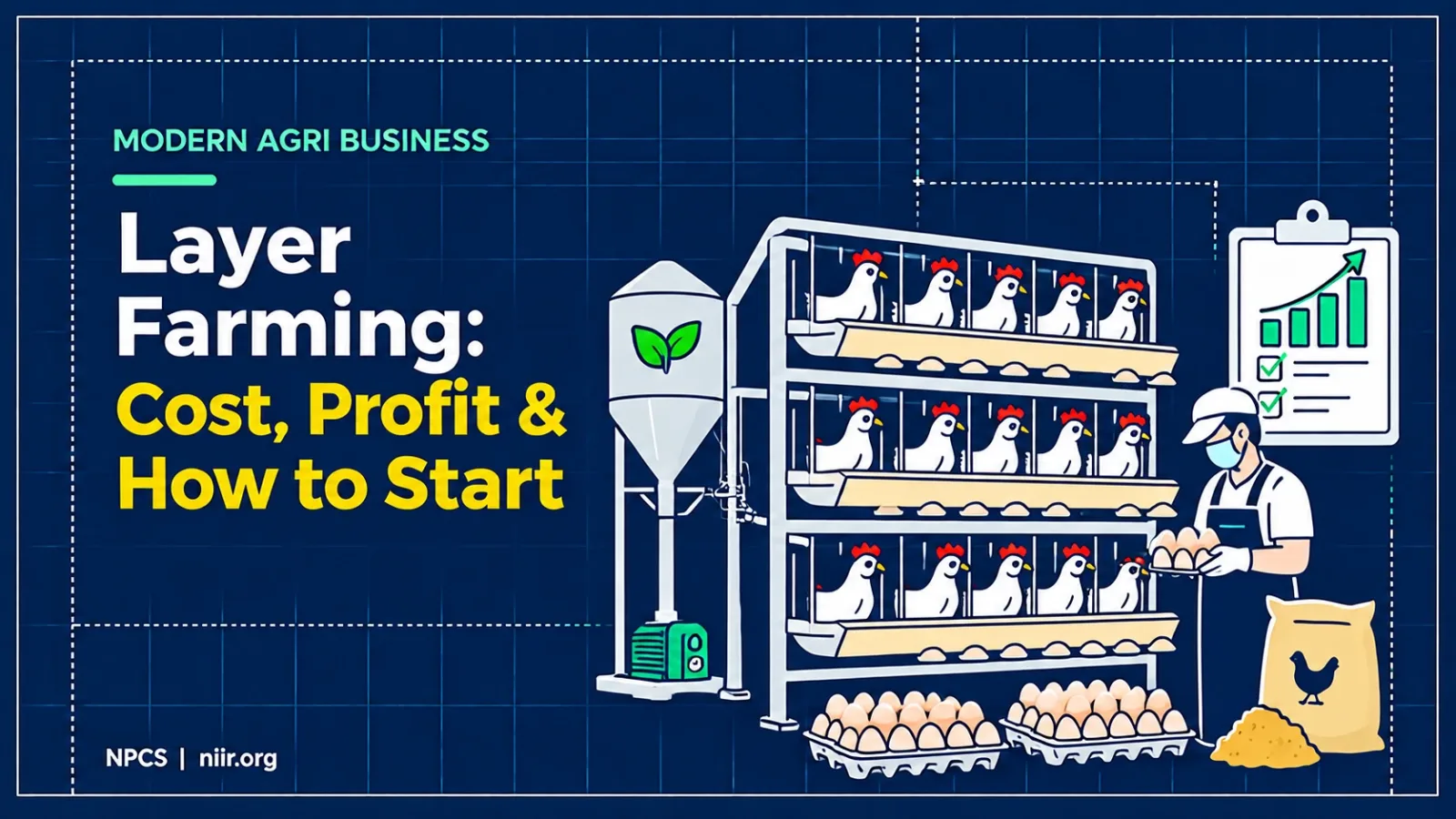
Layer farming is the business of rearing commercial hens for table eggs. You buy day-old chicks, rear them for about 20 weeks, keep them in laying cages for about 52 weeks, then sell them as spent hens and restock. Profit depends on one gap: the farm-gate price of an egg against your cost of producing it, and feed makes up most of that cost.
The market is large and concentrated. Under the Basic Animal Husbandry Statistics 2025, India produced 149.11 billion eggs in 2024-25, and commercial poultry farms supplied 84.49% of them. Andhra Pradesh, Tamil Nadu and Telangana together produced nearly half.
How a layer farm runs, from chick to spent hen
Plan sheds and cash flow around the bird's life cycle. Figures below are from NABARD's model project for layers and the Uttar Pradesh Animal Husbandry Department's 10,000-layer model.
|
Stage |
Age |
Housing and space |
Feed per bird |
|
Brooding and growing |
0 to 20 weeks |
Brooder and grower house, about 1 sq ft per bird on deep litter (NABARD) |
About 6.3 to 8.5 kg |
|
Laying |
About 21 to 72 weeks |
Layer cages, 0.80 to 0.85 sq ft per bird |
About 34.5 to 40 kg over 52 weeks |
|
Culling |
72 weeks |
Sold as spent hens for meat |
None |
The UP model assumes 5% mortality during rearing and 8% during laying. NABARD assumes 310 eggs per hen housed; the UP model uses 300 to 320. Both models run two flocks of different ages, so egg output never stops.
Layer farming cost for a 10,000-bird unit
The UP Animal Husbandry Department's 10,000-layer model puts the total project cost at ₹99.53 lakh on one acre of owned land, financed 70% by a bank loan and 30% by the owner. Use its unit rates to cost your own farm size:
|
Cost line |
Norm in the UP model |
|
Brooder-cum-grower and layer houses |
₹495 per sq ft |
|
Feed store, office and quarters |
₹820 per sq ft |
|
Layer cages |
₹50 per bird |
|
Brooder and grower cages |
₹50 and ₹70 per chick |
|
Day-old chicks |
₹40 each |
|
Feed |
₹24 per kg (starter), ₹22 (grower), ₹22.50 (layer) |
|
Medicine and vaccination |
₹15 per chick |
|
Staff |
A supervisor, a skilled worker and three helpers |
The ₹99.53 lakh also covers land development, a borewell, a feed grinder and mixer, a generator and the first six months of running costs. The model's own tables do not all add up, so treat it as a checklist and get local quotes for every line. NABARD's older 20,000-layer model came to about ₹1.11 crore, but it priced chicks at ₹25 and eggs at ₹3.15, so its rupee figures are now out of date.
Is layer farming profitable? The egg price decides
In the UP model, a 10,000-bird farm earns ₹143.06 lakh a year from eggs and spent hens from year two, against running costs of ₹101.76 lakh. That leaves about ₹41.3 lakh before loan repayment. Feed is about 90% of those running costs. The model assumes eggs sell at ₹4.50 each.
Real prices swing widely. DT Next reported that the National Egg Coordination Committee (NECC) price in Namakkal hit a record ₹6.45 per egg on 17 June 2026. In the months before that, prices had stayed below ₹4.50 for over 20 days while Namakkal farmers put their production cost at about ₹5.20 per egg.
A 10,000-bird flock lays roughly 30 lakh eggs a year. Using ₹5.20 as the cost per egg:
|
Farm-gate price per egg |
Margin per egg |
Yearly margin on 30 lakh eggs |
|
₹4.50 |
Loss of ₹0.70 |
Loss of ₹21 lakh |
|
₹5.70 |
₹0.50 |
₹15 lakh |
|
₹6.45 |
₹1.25 |
₹37.5 lakh |
Work out your own cost per egg from your feed price before you borrow, and keep cash for a few loss-making months.
Starting a layer farm: steps, breeds and equipment
1. Pick a site with firm, well-drained land, road access, water and reliable power, away from other poultry farms.
2. Fix your flock size and the number of flocks of different ages.
3. Build brooder-cum-grower and layer houses, plus a feed store and an egg room.
4. Install cages, water lines and feeders, and test the generator.
5. Buy day-old chicks of a commercial hybrid from a licensed hatchery. India has its own white-egg hybrids, such as Venkateshwara's BV300.
6. Follow the hatchery's vaccination schedule and keep strict biosecurity: footbaths, limited visitors and one-way movement of staff.
7. Shift pullets into layer cages before lay begins, then collect, grade and tray eggs every day.
|
Equipment |
Purpose |
|
Brooder and grower cages |
House chicks and pullets |
|
Layer cages |
Hold hens, let eggs roll to the front |
|
Feeders and nipple drinkers with overhead tanks |
Feed and water every bird |
|
Feed grinder and mixer |
Make your own feed at lower cost |
|
Generator |
Keep fans, lights and water running |
|
Egg trays, trolleys and a sprayer |
Handle eggs and clean the sheds |
Subsidy and bank loans for layer farms
• National Livestock Mission (NLM-EDP). A one-time capital subsidy of up to 50% of the project cost, with a ceiling of ₹25 lakh, but for breeding units: a farm producing chicks from 1,000 mother layers, or a rural hatchery, as a Tamil Nadu government release describes it. A farm that only sells table eggs does not fit these components. Applications go through nlm.udyammitra.in with a bank loan sanction, or a bank guarantee if self-funded. A Lok Sabha answer of December 2025 recorded 207 approved rural poultry projects with ₹49.86 crore in subsidy.
• Bank loans. Banks finance sheds, equipment, chicks and feed until lay, with NABARD refinance. NABARD's model takes a 25% margin and repays over seven to nine years with the first year as grace.
• State policies. Uttar Pradesh's model, for example, offers 7% interest subvention on the loan, capped at ₹14.61 lakh over five years. Check your state animal husbandry department.
Selling eggs, spent hens and manure
NECC announces daily egg prices zone by zone, and traders sometimes buy a little below them, so negotiate on the NECC rate and your egg quality. Sell to wholesalers, retail chains, hotels, institutions and egg processors. Spent hens go to meat traders; the UP model values them at ₹90 a bird. Manure sells to crop farmers as fertiliser.
Next steps
Read our poultry farming guide to compare egg and meat birds, and the poultry farm business plan to build your loan file. To add value, look at a chick hatchery business or egg powder manufacturing. Browse more agriculture business ideas.
Frequently asked questions about layer farming
How much profit is in layer farming?
It depends on the gap between the egg price and your cost per egg. The UP Animal Husbandry Department's 10,000-bird model shows about ₹41 lakh a year before loan repayment at ₹4.50 an egg. With Namakkal farmers putting cost at about ₹5.20 an egg in 2026, each ₹0.50 change in price moves a 10,000-bird farm's yearly result by about ₹15 lakh.
How many eggs can 500 layers produce?
At NABARD's norm of 310 eggs per hen housed, 500 layers give about 1.55 lakh eggs over a 52-week laying cycle, or around 425 eggs a day on average. Output is lower at the start and end of lay and higher at peak. Mortality, heat stress and poor feed all cut the number.
How much does it cost to start a layer farm of 5,000, 10,000 or 20,000 birds?
The UP model costs a 10,000-bird farm at ₹99.53 lakh, including buildings, cages, feed mill, generator and six months of running costs, but not land. Smaller and larger farms do not scale exactly, so cost your size with the per-bird and per-sq-ft norms in the table above and local quotes.
How many bags of feed do 100 layers need per month?
A laying hen eats about 95 to 110 grams a day, based on the UP model's 34.5 kg and NABARD's 40 kg over 52 weeks. So 100 layers need about 285 to 330 kg a month, or roughly six or seven 50 kg bags. Check intake against your feed supplier's chart for your breed and season.
When do layer hens start and stop laying?
Commercial hens start laying at about 20 weeks and are usually kept in lay until about 72 weeks, when output falls and they are sold as spent hens. Farms then clean and disinfect the shed before the next flock moves in.

Planning a new manufacturing unit?
NIIR prepares detailed project reports and feasibility studies for new projects. Share your requirement and the team will get in touch.