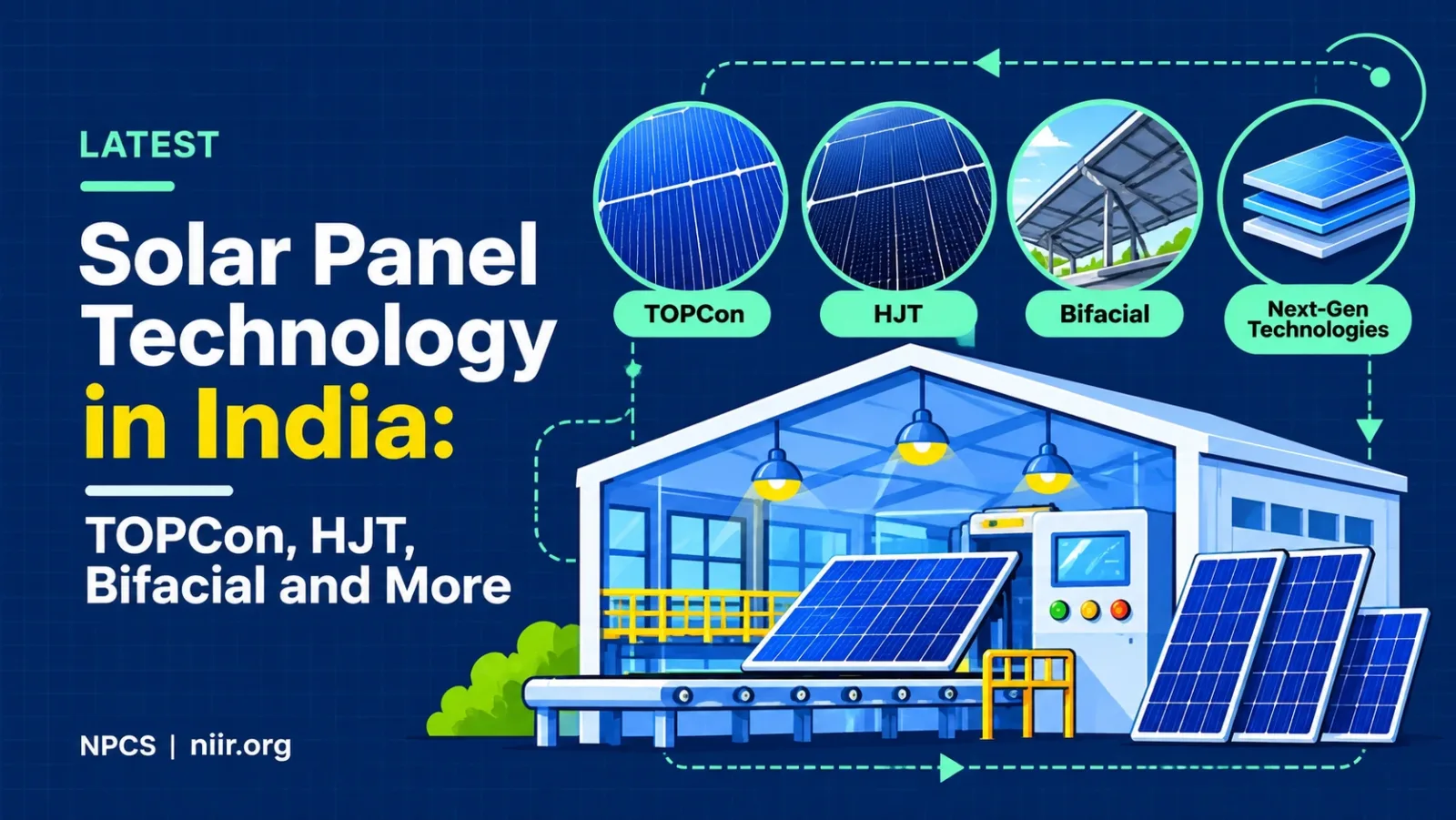
Latest Solar Panel Technology in India: TOPCon, HJT, Bifacial and More
Contents 8 sections
- TOPCon, HJT, back-contact and tandem: where each stands in India
- Why Indian cell makers chose TOPCon over HJT
- Wafer size, busbars and bifacial glass: the upgrades buyers ask for
- Is perovskite solar available in India yet?
- How the approved cell list changes your technology choice
- What a module line or a cell line costs
- Before you order machinery: next steps for a solar module project
- Frequently asked questions about new solar panel technology
The latest solar panel technology in India, as of November 2026, is the n-type TOPCon cell on a large rectangular wafer, built into a bifacial glass-glass module. It is what Indian factories make: TOPCon held 80% of module manufacturing capacity on the government's approved list in June 2026, according to Mercom India data. Heterojunction (HJT) is a distant second, made at scale only by Reliance Industries. Back-contact cells are not yet produced in India, and perovskite-silicon tandem panels are not due in commercial volumes before 2028.
For anyone planning a module or cell plant, that ranking matters more than any efficiency record. Since 1 June 2026, panels for most government-backed projects must use approved Indian cells, and net-metered and open access projects follow from January 2027. The cell technology you build around decides who you can sell to.
TOPCon, HJT, back-contact and tandem: where each stands in India
Efficiency gaps between n-type technologies are now small, so availability on Indian lines is what separates them. Efficiencies are 2025 global averages from the 17th ITRPV roadmap, the industry's annual survey; India shares are Mercom's.
|
Technology |
Average module efficiency, 2025 |
Share of India's approved module capacity, June 2026 |
Made in India today? |
|
N-type TOPCon |
23.5% |
80% (another 11% listed as PERC/TOPCon) |
Yes, the default for new cell lines |
|
Heterojunction (HJT) |
23.5% |
3% |
Reliance Industries, Jamnagar |
|
TOPCon back-contact |
24.1% |
Not listed |
No cell production yet |
|
Mono PERC (older p-type) |
21.7% |
4% |
Yes, but losing share |
|
Thin film (cadmium telluride) |
Not compared |
2% |
First Solar's Indian plant |
|
Perovskite-silicon tandem |
Lab cell record 35.5% |
Not listed |
Partnerships aim at 2028 |
• TOPCon (tunnel oxide passivated contact) adds an ultra-thin oxide and doped polysilicon layer to an n-type wafer's rear, cutting losses where metal meets silicon.
• HJT coats the wafer with thin amorphous silicon on both faces and needs its own low-temperature line.
• Back-contact moves every contact to the rear, leaving the front free of grid lines.
• Tandem stacks a perovskite cell on a silicon cell so each uses a different part of sunlight.
Why Indian cell makers chose TOPCon over HJT
TOPCon is the cheapest proven route to n-type efficiency, and cell making in India is already costly. A May 2026 study by the Council on Energy, Environment and Water (CEEW) found Indian cell production costs nearly 40% more than Chinese production, with TOPCon capex of about US$70 million per GW against US$33.5 million in China. New TOPCon lines also take about 12 months to reach stable yields, against 7 to 8 months for PERC, and silver paste can be 20% or more of cell cost. Budget the ramp-up for both.
Premier Energies commissioned a 7 GW TOPCon plant at Naidupeta, Andhra Pradesh in September 2026 for about ₹3,293 crore, designed for later upgrades. HJT matches TOPCon on average module efficiency, but with Reliance the only listed HJT cell maker, a new HJT entrant has fewer cell suppliers and fewer reference plants to show a lender.
Wafer size, busbars and bifacial glass: the upgrades buyers ask for
Much of 2026's "new technology" is cell format and module build, not cell chemistry.
1. Bigger cells. Indian makers are moving to G12R cells of 210 mm by 182.3 mm. When Waaree Energies switched its approved TOPCon cell from M10R to G12R in August 2026, average output per cell rose from 8.53 W to 9.73 W.
2. More busbars. New listings use 16 busbars, the thin strips that collect current. Reliance's HJT cell uses none.
3. Bifacial glass-glass. ITRPV notes almost the whole market already uses bifacial cells, which also collect light reflected onto the rear. The gain depends on ground reflectivity and mounting height.
The NPCS project report on solar panel manufacturing warns that a stringer and laminator sized for older cell formats may not handle the TOPCon cells buyers now want. Write G12R and 16-busbar compatibility into every machinery order.
Is perovskite solar available in India yet?
Not as a panel you can order in volume, as of November 2026. The headline record is a laboratory cell: LONGi's perovskite-silicon tandem reached 35.5% in July 2026, certified by the European Solar Test Installation.
In India, perovskite is arriving as an add-on to TOPCon lines. In July 2026 Rayzon Solar and Navitas Solar each signed five-year, 5 GW deals with US-based Caelux, whose perovskite layer replaces the top glass of a TOPCon module. TaiyangNews reports a claimed efficiency of up to 28%, with commercial volumes by 2028. Until then, check the BIS registration and approved-list entry of any "perovskite" panel offered.
How the approved cell list changes your technology choice
The Ministry of New and Renewable Energy (MNRE) keeps the Approved List of Models and Manufacturers (ALMM): List-I for modules, List-II for cells. From 1 June 2026, covered projects must use List-I modules made with List-II cells. Net-metering and open access projects commissioned by 31 December 2026 are exempt, with no blanket extension after that, as MNRE's July 2026 notice states. A List-III for ingots and wafers follows from 1 June 2028, as All India Radio reported in March 2026.
In June 2026, List-I held about 225.5 GW of module capacity but List-II only about 35.5 GW of cells. Indian cells are the scarce input. A module-only plant should sign cell supply with a List-II maker before ordering machinery, and buy for that maker's cell format.
What a module line or a cell line costs
Two illustrative NPCS sample project reports show what the module end costs. Both use bought-in cells.
|
NPCS sample report |
Capacity |
Total project cost |
Plant and machinery |
Return, Year 3 |
Break-even |
Payback |
|
Solar panel unit (550 Wp panels) |
57 panels a day, about 9.4 MW a year |
₹262 lakh |
₹133 lakh |
23% |
46% of capacity |
About 3.5 years |
|
Solar PV module assembly (about 580 Wp) |
69 modules a day, about 12 MW a year |
₹476 lakh |
₹239 lakh |
18% |
46% of capacity |
About 4.1 years |
In the solar panel sample, cells are about 65% of raw material cost and the panel sells at about ₹14.5 per Wp before GST. The cell contract, not the machinery, decides your margin. Cell making is a different scale: at CEEW's US$70 million per GW, even a 1 GW line is a large-industry project.
NPCS has prepared project reports since 1994, more than 5,000 across over 40 sectors, under an ISO 9001:2015 certified research process.
Before you order machinery: next steps for a solar module project
1. Pick your route. Build a module line for your cell supplier's format and a cell plant on TOPCon with a stated upgrade path, since back-contact is expected in India from 2028. Do not wait for perovskite: the Indian tandem deals build on TOPCon lines.
2. Decide your buyers: government tenders, rooftop, open access or exports. The cell rules differ by segment until 31 December 2026.
3. Get written quotes from two or three List-II cell makers and check each cell model on MNRE's current list.
4. Cost the project with cells at roughly two-thirds of raw material cost, and test the margin at a higher cell price.
5. Build BIS registration and ALMM enlistment into the commissioning timeline.
If cell or module making is too big a first step, compare other solar and renewable energy business ideas and electrical and electronics manufacturing ideas, or see how a green hydrogen plant uses solar power.
An NPCS project report on solar panel or solar PV module manufacturing sets out the process, machinery with suppliers, cell and other raw material costs, plant layout and manpower. It adds the financials a lender reviews, from project cost and working capital to break-even and cash flow.
Frequently asked questions about new solar panel technology
Which solar panel technology is best for Indian homes in 2026?
For most rooftops, an n-type TOPCon bifacial module from an ALMM-listed maker is the sensible choice. It is the mainstream technology on Indian lines, so replacements, warranty claims and installer experience are easiest to find. Pay extra for back-contact or tandem modules only after checking certification.
Is HJT better than TOPCon?
On efficiency they are level: the ITRPV roadmap puts both at about 23.5% average module efficiency in 2025. The difference in India is supply. TOPCon held 80% of approved module capacity in June 2026 and HJT 3%, with Reliance the only listed HJT cell maker. That makes TOPCon easier to source and finance.
Do new solar panels work at night?
No. Every panel on sale converts light into electricity, so output falls to zero after dark whatever the cell technology. Night-time use needs battery storage or grid power, so treat the battery as a separate decision from the panel type.
When will back-contact solar panels be made in India?
No back-contact cells were in production in India as of October 2026, according to PV Tech. ISC Konstanz's Radovan Kopecek expects TOPCon back-contact cells to start appearing in 2028. Until then, the practical hedge is a TOPCon line built for later upgrades.

Planning a new manufacturing unit?
NIIR prepares detailed project reports and feasibility studies for new projects. Share your requirement and the team will get in touch.