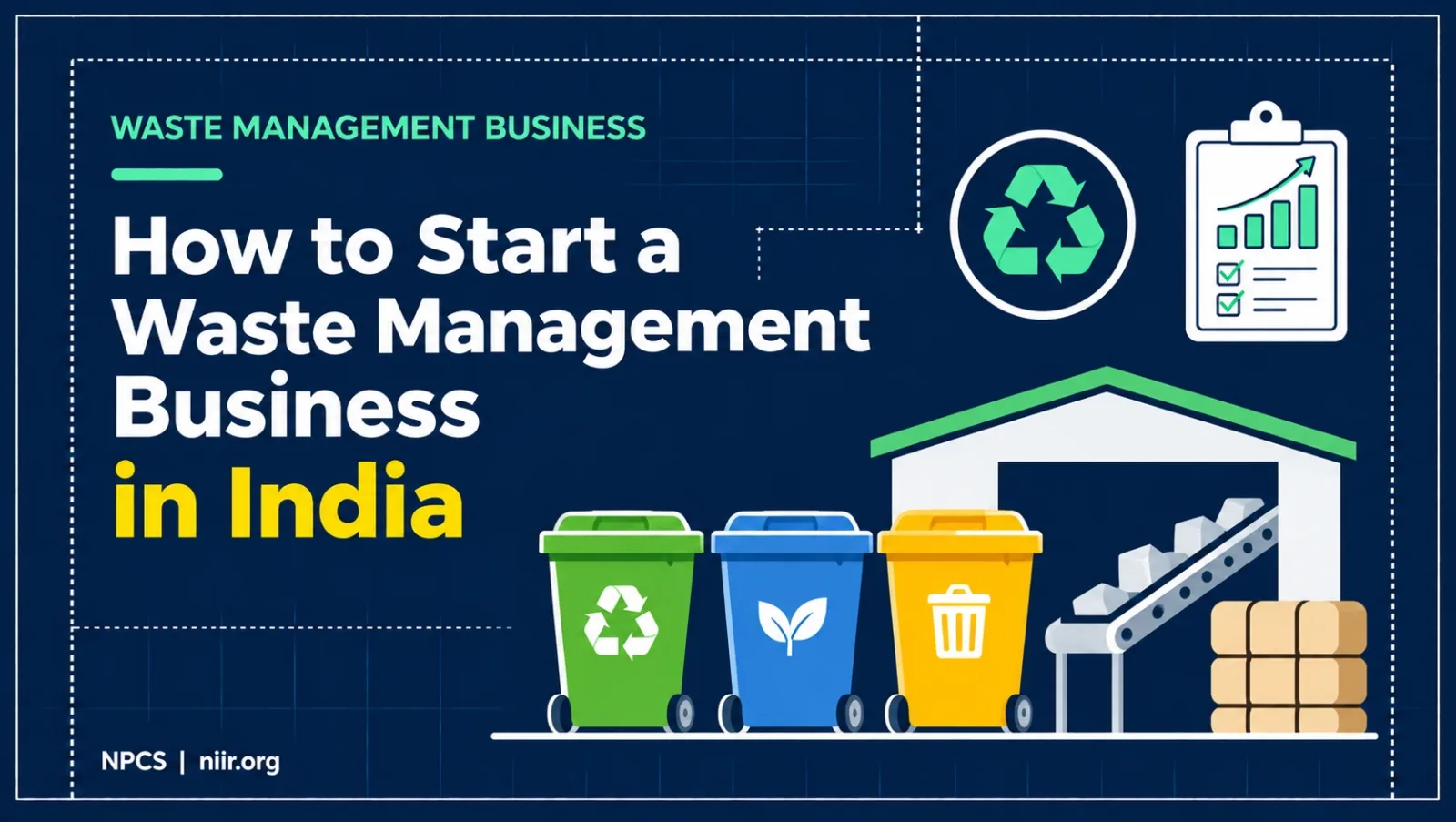
How to Start a Waste Management Business in India
Contents 9 sections
- Which waste management business suits your land, capital and contacts?
- How does a waste business earn, and what decides the margin?
- What do the 2026 solid waste rules change for someone entering now?
- Which approvals does a waste management plant need, and in what order?
- How does a waste management plant turn mixed waste into saleable material?
- What machinery does each processing model need?
- What usually goes wrong, and how do you avoid it?
- What to do in the first month before you buy machinery
- Frequently asked questions about starting a waste management business
A waste management business in India is really five businesses, and the one you pick decides your approvals, your capital and who pays you. Door-to-door collection needs vehicles, staff and contracts but no plant. Dry waste recovery, wet waste composting, e-waste recycling and construction debris recycling each need land, a pollution control board approval and machinery.
Start with the stream where a paying customer already exists: a housing society, a hotel, a municipal ward or a producer that must buy recycling certificates. National rules in force since April 2026 make large waste generators process wet waste on site or obtain a certificate showing it was processed elsewhere, which gives registered collectors and processors work.
Which waste management business suits your land, capital and contacts?
Only collection can start without land. Producers of plastic packaging and electronics must pay for recycling what they sell, a rule called extended producer responsibility (EPR), and they buy recycling certificates from registered processors on portals run by the Central Pollution Control Board (CPCB).
|
Model |
Who pays you |
Approval you will need |
What moves the margin |
|
Collection service |
Bulk generators (monthly fees); local bodies |
Tie-up with the local body |
Route density, segregation quality |
|
Dry waste recovery |
Recyclers buying baled material; certificates for plastic |
Local body registration, pollution board authorisation, CPCB EPR portal for plastic |
Baled grade price against collection cost |
|
Wet waste composting or biogas |
Processing fees; compost, manure or gas buyers |
Local body registration, pollution board authorisation |
Compost offtake, odour control |
|
E-waste recycling |
Producers buying certificates; metal buyers |
Recycler registration on the CPCB e-waste portal |
Certificate price against processing cost |
|
Construction debris recycling |
Builders with recycling targets; aggregate buyers |
Facility authorisation, confirmed with your pollution board |
Distance from debris to plant |
Build a processing plant only after a bulk generator or buyer has agreed in writing to supply your input or take your output, because a plant without offtake loses money from the first month. Construction debris is the newest stream: builder recycling targets rise from 25% in FY 2025-26 to 100% by FY 2028-29, as CEEW's explainer on the construction waste rules sets out. Plastic is covered in the plastic waste recycling guide, biogas in the compressed biogas plant guide and compost in the vermicompost guide.
How does a waste business earn, and what decides the margin?
Each line has its own price driver, and the figures are as of November 2026.
|
Revenue line |
What drives it |
Figure to know |
|
Generator fees |
User fee set by the local body, collected by it or an authorised agency |
Varies by city |
|
Recovered plastic, paper, metal, glass |
Market price of each baled grade |
Moves with scrap demand |
|
E-waste certificates |
Lowest price fixed at 30% of environmental compensation |
₹22 per kg consumer electrical goods; ₹34 per kg IT and telecom |
|
Compost and manure |
Government assistance on fermented organic manure |
₹1,500 per tonne |
|
Refuse-derived fuel (RDF) |
Cement kilns and industrial units raising their waste-fuel share |
Negotiated per tonne |
The e-waste figures come from CPCB's August 2024 environmental compensation guidelines. Recyclers quoted by Waste & Recycling magazine in September 2026 call the floor contested and trading slower, so do not build a repayment plan on it. The compost assistance is from a July 2024 Lok Sabha reply, which also covers GOBARdhan-registered biogas plants.
CEEW's reading of CPCB data for FY 2021-22 shows about 1,70,000 tonnes of municipal solid waste a day, with roughly 54% treated, so capacity is short. Monthly break-even tonnage equals fixed monthly costs divided by what each tonne earns after variable costs. Tonnage under contract, how clean it arrives and the number of revenue lines one tonne can feed move it most.
What do the 2026 solid waste rules change for someone entering now?
The Solid Waste Management Rules, 2026 replace the 2016 rules and apply from 1 April 2026. Three points matter to a new operator, all from the published rules.
• Bulk generators carry the duty. A building of 20,000 sq m or more, a user of 40,000 litres of water a day, or a producer of 100 kg of waste a day must process wet waste on site or obtain a certificate. Only the local body issues it, after the processing facility reports what it received and processed.
• Processors register and get authorised. Composting, biogas and material recovery operators register with the local body on the central online portal and need pollution control board authorisation. Plants above five tonnes a day must keep a buffer zone.
• Fuel substitution creates a buyer. Industrial units using solid fuel must raise their RDF share to 15% over six years.
Which approvals does a waste management plant need, and in what order?
1. Site and source. Settle the plot and the waste supplier first, because every approval assumes both and the buffer zone can rule out a plot near homes.
2. Local body and pollution board. Register as a processor on the central portal, then apply to the state pollution control board for authorisation.
3. CPCB portal for your stream. E-waste recyclers pay ₹15,000 for first-time registration, valid five years, under CPCB's fee schedule. Plastic waste processors must register on the Common EPR Portal, and CPCB's notice of 27 August 2026 says covered entities cannot operate without valid registration.
How does a waste management plant turn mixed waste into saleable material?
These steps describe a dry waste recovery unit.
1. Weigh and log every load at the gate, since certificates and portal reports depend on recorded tonnage.
2. Tip the load on a receiving floor and pull out oversized, hazardous and sanitary items.
3. Feed the rest onto a sorting conveyor where workers pick plastics, paper, glass and metal into separate bins.
4. Pass the leftovers under a magnet to lift iron and steel.
5. Bale or shred each grade. Baled grades go to recyclers, and aluminium scrap goes to metal processors (see the aluminium recycling guide).
6. Send combustible residue to RDF buyers and only inert, non-recyclable residue to landfill.
Wet waste follows its own line: shredding, composting, screening and bagging, or a digester for biogas and manure.
What machinery does each processing model need?
The same few machines recur across models.
|
Machine |
What it does |
Used in |
|
Weighbridge |
Records each load's tonnage |
All models |
|
Sorting conveyor |
Carries waste past pickers who separate fractions |
Dry waste |
|
Baling press |
Compresses paper, cardboard and plastic into bales |
Dry waste |
|
Shredder |
Reduces plastic, e-waste and bulky items to uniform size |
Dry waste, e-waste, RDF |
|
Washing line and granulator |
Cleans plastic and turns it into flakes |
Plastic recycling |
|
Composter or digester |
Turns wet waste into compost or biogas |
Wet waste |
|
Crusher and screens |
Breaks debris and grades recycled aggregate |
Construction debris |
What usually goes wrong, and how do you avoid it?
• Dirty input. Mixed waste lowers bale grades and compost quality, so write segregation standards into every supply agreement.
• Contested prices. Certificate floors are disputed, so keep contracts short enough to reprice.
• Slow municipal payments. If a local body is your main customer, ask how quickly it pays before sizing working capital.
What to do in the first month before you buy machinery
1. Choose one stream and one catchment, such as a ward or a cluster of housing societies.
2. Meet its bulk generators and ask for a written intent to supply or buy.
3. Ask the local body how it registers processors and whether it empanels private agencies for fee collection.
4. Ask a bank which documents it wants. Lenders usually expect a project report showing tonnage, realisation and repayment capacity.
If processing appeals more than collection, compare it with other projects in the recycling business ideas list, or browse every how-to-start guide.
Frequently asked questions about starting a waste management business
Is waste management a profitable business?
It can be, and the stream decides how. Collection earns recurring fees from bulk generators, while recovery businesses depend on material prices and certificates. Total the revenue lines above against your site, power and labour costs before committing land and machinery.
How many types of waste are there, and which can I handle?
Municipal waste has four streams under the 2026 rules: wet, dry, sanitary and special care. Plastic waste, e-waste and construction debris sit under their own rules with separate registrations. Start with one stream and add others once its approvals and buyers are secured.
How much per kg for e-waste?
A household selling old electronics gets whatever local scrap buyers offer, which varies by item and city. For recyclers, CPCB's lowest certificate price is ₹22 per kg for consumer electrical goods and ₹34 per kg for IT and telecom equipment, as of November 2026.
Is it good to invest in waste management?
Rules back demand: bulk generators must process wet waste or obtain certificates, and builders face rising recycling targets. Returns still depend on contracts, prices and approvals, and the rules are only months old, so invest once offtake is in writing.

Planning a new manufacturing unit?
NIIR prepares detailed project reports and feasibility studies for new projects. Share your requirement and the team will get in touch.