Profitable Poultry Business Ideas in India: 10 Options Compared by Investment and Profit
Contents 7 sections
- Which poultry business ideas make money, and what does each one need?
- How much does a 1,000, 5,000 or 10,000 bird farm earn?
- How does one broiler or layer cycle run, and what equipment does it need?
- Which approvals and schemes apply to a poultry business in 2026?
- Where do poultry businesses lose money?
- What should you do in the next 30 days before building a poultry shed?
- Frequently asked questions about starting a poultry business
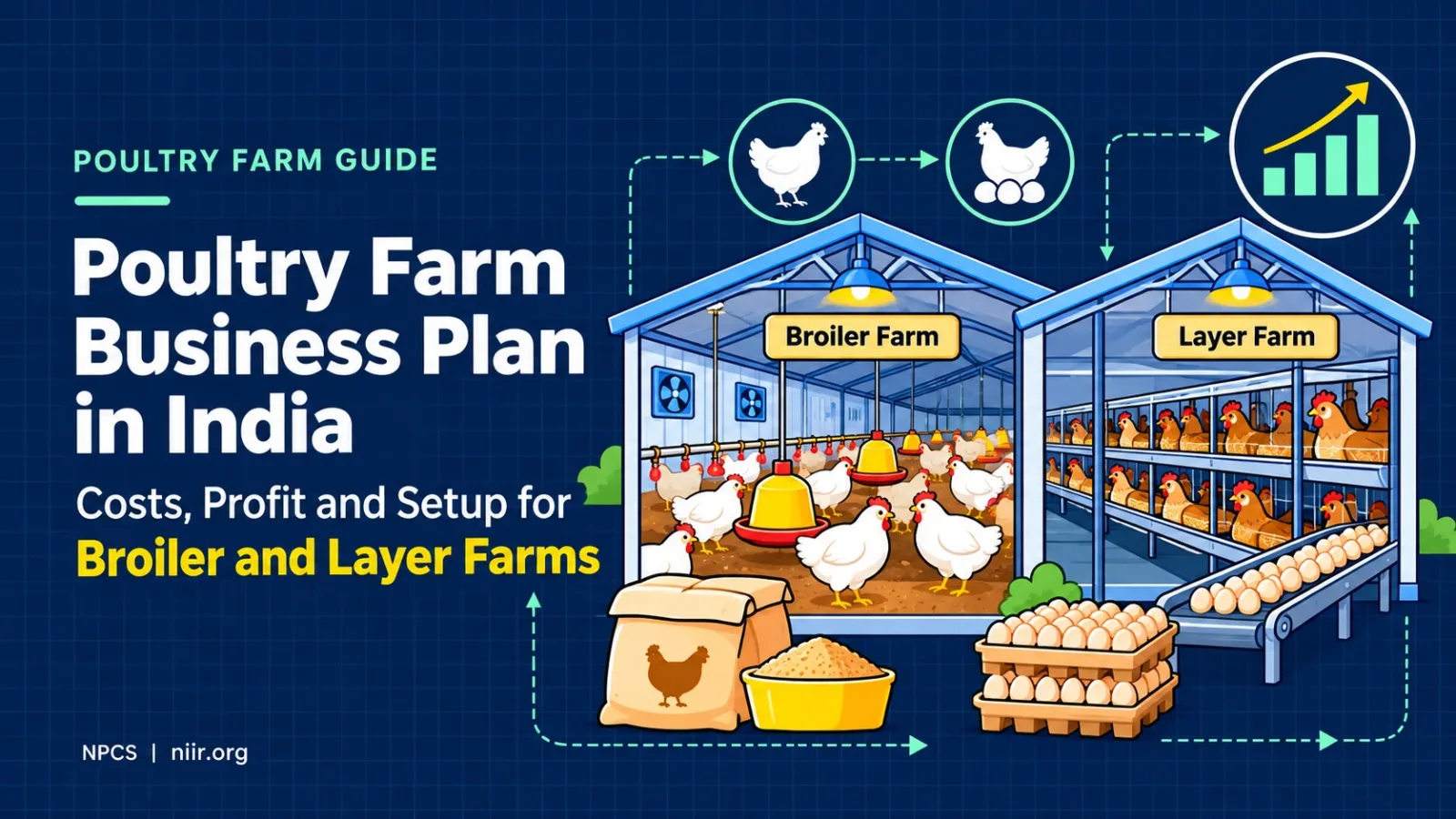
Poultry business profit depends less on the bird than on where you sit in the chain. A farmer rearing broilers or layers earns a thin margin per bird and carries the feed-price and disease risk. The businesses around the farm (hatchery, feed, processing, equipment) earn more per rupee invested but need buyers lined up before the first batch. For a first poultry business, contract broiler rearing or a small layer unit is the lower-risk start. Hatcheries, feed mills and processing suit people who already know the farmers or the retail buyers.
Demand is not the problem. India produced 149.11 billion eggs in 2024-25 and 5.18 million tonnes of poultry meat, about half of all meat output. Margin is the problem, because feed takes most of the cost of every bird.
Which poultry business ideas make money, and what does each one need?
The table runs roughly from least to most capital. Capital is relative, because shed cost varies by district.
| Idea | Capital need | Sells to | What decides the profit |
|---|---|---|---|
| Poultry manure and compost | Low | Crop growers, nurseries | Volume collected and dried; distance to buyer. See the organic fertiliser guide |
| Free-range or native chicken | Low to medium | Premium retail buyers | Birds take 3-5 months (ICAR's Indian Farming); the premium must cover the extra feed |
| Quail, duck or turkey | Low to medium | Restaurants, niche buyers | Size of the buyer base. Confirm buyers first |
| Contract broiler rearing | Medium | The integrator (supplies chicks and feed) | Growing fee per kg, feed conversion, mortality |
| Equipment and medicine shop | Medium | Local farms | Credit given to farmers; dealership terms |
| Independent broiler farm | Medium to high | Traders, retailers | Live-bird rate against feed cost over about six weeks |
| Commercial layer farm | High | Egg traders, retailers | Egg rate against feed, about 75% of egg cost in an RBI field survey |
| Chicken dressing and retail | Medium to high | Households, restaurants | Yield per bird, cold chain, FSSAI licence tier |
| Chick hatchery | High | Broiler and layer farmers | Hatchability; steady supply of hatching eggs. See the chick hatchery guide |
| Feed manufacturing | High | Farmers, often on credit | Raw-material buying; recovering credit. See the animal feed guide |
How much does a 1,000, 5,000 or 10,000 bird farm earn?
No single figure is honest, because the same farm swings between loss and profit with the egg or live-bird rate. Hy-Line's Brown layer standards show 50% production at 139 days, a 93.6 to 98.5% peak and feed intake of about 109 to 117 g per bird a day. The table assumes 90% lay, below peak, because flocks decline with age.
| Layer flock | Eggs a day | Feed a day (115 g a bird) | Daily profit change per ₹1 of margin per egg |
|---|---|---|---|
| 1,000 birds | 900 | 115 kg | ₹900 |
| 5,000 birds | 4,500 | 575 kg | ₹4,500 |
| 10,000 birds | 9,000 | 1,150 kg | ₹9,000 |
Monthly profit is eggs sold times (egg rate minus cost per egg), after mortality and about 20 weeks of feed before half production. On 10,000 birds, a ₹1 move in the egg rate or the cost is about ₹2.7 lakh a month.
Broilers run on a different clock. Aviagen's Ross 308 objectives give about 3.0 kg at 42 days at a feed conversion of 1.53, roughly 4.6 tonnes of feed per 1,000 birds a batch, before losses. The same RBI paper says 65 to 70% of commercial broiler output comes from integrators, with contract growers paid about ₹6.5 to ₹7 a kg when targets were met.
If 5,000 birds average 2 kg, that is 10 tonnes and ₹65,000 to ₹70,000 for the grower before labour, power, litter and shed repayment. The rate dates from 2022 to 2024, so ask the integrator for its current contract.
How does one broiler or layer cycle run, and what equipment does it need?
One cycle follows seven steps. Broilers leave at about six weeks, while layers stay for over a year.
- Fix the buyer first: an integrator contract, or written intent from three traders.
- Build a ventilated shed on raised, well-drained ground, away from other farms and houses.
- Clean, disinfect and dry the shed, then spread fresh litter.
- Place day-old chicks from a hatchery that supplies health and vaccination records, and brood them warm.
- Feed to the breeder's schedule, vaccinate as your veterinarian advises, and log feed, water and deaths daily.
- Sell broilers at about six weeks. Layers go into cages and reach half production at about 20 weeks.
- Empty the shed, rest it and sell the litter before the next batch.
| Equipment | What it does |
|---|---|
| Brooders or heaters | Keep chicks warm in the first weeks |
| Feeders and nipple drinkers | Cut spillage and keep litter dry |
| Layer cages | House hens and keep eggs clean |
| Exhaust fans and cooling pads | Remove summer heat and ammonia |
Which approvals and schemes apply to a poultry business in 2026?
Two approvals apply to most farms. The two schemes help, but their status changes with each funding cycle, so confirm they are open.
| Item | What it means for you |
|---|---|
| Pollution board consent | The Central Pollution Control Board's 2025 classification keeps poultry in the Green category, and Green units still need consent to establish and operate from the state pollution control board. Ask what applies at your flock size. |
| FSSAI | Eggs, dressed chicken and processed products need FSSAI registration or a state or central licence, depending on scale. Check FSSAI's licensing page for thresholds when you apply. |
| National Livestock Mission | One-time 50% capital subsidy up to ₹25 lakh for a rural hatchery or parent farm (at least 1,000 parent layers), with at least 10% margin money, under the January 2025 guidelines. The Union animal husbandry department extended the mission only to 30 September 2026, pending the next cycle. |
| Animal Husbandry Infrastructure Development Fund | 3% interest subvention, up to 8 years including moratorium, for feed manufacturing and meat processing, with 10% margin money for micro and small units (SBI's page, June 2025). Ask your bank if it is taking applications. |
Where do poultry businesses lose money?
- Feed price. Feed is 60 to 70% of a broiler's cost and 70 to 80% of a layer's (RBI paper), so a maize or soya rise cannot be absorbed. Fix the sale or contract price before committing to feed.
- Carrying all the price risk. About 30% of broiler output comes from independents who buy inputs and sell on their own. Contract growers' markup is only about 5 to 6%, so contracts trade upside for stability.
- Weak-season eggs. Over three years, the farmer's share of the consumer rupee on eggs ranged from 69% in summer to 89% in winter. Keep cash for the weak months.
- Starting at the expensive end. A hatchery or feed mill pays only if farmers buy from you. Sign buyers before buying machines.
What should you do in the next 30 days before building a poultry shed?
- Pick one idea that fits your capital and a buyer you can name. If money is tight, start from the low-investment business ideas.
- Run the sums above with three trader quotes and your feed dealer's price. If the margin vanishes when the rate moves by ₹1, choose another idea.
- Visit two working farms of your planned size, not a showcase unit, and ask what their worst batch cost.
- Ask the pollution control board, FSSAI office and state animal husbandry department what applies and whether the schemes above are open. Other support for small units is on the MSME schemes page.
- Compare poultry with other options on the agriculture business ideas page, or use the project identification guide to choose.
These are planning ranges. They change with capacity, district and breed, and a lender will want a report built on your own site, buyers and quotes.
Frequently asked questions about starting a poultry business
How many eggs will 200 chickens lay a day?
About 180 a day at a 90% rate of lay. Hy-Line's standards show 93.6 to 98.5% at peak, or 187 to 197 eggs, but 90% allows for older birds and losses. Recalculate against your actual count every few months, because laying falls as a flock ages.
Is broiler or layer farming better for a first-timer?
Broilers suit most first-timers, because a batch ends in about six weeks and an integrator can carry the input risk. Layers earn for over a year but need about 20 weeks of feed before half production. If you cannot fund that wait, start with contract broilers.
Does the season matter when starting a layer farm?
Yes, because chicks placed today reach half production about 20 weeks later. Count forward from the placement date to see which season your first eggs fall in, and keep cash aside if that is summer, when egg prices to farmers are weakest.
Can I get a bank loan for a poultry business?
Yes, lenders finance poultry units, usually after you put in your own margin money. The livestock mission asks for at least 10%, and the infrastructure fund lists 10% for micro and small units. Bring buyer commitments, a shed plan, feed quotes and a monthly cash flow.

Planning a new manufacturing unit?
NIIR prepares detailed project reports and feasibility studies for new projects. Share your requirement and the team will get in touch.