How to Start a Fruit and Vegetable Powder Business in India
Contents 10 sections
- How much does a fruit and vegetable powder business cost to start?
- Which powders sell, and which should you start with?
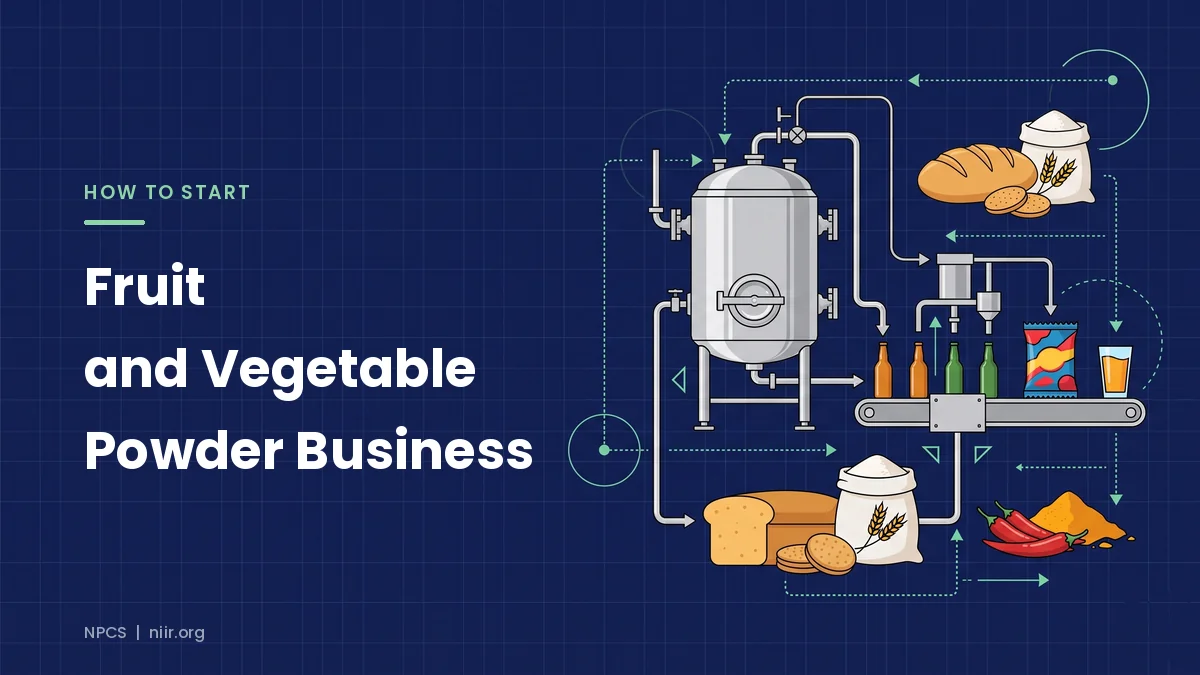
- How is fruit and vegetable powder made?
- What machinery does a fruit and vegetable powder plant need?
- Which licences does a powder unit need?
- Is there enough produce, and how much is really wasted?
- Who buys the powder, and can you export it?
- Can a government scheme pay for part of the plant?
- What should you do before buying machinery?
- Frequently asked questions
A fruit and vegetable powder business is a drying business. You buy a perishable crop, remove the water, grind it and sell the powder by the kilo to food companies, so the decisions that matter are which crops, which dryer and who has already agreed to buy. In two NPCS project reports, a plant drying only onion needs about ₹1.99 crore, and one making banana, onion, orange and tomato powders needs about ₹4.01 crore. Both are sized past the small limit under which a food unit can skip a full FSSAI licence, so plan for the licence from day one. Both must run past half their capacity before they earn anything, so a buyer's written specification matters more than a machine quote. A few lakh rupees will not buy a plant; at that budget the realistic start is job work on someone else's dryer.
How much does a fruit and vegetable powder business cost to start?
The two NPCS reports closest to this business put total investment at about ₹2 crore to ₹4 crore. They differ mainly in how many crops the plant handles.
| NPCS project report | Products and capacity | Plant and machinery | Total investment | Return | Break-even |
|---|---|---|---|---|---|
| Dehydrated Onion | Sliced and chopped onion, 300 MT a year, plus 210 MT of cattle feed by-product | ₹69 lakh | ₹199 lakh | 27% | 57% |
| Banana, Onion, Orange and Tomato Powder | Banana 625 kg, onion 300 kg, orange 500 kg, tomato 500 kg a day | ₹98 lakh | ₹401 lakh | 25% | 65% |
Machinery is under a quarter of the total in the four powder plant. The rest covers land, building, utilities, working capital and start-up costs.
The returns of 25% and 27% are projections, not promises, and they hold only if the plant stays busy. Treat break-even as the number to test: if you cannot see buyers for more than 57% to 65% of capacity, change the crop mix before you order machines. These figures come from NPCS project reports, which the firm has prepared across more than 40 sectors since 1994, not from a survey of running plants.
Which powders sell, and which should you start with?
India publishes no ranking of powders by demand, so treat buyer enquiries as your ranking. Trade is visible in APEDA's processed vegetables list, which names dehydrated garlic powder, garlic flakes, dried potatoes and dehydrated asparagus.
| Powder | Usually sold to | What makes it hard |
|---|---|---|
| Onion and garlic | Masala, soup and seasoning makers, exporters | Strong smell and fine dust, so it needs its own drying and grinding room |
| Tomato | Soup, sauce and seasoning makers | Sticky when dried; spray drying usually needs a carrier such as maltodextrin |
| Mango | Beverage mix and cooking-use buyers | Short harvest, so the plant sits idle unless it takes other crops |
| Banana | Baby food and bakery buyers | Browns fast after peeling, so cutting and drying must follow at once |
Start with one crop that has a named buyer and a long season, onion being the usual example, then add a second crop whose season fills the gap. Tomato looks attractive for its colour but punishes beginners because it is sticky to dry. The onion processing plant, potato powder manufacturing and moringa powder business guides cover crops with different buyers.
How is fruit and vegetable powder made?
- Receive and grade the produce. Reject bruised or overripe pieces, which spoil a batch's colour and microbial count.
- Wash, peel or trim, and cut. Onion needs topping and skinning, mango and banana need peeling, and slices are cut to one thickness so they dry evenly.
- Pre-treat where the crop needs it. Many crops are blanched or dipped to stop browning; any additive must be one FSSAI permits.
- Dry. Slices go into a tray, cabinet or belt dryer. Juices and pulps are spray dried, usually with a carrier agent, as a 2022 review in the ASEAN Journal of Chemical Engineering describes for tomato powder. Freeze drying gives premium quality at a much higher machine cost.
- Grind and sieve to the mesh the buyer specifies. Powder takes up moisture quickly, so keep this room dry.
- Test and pack. Check moisture and microbial counts batch by batch, then seal in moisture barrier packs.
What machinery does a fruit and vegetable powder plant need?
| Machine | What it does |
|---|---|
| Washer, peeler and slicer | Cleans produce, strips skins and cuts uniform pieces |
| Blancher | Treats pieces with steam or hot water before drying |
| Dryer (tray, belt, spray or freeze) | Removes water; the choice sets product quality and plant cost |
| Pulveriser and sifter | Grinds dried pieces and grades powder by mesh |
| Blender and packing machine | Standardises batches and seals them in barrier packs |
| Laboratory equipment | Checks moisture and microbial quality |
Which licences does a powder unit need?
FSSAI registration, the lightest tier, is meant for businesses with turnover up to ₹12 lakh a year or production capacity up to 100 kg a day, according to FSSAI's own licensing FAQ. The NPCS plants above run at 300 kg to 625 kg a day per product, so they need a state or central licence, depending on size and location. A unit that exports all its output, or has premises in several states, needs the central one.
Is there enough produce, and how much is really wasted?
Supply is not the constraint: the Ministry of Agriculture's third advance estimates for 2024-25 put vegetables at 215.684 million tonnes and fruits at 118.76 million. Loss figures of 30% to 40% circulate widely, but the NABCONS study for the food processing ministry (2020-22), cited in a July 2025 Lok Sabha reply, estimated 6.02% to 15.05% for fruits and 4.87% to 11.61% for vegetables. The real constraint is the right grade within hours of harvest at a workable price, so place the plant inside the crop belt, not near the city.
Who buys the powder, and can you export it?
Most powder goes to food manufacturers, and each sends a specification sheet covering moisture, mesh size, microbial limits and colour. Get two before you finalise machinery. APEDA's processed vegetables page shows 726,874.82 MT worth USD 932.19 million exported in 2025-26, led by the USA, UK, Philippines, Saudi Arabia and Indonesia. That group also includes preserved onions, mushrooms and chickpeas, so it is not all powder. Exporters register with APEDA for an RCMC; the export business ideas page covers the wider route.
Can a government scheme pay for part of the plant?
The PM Formalisation of Micro Food Processing Enterprises scheme (PMFME) gives 35% of eligible project cost, capped at ₹10 lakh per micro enterprise, as ministry officials were quoted in May 2026. Its validity ran to 30 September 2026, and Business Standard's 24 August 2026 report said an extension was expected but not yet announced. A ₹10 lakh cap is small against a ₹2 crore to ₹4 crore plant, so check the current position before planning around it. Other options are in government schemes for food processing.
What should you do before buying machinery?
- Collect written specifications from two buyers for one crop.
- Visit a running dehydration unit and ask how many months a year its dryer works. The vegetable dehydration business guide explains that side.
- Request trial runs from two or three dryer suppliers on your own produce.
- Apply for the FSSAI licence and confirm which scheme windows are open.
- Line up a second buyer before you scale, because losing a single buyer can push utilisation below break-even.
An NPCS project report for fruit and vegetable powders covers the market survey, machinery with suppliers, raw material costs, plant layout, manpower and a five to ten year projection in the format banks usually ask for. It cannot promise a loan. For neighbouring projects, see food processing business ideas.
Frequently asked questions
Is the fruit and vegetable powder business profitable?
It can be, at steady utilisation. NPCS project reports show projected returns of 25% to 27%, with break-even at 57% to 65% of capacity. Seasonal crops make that capacity hard to fill, so profit depends more on buyer commitments and crop mix than on the dryer.
Which fruit powder is in highest demand?
No official source ranks them. The clearest trade lines are vegetable powders and flakes such as garlic and potato, which APEDA lists. For mango, banana and orange powders, demand sits with individual buyers, so secure one before you commit.
What is the price of fruit powder per kilogram?
There is no single price. It moves with the fruit, the drying method (freeze drying costs far more than hot air), moisture level, mesh size, packaging and certification such as organic. Get written quotes from three buyers for your own grade.
Where can I export fruit powder from India?
Start with markets that already buy Indian processed vegetables. The USA, UK, Philippines, Saudi Arabia and Indonesia were APEDA's top five destinations in 2025-26, for all processed vegetables, not only powder. Register with APEDA for an RCMC and get each importer's specification before quoting.

Planning a new manufacturing unit?
NIIR prepares detailed project reports and feasibility studies for new projects. Share your requirement and the team will get in touch.