
Why Waste Management and Recycling Industry Consultants Matter in India
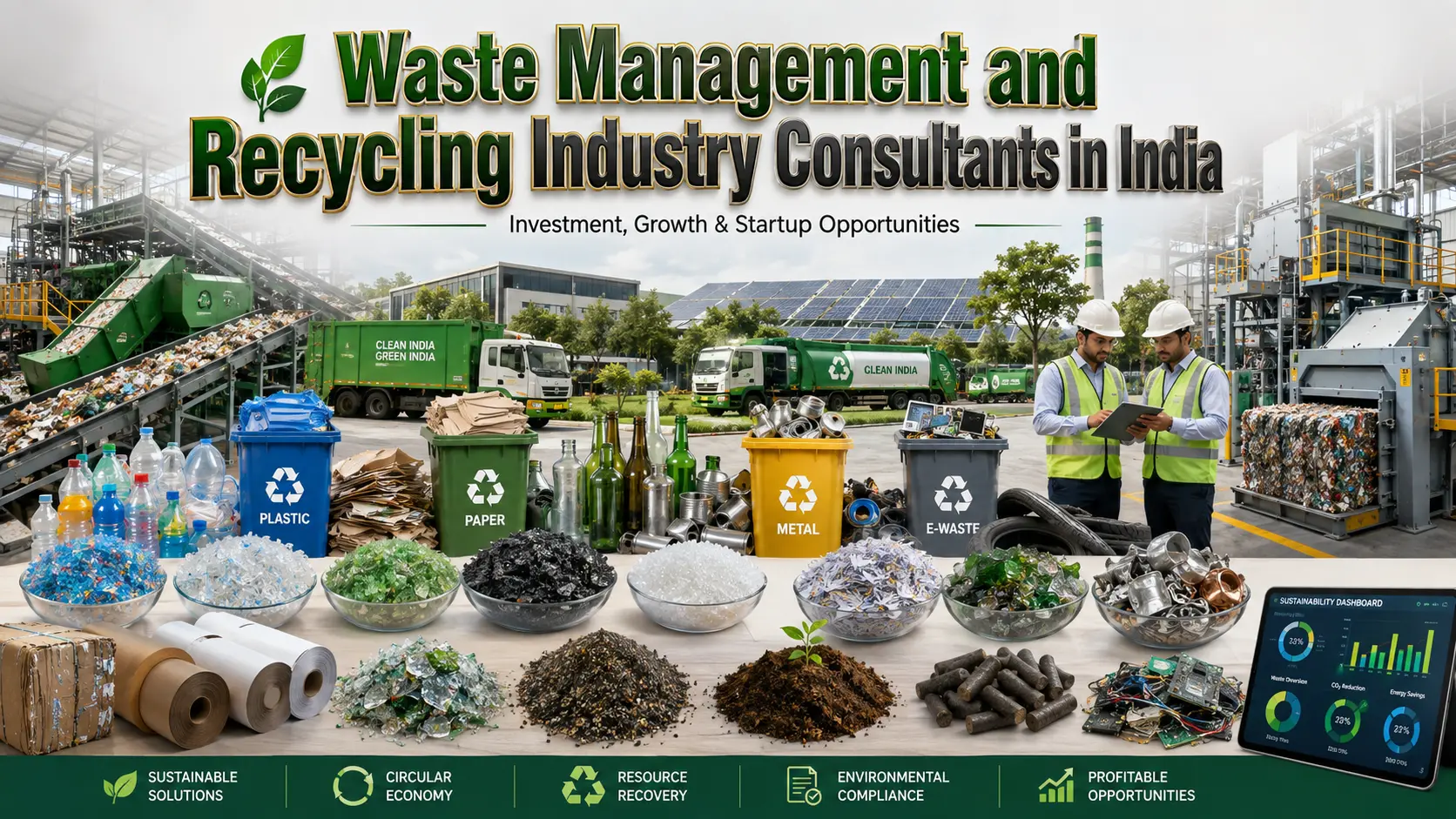
India is at a turning point in waste. A total of more than 62 million tonnes of MSW is produced annually in the country. Tens of millions of additional tonnes are contributed by industrial, agricultural, electronic and biomedical waste. The urban population continues to grow. Consumer habits continue to evolve. Regulatory norms and expectations only become stricter from Ministry of Environment, Forest and Climate change (MoEFCC) and Central Pollution Control Board (CPCB). In this background, there is more need than ever of capable waste management and recycling industry consultants in India.
If you are a startup owner or a MSME investor coming into this industry, it is not just the machinery or land purchase that you need to deal with. It’s about the project economics along the entire process, the compliance aspects that are multi-layered and constructing a commercially viable plant from scratch. All this is easily handled by an experienced industry consultant. Process Engineering, Feasibility Validation, Market Intelligence and Regulatory Knowledge are all combined under one roof for the top waste management and recycling industry consultants in India, providing entrepreneurs with a clear sight from concept to commissioning.
What waste management consultants do and how India’s policy environment has given rise to a legitimate waste management and recycling industry consulting boom, and how to assess and narrow-down the best consultants for your project are all covered in this article.
Get Detailed Insights from This Book: The Complete Technology Book on E-Waste Recycling
What Waste Management Plant Consultants Actually Do
A good waste management and recycling consultant is not just about recommending a technology, it’s about a much broader scope. The best process plant consultants here span the entire project life cycle — from the early stages of process ideation through plant commissioning.
Feasibility Studies and Detailed Project Reports (DPRs)
Any credible consultant will first start with a techno-economic feasibility study. This document addresses the basic question: Is this project viable and on what scale? Feasibility studies for a waste management plant include raw material (waste feedstock) availability, gate-fee benchmarking, processing technology selection, plant capacity (in TPD), capital cost estimates, operating cost structures, revenue projections and 5-year financial projections. This feasibility work is then summarized in a bankable Detailed Project Report (DPR). A formal DPR is required for project finance by Banks, NBFC lenders and MSME scheme administrators.
Process Engineering and Plant Layout
The process flows differ from one waste management plant to another, depending on the material they process, such as plastic, e-waste, biomedical waste, agro residue or municipal solid waste. Process engineering consultants determine the unit operations, equipment selection, mass balances and utilities. They also create plant layout drawings and process flow diagrams (PFDs) that are vital to regulatory approvals and plant construction.
EPC Support and Procurement Guidance
Engineering, Procurement, and Construction (EPC) consultants help clients who wish to have a single entity responsible for project delivery. EPC consultants are engaged in the selection of contractors, in the tendering of equipment, in the qualification of vendors and in monitoring construction, within the field of waste management and recycling. Process engineering consultants, on the other hand, work on the technical end, but do not have the responsibility for procurement or construction. A large number of boutique management consultancy firms in India exist in a hybrid form, first rendering process engineering and then assisting in procurement, but not offering an EPC contract.
Regulatory Compliance and Clearance Support
Multiple approvals are required to run a waste management/waste recycling facility in India. It involves Consent to Establish (CTE) and Consent to Operate (CTO) issued by the State Pollution Control Board (SPCB) or Environmental Clearance (EC) as per the EIA Notification, if applicable; and authorisation under various waste management rules: Plastic Waste Management Rules, E-Waste (Management) Rules, Biomedical Waste Management Rules or Solid Waste Management Rules. Great consultants walk the client down each of these avenues for clearance and put together the technical documentation along the way.
Get Detailed Project Report (DPR): Complete Guide to Waste Management & Recycling
Why India Has Become a Hotspot for Waste Management Consulting
The need for consulting on waste management and recycling has arisen as a rapidly growing niche in India, stemming from several macro forces. A knowledge of these forces will help entrepreneurs and investors value the urgency and the opportunity.
Policy Push: EPR, Swachh Bharat, and SWM Rules
The CPCB has digitised the Extended Producer Responsibility (EPR) framework on its portal and expanded its coverage to nearly 75,000 producers, importers, and brand owners, creating formal demand for organised recyclers. The Solid Waste Management Rules, 2016 (as amended in 2026), require all urban local bodies to implement source segregation and waste processing. Swachh Bharat Mission 2.0 brings in central support for waste processing infrastructure. Both policy frameworks need professional input to manage, not only because of compliance, but to position the commercial.
Market Scale and Investment Momentum
The waste management market in India is valued at ~ USD 14 billion and is expected to grow to USD 19 – 29 billion by 2020 at 6 – 7 percent CAGR. The recycling component of this is expanding at a rate of more than 8% annually, as a result of EPR regulations and increasing demand for recycled raw materials. As of today, the India Investment Grid (IIG) has 46 active investment projects in the solid waste management sector with investments worth more than USD 1.6 billion. Live project opportunities and sector intelligence can be explored directly on the platform by the entrepreneurs and investors.
Import Substitution and Circular Economy Goals
The concept of ‘Atmanirbhar Bharat’ has now extended to the waste economy too. These activities, including the recycling of metals, the recycling of plastics, the recovery of paper and the re-use of aggregates, all contribute to lessening reliance on primary raw material imports. The profile of this sector has been enhanced among the mainstream industrial investors through the efforts of the Confederation of Indian Industry’s Waste-to-Worth platform and FICCI’s work on circular economy. The government tailwinds benefit entrepreneurs for investing in new recycling plants in plastic, metals, rubber, glass, e-waste, and agro-waste.
Choose the right startup backed by real market demand
How to Evaluate the Best Waste Management and Recycling Industry Consultants in India
Not every consultant will be the same. The waste management and recycling industry requires environmental engineering skills, process design expertise, financial modelling knowledge, and regulatory understanding. Listed below are the steps to follow to find and select the best waste management and recycling industry consultants in India.
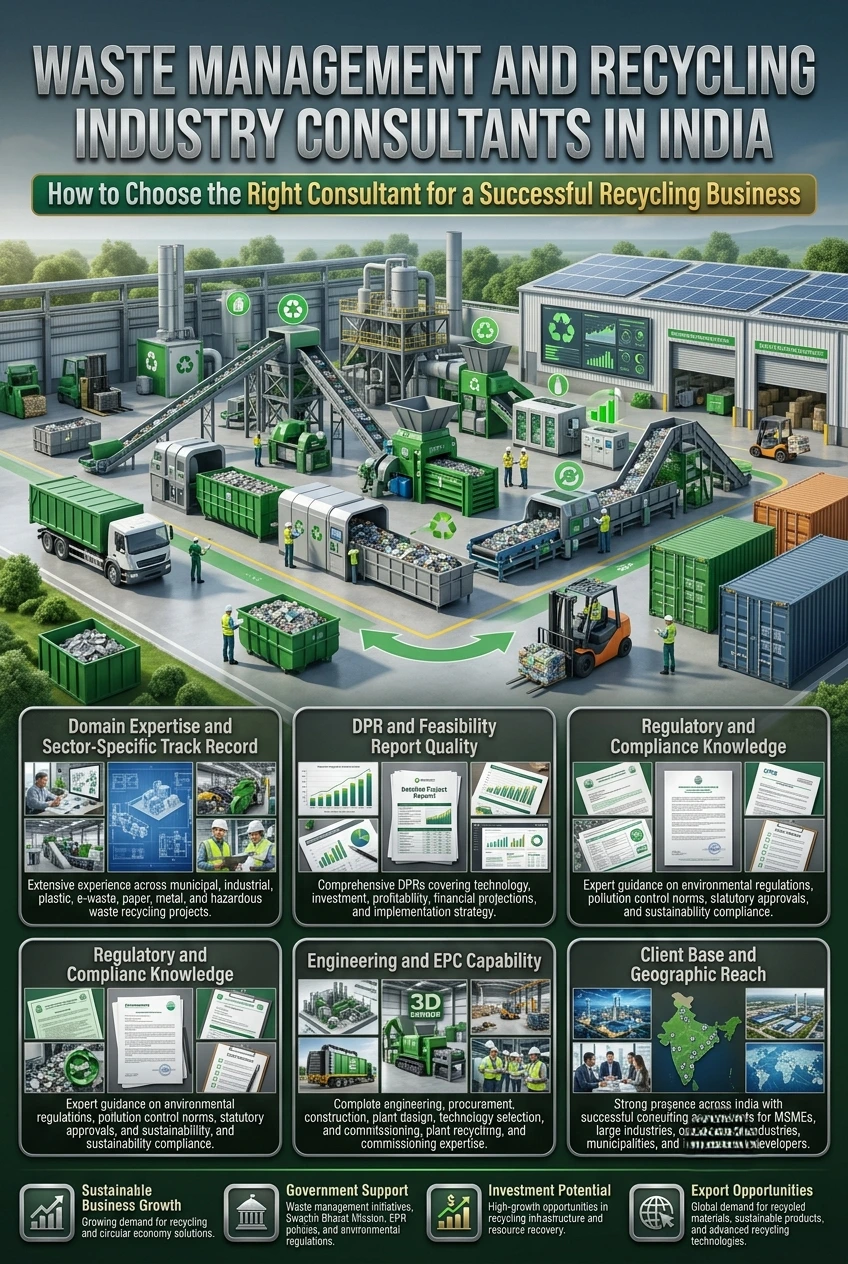
1. Domain Expertise and Sector-Specific Track Record
Waste management includes several diverse sub-sectors. These include municipal solid waste, plastic recycling, e-waste, biomedical waste, agro and wood waste, and industrial hazardous waste. The process technologies, regulation and market structure are different in each sub sector. Ask a potential consultant for examples in your niche project. A consultant that has developed a DPR for a plastic waste recycling plant does not necessarily possess the skills to prepare a DPR for an e-waste dismantling plant. Seek depth, not breadth.
2. DPR and Feasibility Report Quality
One of the most significant items a consultant will provide you is the Detailed Project Report. Request a sample DPR or project profile before taking on the project. A high-quality DPR includes the following components: Description of the process, Mass balance, specification of machinery, plant layout, description of raw material (feedstocks) available, market demand analysis, project cost (in ₹ Crore) breakdown into: Land, Civil, Plant and machinery, pre-operative costs, working capital, and a complete financial model including sensitivity analysis. If you can’t see a well-structured and rigorous example DPR from the consultant, then find someone else.
3. Regulatory and Compliance Knowledge
India has a complex waste management regulatory framework. The basic framework is under the aegis of MoEFCC and brought into practice by CPCB and State Pollution Control Boards. Your consultant should be familiar with the intricacies of EPR registration, CTE/CTO procedures, and the relevant regulations for your waste stream, whether it’s the Plastic Waste Management Rules, E-Waste (Management) Rules 2022, or Biomedical Waste Management Rules 2016. Besides, the Factories Act, MSME registration, GST registration and fire NOC requirements are applicable for the setup of the plant. Appraise if the consultant offers practical advice on more than just the environmental clearance.
4. Engineering and EPC Capability
If the project cost is more than ₹5 crore, you will need an EPC consultant or robust process engineering consultants who can help you in the selection of vendors. Depending on your type of project, make sure that the firm you choose has engineers that have experience in solid waste engineering, Waste-to-Energy (WtE) technology, shredding and sorting lines, composting systems or chemical recycling processes. International tie-ups for technology and import of processing equipment is something that top engineering consultancy companies in India with expertise in waste management will also know about this.
5. Client Base and Geographic Reach
A consultant with a pan-India client base understands state-level waste policies. They also know about local feedstock availability and infrastructure constraints. This experience helps them manage waste projects across different states.
International project experience can also benefit NRI investors. It is useful for units involved in export-oriented recycling.
Ask the consultant for client testimonials and government project credentials. Also, check their experience with MSME or Mudra financing applications.
Related Article: How to Start a HDPE/PP Plastic Recycling Plant in India: Investment, Machinery & Profit Margins
Types of Waste Management Consulting Services: A Comparison
| Consulting Service Type | Core Focus | Key Deliverables | Best-Fit Client |
| Feasibility Study | Project viability assessment | Market study, cost estimates, financial projections | First-time investors, NRIs evaluating entry |
| Detailed Project Report (DPR) | Bankable project documentation | Full DPR with process, machinery, financials | MSME loan applicants, subsidy seekers |
| Process Engineering Consulting | Plant design and technology selection | PFDs, equipment specs, plant layout drawings | Promoters finalising plant configuration |
| EPC Consulting | End-to-end project delivery | Contractor management, procurement, commissioning | Large-scale projects (₹10 Cr+) |
| Regulatory / Compliance Advisory | Clearances and permits | CTE/CTO applications, EC documents, EPR guidance | Projects in sensitive waste streams |
| Market Research & Techno-Economic Study | Sector intelligence and demand analysis | Demand projections, pricing benchmarks, competitor mapping | Investors evaluating multiple project options |
Role of NPCS in Waste Management and Recycling Project Consultancy
Established in Delhi in 1994, Niir Project Consultancy Services (NPCS) has been around since 1994 and has an extensive project coverage, with a vast experience in manufacturing and industrial sectors, which makes it one of the most comprehensive and experienced Indian consultancy services offering support to entrepreneurs in the waste management and recycling industry.
NPCS/CPE provides detailed project report and techno-economic feasibility study for waste management and recycling projects covering plastic waste, agro-residue, municipal solid waste, paper recycling, metal scrap processing, rubber waste, electronic waste, medical waste, glass recycling, solid waste treatment facilities etc. Each study covers the manufacturing process, machinery specifications, and raw material requirements. It also includes market research, demand analysis, process flow diagrams, product mix, and capacity planning. A detailed financial model provides profitability projections.
NPCS has been fulfilling tasks in over 85 nations and following more than 150,000 successful project reports delivered, NPCS has established to be a benchmark for entrepreneurs wanting to find reliable industrial consulting in India. NPCS reports are used as a starting point for the due diligence of many MSME promoters, bank appraisal officers and project investors.
Entrepreneurs exploring multiple project options in this space can browse NPCS’s waste management and recycling project profiles catalog directly on niir.org. The catalog covers a wide range of investable project concepts — from small-scale plastic granulation units and composting plant setups to larger integrated solid waste processing and e-waste dismantling projects.
The value NPCS offers early-stage founders is the project identification assistance and pre-existing DPR frameworks. Existing project profiles for similar business models can be reviewed first. This helps founders avoid starting the feasibility process from scratch. They can also understand different process technology options. A customised DPR can then be developed for the founder’s location, scale, and target market.
Delhi and the Broader India Consultancy Landscape for Waste Management
Delhi-NCR is the consultancy hub for industries in India. The capital region hosts the headquarters of the majority of national’s top process plant consultants, boutique management consultants and industry specialists. In relation to waste management and recycling projects, the concentration is important as equally Delhi-NCR is the centre of the policy making ecosystem like MoEFCC, CPCB, BIS, various industry associations, etc.
Entrepreneurs looking to hire waste management and recycling consultants in Delhi can benefit from strong regulatory expertise. They can also receive faster document processing and access a wide network of technology vendors, equipment suppliers, and project finance providers.
Delhi, Gurgaon, and Noida have several boutique consulting firms. These firms specialize in solid waste management engineering, EPR strategy, and circular economy projects.
But there is so much more to it than that, though, for regional expertise. In Chennai, the consultants are more aware of the process of Tamil Nadu SPCB. The exposure of waste volume and feedstock dynamics of the metros Hyderabad, Mumbai and Bengaluru are stronger. If you manage pan-India or multi-location recycling projects, choose a consultant with an office in Delhi. Also, check their track record in your target states.
The CII Waste-to-Worth initiative and FICCI’s circular economy platform also offer fresh industry information, keeping entrepreneurs and consultants informed of technology trends and policy changes. The sector coverage of IBEF is also helpful in market sizing and investment related information on waste management and recycling in India.
Frequently Asked Questions (FAQs)
1. How much does a Detailed Project Report (DPR) for a waste management plant cost in India?
The cost of a DPR for a waste management and recycling plant in India typically ranges from ₹50,000 to ₹5 lakh or more, depending on the scope and complexity of the project. A basic project profile for a plastic recycling unit or compost plant at a smaller scale cost less. A comprehensive bankable DPR for a larger integrated solid waste treatment facility — covering process engineering, market research, financial modelling, and regulatory compliance documentation — costs more. Some consultants offer tiered packages that separate the prefeasibility study from the full DPR.
2. What is the difference between a process consultant and an EPC consultant in the waste management sector?
A process consultant focuses on the technical and commercial dimensions of your project — process design, technology selection, equipment specifications, financial feasibility, and compliance guidance. They deliver knowledge and documentation. An EPC consultant (Engineering, Procurement, and Construction) takes on project delivery responsibility — managing contractors, procuring equipment, overseeing construction, and commissioning the plant. EPC engagements are typically larger contracts suited to projects above ₹10 crore in capital cost. For MSME-scale waste recycling units, a process consultant combined with self-managed procurement often makes more economic sense.
3. How do I choose the best waste management and recycling plant consultant in India?
Evaluate the consultant on five core criteria: domain expertise in your specific waste stream (plastic, e-waste, agro-waste, etc.); quality of their DPR samples; regulatory knowledge covering CPCB, SPCB, and EPR requirements; engineering track record with process flow diagrams and plant layouts; and client references from completed projects. Ask for at least two or three references from entrepreneurs who have actually commissioned plants based on the consultant’s work. References are the most reliable signal of real-world quality.
4. Do I need a separate environmental consultant for CPCB and SPCB approvals?
Not necessarily. Many full-service waste management and recycling consultants handle environmental clearance and regulatory documentation as part of their DPR or post-DPR services. However, for projects that trigger a full Environmental Impact Assessment (EIA) — typically larger plants above specific thresholds set by the EIA Notification — you will need a certified Environmental Consultant empanelled with the relevant authority. Your primary project consultant can usually recommend one or work in coordination with them.
5. What MSME schemes and subsidies are available for waste recycling plant projects in India?
Several MSME-linked schemes support waste management and recycling projects. The CGTMSE (Credit Guarantee Fund Trust for Micro and Small Enterprises) allows collateral-free lending for qualifying projects. State-specific industrial promotion policies often include capital subsidy, interest subsidy, and power tariff concession provisions. Under the Swachh Bharat Mission, urban local bodies sometimes offer gate-fee contracts or tipping fee structures that improve project revenue certainty. Your consultant should help you identify the applicable schemes for your project location and structure your DPR accordingly.
6. How long does it typically take to set up a waste management or recycling plant in India?
For a small-to-medium recycling plant (plastic granulation, paper recycling, composting), the timeline from DPR approval to commissioning typically runs 12 to 24 months. This includes regulatory clearances (3 to 9 months depending on project category), civil construction (3 to 6 months), equipment procurement and installation (3 to 6 months), and trial runs. Larger integrated waste treatment facilities with Waste-to-Energy components or complex segregation systems can take 30 to 48 months or more. A realistic project schedule, prepared by your consultant as part of the DPR, prevents costly delays.
Conclusion: Practical Next Steps for Entrepreneurs
India’s waste management and recycling sector is no longer a niche or a charity-driven space. It is a commercially compelling, policy-backed, and rapidly scaling industry that rewards well-planned, properly funded, and professionally executed projects. The country’s regulatory framework is maturing fast — EPR mandates, SWM Rules, and state-level waste policies are creating structured demand for formal recycling capacity.
For entrepreneurs looking to enter this space, the path forward starts with three clear steps. First, define your project concept — which waste stream, what process technology, and at what scale. Second, engage with a credible waste management and recycling consultant in India who can conduct a prefeasibility study and help you shortlist the right project. Third, commission a bankable DPR that covers process engineering, market demand, regulatory compliance, and full financial projections — the document you will need for lender conversations, subsidy applications, and investor discussions.
Entrepreneurs exploring project options in the waste management and recycling sector can start by reviewing NPCS’s project profiles at niir.org and browse specific feasibility studies in the waste management and recycling catalog. Starting with a professionally documented project profile is one of the smartest first investments an entrepreneur in this space can make.
India’s waste challenge is large. But so is the business opportunity it represents. With the right consulting partner, the right project structure, and the right regulatory preparation, a well-executed waste management or recycling plant project in India can deliver both strong commercial returns and genuine environmental impact.