Manufacturing Business Ideas in Africa
Africa is quickly catching up to become one of the world’s biggest industrial markets. The continent is poised to generate massive opportunities for manufacturing businesses, with over 1.4 billion people, ongoing rapid urbanization and growing consumer demand, and the newly launched African Continental Free Trade Area (AfCFTA). Africa for decades, relied heavily on manufactured imports, but these days government and private investors are interested in local production to boost the economic growth and minimize the reliance on manufactured goods imports.
It is a significant opportunity for startup founders, MSME planners, and industrial investors. The manufacturing industries linked to agriculture, healthcare, construction, renewable energy and consumer goods are seeing solid demand in several African economies. Early entrants in these industries can develop scalable enterprises that can be profitable in the long run and have a regional export potential.
Why Manufacturing in Africa Is Growing Rapidly
The manufacturing sector is growing in Africa due to some strong economic and demographic drivers. Governments are encouraging the industrialization by granting tax incentives, industrial parks, and exempting import duty on industrial projects. Meanwhile, the growth of middle classes is creating a demand for locally produced goods.
Factors contributing to the growth of manufacturing are:
- Huge import substitution opportunities
- Growing urban population
- Abundant agricultural and mineral resources
- Rising infrastructure development
- Increasing consumer spending
- AfCFTA establishing a single market for Africa
The African Continental Free Trade Area (AFCTA) is facilitating manufacturers to have access to various African markets with lower trade barriers. For more information, please visit the AfCFTA Official Website.
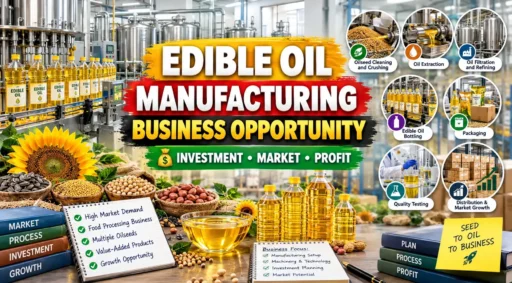
1. Edible Oil Processing Business
Edible oil processing is still one of the most profitable manufacturing businesses in Africa. Despite the fact that countries have potent Agri-Resources to produce their own cooking oil, they continue to import huge volumes of cooking oil from across the continent.(Manufacturing Business Ideas in Africa)
Manufacturers can process:
- Palm oil
- Sunflower oil
- Soybean oil
- Groundnut oil
The business also produces some by-products, which are sold for producing animal feeds and soaps.
Organizations such as FAO Africa Agriculture Program also promote agriculture and food processing opportunities throughout Africa.
Get Detailed Insights from This Book: Fruits, Vegetables, Corn and Oilseeds Processing Handbook
2. Animal Feed Manufacturing
As demand for livestock and poultry products grows, so do the livestock and poultry industries in Africa, growing faster than ever. Commercial farms need good quality feed; however, local feed is lacking in many countries.
Animal feed businesses have the advantage of:
- Recurring demand
- Locally available raw materials
- Strong scalability
- Expanding livestock sector
The manufacturing of feed for poultry, fish and cattle farming has huge growth potential in the long term.
3. Pharmaceutical Manufacturing
This has resulted in Africa currently importing a considerable proportion of its medicines, offering a great opportunity for locally-manufacturing a growing share of those essential medicines. Domestic manufacturing is now being encouraged by governments for improved healthcare security.
Some of the more sought-after pharmaceutical products are:
- Antibiotics
- Vitamins
- Pain relievers
- Antimalarial drugs
- Oral rehydration salts
The governments of countries like Kenya, Nigeria, Ethiopia and South Africa are actively promoting investments in pharmaceutical sector.
Get Detailed Project Report (DPR): India Active Pharmaceutical Ingredient (API) Market Report 2027
4. Cement and Construction Materials Manufacturing
The urbanisation and infrastructure development of Africa has catapulted the demand for construction materials. Housing developments, roads, commercial and industrial building projects continue to spread throughout the continent.(Manufacturing Business Ideas in Africa)
Profitable products include:
- Cement
- Roofing sheets
- Ceramic tiles
- Concrete blocks
- Precast construction materials
Transportation costs can make local production more competitive than imports.
African Development Bank Industry & Services is another source of insights on Industrial development.
5. Textile and Garment Manufacturing
Despite the challenges, textile and garment production is still thriving because of the opportunities of the international export markets that Africa has through trading agreements such as AGOA.
Business opportunities include:
- Cotton processing
- Fabric manufacturing
- Uniform production
- Fashion garments
- Industrial textiles
Some countries like Ethiopia and Kenya already have a well-established garment export sector.
6. Plastic Packaging Manufacturing
Increased demand for plastic packaging products has been recorded in Africa due to the fast growth in FMCG, food processing, cosmetic, and beverages industries.
Common manufacturing categories are:
- PET bottles
- Flexible packaging
- Plastic containers
- Packaging films
- HDPE bottles
The demand for packaging is likely to continue to increase as the manufacturing industry expands in the region.
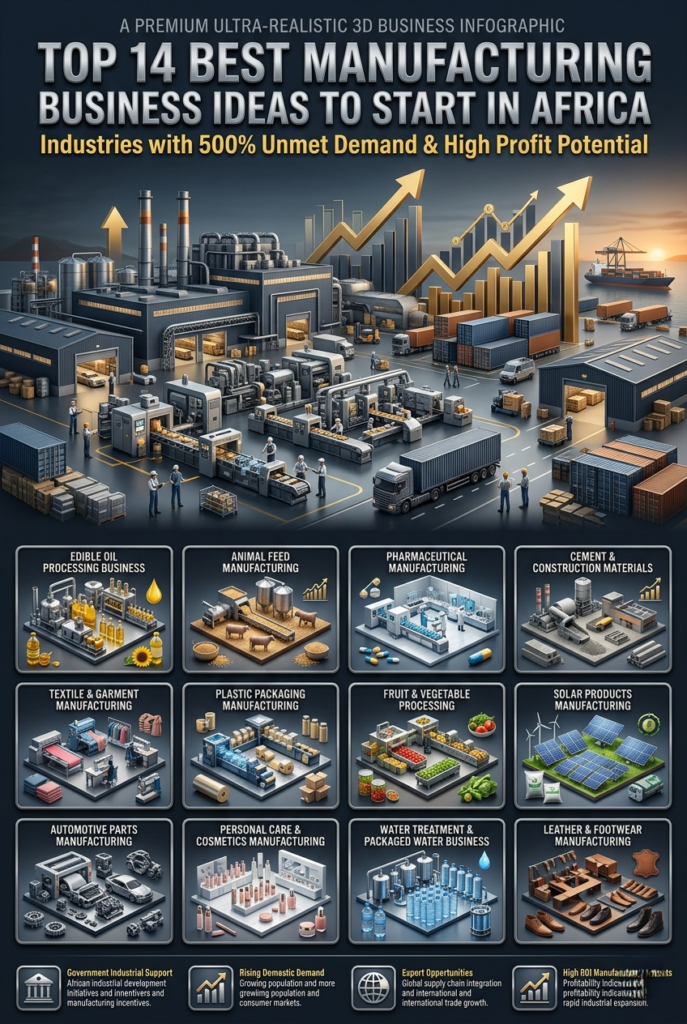
7. Fruit and Vegetable Processing
Africa is a massive producer of agricultural products; however, the post-harvest losses are still very high and are attributed to the limited processing infrastructure.
Agro-processing companies can produce:
- Fruit juices
- Tomato paste
- Purees
- Dried fruits
- Canned vegetables
This sector provides opportunities for domestic sales and exports.
8. Solar Products Manufacturing
Renewable energy is one of the top growth sectors of Africa. There is still a significant population base with no reliable access to electricity and huge demand for products that are solar powered.(Manufacturing Business Ideas in Africa)
Manufacturing opportunities include:
- Solar panel assembly
- Solar batteries
- Solar lighting systems
- Water heaters
- Charge controllers
Electrification programs still provide momentum for growth, both from government and demand. The IRENA Africa Program is an opportunity to learn more about renewable energy initiatives in Africa.
9. Fertilizer Blending Business
While agriculture plays a major role in many African economies, use of fertilizers is still lower than world averages. Fertilizer blending plants can be used to make blended products to suit local cultural and soil types.
This sector is supported by:
- Government agriculture programs
- Rising food demand
- Expanding farming activity
- Distribution support in some countries
Nigeria, Zambia, Ethiopia and Kenya are significant growth markets.
10. Paper and Packaging Carton Manufacturing
The growth of retail and e-commerce, FMCG and industrial sectors is driving demand for paper and carton packaging products in Africa.
Profitable products include:
- Corrugated boxes
- Kraft paper
- Paper bags
- Packaging cartons
- Tissue paper
Paper recycling is going to become more and more popular also as a method of paper making.
Related Article: Biodegradable Packaging Manufacturing: India’s ₹10,000 Crore Sunrise Opportunity Post-Plastic Ban
11. Automotive Parts Manufacturing
The automotive sector in Africa is growing at a steady pace, particularly in Morocco, South Africa and Kenya. It is essential to have spares and component parts made locally to be used in vehicle assembly plants.
Business opportunities include:
- Brake pads
- Wiring harnesses
- Vehicle seats
- Exhaust systems
- Plastic auto components
The after-market spare parts market is also expanding, providing good demand.
12. Personal Care and Cosmetics Manufacturing
The market for beauty and personal care products in Africa is rapidly expanding as the youth population in Africa is becoming more urbanized. Consumers may also favor the purchase of skin and hair products tailored to African skin and hair types.
Popular products include:
- Skin creams
- Hair oils
- Soaps
- Baby care products
- Deodorants and lotions
Beside their low price, the local brands can also attract consumer by offering an adapted formulation to the region.
13. Water Treatment and Packaged Water Business
In many parts of Africa, having access to clean water is still a challenge and manufacturing businesses related to water earn a lot of profit.
Business opportunities include:
- Bottled water plants
- Sachet water production
- Water purification systems
- Filtration equipment
- Water treatment chemicals
The demand is from the households, schools, hotel, hospitals and businesses. Water infrastructure data and insights are available through WHO/UNICEF Water Data Portal.
14. Leather and Footwear Manufacturing
Leather processing and footwear manufacturing is a good opportunity in Africa due to its large livestock population.
Manufacturers can produce:
- School shoes
- Safety footwear
- Leather bags
- Wallets and belts
- Fashion footwear
Some nations such as Ethiopia have been established as major exporters of leather.
Import and Export Opportunities in Africa
The manufacturing sector in Africa is increasingly becoming a very lucrative sector for both local consumption and export. The value-added products are able to achieve much higher profits than exporting raw materials.
Good export prospects are:
- Processed food products
- Generic pharmaceuticals
- Textiles and garments
- Leather products
- Agricultural products
WTO Trade Statistics Portal allows access to global trade and manufacturing statistics.
How AfCFTA Is Transforming Manufacturing in Africa
AfCFTA is establishing one of the world’s largest free trade markets. African manufacturers can now get access to various African countries with lower tariffs and better trade opportunities.
Major Benefits of AfCFTA
- Easier regional exports
- Reduced trade barriers
- The opportunity to sell to more customers
- Stronger industrial integration
- Better long-term scalability
This brings huge first-mover benefits to manufacturers. Further details can be found on the AfCFTA Official Portal.
Choose the right startup backed by real market demand
How NPCS Helps Manufacturing Entrepreneurs
The NPCS Official Website offers professional consultancy services for entrepreneurs who are planning to embark in manufacturing businesses in Africa and all over the globe. Industrial projects are prepared by NPCS in terms of Detailed Project Reports (DPRs), techno-economic feasibility study, market research reports, machinery guidance, and financial analysis.
Entrepreneurs will learn from NPCS about:
- Project feasibility
- Machinery requirements
- Raw material sourcing
- Market demand analysis
- Profitability estimation
- Investment planning
These reports facilitate businesses in obtaining financing and creating informed investment decisions.
Conclusion
With Africa’s industrialization, one of the world’s largest manufacturing opportunities is emerging. The sectors associated with agriculture, healthcare, renewable energy, construction materials, packaging and consumer products are projected to experience strong growth in the coming decade.(Manufacturing Business Ideas in Africa)
AfCFTA can create new opportunities for entrepreneurs who set up manufacturing enterprises early, such as increased demand, subsidies from the government, and the growth of regional trade. Africa is an ideal long-term growth opportunity for MSMEs, start-ups and industrial investors alike.
FAQs
Which manufacturing business is most profitable in Africa?
Most lucrative industries include edible oil processing, pharmaceuticals, solar products, plastic packaging, and agro-processing.
Which African country is the best investment country to make?
Nigeria, Kenya, Ethiopia, Ghana, Morocco and South Africa are regarded as good destinations due to market size and industrial infrastructure.
What’s the capital investment needed to begin a manufacturing company in Africa?
Investments for small and medium-scale manufacturing industry range between $150,000 and $500,000, and larger-scale manufacturing industry needs more investment capital.
Why is AfCFTA important for manufacturers?
AfCFTA lowers trade barriers in the region, supporting manufacturing to grow its exports and access to the larger markets.
What are some of NPCS’s functions?
NPCS offers industrial consultancy, Detailed Project Reports, feasibility studies, market research and financial planning services to manufacturing companies across the globe.