


Setting the Stage: Top 10 industrial towns in Karnataka
When business idea hunting for a solid, infrastructure supported “jump start” into manufacturing or industrial services, the industrial stretch of Karnataka should be one of your top considerations. The state is no longer just the tech capital of India — it has quietly built one of the most diversified and investor-ready industrial ecosystems in the country. From aerospace clusters in Bangalore to garment hubs in Mysuru and chemical corridors in Belagavi, Karnataka offers a rare combination of skilled labour, logistics maturity, export connectivity, and state-level policy support that is difficult to replicate elsewhere. For first-generation entrepreneurs, MSME promoters, and manufacturing investors, understanding where industry has already taken root — and why it continues to grow — can dramatically de-risk project planning decisions.
Why Karnataka’s Industrial Towns Represent a Strategic Investment Window
Karnataka ranks consistently among India’s top three states for industrial output and ease of doing business [BRAP 2024 Rankings]. The state has achieved a credible mix of large anchor industries — such as aerospace, defense, and electronics — alongside a deeply embedded MSME base in textiles, agro-processing, chemicals, and engineering goods. What makes this moment particularly compelling for investors is the convergence of several structural tailwinds.
Secondly, Karnataka has become an experienced exporting infrastructure. With operational dry ports, inland container depots, and direct rail connectivity to Mangalore and Chennai ports, manufactured goods from interior industrial zones now reach global markets with competitive lead times. Second, the state’s labour market — particularly in second-tier cities — offers a productive and trainable workforce at costs significantly lower than Bangalore. Third, with the Union Government’s focus on MSME-led export diversification under schemes like the Production Linked Incentive (PLI) and the Export Promotion Capital Goods (EPCG) scheme, the timing for capacity creation in Karnataka’s industrial towns has rarely been better.
Related Article: Which Manufacturing Units Are Booming in Karnataka in 2026
Government Policies and Incentives Supporting Industrial Growth in Karnataka
The investor-friendly policy framework in Karnataka is arguably one of the most holistic in the peninsula. There are capital subsidies, power tariff concessions and assistance in land allotment under Karnataka Industrial Policy by the Karnataka Industrial Areas Development Board (KIADB) which is the premier body with more than 200 industrial estates in the state [KIADB — Invest Karnataka].. In MSME projects there is the single window clearance through the Udyog Mitra which allows completion of project approval from weeks to months to weeks.
In the Central Government, the ASPIRE (A Scheme for Promotion of Innovation, Rural Industry and Entrepreneurship) scheme of MSME Ministry is a key driver for agro-processing and rural industrial clusters in districts such as Dharwad, Bidar and Tumkur. Complementing this is the Startup Karnataka scheme where early funding and mentorship are provided to manufacturing related startups. PLI scheme provided incentive to firms in Karnataka in textile, food processing, pharmaceutical and electronics sectors to expand capacity. The Technology Upgradation Fund Scheme (TUFS) and Credit Guarantee Fund Trust for Micro and Small Enterprises (CGTMSE) further reduce the financing burden for new entrants. For those setting up projects in notified backward areas, investment subsidies of up to 30 percent of fixed capital investment are available. Entrepreneurs planning new projects should consult the Ministry of MSME’s official portal at
Entrepreneurs planning new projects should consult the Ministry of MSME’s official portal at https://msme.gov.in for the latest scheme notifications and eligibility criteria.
Top 10 Industrial Towns in Karnataka and Business Ideas for Each
Bangalore (Bengaluru) — Electronics, Aerospace, and IT-Linked Manufacturing
Bengaluru is the anchor of Karnataka’s industrial identity, but its value for new investors lies less in competing with IT giants and more in capturing the industrial supply chain that powers them. The city hosts India’s largest aerospace manufacturing cluster through Hindustan Aeronautics Limited (HAL) and the Indian Space Research Organisation (ISRO), both of which rely on a vast ecosystem of precision component suppliers, tooling specialists, and testing service providers [Karnataka: India’s Premier Aerospace Hub].
For an MSME promoter, setting up a CNC precision parts unit, surface treatment facility, or aerospace sub-assembly workshop in areas like Bommasandra, Peenya, or Jigani offers direct access to anchor buyers. Similarly, the electronics manufacturing cluster around Whitefield and Electronics City continues to generate demand for PCB assembly, cable harness manufacturing, and injection-moulded plastic components. The presence of established infrastructure — industrial water supply, three-phase power, and trained ITI graduates — makes project execution risks here manageable even for first-time promoters.
Get Detailed Insights from This Book: Electronic Products Handbook With Circuit Diagrams
Mysuru (Mysore) — Textiles, Agro-Processing, and Light Engineering
Mysore is a relatively balanced industrial centre in Karnataka with a background in the textile industry through the Mysore Silk Factory and with diversification into agro processing and pharmaceutical intermediates more recently. It has more than 500 manufacturing units in its KIADB industrial estate at Hoot galli. Its proximity to the spice and coffee plantations of Coorg and Hassan gives it an natural advantage as an export-oriented food-processing location. Business concepts here vary from value added silk fabric weaving, garment export units, freeze dried spice, lemongrass/citronella essential oil extraction. Compared with Bangalore, it offers lower labor and real estate costs and a consistent power supply. These advantages make it an attractive destination for large, capital-intensive greenfield projects, where operating costs per unit have a significant impact on overall profitability.
Hubli-Dharwad — Cotton Textiles, Steel Fabrication, and Packaging
The commercial and manufacturing hub of North Karnataka, Hubli-Dharwad twin city industrial complex’s strength in traditional cotton textile weaving has been complemented by steel fabrication, electrical machinery manufacturing and corrugated packaging and a network of allied industries. Located advantageously with the industrial region of Maharashtra right next door and having first-rate national highway and rail connectivity, Hubli manufacturers have a logistics advantage most other cities in Karnataka lack. Investments in the KIADB Tarihal Industrial area include furniture and auto components and food processing. For a new entrant, a corrugated packaging plant or a steel door and window fabrication unit targeting the construction boom in Tier 2 cities of North Karnataka and adjoining Maharashtra represents a high-margin, low-import-competition opportunity worth serious analysis.
Belgaum (Belagavi) — Foundry, Auto Components, and Sugar-Based Industries
Belagavi has earned a distinct identity in India’s foundry and castings industry. The city is home to over 300 foundry units producing grey iron castings, ductile iron parts, and steel castings for the automotive, pump, and valve industries [Belgaum Foundry Cluster]. The Belagavi industrial corridor benefits from its proximity to Goa’s Mormugao Port and Pune’s auto component hub. This strategic location makes the city well-suited for export-oriented casting and machining operations. Beyond foundry, Belagavi’s location within Karnataka’s primary sugarcane belt has enabled a thriving ethanol, bagasse, and bio-compost industry. An entrepreneur looking to establish a precision machining unit, a heat treatment facility, or a sugarcane-based biochemical plant would find Belagavi’s existing vendor ecosystem and raw material infrastructure already calibrated for scale.
Mangalore (Mangaluru) — Petrochemicals, Seafood Processing, and Port-Based Trade
The strategic significance of Mangalore is derived from its deep-water port, the New Mangalore Port [NMPA Record FY2025–26] which has been serving more than 50 million metric tonnes of cargo annually. The city has Mangalore Refinery and Petrochemicals Limited (MRPL) and a large concentration of chemical industry, which makes the city very attractive for specialty chemical downstream units, blending of lubricants and polymer compounding.
The seafood processing industry is another dynamic sector. With fishermen operating in the Arabian Sea and access to a strong cold chain network, Mangalore has emerged as one of India’s leading seafood export clusters. Investors can easily establish a value-added seafood export business, such as shrimp peeling and deveining, marinated fish products, or surimi production. This provides direct access to global buyers, especially in Japan, the EU, and the Middle East. Existing export documentation and freight systems further support business operations.
Access Complete Business Plan: Chemicals (Organic, Inorganic, Industrial) Projects
Tumkur — Engineering Goods, Coconut Processing, and Silk
Tumkur, which is only 70 kilometres from Bangalore on National Highway 48, is fast becoming Bangalore’s satellite industrial town thanks to the spillover demand, affordable land prices and a well-designed KIADB industrial estate. The district’s agricultural base—coconut, mulberry silk, and groundnut—has supported the growth of agro-industrial businesses. These industries process coconut oil, desiccated coconut, and silk from cocoon to yarn. Tumkur is also home to engineering units producing transformers, switchgear, and electrical panels, powering the power industry in South India. The city is also part of the Chennai-Bangalore Industrial Corridor [Tumakuru CBIC Node], which strengthens the investment potential of the city. A new investor might consider diversifying into coconut-based products, such as coconut water, coconut milk, and coconut flour. Another option is establishing a precision transformer component manufacturing plant for the utility sector.
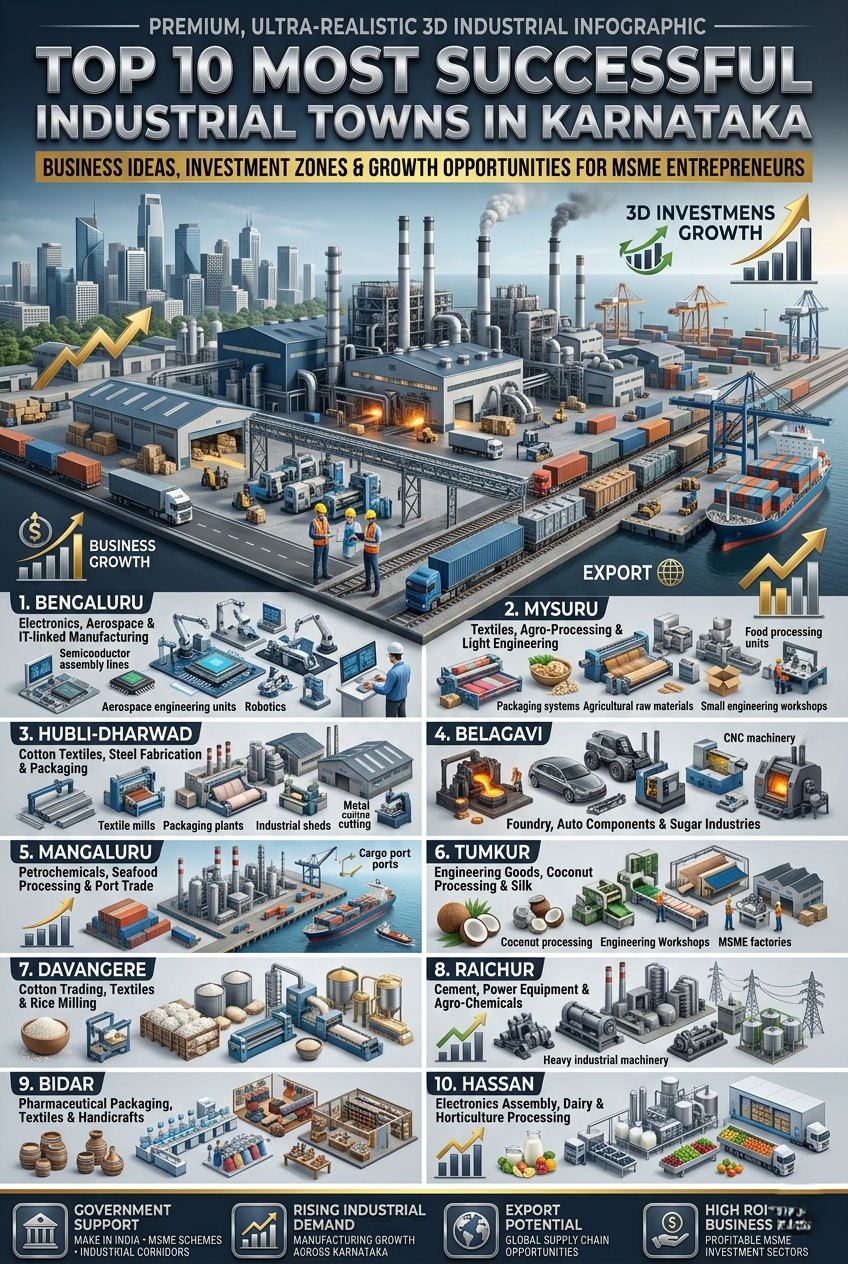
Davangere — Cotton Bale Trading, Textiles, and Rice Milling
Davangere is a hub of Karnataka’s agriculture and textile industry. It is one of the largest cotton trading centres in peninsular India. More than 200 ginning and pressing mills are located in and around the city. The bidi industry has contracted but historically has relied on a large ancillary industry related to tobacco logistics and packaging. Modern investors have opportunities in value-added cotton yarn spinning, open-end spinning, and compact yarn production. In addition, These segments enjoy strong and sustained demand from apparel manufacturers in Bengaluru and Tiruppur. In addition to cotton, Davangere is a major centre for rice milling. A fortified rice manufacturing or parboiled rice export business can be explored in the existing raw material catchment area. It offers a low-risk, high-volume opportunity.
Raichur — Cement, Power Equipment, and Agro-Chemical
Raichur is the Entry Point to the Industrial Zone of Hyderabad-Karnataka with rich mineral resources. Moreover, Cement manufacturing is a traditional business in the district. Additionally, The presence of power equipment maintenance, electrical contracting, and industrial fabrication units around the Raichur Thermal Power Station has also made the city a hub for these industries. Furthermore, Agricultural belt (cotton, sunflower and paddy) is witnessing increasing demand for agrochemical inputs, pesticide formulations and micronutrient fertilizers. In addition, Raichur offers underutilized industrial land at competitive rates for MSME investors. It also provides easy access to raw materials for mineral-based manufacturing and agro-input industries. Consequently, Project economics can be further strengthened by area-based incentives available for capital-intensive industries such as chemicals and building materials.
Bidar — Pharmaceutical Packaging, Textiles, and Bidar Craft
The district of Bidar is one of the northernmost districts of Karnataka and is emerging as an industrial hub. Moreover, It offers attractive incentives for MSME investors. As a designated backward area, Bidar provides higher capital subsidies, stamp duty waivers, and power tariff concessions for new manufacturing units. Consequently, These benefits make it one of the most cost-effective investment destinations in the state.
Bidar also enjoys strong connectivity with Hyderabad’s pharmaceutical belt. As a result, This has created opportunities in pharmaceutical packaging, blister packing, and API intermediate manufacturing. In addition, the revival of the traditional Bidri craft presents opportunities in premium export handicrafts and artisan branding. Furthermore, These initiatives are further supported through the MSME Cluster Development Programme.
Hassan — Electronics Assembly, Dairy, and Horticulture Processing
Over the last ten years, Hassan has quietly undergone an industrial revolution. The city was once known mainly for its proximity to the Belur-Halebid heritage sites. Today, it is also a major manufacturing hub for electronics assembly, horticultural product processing, and dairy manufacturing. Moreover, The KIADB industrial area hosts units engaged in garment manufacturing and precision engineering. The district also produces horticultural crops such as tomatoes, potatoes, and gherkins. As a result, This has attracted agro-processing investments from multinational companies. Furthermore, Hassan’s connectivity to Mangalore Port and Bengaluru makes it an ideal location for export-oriented processing units for gherkins and tomato paste. Consequently, These units can supply directly to European retail chains through contract farming and buyer-linkage models.
Import–Export Opportunity Analysis for Karnataka’s Industrial Zones
The industrial towns collectively contribute to a substantial export volume in a few high-value categories in Karnataka. The engineering enterprises manufacture castings, forgings, and precision-machined products. These products are readily available in Germany, the UK, and the USA. Mangalore is a leading seafood exporter of India, one of the foreign exchange earners in food sector. Textile exports from Mysuru, Davangere, and Hubli-Dharwad are part of India’s apparel export basket. These exports are expected to grow further through bilateral trade talks with the EU.
In the import substitution segment, manufacturers from Karnataka are better positioned to serve the local market, which is currently supplied through imports. In specialty chemicals, electronic components, precision castings for defence and pharmaceutical intermediates the existing talent pool and infrastructure in Karnataka can cater for competitive import substitution manufacturing. Since MSME investors who place their projects at the confluence of export potential and import substitution logic, are likely to have an aligned market with an aligned government, the viability of such projects will be de-risks to a great extent.
Indian MSME Leaders Who Built on Similar Industrial Foundations
Srinivasa Farms — Poultry and Agro-Processing, Andhra Pradesh and Karnataka
Moreover, The Kondapi family’s gold medal Srinivasa Farms is among the biggest integrated poultry companies in India, which provides broiler chicks, commercial eggs and processed poultry products to the entire south India. In fact, What started out as a regional agro-enterprise grew into a multi-state business by controlling feed manufacturing, hatcheries and processing, instead of relying on a fragmented value chain. Therefore, What the investors in MSME need to understand in the context of agro-industrial projects in Karnataka is the principle of vertical integration, which means having a control over different parts of the value chain, thus preventing erosion of margins and buffering the business from commodity price volatility.
Ugar Sugar Works — Sugar and Ethanol, Belagavi District
Notably, The Bhairavnath Munavalli family’s agro-industrial initiative, Ugar Sugar Works, in Belagavi district, is a case study of agro-industrial resilience in Karnataka. Furthermore, The company was early to diversify its business beyond sugar to ethanol, co-generation power generation and bio-fertilizers, all by-products of the sugar manufacturing process. As a result, This strategic diversification provided Ugar with the ability to maintain profitability in several sugar market downturns and to transform waste streams into revenue streams. Therefore, The Ugar model highlights the need to develop multiple-income generating projects from the very beginning of the feasibility stage, for entrepreneurs who are thinking of agro-industrial projects in Karnataka.
Kirloskar Electric — Electrical Equipment, Mysuru
Kirloskar Electric Company, a company based in Mysuru, has been a corner stone of the engineering business in Karnataka for more than seven decades. The company makes traction motors, transformers and alternators for the Indian railways, utilities and industrial plants.
The constant attention to product quality, developing a pool of talented workforce through training centres within the organization, and strategic partnerships with other technology leaders around the world are what is worth learning for new entrepreneurs from Kirloskar Electric.
The company growth curve is a testament to the fact that manufacturing companies, who are set up in the established industrial towns of Karnataka, can grow nationally and internationally provided they adopt process discipline and leverage technology differentiation.
Identify high-growth industries before others do
How NPCS Supports Industrial Project Planning in Karnataka
Building a manufacturing plant in Karnataka’s industrial towns requires more than just selecting a location. It demands detailed pre-investment analysis, engineering clarity, and a robust project model. Moreover, At Niir Project Consultancy Services (NPCS), we provide professional consulting for the preparation of Market Survey cum Detailed Techno-Economic Feasibility Reports (DPRs) for setting up new industries and businesses. Additionally, We offer detailed manufacturing processes, Market Research and demand analysis, process flow diagram, product mix and capacity planning, machine and raw material sourcing details, and complete project financial details like profitability and break-even analysis. Therefore, We want to impact the process of assessing feasibility, profitability, and potential scalability prior to investing money, allowing for informed investment decisions and avoiding costly course corrections after the project kicks off.
Key Industrial Metrics: Top 10 Industrial Towns in Karnataka
Industrial Town | Primary Sectors | Key Industrial Area | Estimated Active Units | Export Orientation |
Bengaluru | Aerospace, Electronics, Engineering | Peenya, Bommasandra, Jigani | 5,000+ | High — Electronics, Defence Components |
Mysuru | Textiles, Agro-Processing, Pharma | Hootagalli, Belagola | 500+ | Medium-High — Silk, Spices, Chemicals |
Hubli-Dharwad | Cotton Textiles, Steel Fab, Packaging | Tarihal, Gokul Road | 700+ | Medium — Textiles, Auto Parts |
Belagavi | Foundry, Auto Components, Sugar | Udyambag, Machhe | 300+ | High — Castings, Forgings |
Mangaluru | Petrochemicals, Seafood, Port Trade | Baikampady IDA | 400+ | Very High — Seafood, Chemicals |
Tumkur | Engineering, Coconut Products, Silk | KIADB Tumkur | 250+ | Medium — Silk, Transformer Parts |
Davangere | Cotton, Textiles, Rice Milling | Lokikere Road IDA | 200+ | Medium — Cotton Yarn, Rice |
Raichur | Cement, Power Equipment, Agro-Chem | Raichur IDA | 150+ | Low-Medium — Agrochemicals |
Bidar | Pharma Packaging, Craft, Textiles | Bidar IDA | 100+ | Low — Growing Export Potential |
Hassan | Electronics, Dairy, Horticulture | Hassan IDA | 180+ | Medium — Gherkins, Electronics |
Frequently Asked Questions (FAQs)
Q1. Best industrial town for low budget entrepreneurs in Karnataka?
Tumkur and Hassan are good options, because of their lower land prices, government incentives and good agro-processing opportunities such as coconut and gherkin products.
Q2. Are there any schemes for backward districts in Karnataka for MSMEs?
Yes. The capital subsidies are provided in districts such as Bidar, Raichur, Yadgir, Koppal and Chitradurga. There are schemes such as CGTMSE and SFURTI that provide MSMEs with loans and cluster development.
Q3. Why Mangalore is good for manufacture and export?
Mangalore is well endowed with a robust export infrastructure that has access to ports, container shipping, warehouses and reduced export logistics costs.
Q4. How to determine the profitability of a manufacturing project?
Analyze expenses such as land, equipment, working capital, operating expenses, break-even point, and ROI. A DPR (Detailed Project Report) assists to determine feasibility and to obtain loans from banks.
Q5. Will MSMEs be a part of Bengaluru’s aerospace & defence supply chain?
Yes. MSMEs work with companies such as HAL and ISRO in terms of components and services. For longer-term opportunities, you may need to have certifications, such as AS9100.
Q6. Best scalable agro-industrial ideas in Karnataka?
Some of these include coconut processing (Tumkur), spice extraction (Mysuru), gherkin/tomato processing (Hassan), cotton yarn (Davangere), and bio-ethanol (Belagavi).