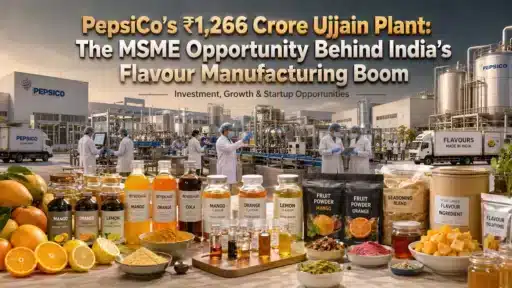
PepsiCo India has opened one of the Indian company’s biggest single manufacturing investments of ₹1,266 crore in Ujjain, Madhya Pradesh, this week, according to Economic Times. PepsiCo’s second flavour concentrate plant in India, the ninth of its kind in the world, will create direct and indirect employment of about 500.
In fact, This isn’t a one-time announcement. It is part of a larger investment plan of PepsiCo of ₹5,700 crore on new plants in Madhya Pradesh, Assam and Tamil Nadu that the company planned in India till 2030. Therefore, Such growth is an indicator of a significant shift in the location of capacity expansion and the motivations of multinational food and beverage companies for entrepreneurs and MSMEs.
For instance, When a global FMCG company parks a big plant in a Tier-2 industrial corridor, it brings an entire ecosystem with it: packaging suppliers, logistics companies, flavour & ingredient suppliers, contract manufacturers, and agri-sourcing companies. As a result, The Vikram Udyogpuri industrial area in Ujjain is now set to become a real-life hub of this kind. Therefore, The opportunity for the founders is not to compete with PepsiCo; it is to join in the ecosystem that is developing around them.
The Ujjain plant was practically opened by Madhya Pradesh Chief Minister Dr Mohan Yadav and other senior leaders of PepsiCo around the world, as the state is becoming a central part of the company’s strategy in India, Economic Times’ manufacturing desk reports.
The plant features zero liquid discharge systems, uses renewable electricity and seeks to fully replenish the water it uses, a sustainability model that is becoming expected as a licence-to-operate for big manufacturers moving to new states.
Why this matters for founders and MSMEs
A confirmed multi-year capex pipeline (₹5,700 crore till 2030) and not closing of the windows for empanelment of vendors after one plant.
PepsiCo already has access to more than 2000 farmers in Madhya Pradesh for chip grade potatoes, which shows how the Madhya Pradesh agri-supply ecosystem is ready for investment by other food processors.
Should the business be investing in large anchors, these companies typically would receive state industrial-policy benefits, land allotments and single-window clearances which are also available to smaller manufacturers in the same industrial corridor.
This is a shift entrepreneurs need to watch: Madhya Pradesh is definitely transforming itself from an agriculture-driven state to a food manufacturing hub and the Economic Times’ report on this event is a living testament of this.
Firstly, The Indian flavour, concentrate and beverage-ingredient manufacturing industry is growing due to three main trends: increased per-capita beverage consumption, ‘China Plus One’ and ‘In India, For India’ procurement policies adopted by FMCG companies, and proactive state government initiatives to attract investments in food processing.
Notably, PepsiCo’s own declaration that this is the ninth global concentrate plant and first in India, speaks for itself — India is no longer a distribution market; it is a key manufacturing and innovation hub in PepsiCo’s global manufacturing network. Furthermore, A global giant that decides to build a second domestic concentrate plant to make the product rather than bring the flavor base from abroad opens the door to many ancillary suppliers in India, such as those providing natural extracts, packaging films, caps and closures, and cold-chain logistics.
Moreover, This growth would be further fueled by dedicated food-processing parks being developed under the initiative of Madhya Pradesh industrial development corporation and production linked incentive scheme of the Centre for food processing. As a result, This creates a broader base of demand that smaller manufacturers can share, not just global giants.
Government Policies & Incentives Supporting This Sector
For those who are assessing whether to enter the flavour industry or food-processing ancillary or agri-sourcing related to this ecosystem, there are several key support systems available at central and state level:
MSME Ministry schemes (credit linked capital subsidy, cluster development support and technology upgradation assistance for small food processing and ancillary units).
Startup India — reduced tax, self-certification and support for funding of early startups on the back of agri-tech, food-tech or supply-chain innovation.
These frameworks can lower the entry barrier for MSMEs wishing to tap the large manufacturing ecosystem that is now emerging in Ujjain as opposed to going through the process of building in isolation.
PepsiCo’s new Ujjain plant represents a major investment in India’s food processing and flavour manufacturing industry.
Business Ideas Emerging from This News
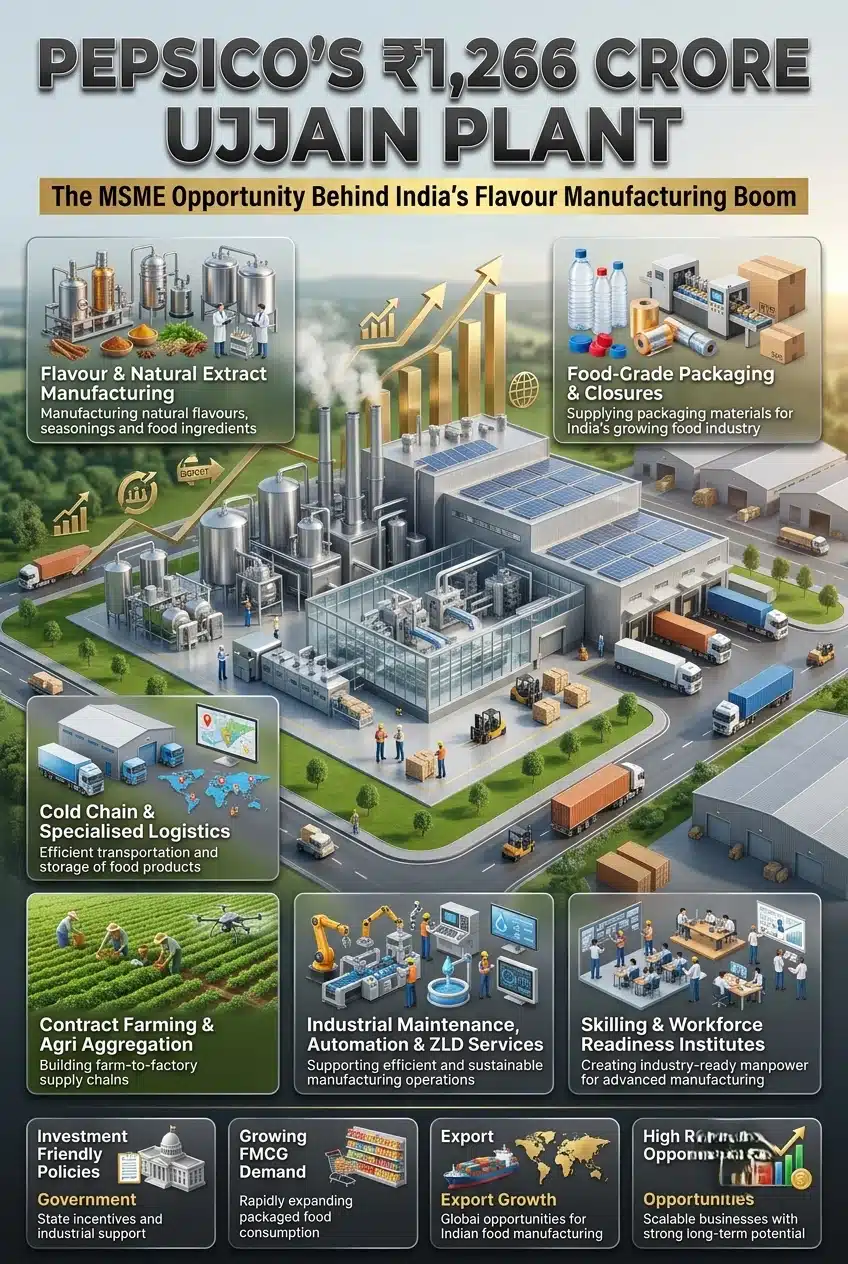
1. Flavour and natural-extract ancillary units
For a small scale or mid-scale natural essence and/or fruit concentrate manufacturing facility, the option to serve as a secondary, or even backup supplier for a large-scale concentrate plant that will qualify several vendors for supply chain resilience is a good one.
2. Food-grade packaging and closures manufacturing
Continuous demand for PET preforms, caps and labels, and corrugated packaging is created by its 22-acre concentrate plant. Placing a packaging unit inside Vikram Udyogpuri corridor will bring down logistics cost for the anchor plant and also packaging vendor.(PepsiCo Ujjain Plant MSME Opportunity)
3. Cold-chain and specialised logistics services
Concentrates and agri-inputs must be transported at a controlled temperature. MSMEs that have facilities for reefer trucking, warehousing, and last-mile cold logistics in Ujjain and Indore can cater to this plant as well as the emerging food-processing cluster in the region.
4. Contract farming and agri-aggregation services
PepsiCo is already sourcing potatoes from more than 2,000 farmers, and agri-aggregators, such as farmer collective organisers, quality-grading service providers, or farm input suppliers, will benefit as the sourcing network expands to other crops that pepsi-food companies use in their beverage and snack production.
5. Industrial maintenance, automation and ZLD servicing
The plant’s zero liquid discharge and renewable-energy design will need special attention from technical service vendors, water-treatment service companies and integrators of industrial automation, all of which have limited competition in central India.
Vocational training providers in food-processing operations, quality control, and industrial safety will find plentiful, high-paying jobs as the pipeline opens. This facility alone is expected to generate about 500 direct and indirect jobs. The many other facilities in the ₹5,700 crore pipeline will likely multiply these opportunities further.(PepsiCo Ujjain Plant MSME Opportunity)
Import–Export Opportunity Analysis
India’s beverage concentrates and flavour manufacturing base has been steadily reducing dependence on imported flavour bases, and facilities of this scale strengthen the case for India as a regional export base for concentrates and food ingredients, not just a domestic-consumption market.
MSMEs eyeing export linkages in this value chain should track compliance and market-access support through APEDA, which supports processed food and agri-product exporters with registration, quality standards and international market development assistance.
For founders building ingredient or packaging businesses with export ambitions, aligning early with APEDA registration and quality certification can shorten the runway to serving both domestic anchor clients and overseas buyers.
Indian MSME Success Stories in This Space
Moreover, India’s food-processing ancillary sector has proof points of small manufacturers scaling by anchoring to large anchor investments. As a result, Contract packaging units in Punjab grew alongside PepsiCo’s original Channo flavour facility, evolving from single-shift job-work operations into multi-client packaging suppliers within a few years.(PepsiCo Ujjain Plant MSME Opportunity)
Similarly, Similarly, several agri-aggregation MSMEs in Gujarat and Punjab that began as informal farmer-collection points scaled into structured supply-chain partners for large snack and beverage manufacturers, eventually exporting processed agri-products themselves. Moreover, The common thread is that they started small, stayed close to one anchor client, and diversified once they had established operational credibility.
Niir Project Consultancy Services (NPCS) has supported entrepreneurs and MSMEs across India for decades with detailed project reports, feasibility studies and market research covering food processing, beverages, packaging and allied manufacturing sectors. Moreover, For founders evaluating an entry into the ecosystem forming around large investments like the Ujjain flavour plant, a structured feasibility report — covering plant cost, machinery, raw-material sourcing and return-on-investment projections — is often the difference between an idea and a bankable business plan. Additionally, NPCS designs its project reports to provide first-time and expanding manufacturers with exactly this kind of ground-level, numbers-backed clarity.
Snapshot: PepsiCo’s Ujjain Facility at a Glance
Parameter
Detail
Location
Vikram Udyogpuri, Ujjain, Madhya Pradesh
Investment
₹1,266 crore (approx. US$133 million)
Plant area
22 acres
Significance
PepsiCo’s 2nd flavour plant in India; 9th globally
Employment potential
~500 direct and indirect jobs
Broader pipeline
₹5,700 crore committed across India through 2030
Sustainability design
Renewable electricity, zero liquid discharge, 100% water replenishment target
Existing MP linkage
2,000+ farmers engaged for chip-grade potato sourcing
FAQ Section for Founders
1. Does PepsiCo’s Ujjain plant directly work with third-party MSME vendors?
Large concentrate plants typically empanel approved vendors for packaging, logistics and select raw materials, so MSMEs should track PepsiCo’s supplier registration channels and Madhya Pradesh’s industrial vendor-development programmes rather than expecting direct retail-style deals.
2. What is the easiest entry point for a small manufacturer into this ecosystem?
Packaging, cold-chain logistics and agri-aggregation typically have the lowest capital thresholds and the fastest path to becoming a qualified ancillary supplier around a large anchor plant.
3. Is government support available for setting up near this industrial corridor?
Yes – credit-linked schemes of MSME Ministry, benefits of Startup India recognition, as well as incentive policies by Govt. Of Madhya Pradesh are also applicable to your unit based on its size and industrial sector.
4. How significant is the ₹5,700 crore pipeline for smaller businesses?
It represents on-going multiyear capital spending not a single event, which indicates that vendor and other opportunities will continue to unfold across Madhya Pradesh, Assam and Tamil Nadu in the coming few years.
5. Can agri-based MSMEs benefit even without a direct PepsiCo contract?
Yes. The expansion of organised farming and sourcing networks in the region tends to lift quality standards and market access for the wider agri-processing base in the state, not only for units contracted to the anchor company.
6. Where can founders get a bankable feasibility report for this sector?
Specialised industrial consultancies such as NPCS prepare detailed project reports covering machinery costs, raw-material sourcing and financial projections for food-processing and beverage-ancillary businesses.
Conclusion
The Economic Times reports on PepsiCo’s ₹1,266 crore Ujjain inauguration as more than a corporate press update; it actively signals how India is redrawing its food and beverage manufacturing map.
Moreover, Madhya Pradesh’s transformation into a flavour and concentrate manufacturing hub, backed by a confirmed ₹5,700 crore multi-state pipeline, gives founders a rare window: the ecosystem around this plant is still forming, companies are still building vendor relationships, and state incentives remain active.(PepsiCo Ujjain Plant MSME Opportunity)
The founders who act now — whether in packaging, logistics, agri-aggregation, or industrial services — will position themselves as early, credible partners by the time the next phase of this investment pipeline reaches Assam and Tamil Nadu. Moreover, As Economic Times continues to track this story, the underlying message for MSMEs remains the same: timing, not size, is the real advantage in catching an industrial wave this early.
P. K. Tripathi is Associate Editor at Entrepreneur India and a seasoned business consultant with over 35 years of experience advising startups and established enterprises across multiple industries. He has worked closely with founders and business leaders, offering strategic guidance on business planning, project execution, and market positioning — helping entrepreneurs transform ideas into viable, scalable ventures.
A published author of several business books on startups, manufacturing opportunities, and practical entrepreneurship, P. K. Tripathi is known for his grounded, execution-focused approach that cuts through theory to deliver actionable insights. Through his writing and consulting work, he continues to equip aspiring entrepreneurs with the real-world knowledge, industry intelligence, and practical strategies needed to thrive in competitive markets.