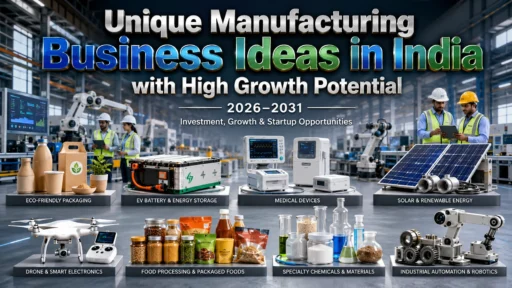


Unique Manufacturing Business Ideas
Thousands of aspiring first-time entrepreneurs look for viable manufacturing business ideas that they can fund and that aren’t already taken by a hundred guys in the same lane. Many end up copying the trends that are popular on YouTube, and many of these units fail within eighteen months. The entrepreneurs who really create successful, enduring companies tend to choose a niche that really isn’t being addressed, do extensive research on the market, and start the right size from the get go. In this article, we check out manufacturing business concepts that match that description — sectors that have noticeable need gaps, viable authorities’ assistance, and a clear pathway from a little business to a growing brand.
Why Manufacturing Is the Right Bet Right Now
What’s important is India’s real structural change in the manufacturing sector and that’s what’s happening. International companies are actively seeking to diversify their supply chains from a single-country to alternative locations and India has been emerging as a viable alternative with the efforts being followed by the Department for Promotion of Industry and Internal Trade.
This change is contributing to the growing order books for specialty chemicals, electronics components, medical consumables and green packaging in particular, which are outpacing domestic capacity. The space which a new entrant can fill profitably is the perfect spot where the product-market fit is appropriate.(Unique Manufacturing Business Ideas)
The domestic consumption represents a second opportunity. In the categories of personal care, processed food, and building materials, which continue to grow at a steady pace, urban incomes are rising and rural markets are becoming increasingly formal. A well-designed unit does not need to rely exclusively on exports. Instead, it can build a strong domestic foundation first and expand into export markets as it demonstrates its quality systems.
Discover business ideas that actually make money
Government Policies and Incentives Backing New Units
There’s never been a more multi-faceted policy support package for a new manufacturing entrepreneur that’s worth the use of than there is now. The Production Linked Incentive scheme, which is operated by various ministries, offers financial incentives to manufacturers who increase production in certain priority sectors, such as the electronics industry, the pharmaceutical industry, specialty steel.
The Ministry of Micro, Small and Medium Enterprises conducts the Prime Minister’s Employment Generation Programme, providing capital subsidy for new business projects established by first-generation entrepreneurs, for smaller units. At the same time, CGTMSE eliminates the requirement for collateral, a hurdle that most entrepreneurs often face when they gather their products before banks.
There are also added depth in state-level schemes. Many states have introduced the provisions of capital investment subsidy, stamp duty exemption, and power tariff concession for new industrial units, especially in the backward areas or notified areas of industry. Manufacturing business ideas from the foundations should consider the central and state incentives involved in the project’s location before making a final decision, as these incentives can significantly impact project economics.(Unique Manufacturing Business Ideas)
Unique Manufacturing Business Ideas Worth Evaluating
We selected this list of manufacturing business ideas for a specific reason: each one belongs to a category where demand already exceeds organised domestic supply. These are not abstract ideas, but each comes with a process, suppliers of the machinery, and an entry level investment slab.
Biodegradable Packaging from Agricultural Waste
States have banned plastic packaging and the demand for compostable packaging, which is real and immediate, has made the use of low-cost raw materials like agricultural residue like sugarcane bagasse, wheat straw and areca leaf possible. A founder uses farm waste to produce moulded plates, bowls, and food containers with hydraulic thermoforming machines, which local manufacturers now produce at a reasonable cost.
The greater opportunity, however, might not be the plate, but the brand story behind it: no less than the hotel, airline and fast-food chains are searching for suppliers who can trace a true sustainability chain all the way from the farmer to the finished product. Two to three years is a time frame for a unit to transition from local contracts for raw material and quality assurance to export orders, given the push for single-use plastics ban in Europe and parts of the Middle East.(Unique Manufacturing Business Ideas)
Get Detailed Project Report (DPR): Biodegradable Products and Eco-Friendly Plastics
Gypsum Plaster Board Manufacturing
The construction industry in India has been making a gradual transition from the traditional wet plastering to dry-wall systems with gypsum board being the main focus. It significantly reduces construction time and delivers a cleaner finish that builders prefer. However, non-metro cities still account for a substantial share of demand, and only a few national brands currently meet that demand. A regional competitor can match synthetic gypsum costs and linehaul by locating near a power plant producing synthetic gypsum or near a natural gypsum source.
The process involves calcining gypsum, mixing it with additives, and forming the mixture between paper liners on a continuous board line. Manufacturers have documented this process well, and it does not require exotic machinery. Founders tend to expect a well-located plant to have reached its stable capacity utilisation sooner than commercial and residential construction in tier-2 and tier-3 cities.
Precision Sheet Metal Components for Electric Vehicles
Electric vehicle (EV) assemblers and two-wheelers and three-wheelers are striving to develop local vendor networks for battery trays, motor housings and structural brackets. Most of these parts are precision sheet metal components, not heavy forging, and that means that the entry investment is not as high as a traditional auto-component unit, which typically incorporates a large amount of heavy forging. The appeal of this idea is the timing: new EV assemblers are scaling up production and require reliable suppliers before they can develop them in-house, and if the founder has only one good quality certification, he can secure several-year supply deals. Working capital cycles in this business are longer than the average MSME manufacturing businesses, and therefore, the founders should plan accordingly. The automotive vendor business is a real long run business as the margin profile and repeat-order in the vendor business are very good.(Unique Manufacturing Business Ideas)
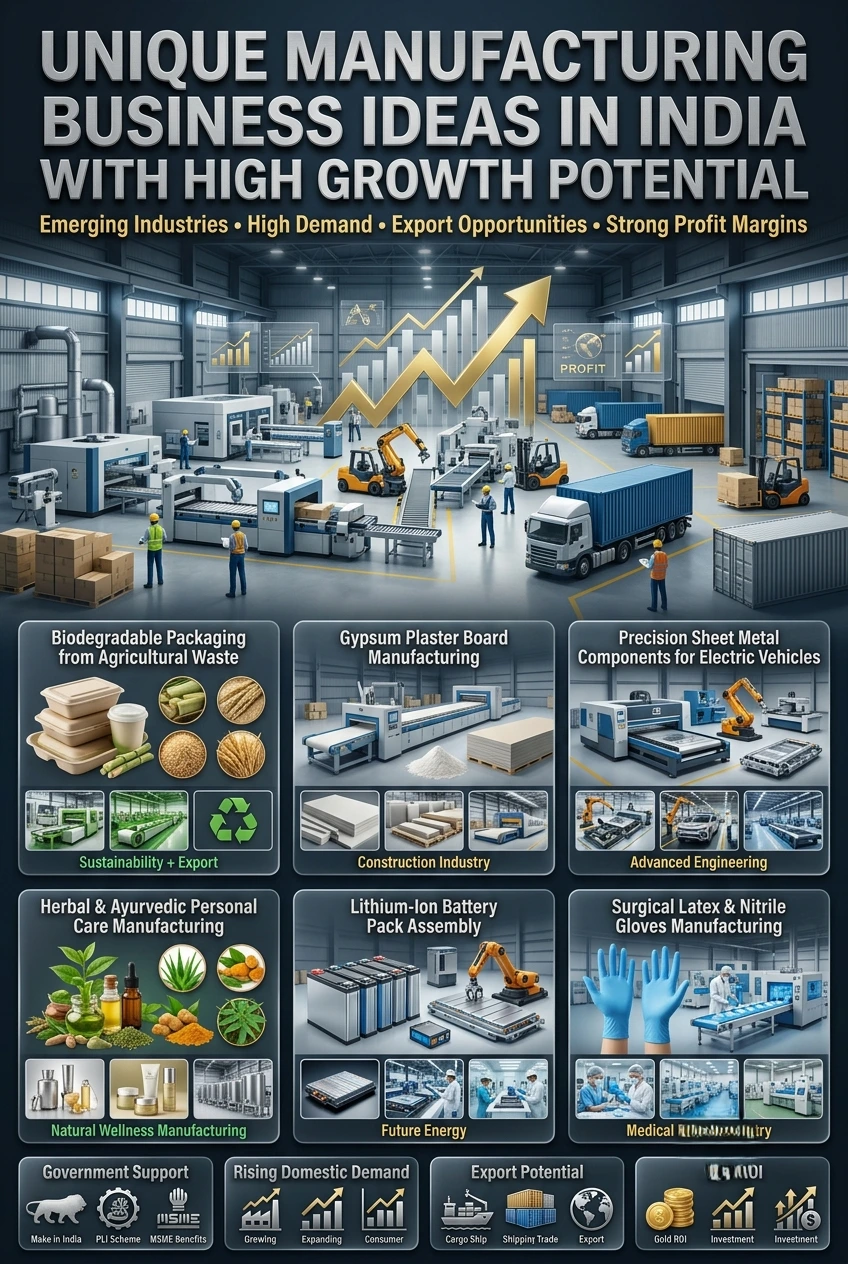
Herbal and Ayurvedic Personal Care Manufacturing
Consumer preference is clearly leaning towards the “natural” or “herbal” products, not just in the form of soaps and shampoos, but in soaps and facial preparations, hair oils, etc. Being new to the market, a new entrant doesn’t have to establish an in-house research team for entering this market; he can avail formulation support from established contract research organizations, while Ayush recognised manufacturing units can produce under the founder’s name. The true differentiator lies in the selection of ingredients and packaging design rather than the chemistry, as manufacturers have already proven most formulations effective with well-known herbal actives. Founders that have developed an exclusive brand value around a particular ingredient story, such as a domestic herb or a traditional formulation, generally are able to achieve better unit economics through shelf pricing than private label products.
Explore This Book: Herbal Cosmetics & Ayurvedic Medicines (EOU)
Lithium-Ion Battery Pack Assembly
Manufacturing battery cells requires massive capital investment, making it a business better suited to large companies. However, mid-sized manufacturers can successfully assemble cells with a battery management system (BMS) and package them into complete battery packs, creating a viable and profitable business opportunity. Demand is from electric two-wheelers, solar backup systems, and industrial equipment makers that require a custom pack configuration rather than an off-the-shelf pack. If you’re a new player in the market, you will need a controlled assembly environment, cycle life and heat tests, and robust safety documentation as battery failures can have real repercussions. If done right, it’s one of the few manufacturing business ideas that can work on a relatively small scale for a very tech-forward market without the capital investment of a cell Gigafactory.
Surgical Latex and Nitrile Gloves Manufacturing
Despite the steady growth in the domestic demand of examination gloves from hospitals, diagnostic laboratories, and export buyers, India still imports a significant portion of the gloves. A new manufacturing unit usually adopts the dipping-line process to convert natural rubber latex or nitrile compounds into high-quality powder-free gloves that meet the standards defined by the Bureau of Indian Standards (BIS). In the early days, the business’s reward for being consistent is exceeding the scale — if a business could not keep up a streak of meeting batch quality standards, a hospital procurement buyer would not re-order from the business, and the reputation will grow with each passing year.
As the world moves away from latex to nitrile gloves for allergy reasons, a founding company with a head start in nitrile manufacturing puts itself in a strong position in domestic hospital business and for export orders to quality-conscious, price-sensitive international markets.(Unique Manufacturing Business Ideas)
Import–Export Opportunity Analysis for New Manufacturers
Some of the ideas mentioned above have a genuine trade aspect to them and it is important that founders consider this aspect early rather than it being an afterthought. Both biodegradable packaging and nitrile gloves have regulatory tailwinds — Europe’s packaging restrictions and the changing global demand for gloves favour Indian suppliers that can demonstrate quality. On the components side, EV parts and battery packs are now more of an import substitution opportunity as India continues to import significant quantities of cells and specialised sheet metal tooling, and a domestic cell manufacturer that localises all or part of these components will mitigate currency risk for the downstream EV buyers and be a preferred supplier.
Before finalising the specifications of a plant for export purposes, it is important for the founders to be aware of the live trade data and opportunities for matching buyers and sellers through the India Trade Portal and export promotion councils for the respective sectors.
Indian MSME Success Stories Worth Studying
Karsanbhai Patel established Nirma as a small backyard business and transformed it into a leading detergent company. He achieved this by targeting a price-sensitive market segment that larger multinational companies had overlooked and successfully captured the market by focusing on a niche segment instead of competing directly in the saturated premium market. He said the logic behind his decision was to keep his cost base very low, to have him widely distributed in smaller towns and to let word of mouth grow before throwing money at advertising.
Cavin Kare’s founder C.K Ranganathan went the other way with shampoo sachets targeted at people in rural and semi-urban areas who didn’t have enough money to buy a full bottle of shampoo. This packaging innovation created an entirely new market segment that businesses had not previously targeted. It remains a valuable case study in identifying a price point that matches consumers’ actual purchasing power rather than simply setting arbitrary prices.(Unique Manufacturing Business Ideas)
In a classic example of how entrepreneurs can turn traditional products into high-growth manufacturing businesses, Ghanshyam Das Poddar’s Emami Group successfully combined Ayurvedic positioning with modern marketing and disciplined distribution. For new founders, these three stories highlight three common lessons: choose an underserved market segment, control costs relentlessly during the early years, and expand your distribution network before increasing manufacturing capacity.
How NPCS Helps Entrepreneurs Validate These Ideas
At Niir Project Consultancy Services (NPCS) we offer professional Market Survey cum Detailed Techno-Economic Feasibility Reports (DPRs) for the establishment of new industries or business. The report features full financials and profitability analysis, process flow diagrams, raw material details, machinery details, product mix, capacity planning, market research and demand analysis, project process and much more. Founders would be better off having a structured DPR that tests assumptions and projections for capacity, raw material costs, and the time to break even against actual market conditions before investing capital in any of the manufacturing business ideas listed above. We want to help entrepreneurs determine the feasibility, profitability and sustainability of the business model they are considering so they can make informed choices based on actual numbers, not guesses.
Related Article: Unique Selling Proposition (USP) & Sales Introduction
Indicative Investment and Return Snapshot
A very general range of entry-level units for the following ideas is provided below. Actual figures will differ depending on the capacity, location and the type of machinery chosen and need to be confirmed by detailed feasibility studies before any project is finalized.
| Business Idea | Indicative Investment (Entry Level) | Approx. Payback Period |
| Biodegradable Packaging (Agri-Waste) | ₹18–30 Lakh | 2–3 Years |
| Gypsum Plaster Board Unit | ₹80 Lakh–1.5 Crore | 3–4 Years |
| Precision Sheet Metal (EV Components) | ₹50–90 Lakh | 2.5–3.5 Years |
| Herbal/Ayurvedic Personal Care | ₹20–40 Lakh | 2–3 Years |
| Lithium-Ion Battery Pack Assembly | ₹60 Lakh–1.2 Crore | 3–4 Years |
| Surgical Nitrile Gloves Unit | ₹1.5–3 Crore | 3–4 Years |
Figures are indicative and vary by location, capacity, and machinery vendor. A detailed DPR is recommended before finalising investment.
Frequently Asked Questions
Which manufacturing business idea needs the lowest starting investment?
Biodegradable packaging from agricultural waste generally has the lowest entry cost among the ideas discussed, since the core machinery and raw material base are both relatively affordable.
Do these businesses require heavy technical expertise to start?
Most do not require the founder personally to be a technical expert. Formulation support, machinery training, and quality consultants are available across all six categories, though hiring one experienced production supervisor early is strongly advisable.
Can these units qualify for MSME loan schemes?
Yes. Units falling within MSME investment thresholds can typically access the Prime Minister’s Employment Generation Programme and collateral-free lending backed by the Credit Guarantee Trust for Micro and Small Enterprises, subject to bank appraisal.
How long does it usually take to break even?
Depending on capacity utilisation and pricing, most of these units target break-even within two to three years of stable operations, though export-oriented units may take slightly longer to build buyer trust.
Is a formal feasibility report really necessary for a small unit?
Yes. Even a modest-sized unit benefits from a structured DPR, since it forces realistic assumptions on machinery cost, raw material pricing, and demand, and it is usually required by banks for term-loan sanction.
Which of these ideas has the strongest export potential?
Nitrile gloves and biodegradable packaging currently show the strongest export pull, driven by global regulatory shifts, though both require consistent quality certification to access international buyers.
Conclusion
The manufacturing business ideas covered here share one common thread: each addresses a demand gap that is already visible in the market, not a speculative trend. Founders who combine the right idea with disciplined project planning, correct government scheme mapping, and a properly validated DPR stand a genuinely strong chance of building a durable, scalable manufacturing business rather than a short-lived venture.