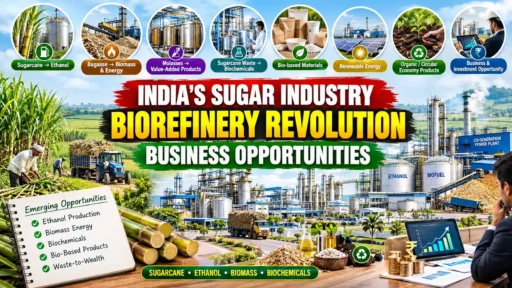
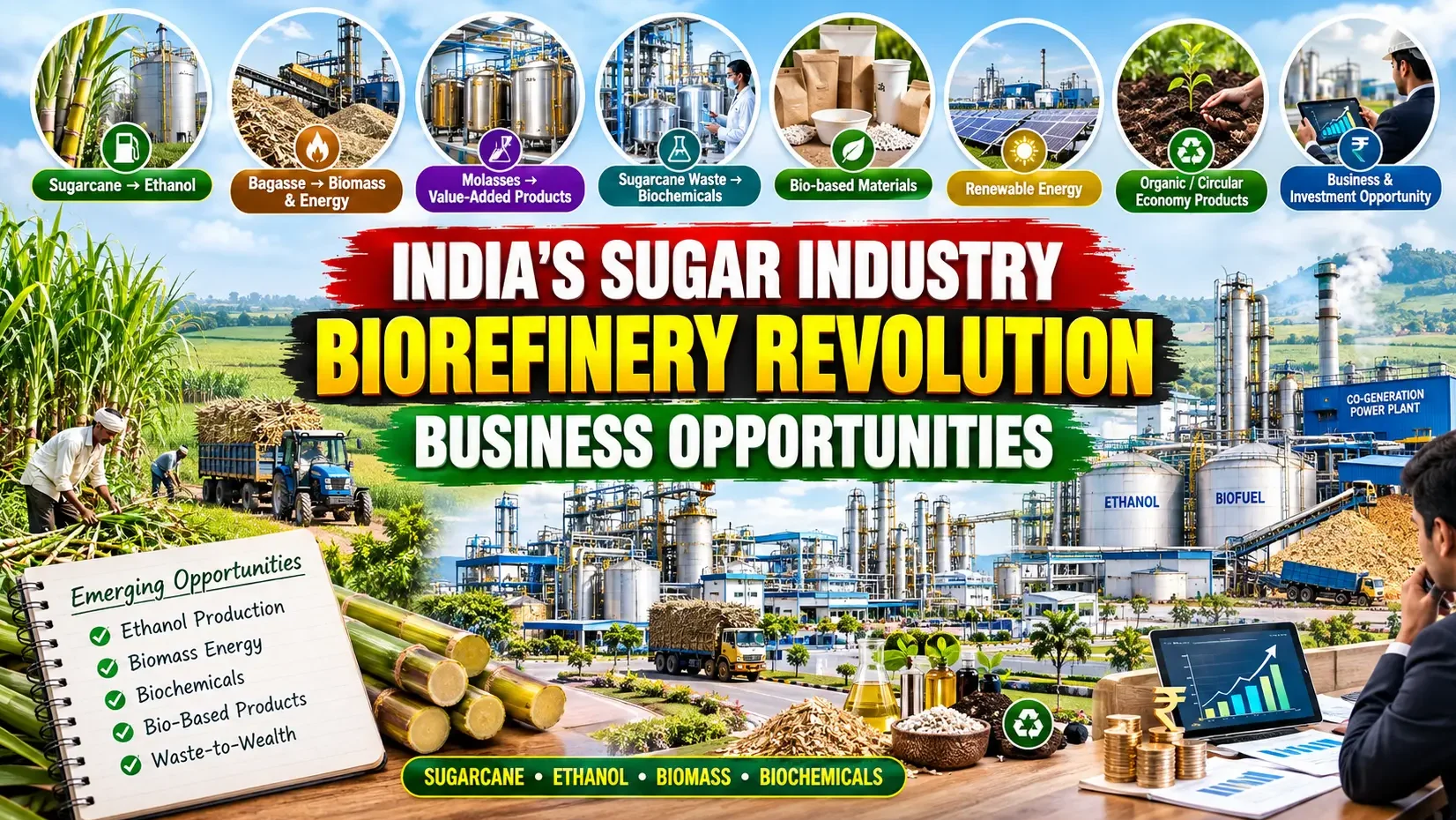

India’s sugar industry, which has traditionally been seen as a sugar maker, is at a true crossroads. Many industry experts and bio-energy specialists are now urging sugar mills to convert into integrated biorefineries. These can utilize sugarcane juice, molasses, bagasse, press mud, digestate and other co-products. Most of these are sold at low prices or burnt off by the mills.
This is not a theoretical change. The issue is being discussed at all levels in the sugar and bio-energy sector of India.
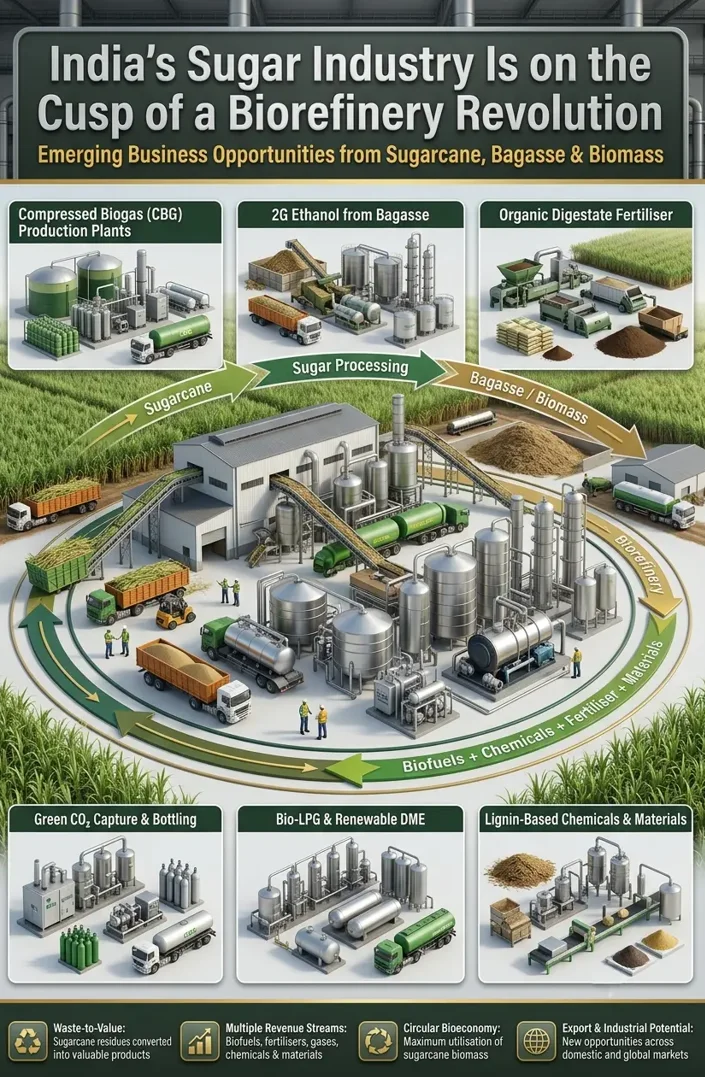
The economic rationale behind the argument is quite strong, as sugarcane processing generates amazing quantities of by-products and residues. These can be effectively utilized to produce renewable gas, second generation ethanol, compressed biogas (CBG), bio-LPG, renewable dimethyl ether (rDME), organic digestate fertilisers, and green carbon dioxide. A mill with integrated models is able to generate more than one stream of income. It is able to capture these streams.
This is a new category of business opportunity that entrepreneurs, MSMEs, chemical manufacturers, energy companies, agri-waste processors and start-ups in India’s bio-economy need to seriously assess now.
What This Development Means for Indian Businesses
The bottom line coming from the bio-energy and sugar industry in India is clear – sugar mills that focus only on sugar and 1st generation ethanol are missing out on massive commercial potential on their factory floor.
The concept of an integrated biorefinery model is a novel approach that redefines each output stream. Bagasse, fibrous material remaining after crushing, is not used as a boiler fuel. It is a high-quality feedstock for second generation (2G) ethanol. The residue from the clarification process (press mud) contains high levels of phosphorus and organic carbon. This makes it a perfect input for digestate based organic fertilisers. Biogas and Bio-fuels are produced from molasses. The CO₂ captured from biogas upgrading and CBG projects can be upgraded to food grade or industrial grade green CO₂ which can fetch high market prices.
All of these streams are different businesses. The potential for entrepreneurs who do not run sugar mills is to set up technology-based ancillary units near sugar mills. These may include CBG plants, 2G ethanol plants, organic fertiliser processing plants, CO₂ capture and bottling plants, and Bio-LPG or rDME production plants.
Such projects are actively encouraged by the government at both central level (Ministry of New and Renewable Energy – MNRE) and state level. Policy tailwinds, preferential pricing and a growing domestic demand base offer an opportunity for entrepreneurs to move in early to this space.
Why This Industry Could See Stronger Growth
The integration of sugarcane biorefineries is becoming economically viable as several structural forces come together for the first time.
India produces the second largest quantity of sugar in the world and has over 500 sugar mills running in various states like Uttar Pradesh, Maharashtra, Karnataka etc. where most sugar cane is produced. These mills combine to crush hundreds of millions of tonnes of sugarcane a season, producing vast amounts of bagasse, press mud and molasses. Traditionally, this material has been consumed in a sub-optimal manner.
The ethanol blending programme has already proved that the sector has the ability to make a successful turnaround. India’s National Biofuel Policy has gradually increased the ethanol blend mandate for petrol. This has led to significant investments in distillery capacity from the sugar industry. The next logical step, moving on from the existing CBG policy frameworks, is to carry on with value recovery further into the residue streams.
Read the Complete Guide to Sugar Production and Sugarcane Processing
The Indian Government’s Sustainable Alternative Towards Affordable Transportation (SATAT) scheme, led by the Ministry of Petroleum and Natural Gas, has established a regulatory framework for CBG and forced oil marketing companies to buy CBG from registered producers. This gives a sure offtake opportunity to the entrepreneurs investing in CBG plants near the sugar mills.
Another strong force is rural energy security. Catalytic upgrading of biogas can be used to produce bio-LPG and rDME which can replace fossil LPG in cooking in rural areas. As India continues to rely on imported LPG and the government aims to cut down on the import bill, these bio-fuels have significant policy momentum.
The organic digestate from biogas plants is a valuable soil amendment. It contains high levels of nitrogen, phosphorus and potassium. In a country where conventional chemical fertiliser prices have increased several times due to import dependence, digestate-based organic fertilisers are now commercially available. Progressive farmers are increasingly using these fertilisers.
Government Policies and Incentives
Entrepreneurs looking to invest in sugar-sector biorefineries and related bio-energy ventures can draw on a robust set of government programmes. The National Biofuel Policy 2018 (and its subsequent amendments) provides the overarching framework, establishing blending mandates, feedstock priorities, and incentive structures for both ethanol and advanced biofuels.
The SATAT scheme for Compressed Biogas is perhaps the most significant near-term policy support for entrepreneurs. Under SATAT, oil marketing companies are required to purchase CBG produced by private entrepreneurs and sugar mills, providing a market-linked offtake guarantee. This substantially de-risks the demand side of CBG projects.
For second-generation ethanol investments, the Department of Food and Public Distribution (DFPD) oversees distillery licensing and interest subvention schemes for sugar mills that invest in ethanol distilleries. The government has offered capital and interest subsidies for new distillery capacity, particularly for projects using non-food cellulosic and lignocellulosic feedstocks like bagasse.
MSMEs investing in bio-energy or organic fertiliser manufacturing can access financial support through the Ministry of MSME’s various credit and technology schemes, including the Credit Guarantee Fund Trust for Micro and Small Enterprises (CGTMSE), which enables collateral-free lending for eligible manufacturing projects.
How to Start a Sugarcane Processing Plant for the Sugar Industry: Business Ideas, Investment, and Growth Strategy
Startups in the bio-energy, green chemistry, and agri-waste processing space can register under the Startup India initiative to access tax exemptions for three consecutive years, simplified regulatory compliance, and priority access to government procurement.
For export-oriented organic fertiliser and bio-fuel manufacturers, the Agricultural and Processed Food Products Export Development Authority (APEDA) provides registration, market intelligence, and financial assistance for exporters of agricultural products including bio-based inputs.
State-level industrial development authorities—such as the Maharashtra Industrial Development Corporation (MIDC)—offer developed industrial land, utility connections, and single-window clearance for manufacturing projects. Uttar Pradesh and Karnataka have similarly active industrial investment bodies offering investment-linked incentives for bio-energy projects adjacent to sugar mills.
Exporters of renewable chemicals and bio-fuels can also tap into the Directorate General of Foreign Trade (DGFT) for export promotion schemes including the Remission of Duties and Taxes on Exported Products (RoDTEP), which supports cost competitiveness for exporters.
Manufacturing Business Opportunities Emerging From This Development
1. Compressed Biogas (CBG) Production Plants
One of the most commercialized prospects in this area is CBG production from press mud, molasses, and organic residues of sugar mills. A CBG plant purifies raw biogas (methane) to nearly 95% purity. It then compresses and delivers it to oil marketing companies under a scheme called SATAT. Government-guaranteed purchase price is a way of having predictable revenue.
The target customers are oil marketing companies (Indian Oil, HPCL, BPCL), industrial consumers and CNG vehicle fleet operators. The mud and spent wash from sugar mills are good feedstock. A medium scale CBG plant involves a huge capital investment, however a long purchase agreement with OMCs can be beneficial. Medium term export opportunities include renewable natural gas (RNG) certificate markets. The key danger is the consistency of feedstocks – entrepreneurs should ensure they have assured feedstock supply contracts in place before they invest.
Biogas and Compressed Biogas (CBG) Production Handbook
2. Second-Generation (2G) Ethanol from Bagasse
Bagasse—the fibrous residue after sugarcane crushing—is the most abundant agri-industrial residue in India. Bagasse can be enzymatically hydrolysed and fermented into 2G ethanol that fits blending mandates and premium pricing over first generation grain or molasses ethanol, instead of being burned in boilers.
The National Biofuel Policy and the government’s ethanol blending programme targets are directly supporting the market for 2G ethanol. The oil marketing companies are compulsory buyers. Raw material is captive at sugar mills. Domestic and international technology is available for licensing. The challenge is the high capital spending on enzymatic hydrolysis and fermentation units and these are more suited to large investors, or mill level joint ventures than single small MSME units.
Handbook on Biofuel, Ethanol and Bioenergy Based Products
3. Organic Digestate Fertiliser Manufacturing
In most of the current CBG projects, digestate (the nutrient rich slurry from the production of biogas from press mud and spent wash) is an underutilized asset. It is processed to make excellent organic fertiliser with a high nitrogen, phosphorous, potassium and micro-nutrient content. Sugar cane is a crop that is becoming less productive over time and the re-use of the processed digestate on the farms economically completes the nutrient cycle.
MSMEs can set up digestate processing and pelletisation plant near CBG plants or sugar mills. The target group are the sugarcane farmers, progressive farms and agricultural input distributors. Can be branded and sold as premium organic fertilisers. Some countries are developing organic agriculture and demand for certified bio-fertilisers is on the rise, which creates export potential. Moderate investment needs and incremental expansion of the business.
Explore the Complete Fertilizer Manufacturing Guide
4. Green Carbon Dioxide (CO₂) Capture and Bottling
Biogenic carbon dioxide forms as a separation by-product during biogas upgrading and CBG production processes in high amounts. This process captures and purifies this CO₂, making it commercially different from fossil-origin CO₂, as it is biogenic and can be verified for carbon credits. The applications are wide-ranging – beverage carbonation, industrial CO₂ (fire suppression, welding), greenhouse gas (controlled-environment horticulture).
Establishment of CO₂ capture units with a relatively low additional investment is possible in parallel with CBG plants. Food grade CO₂ market is well established and has been steadily rising with growth in organised beverage industry in India. The main criteria is, the purity specification set by Bureau of Indian Standards. It is a great opportunity to join the MSME scale, with a variety of customer categories.
5. Bio-LPG and Renewable Dimethyl Ether (rDME) Production
Bio-LPG and rDME are drop-in replacements for LPG and other gas fuels, respectively. They can be produced by catalytic conversion of biogas after cleaning. These bio-fuels can be physically and chemically used in the same distribution system as LPG. There is no change required at the consumer level.
The focus is on the rural cooking fuels market. When the production of BLPG is scaled up, it becomes commercially attractive with respect to India’s dependency on imported LPG. Technical investment is complex – entrepreneurs must work in partnership with technology suppliers for catalytic conversion units. This is a medium-large investment category, suitable for a more established company or industrial group, and not an early-stage MSME. The long-term upside is huge because of India’s priorities to import substitute fuel.
6. Lignin-Based Chemical and Material Production
Lignin is a complex organic polymer, which has important commercial applications in bio-composites, bio-resins, carbon fibres, and specialty chemicals, is found in bagasse and digestate. Furthermore, lignin valorisation is a research and early commercialisation field which is active worldwide. However, the opportunity is largely untapped in India.
Moreover, investors can purchase lignin extraction and processing units. In addition, these units can provide lignin-based binders, adhesives, or bio-composites to construction materials, paper, and packaging industries. Furthermore, this is a longer-term opportunity involving technology linkages and R&D. However, it holds good potential for import substitution of petroleum-based resins and chemicals. Therefore, this could be a differentiated career path for start-ups with chemistry or materials science backgrounds.
Import-Export and International Market Opportunity
The transition of sugar industry towards biorefinery has important implications for exports and import substitution in India.
The opportunity to export: India is already a sugar and ethanol exporter. As biorefinery capabilities grow, new categories of exports come into existence. European, Japanese and Middle East markets are seeing a rise in the demand for organic digestate fertilisers and bio-stimulants. This demand is growing in premium organic agriculture. The verified biogenic certified green CO₂ can be exported or utilized for generating carbon offset revenues. These revenues can come from the voluntary carbon market. Once produced in large quantities, Bio-LPG can be marketed in the export markets of South and Southeast Asian countries. LPG dependency and clean cooking policies are increasing in these markets.
Import Substitution: India is currently importing at large quantities specialty chemicals like some industrial CO₂ categories, bio-based resins and lignin derivatives etc. As a maturing sugarcane biorefinery industry can increasingly replace many of these imports with locally produced bio-based alternatives. The most compelling import substitution argument is in the specialty chemicals area, where value addition is the greatest. By the same token, the use of bio-LPG from domestic sources helps to lighten the import cost on petroleum account and has a constant strategic and policy significance on this front.
Indian MSMEs and Startups in Related Industries
There are a number of Indian companies already working in these sectors adjacent to the integrated biorefinery opportunity that can provide models and lessons for entrepreneurs looking at entering the space:
Imagine PowerGen Private Limited: Pune-based company with experience involved in CBG and biogas projects with agri-waste and sugar mill residues in Maharashtra. Their understanding of the commercial pathway for CBG entrepreneurs in the context of feedstock management and gas offtake agreements with the oil marketing companies is an example of what they have learned.
EverEnviro Resource Management: A bio-energy and waste management firm operating CBG projects in various States, EverEnviro proves that CBG is commercially viable across multiple States with the right feedstock agreements and partnerships with technology providers. Their model – covering digestate management – is immediately applicable to those who are interested in integrated biogas-fertiliser business around sugar mills.
Bio-fertiliser manufacturers such as Biolchim India: There are a few MSMEs in India already transforming organic wastes into products that are marketable in the agriculture sector as bio-fertiliser. These companies prove that businesses can successfully commercialise products based on organic nutrients from agri-industrial residues and offer them through existing agri-input channels. Digestafe units can be studied by entrepreneurs who are thinking of implementing digestate fertiliser.
What Entrepreneurs Should Evaluate Before Investing
While the biorefinery opportunity is commercially viable, businesses must assess the feasibility of each business line in a disciplined manner before committing capital:
- Market demand: Confirm offtakes / market access prior to project sanction – especially for CBG (SATAT empanelment), 2G ethanol (oil marketing company purchase orders) and green CO₂ (industrial buyer contracts).
- Inconsistent feedstock supply is the most prevalent challenge in Indian CBG projects, known as feedstock security. A binding feedstock supply contract with sugar mills or co-operative societies is required before the project is commissioned to the entrepreneur.
- Multiple technology options are available for each conversion step: Technology Selection. The technology, equipment, and availability of trained operators should be confirmed.
- Feedstock logistics costs are greatly reduced if the facility is located near a sugar mill or cane processing clusters. Sugarcane growing states like Maharashtra (Kolhapur, Solapur, Nashik), Western UP sugarcane belt, Karnataka (Belgaum, Mandya) are natural hubs.
- Water: CBG and 2G ethanol facilities need a lot of water and waste water treatment. Project planning needs to consider water availability and effluent management.
- Regulatory Requirements: CBG projects require SATAT empanelment; distilleries require licensing from state excise departments and DFPD; organic fertiliser units require registration under the Fertiliser Control Order.
- Working Capital: Most bio-energy projects have 30–90-day payment cycles from oil marketing companies and institutional buyers. Working capital funding must be adequately planned.
- Competition: CBG is attracting significant institutional and corporate investment. Entrepreneurs should identify market niches—geography, feedstock type, or product grade—where they can operate profitably without frontal competition with large players.
- Break-Even and Payback: CBG and 2G ethanol projects typically have 5–8 year payback periods at current pricing. Organic fertiliser units can generate faster returns. Model the financial projections conservatively.
Discover business ideas that actually make money
How NPCS Can Help Entrepreneurs Evaluate the Opportunity
NPCS – Niir Project Consultancy Services is a leading provider of industrial feasibility studies, Detailed Project Reports (DPRs), and market research for entrepreneurs, MSMEs, startups, and investors evaluating manufacturing and industrial investment opportunities in India.
For entrepreneurs exploring the sugar biorefinery space—whether in CBG production, 2G ethanol, organic fertiliser manufacturing, green CO₂ capture, bio-LPG production, or lignin-based chemicals—NPCS offers end-to-end consultancy support covering:
- Detailed Project Report (DPR) preparation covering technical, financial, and commercial aspects
- Market research and demand analysis for bio-energy and bio-based chemical products
- Feasibility studies covering feedstock, technology, location, regulatory compliance, and financial modelling
- Plant and machinery identification, vendor evaluation, and technology comparison
- Manufacturing process planning and capacity determination
- Investment evaluation including project cost estimation, return analysis, and risk assessment
Engaging a specialist consultancy at the pre-investment stage significantly reduces the risk of project failures—particularly in a technically complex sector where feedstock management, technology selection, and market access are all critical variables.
Business Opportunity Snapshot
| Parameter | Details |
| Industry | Sugar & Bio-Energy / Sugarcane Biorefinery / Green Chemicals |
| Market Driver | India’s ethanol blending targets, SATAT CBG policy, rural clean fuel demand, organic farming growth |
| Key Development | Industry-level push for integrated biorefineries converting sugarcane residues into CBG, bio-fuels, fertilisers, and green chemicals |
| MSME Opportunity | CBG plants, digestate fertiliser units, CO₂ bottling plants, lignin processing ventures |
| Manufacturing Potential | High – multiple product categories with established government offtake frameworks |
| Export Potential | Moderate to High – organic fertilisers, green CO₂, bio-LPG, carbon credits |
| Import Substitution | Bio-LPG, specialty bio-chemicals, lignin derivatives, industrial CO₂ |
| Government Support | SATAT scheme, National Biofuel Policy, MSME credit schemes, Startup India, APEDA export support |
| Investment Consideration | CBG and 2G ethanol are capital-intensive (₹10–100+ crore); fertiliser/CO₂ units are more MSME-accessible |
| Risk Level | Moderate – feedstock security and regulatory empanelment are key risk variables |
| Growth Outlook | Strong – structurally supported by energy transition, agri-sustainability mandates, and carbon market development |
Conclusion
The push to transform India’s sugar mills into integrated biorefineries marks one of the most commercially significant shifts in the country’s agro-industrial sector in recent years. Moreover, It is not simply a technical upgrade. Instead, It is a fundamental repositioning of a centuries-old industry toward multiple revenue streams, circular resource use, and alignment with India’s energy transition and rural development objectives.
For entrepreneurs, investors, and MSME manufacturers, this shift creates concrete entry points: CBG production, 2G ethanol manufacturing, digestate fertiliser processing, green CO₂ capture, bio-LPG ventures, and lignin-based chemical production.
Furthermore, Each business line directly connects to the structural changes occurring in India’s sugar sector. In addition, Government policy frameworks also support it—to varying degrees—and reduce demand-side risk.
Therefore, The window for early-mover advantage is open now. At the same time, Mill-level infrastructure, government policy frameworks, and market demand for bio-based energy and chemicals are all converging in 2026. As a result, Entrepreneurs who conduct rigorous market research, develop sound feasibility studies, prepare well-structured Detailed Project Reports, and plan capital deployment carefully can participate in one of India’s most promising industrial transitions…
Ultimately, Conducting thorough Market Research → Commissioning a Feasibility Study → Preparing a Detailed Project Report → Planning Investment strategically remains the responsible and commercially sound pathway into this opportunity…