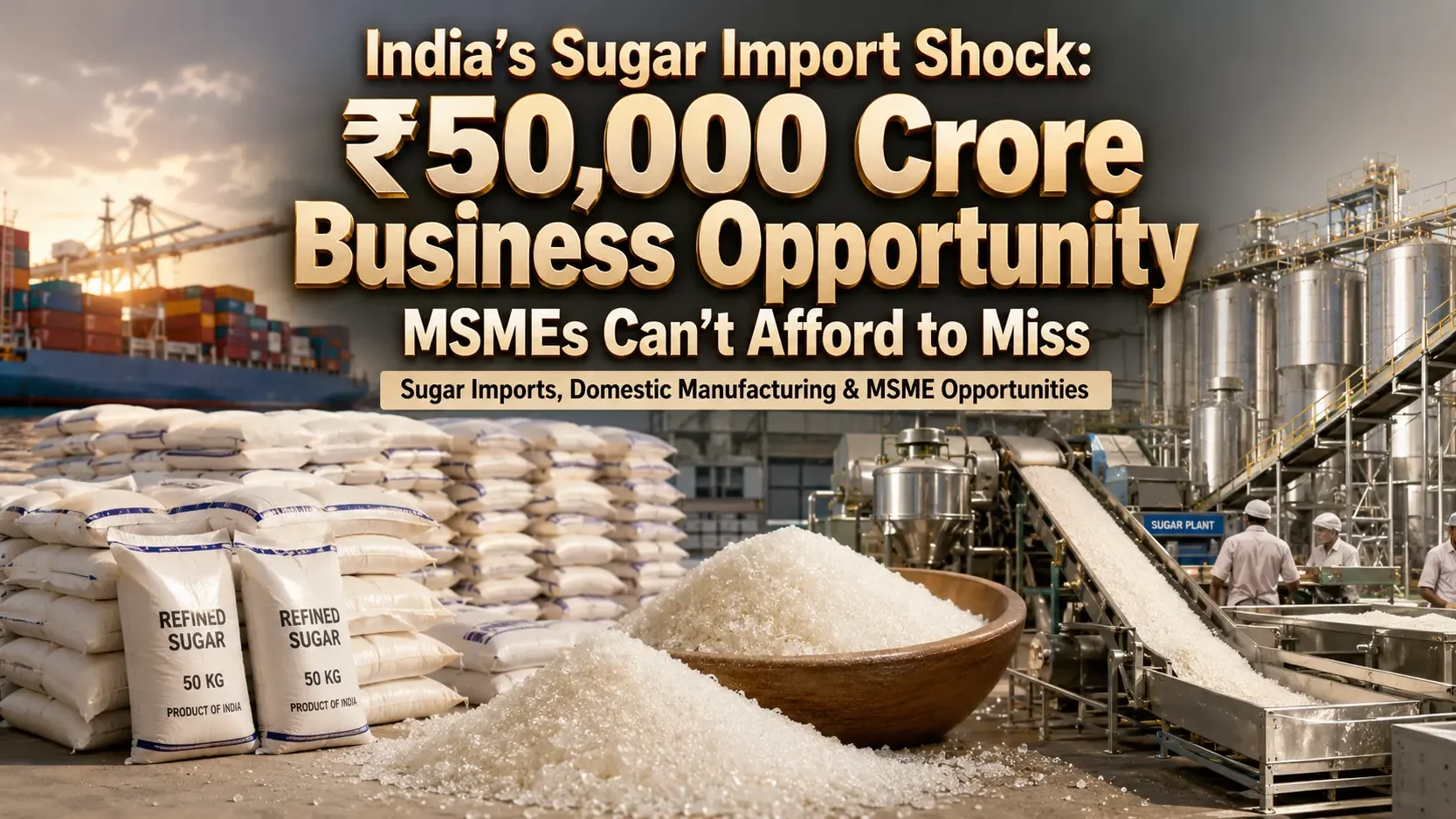

In one of the most significant interventions in the food sector in nearly a decade, the Indian government on August 20, 2026 allowed duty-free imports of 1 million metric tonnes of raw sugar under a Tariff Rate Quota (TRQ) mechanism — valid until October 31, 2026. As reported by Reuters, India — the world’s second-largest sugar producer and its biggest consumer — has taken this rare step to arrest a price surge tahat has seen sugar rise nearly 40% in two months.
Sugar at retail prices rose 13% YOY to ₹52.30 per kg in the middle of August 2026, whereas it stood at ₹3,900 per quintal a year ago. The decision, which was notified by the Directorate General of Foreign Trade (DGFT), is meant for bringing down the prices in view of the festival season (Ganesha Chaturthi, Dussehra and Diwali), where the demand for sugar rises steeply.
The policy change is more than a price-stabilisation step, especially for entrepreneurs and manufacturers and MSMEs in the food and agro-processing value chain in India. It is a strong indicator of a structural imbalance between demand and supply in the world’s biggest sugar consumer market and it opens tremendous, time-sensitive business opportunities.
Related Article: Top 10 Value-Added Products Manufactured from Sugarcane Bagasse Waste
What Reuters’ Reporting Reveals About India’s Sugar Market Shift
What Happened
The Ministry of Finance on August 20, 2026, issued Notification No. 30/2026-Customs to exempt all customs duty on raw sugar imports up to 10 lakh metric tonnes. The normal import duty on sugar is 100% – this is a broad window of zero duties. The importers are required to obtain the TRQ authorisation from 21st August to 28th August by applying to DGFT and the authorisation to be forwarded to Indian Customs EDI System (ICES) electronically.
Following this, Food Minister Pralhad Joshi said that bulk consumers with usage of over 10 tonnes of sugar per month would not be allowed to keep sugar in stock after consumption dates between 15th September and 30th November — a clear anti-hoarding measure.
Why It Matters
With a domestic demand of around 50 lakh tonnes, stocks are at a minimum of 32–42 lakh tonnes at the start of the sugar season in India for 2026-27 (October 1, 2026). This is not a cyclical aberration; it’s a structural imbalance. The supply situation has become very tight due to poor production in Maharashtra and Karnataka, with an increase in demand during the festive season and high industrial demand.
The Indian Sugar & Bio-energy Manufacturers Association (ISMA) said that while the overall stocks in the mills were satisfactory to meet the demand during the lean period, the government’s action was meant to make it clear: speculative price inflation will not be tolerated.
Why Entrepreneurs Should Pay Attention Right Now
The duty-free period ends October 31, 2026. However, the business opportunity it brings is of a longer duration. Structural demand-supply gap issues in India’s largest market for sugar are a green flag for:
- Raw sugar refining and processing industries
- Sugar-based confectionery and food manufacturing
- Sugarcane diversion for ethanol/biofuel production
- Agri-logistics and cold chain investment near mill clusters
- Manufacturing of sugar for export purposes as specialty sugar (organic sugar, invert sugar, liquid sugar)
Those that make the source, processing or infrastructure decisions during this window will find their position.
Why India’s Sugar Industry Is Growing — And Why It’s Structurally Complex
Sugar industry is a ₹1.8 lakh crore economy with direct and indirect employment of more than 5 lakh people in cane cultivation, cane milling, logistical and downstream food manufacturing in India. The sector is tightly interwoven with rural economy and MSME economy in India.
There are several structural factors that are making the industry one of growing dynamics and opportunity:
- The demand spikes for the festivals in India (August-November) is predictable and contributes to volatility in price — one of the major factors to consider in the manufacturer’s planning.
- The government has been creating a balance in the sugar supply by allocating more and more sugar cane for ethanol production under its Ethanol Blending Programme (EBP).
- Specialty sugars – low GI, organic, invert and liquid – offer niche manufacturing opportunity in FMCG sector.
- Domestic confectionery, bakery and beverage industries are emerging as huge consumers of sugar.
- India’s push for import substitution in food processing aligns directly with domestic sugar-derivative manufacturing
As reported by Reuters, the duty-free import exercise is one such example that highlights the stark reality: Sugar demand has consistently outstripped supply in India and this imbalance is a business opportunity.
Government Policies and Incentives Backing the Sugar Sector
India’s government provides one of the most elaborate support architectures in the world for its sugar sector. Entrepreneurs entering this space benefit from multiple policy levers:
- Ethanol Blending Programme (EBP) — Ministry of Petroleum — Sugar mills diverting juice and B-heavy molasses to ethanol receive purchase price guarantees from Oil Marketing Companies (OMCs). This de-risks capital investment in distilleries.
- Department of Food and Public Distribution (DFPD) — Regulates minimum selling price (MSP) of sugar and announces export/import policies. Entrepreneurs need to track DFPD notifications actively.
- Directorate General of Foreign Trade (DGFT) — Administered the TRQ notification for 10 lakh MT duty-free sugar import. DGFT manages all trade policy instruments including import/export licensing.
- Ministry of MSME — Agro-processing MSMEs can access credit-linked capital subsidy, priority sector lending, and technology upgradation support under PLI-linked programmes.
- Ministry of Food Processing Industries (MoFPI) — PLI Scheme for Food Processing and PM Formalisation of Micro Food Processing Enterprises Scheme (PM FME) provide capital subsidy up to 35% for small sugar-based food manufacturers.
- NABARD — Agri & Rural Development Finance — Provides low-interest loans to agro-processing ventures, sugar cooperatives, and rural food manufacturers. NABARD’s Rural Infrastructure Development Fund (RIDF) funds storage and logistics.
- SIDBI — Small Industries Development Bank of India — Finances MSME-scale food processing and agro-industrial ventures. Startup-friendly SIDBI Fund of Funds schemes support early-stage food tech ventures.
- UP State Industrial Development Authority (UPSIDA) — Uttar Pradesh, India’s largest sugarcane-producing state, offers industrial plots, power subsidies, and tax incentives for food processing ventures near sugar mill clusters.
- Maharashtra Industrial Development Corporation (MIDC) — Maharashtra’s MIDC agro-industrial parks offer ready-to-use infrastructure for sugar-based MSME manufacturing near Pune, Kolhapur, and Nashik mill clusters.
6 Manufacturing Business Opportunities Directly Unlocked by This Policy
The duty-free import policy will provide an instant source of raw materials at international competitive prices. Let’s take a look at six manufacturing business models that directly benefit:
1. Raw Sugar Refining and White Sugar Production
Why now: Duty-free raw sugar is available at global prices (significantly lower than DExM rates); this is an opportunity for cost arbitrage. With TRQ, small and medium scale refiners can be able to process raw sugar into white sugar and sell in FMCG and institutional buyer market at prevailing high prices. Domestic ex-mill prices for the commodity are around ₹5,400–5,500 per quintal, which leaves a huge margin for early-mover refiners.
Job market: Small refinery requires investment of ₹2-15 crore. The MSME scale operations can be established at Kolhapur (Maharashtra), Meerut (UP) and Mandya (Karnataka) where mill infrastructure is already available.
View Full Project Details: Sugar Production & Sugarcane Processing: A Complete Guide
2. Specialty Sugar Manufacturing (Organic, Invert, Liquid Sugar)
Why now: The food, bakery, beverage & pharmaceuticals markets in India are undergoing a rapid transformation to specialty sugar formats. Invert sugar syrup which is used in the confectionery, soft drinks and pharma syrups is currently imported. Liquid sugar is in demand by large beverage manufacturers. The duty-free price of imported raw sugar allows the small manufacturers to manufacture these value-added products at globally competitive input costs.
Market: India’s specialty sugar market is emerging and expanding at 12-15% CAGR. Southeast Asia, Middle East and East Africa are among export markets.
3. Confectionery and Sugar-Based Food Manufacturing
Why now: India’s confectionery market size is more than ₹30,000 crore and is expanding by 8-10% per year, due to the growing youth population, growth in retail FMCG and rising incomes. The high domestic sugar prices have squeezed many MSMEs in the confectionery sector. The duty-free window offers a chance to reduce costs of input, and expand the production ahead of the peak demand season of Diwali-Dussehra.
Product “categories”: Hard candy, toffees, mithais, chocolates, sugar coated nuts, health bars. The premium and giving margins are 3-5 times that of commodity sweets.
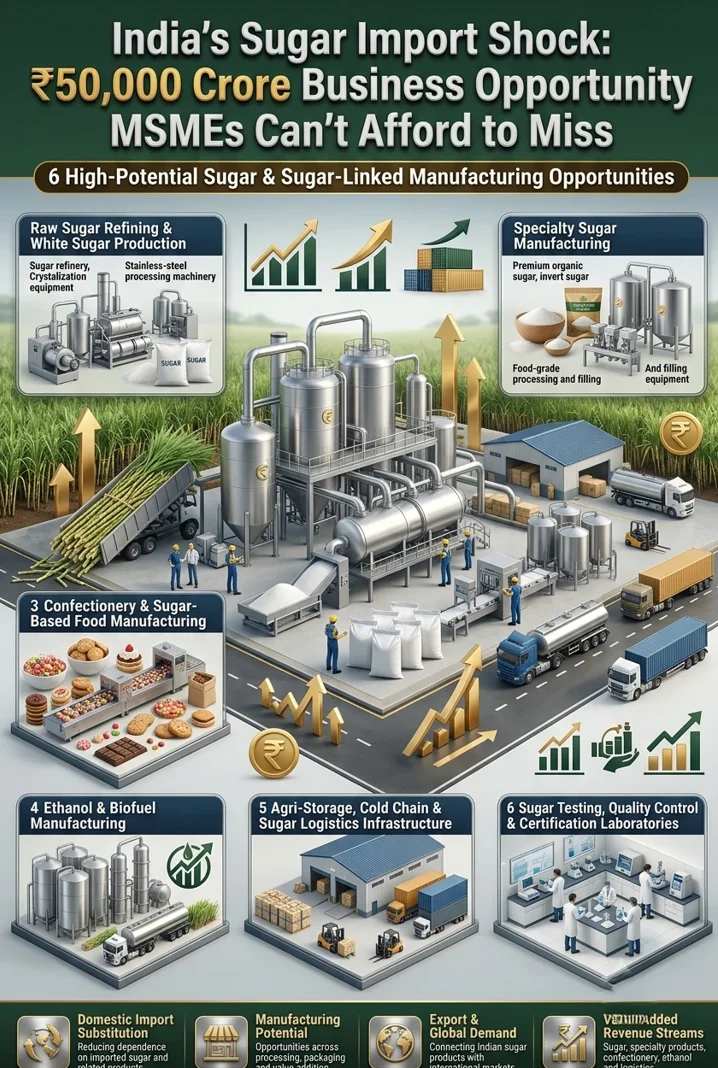
4. Ethanol and Biofuel Manufacturing (Sugarcane-to-Ethanol)
Why now: One structural reason for the current sugar supply tightness is the diversion of the government’s Ethanol Blending Programme for increased sugarcane volumes for biofuels. This provides another alternative, but parallel opportunity: Entrepreneurs can develop B-heavy molasses-based distilleries or small grain-to-ethanol facilities in proximity to sugar mill centers. Oil Marketing Companies have long-term offtake contracts for ethanol, which assures revenue for them.
Policy support: Interest subvention loans are available for distillery capacity addition under EBP scheme through ministry of petroleum and natural gas.
Get Detailed Insights from This Book: Sugarcane Processing and By-Products Guide
5. Agri-Storage, Cold Chain, and Sugar Logistics Infrastructure
Why now: There is an instant requirement for storage and handling facilities due to the duty-free import of 10 lakh MTs. There is an urgent need for port-side warehousing (JNPT, Mundra, Kandla, Kakinada), rail-linked dry warehouses near the clusters, and refrigerated transport for sugar-based food products. The government’s anti-hoarding measures also boost the flow of sugar from production to consumption, which could open up logistics business opportunities.
Storage infrastructure investment: ₹50 lakh to ₹5 crore. There is capital subsidy available under NABARD and State Govt schemes for agri-warehousing in notified areas.
6. Sugar Testing, Quality Control, and Certification Laboratories
Why now: sugar is being imported on DGFT TRQ basis so each of the import shipments will be subjected to FSSAI quality norms. Quality testing of sugar is required at the ports of entry by the customs and FSSAI. Small scale NABL accredited sugar quality testing laboratories, where sugar quality analysis (purity, colour, moisture, ICUMSA grade) is carried out are available in limited numbers as compared to the anticipated import volumes. A low capital high margin B2B services business opportunity for science startups.
Import-Export Opportunity Analysis
Import: The Current Opportunity Window
The duty-free window (21st August to 31st October 2026) allows Indian refiners and food manufacturers to buy raw sugar at international prices, which are now lower than the prices in India, even after freight and handling charges. Sugar futures in India have been trading near their lowest level in 16 months in comparison with global prices. Significant margin can be gained by entrepreneurs who have DGFT import license and refinery capacity.
Export: Long-Term Play in Value-Added Formats
Domestic price stability does not mean that India’s structural export opportunity is to be found in commodity white sugar, where export restrictions continue to be a policy option, but in:
- Organic and certified sugar to Europe and North America – 30-50% premium over commodity price.
- Turn sugar syrup and liquid sugar upside down to Southeast Asian manufacturers of food.
- Specialty mithai and confectionery exports to the Indian diaspora in the USA, UK, UAE and Canada, worth more than ₹4,000 crore, will be the most important markets to focus on.
- Industrial molasses for world manufacturers of biofuels and pharmaceuticals
Import Substitution Opportunity
Specialty sugar products such as high purity pharmaceutical grade sugar, fructose syrups and specialty confectionery coatings are being imported to India currently. These are direct import substitution targets for MSME manufacturers that have quality infrastructure in India.
Indian MSME Success Stories in Sugar and Agro-Processing
1. Godavari Biorefineries Ltd — Pioneer of Sugar-Ethanol Integration
Godavari Biorefineries (Sri Godavari Sugars) of Maharashtra is one of the oldest sugar mills. Over 65 years, it has transformed into an integrated biorefinery. The company produces sugar, ethanol, chemicals and biofertilizers. It is a representative case study of how MSMEs can transform into large-scale enterprises in the sugar-agro processing segment. It has also shown how co-product diversification can improve profitability in the sugar industry.
2. Triveni Engineering & Industries — Diversified Sugar-Biofuel Model
Headquartered in Uttar Pradesh, Triveni Engineering pioneered the B-heavy molasses route for ethanol production. It operates seven sugar mills with integrated distillery capacities. The model focuses on running sugar mills at low output while maximising ethanol production. Smaller co-operative mills in UP and Maharashtra are now replicating this model. This creates a blueprint for MSME-scale ethanol ventures.
3. Dwarikesh Sugar Industries — Community-Integrated MSME Model
Dwarikesh Sugar, a Uttar Pradesh-based company has established a vertically integrated business with 40,000+ farmers of the state connected in its cane development initiatives. Its MSME-scale ethanol distillery and cogeneration operations have been referred to as examples of integration of agro-industry in rural areas. The company provides proof that even smaller-scale operators can create sustainable policy-driven enterprises in sugar value chain.
Discover business ideas that actually make money
About NPCS — Niir Project Consultancy Services
NPCS (Niir Project Consultancy Services) is India’s best industrial consulting and knowledge platform for the entrepreneurs and MSMEs who want to enter in the sugar processing, specialty sugar manufacturing, ethanol production or agro-food sectors.
NPCS provides:
- Detailed Project Reports (DPR): Fully bankable project reports for Sugar Refinery, Confectionery, Ethanol Distillery, Specialty Sugar Production etc accepted by all major banks and financial institutions for project finance.
- Market Research: Sugar industry sizing, demand-supply analysis, competitor benchmarking, sugar price trends and food sectors price trends.
- Agro-industrial feasibility studies: Site selection, capacity planning, financial modelling and ROI projections.
- Technology Consultancy: Sourcing of equipment, process design, identification of vendors, and facilitation of technology transfer for new manufacturing units.
- DFTG Licensing, TRQ Application Support and trade compliance advisory to entrepreneurs, who have entered the Sugar import opportunity window.
Visit Niir Project Consultancy Services to access project reports, feasibility studies, and expert consultancy for your agro-industrial venture.
Industry Opportunity at a Glance
| Industry | Sugar Processing, Specialty Sugar Manufacturing, Ethanol & Biofuel Production, Agro-Food Processing |
| Triggering Event | India allows duty-free import of 10 lakh MT raw sugar (August 20, 2026) — first such move in nearly a decade |
| Domestic Sugar Price | ₹52.30/kg retail (August 2026); Ex-mill ₹5,400–5,500/quintal — up ~40% in two months |
| TRQ Import Volume | 10 lakh metric tonnes (1 million MT) at nil customs duty until October 31, 2026 |
| MSME Opportunity | Raw sugar refining, specialty sugars, confectionery, ethanol distilleries, agri-storage, quality labs |
| Export Potential | Organic/specialty sugar to Europe & North America; confectionery to diaspora markets; molasses to global biofuel sector |
| Government Support | PLI (Food Processing), EBP (Ethanol Blending), NABARD agri-lending, PM FME Scheme, MSME credit-linked capital subsidy |
| Risk Level | Medium — policy intervention signals intent to stabilise prices; import window closes Oct 31; market re-tightening likely post-season |
| Growth Outlook | Strong — India’s sugar demand growing at 2–3% CAGR; ethanol blending target (20% by 2025-26) structurally diverts supply; specialty formats growing 12–15% CAGR |
Conclusion: A ₹50,000 Crore Sector in Motion — Act Before the Window Closes
The move to import sugar without any import duty is not only a price management tool. As quoted by Reuters, this is the first time in almost 10 years. It is also a strong indicator for entrepreneurs, manufacturers, and investors across the food and agro-processing value chain.
The entrepreneurs entering raw sugar refining, specialty sugar manufacturing, agri-logistics, ethanol distillery operations, or quality services will shape India’s pivotal food supply chain.
The sale of duty-free goods ends October 31, 2026. The business opportunity it opens up, however, will still take many years.