

The steel container industry has become an overnight corporate priority on a national level. The Union Budget 2026-27 has allocated ₹10,000 crore for 5 years under the Container Manufacturing Assistance Scheme (CMAS) to achieve an ambitious goal of 7.5 lakh Twenty-foot Equivalent Units (TEUs) in a year. With that in mind, when it comes to the entrepreneurial community and manufacturing investors, it’s not a matter of whether they should invest in this industry — it’s how they invest in it right. It’s here that a steel container industry consultant in India can make the difference.
The difference between wish and action is great. The establishment of an ISO compliant Intermodal container plant involves sourcing knowledge of the properties of the Corten Steel, knowledge of the international container standards (ISO 668, ISO 1161, the norms of the CMAS adjudicating bodies, banks and investors). A project can fail at the approvals stage regardless of the amount of funding. This article will guide you in understanding the consultative services that top steel container industry consultants in India offer, how to find the right company, and why this is an opportune time to take initiative.
What Does a Steel Container Plant Consultant Actually Do?
People who don’t work in the sector mistakenly equate with someone who is preparing a generic report and call themselves a project consultant. In fact, the services serious steel container plant consultants offer is actually available throughout the project life — from first pencil sketch to first container rolling out the production line.
The first step is a techno-economic feasibility study. The consultant evaluates the availability of raw materials, mainly Corten steel, corner castings, wooden flooring, and sealants. The consultant also maps the local and export markets for the particular container and proposes an initial estimate of the expected IRR, payback period, and break-even point. This document provides that most fundamental question of entrepreneurship: “Is this project worth building?
If yes, then a Detailed Project Report (DPR) is used. This is a much more detailed document. It outlines the manufacturing process from cutting and forming steel plates to assembling the panels, welding, treating the surface for corrosion, and final inspection, as well as plant layout drawings, equipment specification, the number of workers needed, utility plans, and a multi-year profitability model. Banks, DFIs, A credible DPR is a precondition for SIDBI and the screening committee of the CMAS to release funds. The DPR, therefore, does not represent a simple box-ticking exercise, but rather a fundamental document for the entire project.
Get Detailed Project Report (DPR): Steel Shipping Containers Manufacturing
In addition to DPR preparation, process engineering consultants describe the exact fabrication process: which weld procedures each structural member uses, the sequence of blasting and painting operations, and how to set up jigs and fixtures to ensure consistent panel dimensions. EPC (Engineering, Procurement and Construction) consultants take the next step, managing the procurement of equipment, overseeing civil construction, coordinating equipment erection and conducting the commissioning. For a greenfield container plant, this ability can lead to a promoter saving months in coordinating this end-to-end, and a good amount of capex leakage.
Why India Has Become a Hotspot for Steel Container Consulting
The timing of the CMAS scheme isn’t by chance. Nearly 2 lakh containers enter India empty each year. Nearly 2 million empty containers enter the country annually, leaving Indian exporters vulnerable to freight volatility in the global market. During the global container crunch in 2020-22, Indian exporters had to pay freight rates 3-5 times their normal costs and wait for weeks for the containers. It revealed a basic structural weakness: an economy as the world’s third largest was importing a commodity steel box. The response of the Ministry of Ports, Shipping and Waterways has been mulberry and resolute.
Other PLI Schemes for Specialty Steel, now in its third round, PLI 1.2, can be used for Corten steel production, which is the most frequently used high strength weatherproof material for the skin of most intermodal containers. To enable this ecosystem Tata Steel’s Jamshedpur plant is the first in India to be granted license for the production of Corten steel by BIS. Meanwhile, port modernisation through Sagarmala and opening of new terminals at Vadhavan and Galathea Bay are laying the logistics backbone for the manufacturing of containers.
Read the Complete Book Here: The Complete Technology Book on Steel and Steel Products
Container procurement is coming to the boardroom of Maersk, CMA CGM and MSC thanks to the diversification of the global China+1 supply chain trend. India’s maiden EXIM shipping container made by the CONCOR at its EXIM shipping container manufacturing facility at Dadri was shipped off for Maersk, followed by an immediate order of one thousand from the DCM Shriram Group. India’s container port traffic hit the 20 million TEU mark and is gaining momentum with increase in volumes in automotive, electronics and pharma segments, says IBEF’s container traffic analysis. This is a stream of feasibility and DPR work for boutique management consulting companies who have in-depth knowledge of steel fabrication and will keep them busy for years.
Add to this the policy environment, with its Make in India and Aatmanirbhar Bharat framework, Merchant Shipping Act 2025, Coastal Shipping Act 2025 and Indian Ports Act 2025, all of which are pushing maritime governance to a new modern era and the landscape has never been more encouraging for a first-mover in domestic container manufacturing. The IBEF steel sector portal projects that India’s steel capacity will expand further by 300 MT by 2031—thus directly supporting steel supply chain for the production of containers.
How to Evaluate the Best Steel Container Industry Consultants in India
The market for consulting services has been expanding quickly, and there are many generalist advisors that have taken on a new service item: “container project report”. You need a systematic evaluation process to differentiate a true expert domain from a superficial competency.
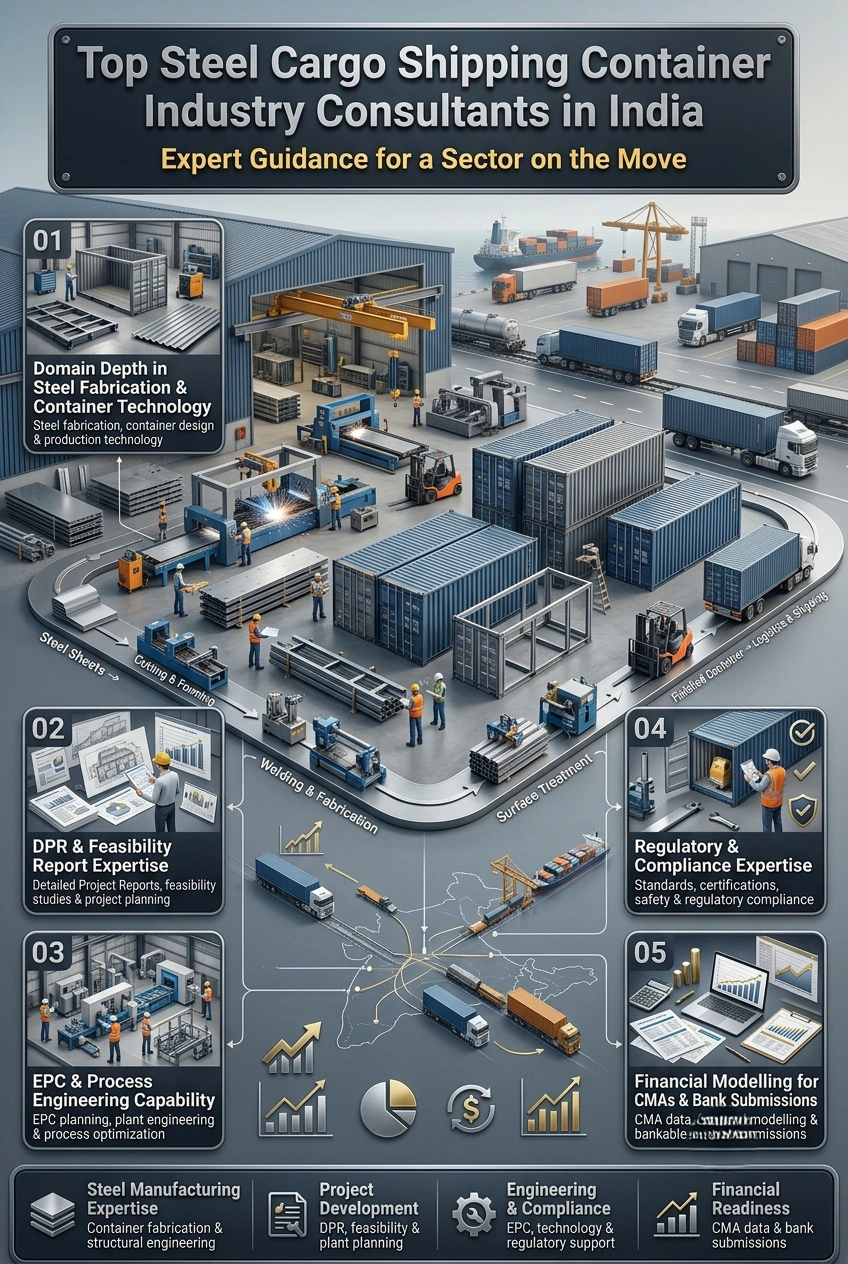
1. Domain Depth in Steel Fabrication and Container Technology
Steel container manufacturing is a specialised area of structural steel fabricating. The consultant should be familiar with the IS:2062 (structural steel), BIS Quality Control Orders for inputs Tinplate and Corten and international standards – ISO 668, ISO 1161 (corner fittings) and requirements for CSC (International Convention for Safe Containers). Have a potential consultant show you a typical process for making a 20′ dry container. Answers that are vague or at the textbook level are red flags; the important thing is that you are fluent in weld procedures, panel forming sequences and anti-corrosion coating systems.
Related Article: How to Start a Steel Fabrication Business in India: Plant Setup, Investment & Profit Guide
2. Track Record in DPR and Feasibility Report Preparation
The best steel container plant consultants have written DPRs which have actually been funded by commercial banks, NBFCs, SIDBI or state financial corporations. Request to view references or case studies from the manufacturing industry. Financial modelling will show the quality of a DPR: A quality consultant will construct a cost model of the project by adding up all of the project costs (civil works, equipment, utilities, pre-operative expenses, working capital margin) instead of giving a lump-sum number. Likewise, the profitability analysis should reflect realistic ramp ups, typically 50% in Year 1, 70% in Year 2 and 90% for years 3 and beyond, not full-capacity production from the get-go.
3. EPC and Process Engineering Capability
For a project such as a container plant, where the investment could be anywhere between ₹15 crore for a small plant and producing 30–35 containers a day, and up to ₹200+ crore for a large greenfield plant, you need a consultant who can do more than just write documents. When an in-house or associated process engineering and EPC capability firm gets involved, it can manage the entire work from DPR to plant commissioning without any gaps. This continuity saves time, prevents cost overruns, and guarantees that the team builds the plant exactly as modelled.
4. Regulatory and Compliance Expertise
The steel container industry is located at the crossroads of a number of regulators. Under steel and steel products (quality control) order, the Bureau of Indian Standards (BIS) regulates the quality compliance of the steel input. CMAS scheme is administered by Ministry of Ports, Shipping and Waterways (MoPSW) and the categories of eligible products are set by MoPSW. Clearances from the Factory Act, State Pollution Control Board (PCB) consents (air, water, hazardous waste for paint and blasting operations), and GST registration are some of the “table stakes” requirements for compliance. CSC approval and ISO certification is required for export containers. The Metal Container Manufacturers’ Association (MCMA) is an active member of BIS and QCO engagements. The top consultants go through all of these features at the same time and not turn compliance responsibility back over to the client to solve.
Access Complete Business Plan: Start Manufacturing of Steel Containers (Cargo Containers)
5. Financial Modelling for CMAS and Bank Submissions
The financial model serves as a requirement for both CMAS capital assistance applications and project loan proposals submitted to commercial banks. The price of steel is the biggest variable in the economics of a container plant — the price of corten steel is in the range of ₹65,000–75,000 per MT and is volatile. A good consultant will create sensitivity analyses that depict the impact on IRR and payback if the price for steel, capacity utilisation and the realisation of containers changes. Invest India says that India’s steel capacity target will require investments that range in the multi-thousand crores and thus a proper financial model is mandatory for any serious steel project.
Role of NPCS in Steel Container Project Consultancy
Since its establishment in 1994, Niir Project Consultancy Services (NPCS) has maintained its presence in India’s steel and metals fabrication consulting. With over 30 years’ experience, NPCS is an ISO 9001:2015 certified company headquartered in New Delhi. NPCS has implemented Detailed Project Reports and techno-economic feasibility studies across 85 countries and delivered more than 150,000 projects.
For the steel container sector specifically, NPCS will prepare DPRs covering, but not limited to, the following: manufacturing process and technology selection, plant layout, plant capacity planning by container type and shift configuration, machinery selection, vendor identification, raw material sourcing (Corten steel, corner castings, floor timber, paint systems, and sealants), market research (Demand Supply Analysis and Pricing Benchmarks), and a detailed financial model covering Project Cost, Funding Structure, Revenue Projections, Profitability Analysis, Break-even, IRR, and Payback Period.
Project reports on steel and container type projects developed by NPCS are available on their project profile catalog on niir.org, namely; Steel Shipping Containers project profiles on niir.org. It is an excellent tool for entrepreneurs who want to explore different project configurations in the container and steel fabrication field before they settle on a project design for a particular plant.
Commercial banks, SIDBI, NABARD and state industrial development corporations use the reports prepared by NPCS as reference documents for credit appraisal. Whereas the process engineering expertise and financial modelling capability of the NPCS gives a useful head-start to NRI investors or first-generation entrepreneurs who are not part of the local industrial network and are able to convert a business concept into a document that enables finance.
Discover business ideas that actually make money
If you are looking to have a wider perspective on the opportunity of container manufacturing industry in India, apart from the DPR, then the CMAS scheme guide published by NPCS, at niir.org, provides a detailed picture of the working of the scheme, business ideas linked to the CMAS and even financial profile for a typical 10,000 units per year plant. NPCS should be seen not just as an advisor who can put together a bound report, but as a company that manages hundreds of steel and manufacturing projects and has developed institutional experience in the steel sector. That knowledge base is what gives their container DPRs operational credibility, not financial.
Best Steel Container Industry Consultants in Delhi and the Pan-India Landscape
Delhi-NCR is now the logical choice for project consultations in the field of industry in India. In fact, Delhi is the most efficient place in the country to establish a project consulting firm catering to pan-India clients, due to the concentration of government ministries (Ministry of Steel, Ministry of Ports, Shipping and Waterways, MSME Ministry), national level financial institutions (SIDBI head office, national banks’ project finance divisions, etc) and technical experts and chartered engineers.
Moreover, The best steel container industry consultants in Delhi work with a vast client base all over the country. In addition, They also cater to entrepreneurs from the EXIM trade corridors adjoining states of Gujarat (Mundra and Hazira), Maharashtra (JNPA, Nhava Sheva and Mumbai Port), Andhra Pradesh (Visakhapatnam), Tamil Nadu (Chennai, V.O. Chidambaranar) and Kerala (Cochin). The Indian Ports Association data of the container port shows that India’s major ports have been recording sustained growth in throughput, further substantiating the demand outlook for locally produced containers.
Meanwhile, The broader India consultancy landscape includes process engineering consultants in Mumbai with shipbuilding and heavy fabrication backgrounds, boutique management consulting firms in Pune and Bengaluru with logistics and supply chain specialisations, and EPC consultants in Hyderabad and Surat with fabrication plant commissioning experience. Therefore, The most useful arrangement for a steel container project investor is typically a two-tier approach: a project consultancy firm for the DPR and financial model, plus a local process engineering firm for plant layout and equipment commissioning in the actual state of investment.
Consulting Service Types for Steel Container Projects: At a Glance
| Consulting Service Type | Core Deliverable | Best-Fit Client |
| Techno-Economic Feasibility Study | Market analysis, technology review, preliminary financials, go/no-go recommendation | Entrepreneur at ideation stage exploring viability of a steel container plant |
| Detailed Project Report (DPR) | Complete manufacturing process, plant layout, machinery specs, raw material sourcing, 5-year P&L, IRR, break-even | MSME promoter seeking bank loan, CMAS benefit, or equity investor |
| Process Engineering Consultancy | Steel fabrication process flows, weld procedure specs, ISO/BIS compliance mapping, production capacity planning | Existing fabricator scaling from general steel to certified ISO containers |
| EPC Project Management | Turnkey plant commissioning — civil works, equipment procurement, erection, trial run | Large investor or industrial group building greenfield container manufacturing facility |
| Regulatory & Compliance Advisory | BIS certification support, Factory Act, Pollution Control Board NOC, CSC/ISO container certification guidance | New entrant with no prior experience in steel manufacturing compliance |
| Business Plan for Investors / Banks | Executive summary, SWOT, financial model, funding structure, investor pitch deck | Startup or NRI investor seeking bank funding or CMAS capital assistance |
Conclusion: The Right Consultant Is Your First Competitive Advantage
India’s steel container manufacturing sector is entering a structural growth phase. Moreover, CMAS, EXIM traffic expansion tracked by the Indian Ports Association, the China+1 supply chain pivot, and India’s maritime sector reforms have converged to create a genuinely time-sensitive investment window. However, the quality of your first steps will determine whether your project secures funding, wins commissioning approval, and earns certification — or stalls in the pre-approvals stage.
Therefore, Steel container industry consultants in India who combine domain expertise in steel fabrication, DPR and feasibility credentials, process engineering depth, and regulatory navigation capability are the difference-makers in this sector. Furthermore, Identify them by their questions, not just their answers — a great consultant asks about your container type mix, target customer base, Corten steel sourcing plan, and CMAS eligibility before saying a word about their own services.