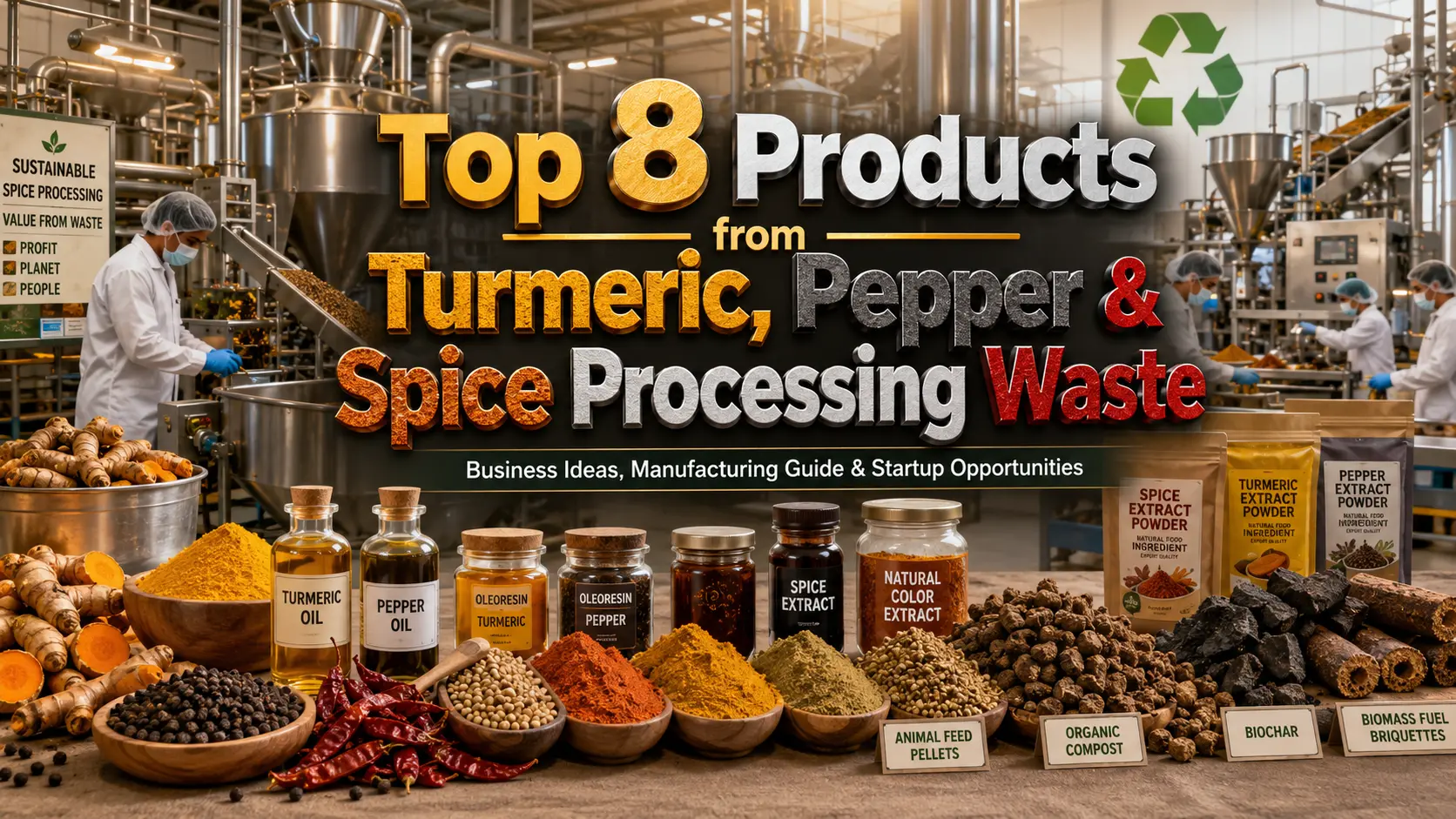

Spice Processing Waste Business
India is the largest producer, consumer and exporter of spices with export of around 1.5 million tonnes of spices worth Rs. 2lakhs crores. Sends more than 150 countries 32,000 crores per year. There are large quantities of waste streams in the spice processing industry during cleaning, grading, grinding, extraction and quality sorting process. During turmeric processing, manufacturers obtain rhizome peels, low-grade turmeric, and curcumin-depleted spent residue (CDSR) after extracting oleoresin During pepper processing, manufacturers produce immature pepper (green waste), pepper dust, and spent pepper after extracting oleoresin. Cardamom processing generates husk after removing seeds from the pods, and it accounts for around 60% of the pod weight. These waste streams contain bioactive compounds, essential oils and fibre that industries can valorise into high-quality products.
The gap between the value of commodity spice export and the value of bioactive compounds in the form of concentrated products is the opportunity. Turmeric commands Rs. The commodity trade rate of the 60-100 per kg is higher while curcumin, the yellow pigment and bioactive compound in turmeric, fetches Rs. The price of pepper oleoresin in the market is Rs. 800-3000 per kg. 5,000–8,000 per kg versus Rs. 400–600 per kg for dried pepper. Following are the values of Cardamom essential oil. 3,000–6,000 per 100 ml versus Rs. 1,800–3,000 per kg for cardamom pods. Processing waste generated during spice extraction, such as spent turmeric, spent pepper and cardamom husk, still contains bioactive compounds that industries can recover for secondary use or valorise for biomass energy, compost and fibre products.(Spice Processing Waste Business)
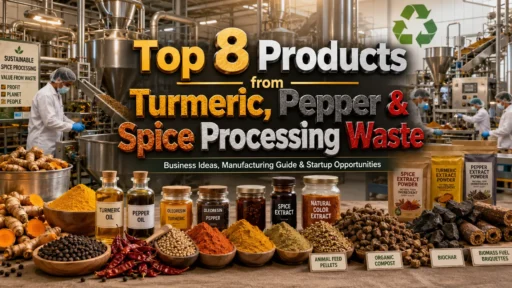
Top 8 Products from Spice Processing Waste
1. Curcumin Extract from Spent Turmeric
Turmeric extract (oleoresin) residue has 0.5-1.5% curcumin, which can be extracted sequentially with solvents. Furthermore, turmeric waste (immature and colourless rhizomes) which is not suitable for direct market can be used for extracting curcumin (3–5% curcumin). The price of Curcumin 95% (crystalline curcumin) is Rs. In the nutraceutical and pharmaceutical sectors, the amounts are 2000-5000 per kg. Investment: Rs. 50–150 lakh.
Get Detailed Project Report (DPR): Curcumin Manufacturing & Turmeric Extraction Guide
2. Pepper Oleoresin (from Pepper Waste)
The extraction feedstocks for pepper oleoresin include broken pepper, dust, and off-grade pepper generated during sorting and cleaning operations. These feedstocks produce a concentrated liquid containing piperine (the pungency compound), pepper essential oil, and other volatile compounds. The price of pepper oleoresin is Rs. 5,000–8,000 per kg versus Rs. 400–600 per kg for whole pepper. A pepper oleoresin extraction unit: 80–200 lakh.
3. Cardamom Husk Essential Oil and Fibre
The seed processing removes a part of the essential oil, namely cardamom husk (that constitutes 60% of the pod weight), which contains 0.5-1% essential oil by steam distillation. Husk essential oil is used for flavours and fragrances. Once the oil has been extracted, the husk is used as biomass fuel or composted. The investment required for cardamom husk oil unit: Rs. 20–50 lakh.
Get Detailed Project Report (DPR): Cardamom Oil Manufacturing Project Report
4. Capsaicin from Chilli Processing Waste
Ethanol or hexane extracts capsaicin oleoresin, a very pungent compound, from chilli seeds, placenta (the white inner membrane), and low-grade chilli collected during sorting and grading. Manufacturers use this oleoresin to produce pharmaceutical pain relief creams, food flavourings, and non-lethal self-defence sprays. The oleoresin capsaicin fetches Rs. 2,000 to 8,000 units per kg, depending upon the concentration of capsaicin.
5. Turmeric Fibre and Starch (Spent Rhizome)
The spent turmeric after extraction of curcumin and oleoresin has 50-60% starch and 15-20% fibre. The starch is used as a food ingredient for thickening and the fibre as a dietary supplement ingredient. Both of them are able to collect value from already discarded spent turmeric. A starch and fibre separation unit from spent turmeric: Rs. 30–80 lakh.
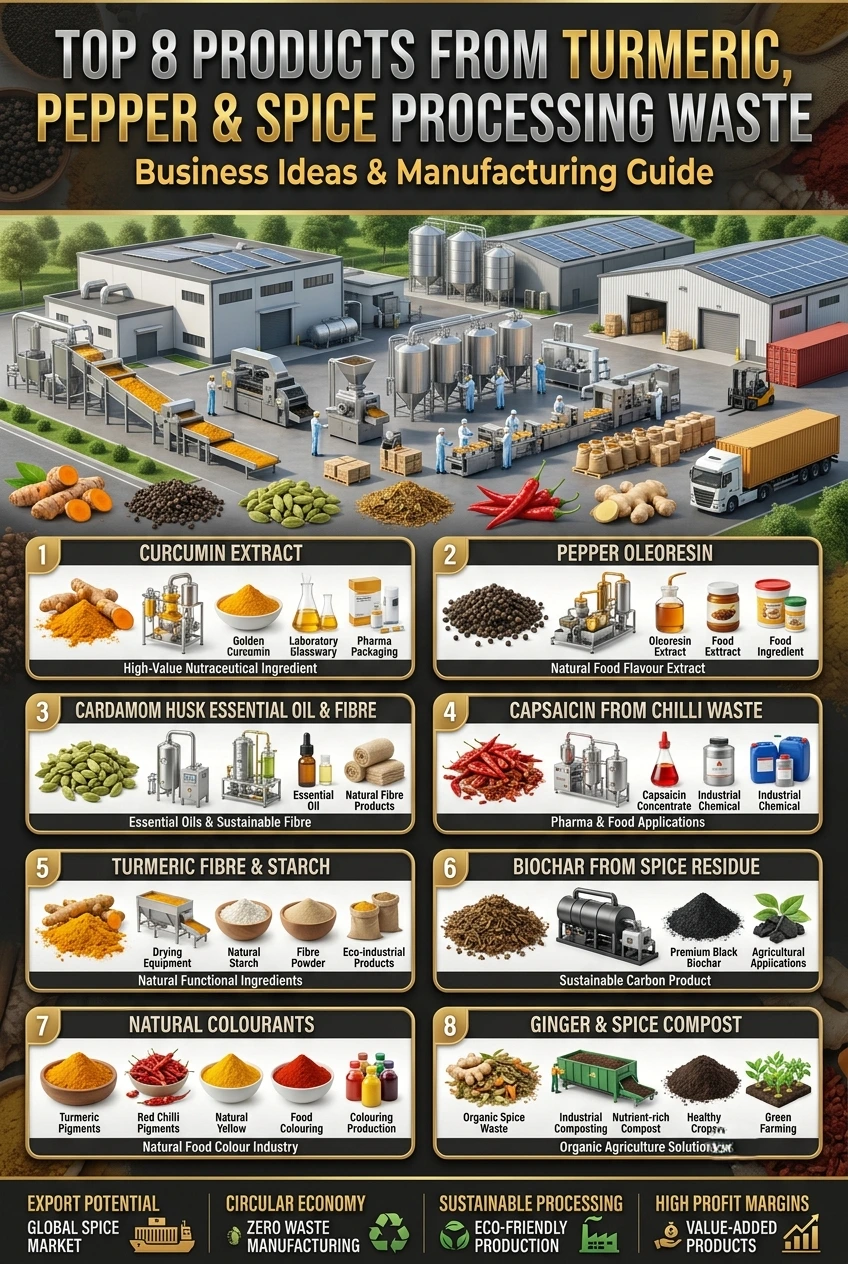
6. Biochar from Spent Spice Residue
7. Natural Colourants from Turmeric and Chilli Waste
Low-grade turmeric, which has high curcumin content but poor marketable appearance, serves as a raw material for natural food coloring. Manufacturers extract yellow colour (E100) as curcumin from turmeric and produce red colour (E160c) as paprika oleoresin from chilli. The fastest growing segment of India’s Rs. is natural food colours. The food colour market is a huge industry valued at Rs. 3,000 crore, with consumer demand for clean-label foods driving the growth.
8. Ginger and Spice Compost (Nutrient-Rich)
The spent ginger, spent pepper and spent spice from oleoresin extraction is a rich source of potassium (from pepper), sulphur compounds (from ginger) and protein residues (from spice) and are excellent composting materials. The compost of spice processing waste has been proved to be beneficial for the growth of crop in spice growing area. A spice processing unit near a composting unit: Rs. 10–30 lakh.(Spice Processing Waste Business)
Related Article: Ginger Oil & Ginger Powder Manufacturing: A High-Growth Business Opportunity for Indian Entrepreneurs
Investment and Market Summary
| Product | Investment (Rs.) | Price | Key Buyer |
| Curcumin 95% | 50–150 lakh | Rs. 2,000–5,000/kg | Nutraceutical, Pharma |
| Pepper Oleoresin | 80–200 lakh | Rs. 5,000–8,000/kg | Food Flavour, Export |
| Capsaicin Oleoresin | 80–200 lakh | Rs. 2,000–8,000/kg | Pain Relief, Food, Defence |
| Natural Food Colour (Curcumin E100) | 50–150 lakh | Rs. 800–2,000/kg | Food Processing Industry |
| Cardamom Husk Oil | 20–50 lakh | Rs. 3,000–6,000/100ml | Fragrance, Food Flavour |
India’s Spice Export Cluster: Market Access and Buyer Networks
Kerala leads the Spice Processing industry with cardamom, pepper, and ginger production, while Tamil Nadu focuses on turmeric and chilli. Andhra Pradesh produces chilli and turmeric, Gujarat specializes in cumin, and Rajasthan and Madhya Pradesh contribute coriander and fenugreek. The Spices Board of India provides support for export market development and quality certification of products with spice as the base. APEDA provides assistance for exporting spice and spice products to buyers through buyer connection programmes, quality certification and by participating in international food exhibitions. The Spices Board provides market intelligence and trade facilitation services which enables entrepreneurs to tap into the existing international market for curcumin extract, pepper oleoresin and capsaicin products.
Get Detailed Insights from This Book: Handbook on Spices, Seasonings and Condiments Processing, Extraction with Kitchen Spices Manufacturing
Spice Oleoresin Export and Quality Certification
India is the largest producer of oleoresin spices in the world accounting for 60-70% of the world production in case of curcumin, capsaicin, pepper oleoresin and cardamom oleoresin. This configuration gives Indian entrepreneurs export edge with the following advantages: Spice processing industry has developed export networks, shipping facilities, and familiarity with the requirements in the spice markets overseas. The Spices Board of India handles export data and actively participates in various international food exhibitions, including Anuga Germany, SIAL Paris, and Gulf Food Dubai, where buyers from around the globe seek Indian oleoresin suppliers. Quality Certification for EU/US market’s needs; hexane residue testing (less than 25 ppm), heavy metal testing (Arsenic, Lead, Cadmium, Mercury (FDA/EU limits)), Declaration for Allergic status, and a COA (Certificate of Analysis) from 3rd party accredited laboratories.
The most crucial information for new spice oleoresin extractors is that they should build quality management systems according to these international standards from the outset, rather than waiting until customers reject their products.
Curcumin Market: Pharmaceutical vs Nutraceutical vs Food Segments
The curcumin market has three distinct segments with different quality requirements, price points, and buyer relationships. The pharmaceutical segment — API-grade curcumin for Ayurvedic drug formulations under CDSCO regulation — requires GMP manufacturing facilities (Schedule M compliance), standardised curcumin content (95% minimum by HPLC), absence of pesticide residues below regulatory limits, and pharmaceutical dossier documentation. Pharmaceutical curcumin commands Rs. 3,000–6,000 per kg. The nutraceutical segment — curcumin for dietary supplements, sports nutrition, and functional foods — requires ISO 22000 food safety certification, FSSAI food business operator licence, Informed Sport certification for sports nutrition applications, and typically 95% curcumin standardisation. Nutraceutical curcumin commands Rs. 1,500–3,500 per kg.
The food colour segment — curcumin E100 for food and beverage colouring — requires lowest purity (25–95% depending on colour intensity required), FSSAI food colour standard compliance, and lowest price (Rs. 500–1,500 per kg). Entrepreneurs should target the nutraceutical segment first — lower regulatory barrier than pharmaceutical but substantially higher margin than food colour — and develop pharmaceutical market relationships progressively as GMP capability matures.(Spice Processing Waste Business)
Build a profitable business with the right idea
How NPCS Helps Entrepreneurs Enter This Sector
At Niir Project Consultancy Services (NPCS), we provide professional consulting for Market Survey cum Detailed Techno-Economic Feasibility Reports (DPRs) for setting up spice processing waste extraction and value-added product manufacturing manufacturing businesses. Our reports cover the complete manufacturing process, market demand analysis, process flow diagrams, plant layout, machinery and raw material sourcing, and full financial projections with profitability analysis.
For entrepreneurs looking to enter waste-based manufacturing, NPCS project reports give you the technical and financial foundation to approach banks, investors, and government agencies with confidence. Visit www.niir.org to explore our full library of waste-based project reports.
Conclusion: The Business Case for Spice Processing Waste Manufacturing
India’s Rs. 32,000 crore spice export industry generates processing waste containing concentrated bioactive compounds — curcumin, piperine, capsaicin — that command 10–50x more value per kilogram than the spice from which they are derived. The spice processing industry considers its waste stream as its most valuable output, yet it currently composts or discards most of this waste. Entrepreneurs who invest in extraction, purification, and standardisation infrastructure near India’s spice processing clusters are building high-margin businesses on raw materials that are abundant, low-cost, and growing with India’s expanding spice industry.
Entrepreneurs who move early into waste-based manufacturing secure raw material relationships, buyer networks, and regulatory approvals that latecomers find difficult to replicate. The best time to act on these business ideas is before the sector becomes crowded — and for most waste streams profiled here, that window is still open.(Spice Processing Waste Business)
Frequently Asked Questions (FAQ)
Q1. What extraction solvent is used for curcumin and oleoresin production?
The common extraction solvents used are Hexane and Ethanol 95%. Hexane provides better yields of oil and oleoresins, though careful elimination of residual solvent is needed ( < 25ppm required for food grade). Ethanol extraction provides the right choice for obtaining organic certified or pharmaceutical grade curcumin. Supercritical CO extraction produces the purest and highest-quality extracts, though it requires an investment of Rs 2-5 crore for equipment and space.
Q2. What is the market size for natural curcumin in India and globally?
The nutraceuticals demand for curcumin is pegged at Rs. 500-800 crore annually in the Indian market. According to the reports Global curcumin market would reach a value of USD 95 million by 2024 with CAGR of 12% owing to strong consumer demand in the nutraceutical sector comprising of health supplements and functional foods and beverage sector. Currently over 80% of the global production of curcumin falls from India, thus it has a competitive cost advantage from global suppliers.
Q3. What FSSAI and export certifications are required for oleoresin products?
FSSAI food business operator license for manufacturing, ISO 22000 food safety management certification for export markets, organic certification for organic-grade extract, residual solvent test (GC-analysis for below 25ppm hexane for food grade). Exporters need Spice Board export registration and APEDA product quality certification for international trade.
Q4. Is there pharmaceutical market demand for curcumin in India?
Yes. Curcumin 95% has applications as API in anti-inflammatory herbal product dossiers approved in India by CDSCO, while leading Ayurvedic drug producers like Himalayan drug, Dabur and Patanjali (using standardised curcumin) offer product lines for liver function, joint health and as anti-inflammatory treatments. Production for pharmaceutical use of curcumin will only happen in GMP certified plants.
Q5. Can capsaicin be exported from India?
Yes. Capsaicin oleoresin exports are allowed with APEDA/Spice Board registration. Main destination markets are the US (pharma pain reducing creams and capsicin patches), Europe (food flavouring, harmless to self-defence), and Japan (cosmetics, health-food); US pharma capsacin should conform to USP monograph of GMP manufacturing.
Q6. What is the revenue per tonne of spice waste processed?
Curcumin extraction from spent turmeric: Rs. 50,000–200,000 per tonne of spent turmeric (depending on curcumin recovery and product grade). Pepper oleoresin from pepper waste: Rs. 80,000–150,000 per tonne of pepper waste processed. Capsaicin from chilli waste: Rs. 100,000–300,000 per tonne. These value multiples (10–30x) over raw waste value make spice extraction one of the highest-margin waste processing investments available.
Key References and Useful Links
- Ministry of MSME — Government of India
- Make in India — Official Portal
- DPIIT — Dept. for Promotion of Industry
- APEDA — Agricultural and Processed Food
- NPCS — Waste-Based Project Reports
- Ministry of Environment, Forest & Climate