Soybean Hull Processing Business
Madhya Pradesh is India’s top indigo soy bean producer state with an estimated production of 45-50% of the total soy bean production in the country of 12 million tonne per year. Indore, Ujjain and Dewas are the main centres for soybean processing with oil extraction industries, soy meal processors and value-added soybean industries. About 80-100 kg of soybean hull (the outer seed coat after oil removal) will be produced for every tonne of Soybeans processed. Indian soybean processing industry manufactures approximately 800,000 -1,000,000 tons of hull each year. So, soybean hulls are being sold mostly as an animal feed without processing.
Soybean hull is unique as to its chemical composition due to 38-40% cellulose (higher than the other common oilseed hulls) and 14-17% hemicellulose. The percentage of cellulose (38-40%) in soyabean hull is higher than the other commonly used oilseed hull and the percentage of hemicellulose is 14-17% and that of pectin is 1-3% and that of lignin is 16-18%. Because of the higher percentage of cellulose and pectin, soyabean hull could be used as raw material to produce dietary fiber supplement, bio gas, activated carbon and specialized package materials. Additionally, the low lignin content of the hull makes it an attractive bioethanol fermentable substrate as compared to wood residues. In addition to hulls, soy processing produces soy molasses (from protein extraction), soy whey (from protein precipitation), and lecithin-rich soy sludge, which have all proven to have commercial uses.
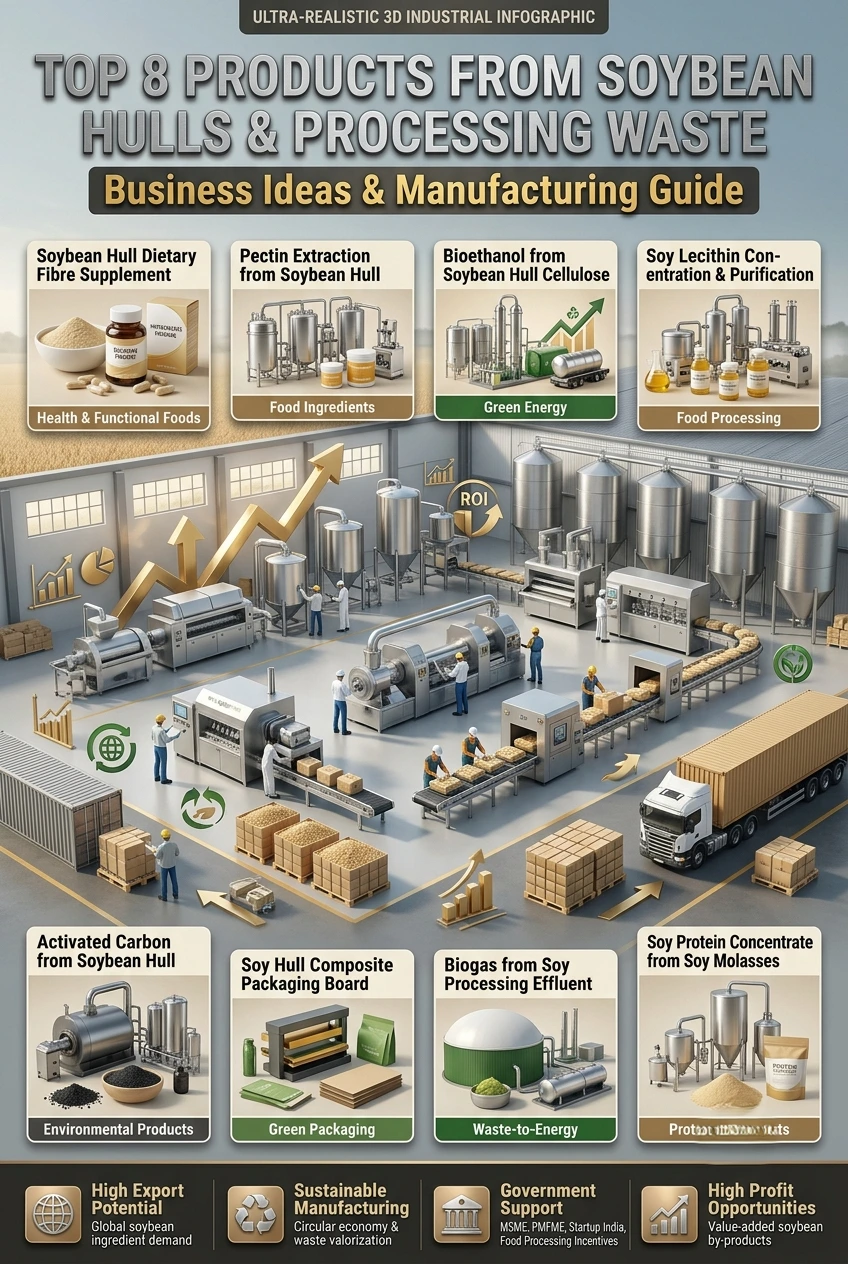
Top 8 Products from Soybean Hull and Processing Waste
1. Soybean Hull Dietary Fibre Supplement
Washed, dried and milled to fine powder, soybean hull is a source of insoluble dietary fibre supplement containing 68–75% total dietary fibre (TFd). It is used in functional foods and fibre fortified bread, breakfast cereal and dietary supplement capsules. The price of selling soy hull fibre is Rs. 50–120 per kg versus Rs. As hull feed additive, the value is multiplied by 20–50x, 2,000–3,000 per tonne.
2. Pectin Extraction from Soybean Hull
Soyhulls typically contain about 1-3% pectin, an edible dietary fiber that people utilize for its ability to form gels, emulsify, and reduce cholesterol. Researchers successfully extracted soy hull pectin using hot water and obtained good food-grade pectin that can be utilized as a low methoxy pectin ingredient for jam and jelly manufacturing, drug tablet coating, and nutraceutical applications. The price of Soy hull pectin is priced at Rs. 150–300 per kg. A unit to extract pectin: Rs. 80 lakh–2 crore.
Discover business ideas that actually make money
3. Bioethanol from Soybean Hull Cellulose
The cellulose content (38-40%) of soy hulls is high, and the lignin content is low, making it one of the most efficient lignocellulosic ethanol feedstocks with enzymatic conversion rates of 80-90%. The cost of a pilot ethanol plant with soy hull is Rs. . The company has a capacity of 2–5 crore; it produces ethanol at Rs. Current enzyme cost structures are 40-55 per litre.
4. Soy Lecithin Concentration and Purification
Crude soy lecithin is a viscous brown liquid that manufacturers separate from degummed soybean oil and use to make food emulsifiers, pharmaceutical excipients, and animal feed supplements. The price of deoiled soy lecithin (spray-dried) is Rs. India imports large amount of soy lecithin presently which is priced at 200 to 350 per kg.
5. Activated Carbon from Soybean Hull
Carbonising soybean hulls at 500–700°C and subsequently steaming the carbonised material produces this activated carbon. The surface area of the activated carbon produced is 700–900 m2/g when carbonised at 500–700°C and steamed. Soy hull activated carbon is especially suitable for the removal of heavy metals from industrial effluents, which is close to the ETP applications of the soybean processing cluster. A soy hull activated carbon unit: 50–120 lakh.
6. Soy Hull Composite Packaging Board
Manufacturers create compostable packaging trays and boards from soy hull fibres combined with starch or polylactic acid (PLA) glue, and they use compression moulding to produce these products, making them a new competitor in the bagasse tableware market. Soy hull composites are rigid and contain high fibre which is suitable for agricultural product packaging. Investment: Rs. 80–200 lakh.(Soybean Hull Processing Business)
7. Biogas from Soy Processing Effluent
Soybean extraction plants produce high Biochemical Oxygen Demand (BOD) wastewater during washing, degumming, and lecithin separation processes. The generated wastewater is used in anaerobic digestion to produce biogas, which is used for process heat. The cost of biogas unit at medium scale soy processing plant (500 TPD) is Rs. Payback period of 2-3 years for LPG/coal replacement, with the investment cost of 50-150 lakh.
8. Soy Protein Concentrate from Soy Molasses
Molasses, a by-product of aqueous alcohol washing in the production of soy protein concentrate, is a source of sugars which can be recovered to produce soy protein and isoflavones. The price of soy isoflavone extract (genistein, daidzein) is Rs. For menopausal health management applications, the market for nutraceuticals was valued at 1,000–5,000 per kg.(Soybean Hull Processing Business)
Get Detailed Project Report (DPR): Soya & Soy-Based Food Products Manufacturing Guide
Investment and Market Summary
| Product | Investment (Rs.) | Price | Key Buyer |
| Soy Hull Dietary Fibre | 30–80 lakh | Rs. 50–120/kg | Health Food, Functional Food |
| Soy Pectin | 80 lakh–2 crore | Rs. 150–300/kg | Food Industry, Pharma |
| Soy Lecithin (Deoiled) | 50–150 lakh | Rs. 200–350/kg | Food Emulsifier, Pharma |
| Soy Isoflavones | 50–150 lakh | Rs. 1,000–5,000/kg | Nutraceuticals, Pharma |
| Soy Hull Fibre Board | 80–200 lakh | Rs. 1–5/piece | Packaging, Agriculture |
Soybean Processing Cluster: Colocation Advantages
The soybean processing cluster in Indore (100+ solvent extraction plant and value added processors) is the perfect place to consider the investment in soy hull and waste processing. The supply of Hull is continuous, localised within 5 Kms. from the extraction plants and is available at the rate of Rs. 500–2,000 per tonne. The proximity also allows for chemical supply chains (hexane recovery systems, acid/alkali suppliers), engineering support and logistics infrastructure to lower capital and operating costs compared to greenfield sites. At the GIS 2025 summit, the commitment was given in the form of Rs. The investment of 3.07 lakh crore in the state of MP is indicative of enhanced government support to industrial growth in the soybean heartland.(Soybean Hull Processing Business)
Read the Complete Book Here: Modern Technology of Agro Processing & Agricultural Waste Products
MP’s Soybean Belt Industrial Policy Support
Madhya Pradesh’s Global Investors Summit 2025 attracted Rs. 3.07 lakh crore in investment commitments across sectors including food processing, agro-chemical, and pharmaceutical manufacturing — all of which have direct alignment with soybean hull value-added processing. The MPIDC (Madhya Pradesh Industrial Development Corporation) manages developed industrial areas in Indore, Dewas, and Pithampur with ready utility connections, road and rail logistics, and single-window clearance through the InvestMP portal. The state’s 18 new industrial policies include dedicated incentives for agro-processing investments — capital subsidy up to 25% for units processing agricultural produce, power tariff concessions, and land at concessional rates in designated agro-processing parks. Indore’s APEDA-designated food processing zone near the Bypass Road houses multiple food processing companies that are potential buyers for soy hull dietary fibre, soy lecithin, and soy isoflavone extracts. Entrepreneurs evaluating soy hull processing investment in MP have unusually strong infrastructure, incentive, and market access support.
Soy Lecithin: Building a Premium Ingredient Business
Soy lecithin produced from degumming sludge at soybean oil extraction plants is one of the most commercially straightforward value-addition opportunities in the soy processing waste space. The degumming sludge — already separated from crude soy oil in the oil refinery process — requires drying (drum dryer or spray dryer at Rs. 30–80 lakh investment) and optional deoiling (acetone extraction at Rs. 50–150 lakh additional) to produce deoiled soy lecithin powder. The quality specifications for different markets vary significantly: food emulsifier grade requires 60–65% phospholipids in liquid form or 95%+ in deoiled powder; pharmaceutical grade requires additional purity testing including heavy metals, residual solvents, and specific phospholipid profile; and infant formula grade requires the most stringent quality controls including oxidation stability and microbiological standards.
Entrepreneurs should target the food emulsifier market first (lowest entry barrier, largest volume) and progressively develop pharmaceutical market relationships as quality management competencies mature. The Oils and Fats Manufacturers Association (OEMA) provides buyer network access to domestic food manufacturers who are the primary domestic lecithin consumers.(Soybean Hull Processing Business)
Related Article: Manufacturing Business Opportunities in Soya and Soy Based Food Products
How NPCS Helps Entrepreneurs Enter This Sector
At Niir Project Consultancy Services (NPCS), we provide professional consulting for Market Survey cum Detailed Techno-Economic Feasibility Reports (DPRs) for setting up soybean hull and soy processing waste manufacturing manufacturing businesses. Our reports cover the complete manufacturing process, market demand analysis, process flow diagrams, plant layout, machinery and raw material sourcing, and full financial projections with profitability analysis.
For entrepreneurs looking to enter waste-based manufacturing, NPCS project reports give you the technical and financial foundation to approach banks, investors, and government agencies with confidence. Visit www.niir.org to explore our full library of waste-based project reports.
Conclusion: The Business Case for Soybean Hull Manufacturing
Soybean processing industries in Madhya Pradesh produce more than one million tonnes of soybean hulls, molasses, and processing wastes, which currently have low value as animal feeds.
Businesses target high-value health food and pharmaceutical ingredient markets by selling soy hull dietary fibre, pectin, and 2G ethanol products. They also recover lecithin and isoflavones from soy waste streams, while most of these markets currently depend heavily on imports. With vast raw material availability, a good opportunity for the import substitution and increasing demand for health food in the local market, the processing of soy hulls is one of the most promising and strategic investments in waste to product in central India.(Soybean Hull Processing Business)
Latecomers in the waste-based manufacturing value chain do not have the same relationships, networks, and certification as entrepreneurs who are early movers. For most waste streams profiled here, there’s still time to take action on these business ideas before the sector becomes too saturated.
Frequently Asked Questions (FAQ)
Q1. Is soybean hull fibre appropriate for human dietary use?
Soybean hull from food-grade soybean processing (for tofu, soy milk, edamame) is food-safe. Hull from solvent extraction plants requires hexane removal verification before food use — food-grade hull must come from cold-press or aqueous extraction operations. FSSAI food business operator licence and dietary fibre specification testing are required.
Q2. How does soy lecithin quality differ by extraction method?
Crude soy lecithin from hexane extraction contains 60–65% phospholipids and 30–35% oil — it is a viscous liquid requiring dehydration and degumming. Deoiled lecithin (spray dried after acetone or supercritical CO₂ treatment) is a free-flowing powder with 95%+ phospholipid content preferred for pharmaceutical and premium food applications.
Q3. What is the yield of bioethanol from soybean hull?
Soybean hull contains 38–40% cellulose convertible to 400–430 litres of ethanol per tonne of dry hull after enzymatic hydrolysis and fermentation. At current enzyme costs, the production cost is approximately Rs. 40–55 per litre — competitive with second-generation ethanol from sugarcane bagasse. Government viability gap support makes 2G ethanol from soy hull financially viable.
Q4. Can soy isoflavones be produced profitably from soy processing waste?
Soy isoflavones are present in soy molasses at 0.1–0.5% concentration — requiring significant volume (50–100 kg molasses per kg isoflavone extract) for economic extraction. At Rs. 2,000–5,000 per kg for standardised isoflavone extract, the economics work at scale (processing 10+ tonnes of molasses daily). This is a secondary by-product application rather than a standalone business.
Q5. Is there a domestic market for soy hull dietary fibre?
India’s functional food and dietary supplement market is growing at 15–20% annually. Health food brands, breakfast cereal manufacturers, and protein bar producers are adding dietary fibre ingredients to their formulations. Soy hull fibre is cost-competitive with imported psyllium husk powder (isabgol) for insoluble fibre applications. Institutional buyers (school nutrition programmes, ICDS supplementary nutrition) also represent large-volume opportunities.
Q6. How does the Madhya Pradesh Industrial Policy support soy processing investments?
MP’s GIS 2025 investment commitments and MPIDC industrial estate infrastructure in Indore and Dewas support soy waste processing investments. Power tariff concessions for agro-processing and capital subsidies under the MSME promotion scheme further encourage this sector. The Dhar PM MITRA Textile Park and nearby Pithampur auto cluster create logistics synergies for packaging materials made from soy hull composites.
Key References and Useful Links
- Ministry of MSME — Government of India
- Make in India — Official Portal
- DPIIT — Dept. for Promotion of Industry
- APEDA — Agricultural and Processed Food
- NPCS — Waste-Based Project Reports
- Ministry of Environment, Forest & Climate