Why Rice Husk Ash Industry Consultants Matter in India
Every year, the rice production process in India produces over 30 million tonnes of rice husk as an agricultural by-product which was previously considered as a waste disposal issue. Today, the same husk is utilized for precipitated silica, activated carbon, sodium silicate, ethanol, biomass briquettes, construction materials and other higher value industrial products. This change from waste to wealth isn’t a figment of our imagination, it is a fact, measurable, and accelerating. The transformation of rice husk or rice husk ash into a viable and profitable manufacturing unit, however, demands a profound understanding of the industry, meticulous financial modelling, and shrewd regulatory manoeuvring. This is where rice husk ash industry consultants in India come into play.
For those starting up in this field there is a multi-layered decision to be made. Which product will provide the greatest return – precipitated silica or activated carbon? Which is the economically best size for the first plant? State has the most conducive environment to access to raw materials and MSME incentives? If the project designs itself as a biomass power plant, a chemical plant, or a combination of both, the right path becomes important.
If the project doesn’t take the right path and doesn’t utilize the material correctly, that capital can go down the wrong way, and the project can stall before it eventually makes its way to commercial production. In this article, I will shed light on the activities of these consultants, why the agro-waste processing industry has become a hub for these consultants, how you can choose a good consultant and what you can expect from a professional consultant.
What Rice Husk Ash Plant and Process Consultants Actually Do
A rice husk ash process consultant’s role is not limited to a mere report preparation. It starts with knowledge of a client’s investment potential, risk appetite and business objectives and continues with the formulation of a technically viable and financially viable project plan. Five main deliverables include techno-economic feasibility studies, Detailed Project Reports (DPRs), process engineering documents, plant layout drawings, machinery procurement support, and compliance advisory.
The initial project is usually a feasibility study. An effective consultant reviews the demand-supply gap for the product in question, which in this example is precipitated silica for tyres and rubber. The consultant also reviews potential feedstock supply and pricing in the proposed region and models the project’s profit using realistic assumptions. It is not a template exercise, as rice husk prices have different levels in various rice-belt states of Punjab, Haryana, Uttar Pradesh, West Bengal, Andhra Pradesh and Odisha.
The DPR stage is the heavier of the two. It includes detailed process description of thermochemical conversion routes (combustion, gasification, pyrolysis), drying and milling processes, post combustion ash processing as well as precipitation processes for alkali/acid production for silica. A DPR includes process flow diagrams, mass balance sheets, utility requirements, plant capacity recommendations, equipment specifications, and complete project financials, such as capital expenditure, working capital, revenue projections, IRR, and payback period. A DPR is the first and foremost document for bankers / NBFCs and becomes a must have for entrepreneurs.
Get Detailed Insights from This Book: Manufacture of Value Added Products from Rice Husk (Hull) and Rice Husk Ash (RHA)
In addition to DPR preparation, many experts in the rice husk ash plant can assist with EPC (Engineering, Procurement and Construction) execution including the shortlisting of vendors, reviewing the civil & structural drawings and overseeing the erection and commissioning. The process engineering consultants specialising in agro-waste processing technology can also support in capacity expansion, in diversification of the products to premium silica grades and in technical troubleshooting of the operated units.
Why India Has Become a Hotspot for Rice Husk Ash Consulting
India is one of the most dynamic markets in the world for consultancy on rice husk ash project, owing to several structural factors. First, the amount of raw material is unparalleled. The paddy production in India is always among the world’s largest, and it generates a proportionately significant amount of husk, giving Indian manufacturers a feedstock cost advantage that manufacturers in developed markets cannot match. This structural cost advantage directly equates to export competitiveness for certain product types, such as precipitated silica produced through the RHA route.
Secondly, the governmental policy has established a high incentive for agro-waste valorisation. The National Bioenergy Programme under the Ministry of New and Renewable Energy (MNRE) has been established with Central Financial Assistance (CFA) for biomass briquette and pellet manufacturing plants and non-bagasse cogeneration units (NBC) which includes various types of projects in the rice husk value chain. Smaller promoters have also seen reduction in financial barrier with access to credit-linked capital subsidy schemes and priority sector lending in the MSME sector.
Third, there is a growth in export demand. International tyre manufacturers, rubber compounders and specialty chemical companies are looking for sustainable raw materials and this is where precipitated silica from RHA comes in. India is emerging as a value added agro-processing hub, and the rice husk ash segment is right on the cusp of such a trend, Invest India notes.
View Full Project Details: Rice Husk & Rice Husk Ash Based Projects
Fourth, the PLI ethos and import substitution policy has created demand for locally produced chemicals that were once imported, such as silicon metal, sodium silicate, etc. Indian boutique management consulting firms, as well as larger plant process consultancy firms, have responded to this opportunity by building up their rice husk ash offering. There has been a high demand for structured consultancy, in addition to which, the Confederation of Indian Industry (CII) and allied industry organizations have been actively involved in creating awareness among the entrepreneurs on agro-waste processing.
How to Evaluate and Shortlist the Best Rice Husk Ash Industry Consultants in India
1. Domain Expertise in Agro-Waste Processing Technology
The key difference between consultants is their knowledge of rice husk valorisation science and economics. A precipitated silica consultant with experience in silica precipitated work knows that the purity, particle size, and surface area of silica dictate its end market, whether rubber grade, food grade or pharmaceutical grade. They are aware that the activated carbon from rice husk is different in the sense that it needs a different activation process and has different adsorption property as that activated carbon from coconut-shells. This product-specific depth is what generic process engineering consultants are lacking. So, make sure to always inquire about past projects that used rice husk ash, the number of DPRs consultants have delivered, and references from past clients in the same segment.
2. DPR and Feasibility Track Record
A credible consultant has a clearly established track record of bankable DPRs – reports that banks have used to support loan approvals, equity raises and/or government scheme applications. Inquire specifically what the financial institutions are which have accepted their reports. Some of the niche management consultancy companies in India can prepare technically sound papers, but there is a lack of financial rigor to satisfy the lender’s requirements. The top rice husk ash industry consultants in Delhi and all over India have known both the technical and commercial aspects.
3. Regulatory and Compliance Knowledge
The production of rice husk ash in India involves several regulatory processes. Multiple regulatory processes are involved in any rice husk ash manufacturing project in India. Biomass based power or cogeneration projects with CFA is subject to MNRE approval. Manufacturing units must obtain consent from the State Pollution Control Board (PCB) under the Air (Prevention and Control of Pollution) Act and Water Act. The factory Act registration is applicable after the unit is running. The Bureau of Indian Standards (BIS) regulates specifications of construction materials containing RHA and chemical products such as sodium silicate and precipitated silica must comply with relevant quality standards for domestic and export markets for product standards. These are not only the project economics, but a top rice husk ash industry consultant in India should be familiar with them.
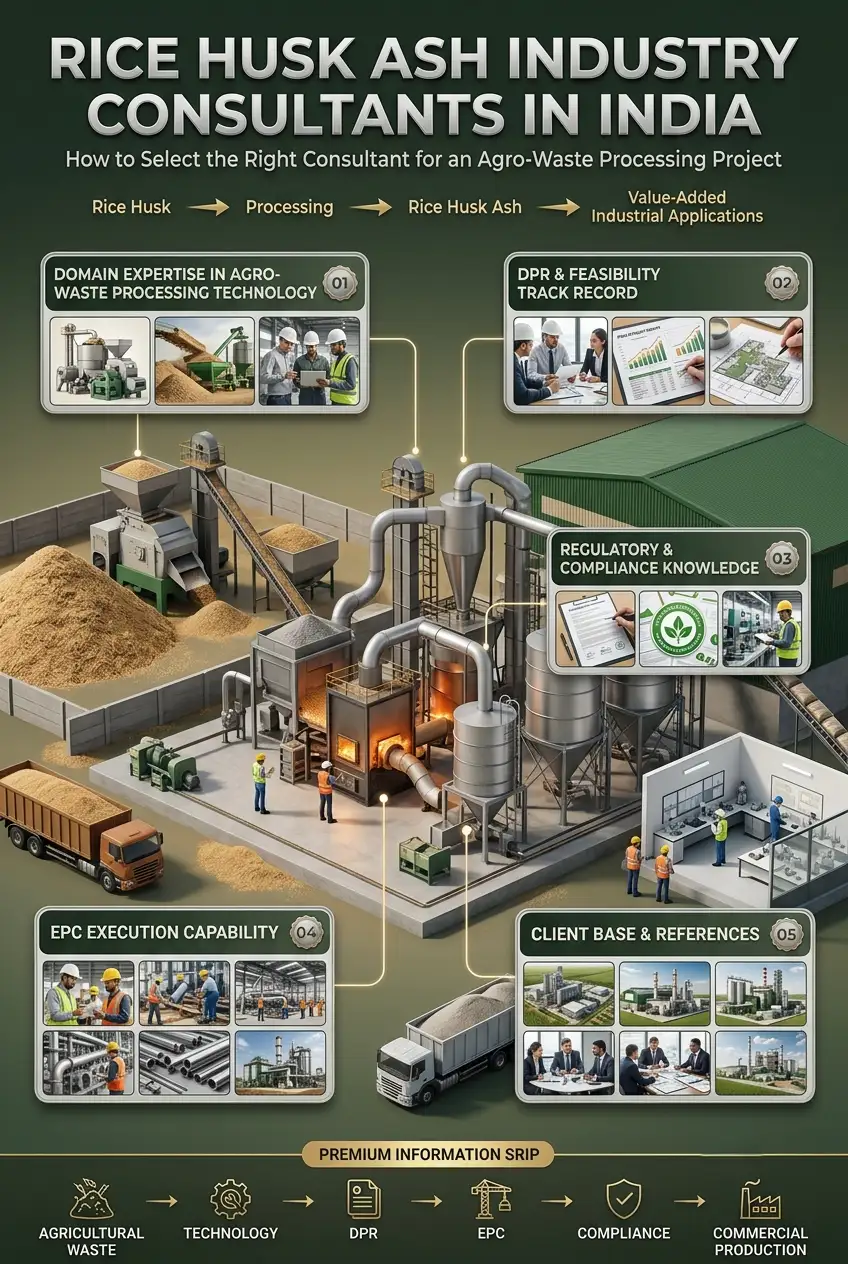
4. EPC Execution Capability
5. Client Base and References
Ask to see reference projects from at least 3 customers who have had the same type of project. Hiring a consultant who has predominantly worked for large corporates may not be suitable for an MSME promoter investing ₹3–8 crore in a small precipitated silica plant. On the other hand, a consultant who has only done small MSME jobs may not be as rigorous as the integrated facility. Ensure that the consultant’s historical client sample is aligned with your task size and business.
Related Article: Rice Husk Ash Silica Manufacturing in India: Market Demand, Plant Cost & Profit Outlook
Role of NPCS in Rice Husk Ash (Agricultural Waste) Project Consultancy
In fact, Niir Project Consultancy Services (NPCS) with its long experience since 1994 from its headquarter at Delhi, has a substantial body of work in the rice husk ash and agricultural waste processing area. NPCS has provided DPRs, techno-economic feasibility studies and project profile for various agro-waste based manufacturing projects in India and abroad for over three decades of consultancy practice.
NPCS’s rice husk ash project consultancy services encompass all the value-added products from rice husk and RHA like precipitated silica, activated carbon, sodium silicate, ethanol, biomass briquettes and pellets, hard board, particle board, oxalic acid, paper, silicon and biomass electricity generation. NPCS records the manufacturing process of each product with detail: raw material specifications, thermochemical conversion parameters, downstream processing steps, requirements of plant and machinery, raw material sourcing and market demand analysis. Also, the project financials, such as capital cost, working capital, production cost, revenues, profitability ratios and project IRR, specifically calculate the figures for Indian market conditions, taking into account input costs and pricing benchmarks in the Indian context.
Having delivered more than 150,000 successful projects, received clients from over 85 countries, and actively worked in the manufacturing industries for over 30 years, NPCS is a dependable benchmark for entrepreneurs looking into rice husk ash and allied agro-waste project ideas. NPCS’s rice husk and RHA project profiles catalog is a good starting point for founders who may want to explore several project opportunities in the rice husk value chain before deciding on a project to pursue; it details product profiles, process description and a preliminary estimate of project economics for a variety of product categories.
Your investment deserves the right opportunity
This consultancy process is very helpful for the promoters of MSMEs who are at the initial stage of identification of any project and need to get it technically feasible as well as marketable before approaching banks or the government scheme office. NPCS puts the project consultancy in the structured environment of a defined and transparent DPR that is suitable for the needs of financial institutions and scheme administrators for project appraisal.
The Regional Landscape: Best Rice Husk Ash Industry Consultants in Delhi and India
Delhi and the National Capital Region (NCR) continue to be the most focused areas of industrial project consultancy in India. The best ones to consult with for the rice husk ash industry in Delhi also have access to the proximity of the central government ministries such as MNRE, Ministry of Agriculture and Farmers Welfare, and other industry bodies such as CII, major financial institutions etc. This proximity is important as the regulatory submission, scheme application and engagement with the policy are more manageable when the consultant is close to the decision-making machinery.
But, the function of rice husk ash project consultancy is not confined to the city of Delhi. Process plant consultants and EPC consultants who have close connections in the region, especially Uttar Pradesh, Punjab, Haryana, West Bengal and Andhra Pradesh, where rice husk is available in abundance, often have the much-needed site level market knowledge which may be lacking in consultants from Delhi. In the Gangetic belt, for example, a consultant with regulatory experience in Delhi might serve a project most successfully, while local knowledge of the feedstock and logistics helps the consultant handle these aspects on the ground.
The range of consultancy services for this industry in India includes large diversified engineering consultancies, boutique management consulting and specialist agro-industrial consultants and project report publishers in India. IBEF data always backs the story of India as a high-end agro-processing economy, which has been attracting an increasing number of investors from the NRI community and MSME promoters to the rice husk and RHA space, thereby boosting demand for credible consultancy services in the country.
Your investment deserves the right opportunity
Comparison of Rice Husk Ash Consulting Service Types
| Consulting Service Type | Core Focus | Key Deliverables | Best-Fit Client |
| Techno-Economic Feasibility Study | Market demand analysis, process viability, investment appraisal | Feasibility report, revenue projections, IRR/NPV analysis | First-time entrepreneur, investor evaluating risk |
| Detailed Project Report (DPR) | End-to-end project documentation for financing and approvals | Complete DPR with plant layout, machinery list, financial model | MSME promoter, bank loan applicant |
| Process Engineering Consultancy | Manufacturing process design, plant capacity planning | Process flow diagrams, mass balance sheets, utility requirements | Technical founder scaling an existing unit |
| EPC / Turnkey Consultancy | Full project execution from design to commissioning | Vendor selection, civil & mechanical engineering, site supervision | Investor seeking a built-and-ready plant |
| Regulatory & Compliance Advisory | MNRE approvals, State PCB consent, Factory Act compliance | License applications, environmental clearance documents | New entrant unfamiliar with statutory requirements |
| Market Research & Demand Analysis | Sector sizing, competition mapping, export opportunity assessment | Market research report, pricing benchmarks, competitor analysis | Strategic investor or existing player diversifying |
| MSME Scheme Advisory | Identification and application for government schemes, subsidies, credit-linked capital subsidy | MSME registration, scheme application documentation | Small-scale promoter seeking government financial support |
The table above maps the principal consulting service types available in the Indian market to their focus areas and ideal clients. Most serious rice husk ash industry consultants in India offer several of these service types, often combining feasibility, DPR, and compliance advisory as a bundled engagement.
Conclusion: Practical Next Steps for Rice Husk Ash Project Entrepreneurs
Overall, India’s rice husk and RHA sector offers a compelling combination of low-cost raw material access, multiple high-value product options, strong domestic and export demand, and an enabling policy environment. Therefore, For entrepreneurs serious about building a viable agro-waste processing business, the quality of early-stage consultancy support is often the single most decisive factor in whether a project succeeds or stalls.
First, Start by defining your product focus — precipitated silica, activated carbon, sodium silicate, biomass energy, or an integrated combination — based on your capital, location, and market connections. Then, Then engage the best rice husk ash industry consultants in India who have demonstrable domain expertise in your chosen product category. Furthermore, Insist on a proper feasibility study before committing capital. Next, Use the DPR to approach banks, NBFC lenders, and MNRE scheme administrators with a credible, bankable project document.
Meanwhile, For entrepreneurs still exploring multiple product ideas within the rice husk value chain, reviewing established project profiles — such as those available through NPCS’s rice husk ash project profiles catalog — provides a useful comparative starting point before commissioning a full feasibility study. Making an informed product choice early prevents the more costly mistake of mid-course corrections once capital has been committed.
Moreover, India’s biomass industry is on a strong growth trajectory. IBEF reports project the Indian biomass market to reach USD 3.86 billion (₹32,000 crore) by FY31 — and the rice husk ash value chain sits at the heart of that growth story. The right consultancy partner, engaged at the right stage, can be the difference between a project that creates lasting enterprise value and one that never gets off the ground.
Key Reference Links
- Ministry of New and Renewable Energy (MNRE) — Bioenergy Overview
- MNRE — Biomass Programme
- IBEF — India Agriculture Sector
- IBEF — Biomass Industry in India
- Invest India — Food Processing / Agro Processing Sector
- Confederation of Indian Industry (CII)
- NPCS — Rice Husk Ash Project Profiles
Assumption note: The primary regulatory body referenced is the Ministry of New and Renewable Energy (MNRE) — relevant for biomass/bioenergy components of rice husk projects. BIS standards and State Pollution Control Boards additionally apply to manufacturing and product quality compliance across all plant types in this sector.