Introduction: Pulp Bottle Business India
India is in the pipeline of moving away from single-use plastics with beverage brands coming under growing pressure to adopt sustainable packaging. Consumers are looking for eco-friendly products, corporate ESG objectives are driving change, and government mandates are enforcing changes.
Within this context, biodegradable pulp bottles are a non-compromising and environmentally responsible alternative for beverages. For entrepreneurs, this is an opportunity to create a profitable business while making a contribution to sustainability.
Globally, the biodegradable bottle market is estimated to be about $2.5 billion in 2023 and is estimated to grow at a growth rate of 5.5% CAGR until 2030. India’s molded pulp packaging market is worth $250 million in 2023, and forecasted to grow by almost 10% CAGR over the next decade (2023 to 2030), mainly due to the food and beverage sector.
Read More: Handbook on Biodegradable Plastics (Eco Friendly Plastics)
Why Biodegradable Pulp Bottle Market is Booming in India
The growing need for pulp bottles is a result of consumer awareness, as well as corporate responsibility. Packaging has become a part of a brand’s identity, and consumers who are concerned about sustainability are ready to pay a premium for sustainable options.
Pulp bottles are ideal for:
- Packaged drinking water, juices and smoothies
- Functional Beverages and Nutraceutical Beverages
- Coffee, including: – Cold brews – Kombucha – Artisanal drinks
- Premium hospitality and events services
In addition, India imports sustainable packaging of high end. Local production may lessen the reliance on imports and provide export opportunities for MSMEs in the production of well-designed pulp bottle.
Paper Water Bottles, Bioplastics & Biodegradable Products Manufacturing Handbook
Government Support for Sustainable Packaging
Many policies in India are favorable for biodegradable packaging ventures:
1.Plastic Ban & EPR Compliance
Single-use plastics are banned, and companies must use recyclable or biodegradable packaging. Pulp bottles help companies in meeting these norms in an efficient way.
2.MSME Incentives
Subsidies, low interest loans and technological support are available to small and medium scale enterprises to enter the green packaging sector.
3.Promotion of Renewable Materials
The use of recycled paper and sugarcane bagasse along with other agro-residues presents cost savings through sustainable methods of production. The new regulations create market demand which provides financial advantages and operational benefits to emerging enterprises.
Read More: Plant Biotechnology Handbook
Read More: Bioplastics & Biodegradable Products Manufacturing Handbook
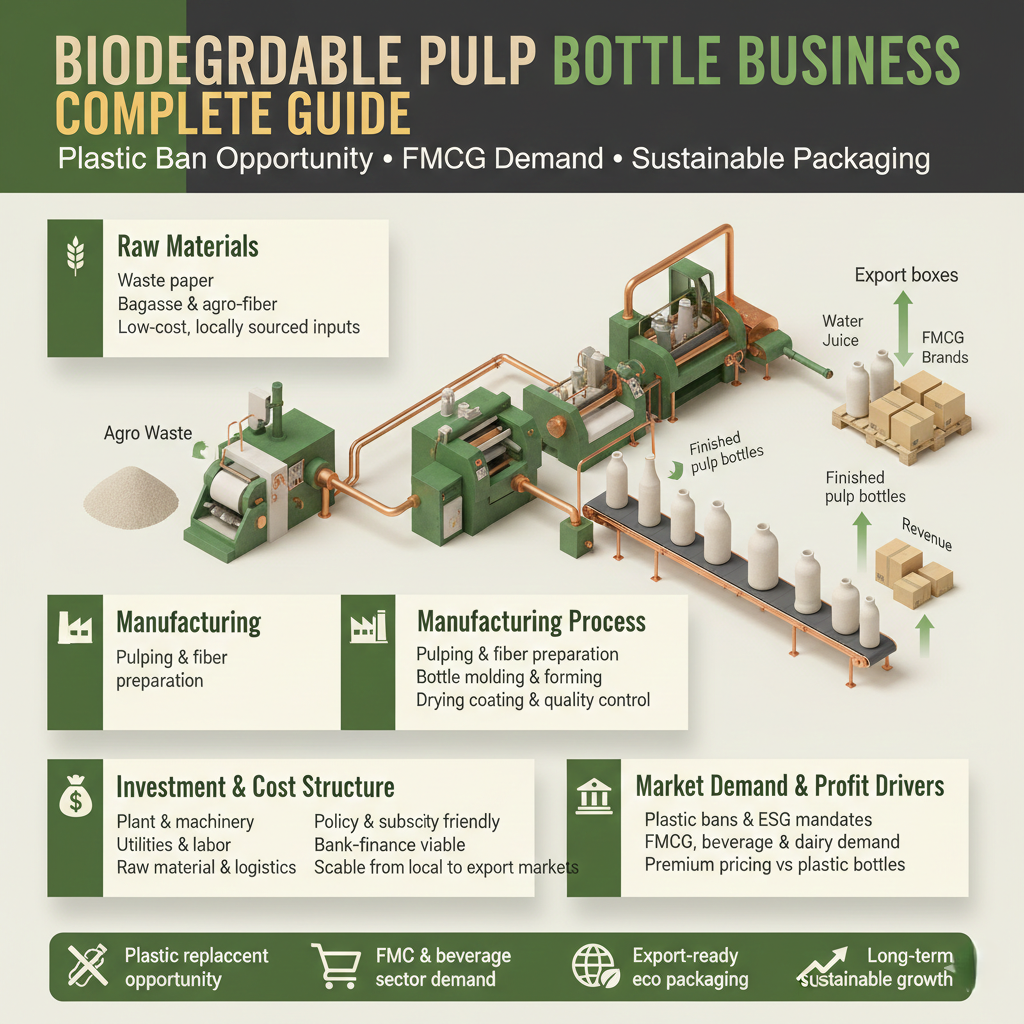
Biodegradable Pulp Bottle Production Process
Manufacturing workflow comprehension enables entrepreneurs to create effective plans. The requirement for engineering skills exists at a basic level but at the same time you need to know the major engineering concepts.
1.Raw Material Preparation
The process involves collecting and pulping recycled paper along with sugarcane bagasse and other agro-residues.
2.Refining and Formulation of Pulp
The process changes fiber strength while adding materials that create water resistance and oxygen barrier properties.
3.Molding and Dewatering
The molding machines shape the bottles while vacuum dewatering machines remove the extra water from the production process.
4.Hot Pressing and Curing
The process improves strength through moisture consolidation which results in better surface appearance.
5.Barrier Coating (Optional)
Bio-based coatings can be used to prolong the shelf life of some beverages.
Read More: The Complete Book on Biological Waste Treatment and their Utilization
6.Finishing and Branding
Bottles are cut, leak tested, and printed with logos for the brand name, and then distributed.
Financial Considerations
Investment is based on the scale and degree of automation:
- Fully automatic lines; Higher capital cost, consistent quality, less labor.
- Semi-automatic lines -less investment, more labour-intensive, suitable for small production.
Other financial factors are:
- Raw materials supply from recycled paper mills or sugar factories
- Energy costs – hot pressing and drying
- Securing anchor clients for good cash flow
- Scalable growth through modular capacity planning
We suggest preparing a Detailed Project Report (DPR) to estimate costs, revenues, break-even and ROI, which makes it easier to approach investors or banks.
Read More: Top Biodegradable Products Business Ideas
Branding and Market Strategy
Packaging is no longer functional, but a marketing tool. To stand out:
- Provide standard bottle sizes based on beverage stock keeping units (SKUs)
- Point out eco-friendly credentials during marketing campaigns
- Start with domestic brands then gradually expand to exports
- In this case – “strategic” includes: – Explore allied opportunities such as contract filling, packaging design or niche D2C beverages
Well-positioned brands have the opportunity to use sustainability as a point of differentiation that can appeal to environment-minded consumers and corporate clients.(Pulp Bottle Business India)
Steps to Get Started
1.Market Research: The process begins with demand identification followed by customer targeting and competitor analysi.
2.Secure Raw Materials: The company should establish partnerships with paper mills and sugarcane processors.
3.Choose Technology: You should select one of two available production line options which include semi-automatic production and fully automatic production.
4.Prepare DPR: The analysis must include capital expenses and operational costs together with revenue projections and assessment of the break-even point.
5.Regulatory Compliance: The company needs to complete three steps which include obtaining MSME registration and environmental permits and food grade certification.
6.Branding & Marketing: The company needs to emphasize sustainability and quality to attract beverage industry customers.
Read More: How to Start Paper Water Bottles Manufacturing Business
Conclusion
Starting a biodegradable pulp bottle making unit in India is the perfect combination of profitability and environmental effect. With increasing awareness among the consumer, supportive government policies, plentiful availability of raw materials and exports, this segment is set for good growth.(Pulp Bottle Business India)
By prioritizing quality, sustainability, and branding, entrepreneurs can create a business that not only benefits the planet but can also build a profitable and scalable business.
Biodegradable Pulp Bottles in India FAQ
- Are pulp bottles safe for drinks?
Yes, they are made of food grade fibers. Optional coatings for suitability for liquid products. Third-party certification is recommended for commercial use.
- Can pulp bottles completely replace plastic bottles?
They are great for short-shelf-life drinks such as juices, smoothies and functional drinks. Carbonated or long shelf life beverages may require specialized liners.
- What is the minimum viable scale for a plant?
Optimal scale is dependent on the demand in the market and the technology. Feasibility studies can be used to determine the appropriate starting capacity.
- How is government policy helping new entrants?
Plastic bans, EPR mandates and renewable material incentives make up structural demand MSME schemes consider reduction of capital and interest burden.
- Is it possible to export pulp bottles from India?
Yes. Proper planning enables MSMEs to export products from India because the country’s cost advantage and quality compliance and logistics networks support international trade.